Nancy Cato, All the rivers run, Book 1 (Review)

It’s been a long time since I reviewed an audiobook or, more accurately, reviewed a book via its audiobook version. As I’ve said before, I don’t listen often to audiobooks, but last month Mr Gums and I did a long drive and so decided to listen to Nancy Cato‘s All the rivers run. I referred to this novel a few Monday Musings ago, because it was one of Australia’s early, successful adaptations for television.

Enough introduction though, time to talk about the book. Our audiobook contained the first book* of Philadelphia (Delie) Gordon’s saga. It starts her story when, in 1890 at the age of 13 she is orphaned in a shipwreck off the coast of Victoria. She is taken in by her dour aunt and more welcoming uncle who lead a spartan prospecting life at Kiandra in the Australian Alps. When her uncle Charles strikes it rich – that is he finds a large nugget of gold – the family (with her cousin, Adam, who is three years older than she) move to a sheep farm on the Murray River not far from Echuca. This first book, which is pretty much a coming-of-age story, finishes when Deli (as she prefers to be called) leaves home at the age of 17, after a tragedy has struck the family.

This is not really the sort of book I would normally read, though it is the sort of book I’d listen to on audiobook. Why so? Well, at the risk of being called a literary snob, I tend not to read sagas (whether they be historical fiction, fantasy or whatever). This is because their focus tends to be plot rather than style, structure, theme and, even perhaps, character development, though I know aficionados will argue with me and they will probably be right (to a degree!). Anyhow, there’s nothing wrong with that, it’s just not what I prefer to read. However, such stories are perfect for listening to in the car. Literature requiring intense concentration is not a safe bet when you are driving (or even when you are navigating). Horses for courses, as they say.

Cato’s book, like good historical fiction, captures the social history of the era well, particularly the tail end of the gold rush, the 1890s depression, life along the Murray River for the pastoralists and paddle steamers, the challenges faced by women in a male dominated society. She also touches on the dispossession of the indigenous people, showing the women working as “house-girls” for the pastoralists and their all too often descent into prostitution, often as the result of being used by and bearing the children of their white male bosses. Cato was, apparently, an active campaigner for indigenous land rights as well as for conservation.

I enjoyed Cato’s vivid descriptions of the landscape. The plot is a little predictable and the characters are somewhat stereotypical – the welcoming, easy-going farmer, the tough wife, the handsome son champing at the parental bit – but not so much that they don’t engage. Delie in this first book, for example, is a believable young girl, orphaned and taken in essentially by strangers and then experiencing her first love. She’s bright but not brash, independent but not without uncertainties.

I enjoyed one little description in particular. At a moment when things are going wrong for Deli, Cato writes that “a pair of kookaburras laughed sardonically”. I liked this description because only recently I’d been thinking about the first white settlers in Australia and what they made of the birds here, many of whom can sound pretty raucous. I wondered, in particular, what they thought when they first heard a kookaburra’s “laugh” as we describe it. Sardonic, is a very good description of it!

Overall then, it’s an enjoyable read, if you enjoy historical sagas, are interested in life in country Australia in the 1890s – and particularly if you have a long drive ahead of you! You could do way worse …

Nancy Cato
All the rivers run: A river not yet tamed (Audio CD)
Read by Kate Hosking
Bolinda Classics
6 hrs 15 mins on 5 discs
ISBN: 9781742336732

* Note: As far as I understand it, the three books in the trilogy were originally separately published as: All the rivers run (1958); Time, flow softly (1959); and But still the stream (1962). Recent editions, however, combine the three novels into one volume titled All the rivers run. I am not sure where the title A river not yet tamed comes from, but it looks like it might be Bolinda’s title for the first part of their recording of the trilogy.

Dame Mary Durack, Lament for the drowned country (Review)

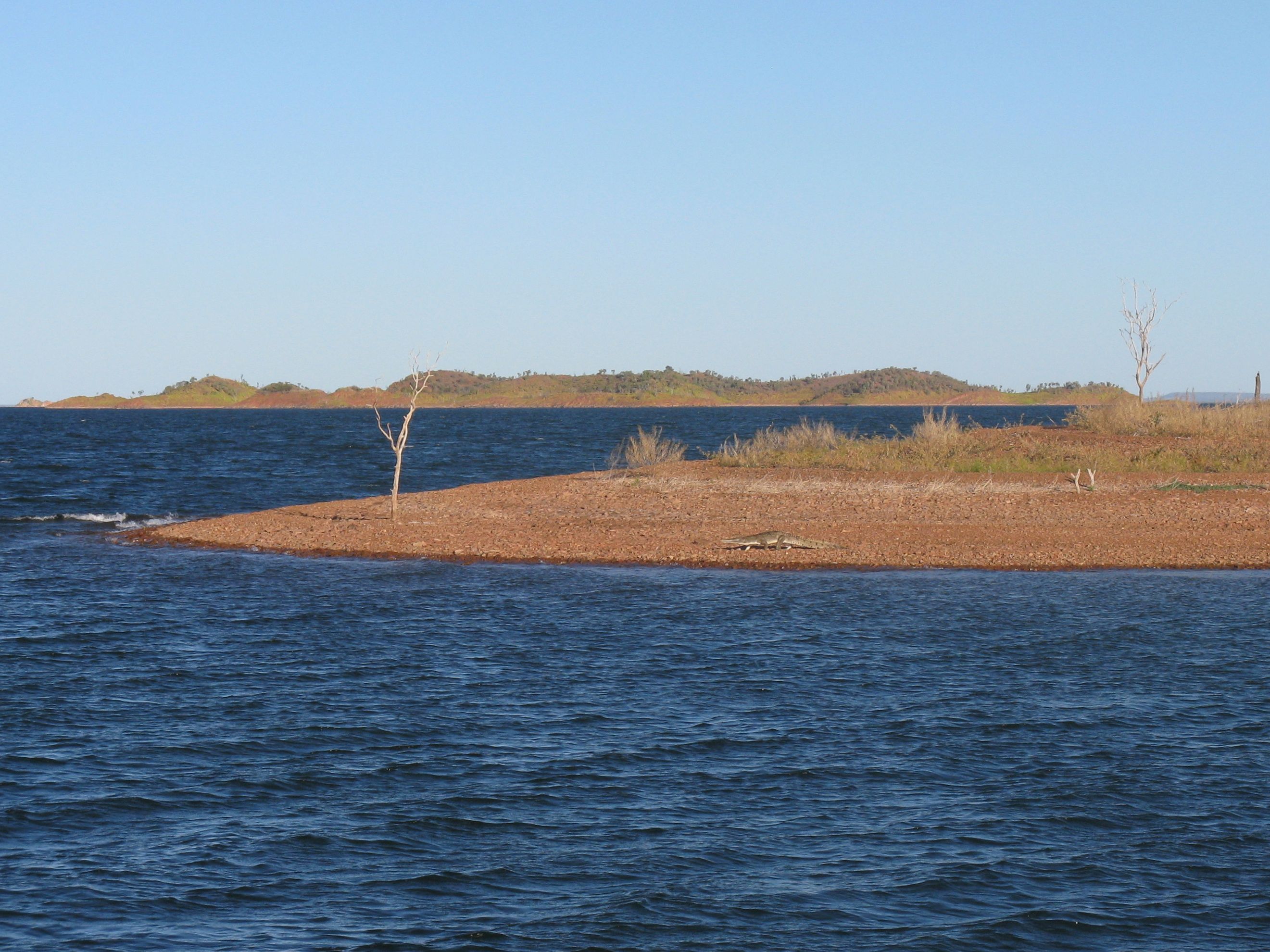
Lake Argyle with Crocodile

Freshwater crocodile heading into Lake Argyle

Near the end of her book True north about Mary and Elizabeth Durack, biographer Brenda Niall writes of Mary Durack‘s poem, “Lament for the Drowned Country”, which she says “has been judged her finest poem”.  Of course, with such a statement, I had to read it. I could have Googled* it, but I decided to check my Penguin Book of Australian women poets and, hallelujah, it was there. (Once again this book didn’t let me down!)

“Lament for the drowned country” is a long poem and is presented in the voice of an Aboriginal woman, Maggie, mourning the drowning (for the Ord River Irrigation Scheme) of her “born country”. It’s a poignant poem – for obvious reasons – as it’s about the loss of country (for the indigenous people) and home (for the Duracks, whose Argyle homestead went under the water). But, there’s something else too – an irony, because the idea of damming the Ord River was first proposed by Mary’s brother Kimberley Durack in the 1940s. Mary supported her brother** at the time … but the reality many years later, after her brother’s death, was sad for her.

The interesting thing about the poem is that Durack chose to write it in the voice of an Aboriginal woman. Niall writes of this that:

At a later time, her creation of a first person voice for Maggie Wallaby might have been questioned. In 1972 it was taken as she intended it, as a work of empathy and imaginative identification.

This made me think of Thomas Keneally‘s The chant of Jimmie Blacksmith which was shortlisted for the Booker Prize in 1972. It was written in the voice of the Aboriginal protagonist, but Keneally has since said that he wouldn’t presume to do that now, and would tell the story from a white point of view. This says something, I think, something positive, I hope, about Australia’s cultural development. In the 1970s and before, indigenous voices were hard to find. This is less so now – and will hopefully only get better bringing us more voices, and a greater variety of story representing the diversity of indigenous experience.

Anyhow, back to the poem. According to Niall, the poem was inspired by Mary seeing Maggie “catching fish and unaccountably throwing them back into the [new] lake”. Mary saw this – realistically or romantically, who’s to say? – as signalling hope. She has Maggie saying:

I sit along river coming down from my born country.
That heart place! I got to talk to that water.
I got to tell that fish: ‘You go back – you go back now –
talk strong my country. You tell him that spirit can’t leave ’em.
You tell him – Wait! Hang on! This is not the finish!
…’

Later in the poem, Maggie talks of the land drying, the sun coming once again to warm it, and the animals and birds returning. Maggie also makes a reference to the Durack homestead:

You go back up there, that old station – Argyle station –
(poor fella my old boss, my old missus. Nothing left that
house, where I sweep’m every day!) You look out that house,
you look out
windmill, tank, garden, kitchen, saddle shed.

The remarkable thing about the poem is how well – or so it seems to me – Mary Durack captures the cadence, the intonation even – of Aboriginal speech and story-telling. I shouldn’t be surprised though, because Durack spent much of her childhood playing with Aboriginal children and spent her adult life, when she could, not only arguing for but working with indigenous people in their fight for equal rights. According to Niall, as Mary Durack left the north for the last time, “the Aboriginal women, knowing they would never see her again, began to beat their heads and wail inconsolably”. We all know the psychology of master-servant/white-black relationships is a complex one, but that doesn’t deny the fact that amongst it all there can genuine feelings and mutual respect.

I’ll be writing more on the Duracks, and particularly on Mary whose love for the land of her birth was, like Maggie Wallaby’s, absolute:

she can’t forget ‘im, my country, she all day heart-crying.

Meanwhile I recommend this poem …

Mary Durack
“Lament for the drowned country”
In Susan Hampton and Kate Llewellyn (ed)
The Penguin Book of Australian Women Poets
Ringwood: Penguin, 1986
pp. 65-68.

* I did Google it too, to provide a link for this post, but I only found excerpts rather than the whole poem. Hence no link here. I guess it’s too recent to be in the public domain.

** Kim Durack was an agricultural scientist. He apparently loved the land and was committed to improving it after the damage caused by years of over-grazing.

Virginia Woolf on Jane Austen’s Love and freindship

A couple of weeks ago I reviewed Jane Austen‘s juvenilia work, Love and freindship. I wanted, then, to share with you Virginia Woolf‘s take on Jane and the work, but decided it would be better as its own post, so here I am again.

Woolf was quite an essayist, as you probably know, as well as a novelist, and she wrote several essays about Jane Austen (as well as featuring Austen in her famous A room of one’s own). Today’s post was inspired by an essay that is simply titled, “Jane Austen”. You can read it at Project Gutenberg. The essay was published in 1925 in her book, The common reader, though it may have been previously published in a newspaper or journal. It says something, I think, that in an essay of just a few pages she devotes a couple of paragraphs to a piece of juvenilia (that is, Love and freindship). This is what she says:

To begin with, that prim little girl whom Philadelphia [a cousin] found so unlike a child of twelve, whimsical and affected, was soon to be the authoress of an astonishing and unchildish story, Love and Freindship, which, incredible though it appears, was written at the age of fifteen. It was written, apparently, to amuse the schoolroom; one of the stories in the same book is dedicated with mock solemnity to her brother; another is neatly illustrated with water-colour heads by her sister. These are jokes which, one feels, were family property; thrusts of satire, which went home because all little Austens made mock in common of fine ladies who “sighed and fainted on the sofa”.

Brothers and sisters must have laughed when Jane read out loud her last hit at the vices which they all abhorred. “I die a martyr to my grief for the loss of Augustus. One fatal swoon has cost me my life. Beware of Swoons, Dear Laura. . . . Run mad as often as you chuse, but do not faint. . . .” And on she rushed, as fast as she could write and quicker than she could spell, to tell the incredible adventures of Laura and Sophia, of Philander and Gustavus, of the gentleman who drove a coach between Edinburgh and Stirling every other day, of the theft of the fortune that was kept in the table drawer, of the starving mothers and the sons who acted Macbeth. Undoubtedly, the story must have roused the schoolroom to uproarious laughter. And yet, nothing is more obvious than that this girl of fifteen, sitting in her private corner of the common parlour, was writing not to draw a laugh from brother and sisters, and not for home consumption. She was writing for everybody, for nobody, for our age, for her own; in other words, even at that early age Jane Austen was writing. One hears it in the rhythm and shapeliness and severity of the sentences. “She was nothing more than a mere good-tempered, civil, and obliging young woman; as such we could scarcely dislike her–she was only an object of contempt.” Such a sentence is meant to outlast the Christmas holidays. Spirited, easy, full of fun, verging with freedom upon sheer nonsense,–Love and Freindship is all that; but what is this note which never merges in the rest, which sounds distinctly and penetratingly all through the volume? It is the sound of laughter. The girl of fifteen is laughing, in her corner, at the world.

I like the way Woolf looks at Austen with a writer’s eye – in regards to both content and style. I particularly love the line – “She was writing for everybody, for nobody, for our age, for her own; in other words, even at that early age Jane Austen was writing”. I like her recognition of Austen’s technical skill when she describes “the rhythm and shapeliness and severity of the sentences”. On top of all this, Woolf sees Austen’s humour, her ability to laugh at the world. The humour in this little piece of juvenilia is broad, but it’s there and Woolf saw and appreciated it.

And that’s all I’m going to say, because these two paragraphs stand on their own, don’t they?

Robert Frost, The question of a feather (Review)

Well I never! Never knew, that is, that Robert Frost wrote prose as well as poetry. I suppose I didn’t know that he didn’t do it, either, but now I know that he did! And how do I know? Through the Library of America of course! This week’s story is “The question of a feather” by Robert Frost.

LOA’s notes, as usual, provide some interesting background. It appears that in 1899 Frost was chronically ill with, the doctor thought, tuberculosis which had caused his father’s death. The doctor’s advice? Go work outdoors, young man! And so Frost, “a born-and-bred city boy”, and his wife, decided to take up poultry farming, first on a rented farm and then on a farm bought for them by Frost’s grandfather. Robert and Elinor farmed for around nine years at the beginning of the 20th century.

Still wanting to write, Frost wrote poems which were, apparently, regularly rejected for publication so, LOA says, “he eventually lit upon the idea of writing pieces for the regional poultry-farming papers”. “The question of a feather” was one of these pieces. Frost scholar, Mark Richardson, amusingly wrote of these pieces:

In regards to Frost’s writing for poultry journals, it must be acknowledged first that they are certainly the best poultry-stories written by a modern American poet.

I bet they are!

Now, I have to be honest here and say that I really only know a couple of Frost’s famous poems – “the road not taken” and so on – so this is not going to be an analysis of how this sketch illuminates or represents his work. Rather I’m just going to introduce it a little, and hope you decide to read it yourselves using the link below. It’s a short piece. (LOA’s notes say that there are hints of this story in his poem “A Blue Ribbon at Amesbury”).

It is subtitled “How an editor got out of the frying pan and into the fire” and concerns the editor of the poultry journal, Hendom, who receives a letter from a reader stating that their poultry farm

is the result of following your instructions to the letter … You have been our only teacher, and we want you to be the judge whether it has been to our advantage.

Now, our editor is not thrilled about this. He tells his readers not to follow him exactly, but to “use judgment in keeping hens”. However, he’s been stuck in his office all day “and he was tired of it” so decides to visit the two sisters “though he did not feel he was to blame”. He fancies the result will be “bad” or “amusing”. He assumes he will be confronted by “a failure to make money in hens”. There’s a mock-heroic sense to all this, which I liked:

He considered himself as having one of the good times incident to his calling. He liked nothing better than visiting a farm, and visiting this one had a spice of real adventure.

Of course, what he finds is not what he – the superior male editor – assumes. And he is confronted with an ethical question regarding poultry showing:

“… you are just in time, Mr Fulton, to help us with that feather on the leg of, I think, our best pullet.”
“Pull it?”
“Yes, pullet.”
“Help you pull it, I mean.”
“Tell us whether it is right to pull it,” she answered, flushed and serious.

There is quite a bit of sly humour in the piece … and a lovely description of character. You know exactly what sort of man the editor is – pompous and patronising towards women, particularly spinsters, and yet his unwillingness to be definite about anything gives away a degree of wishy-washiness, a lack of confidence perhaps. And you know the sisters too, their conscientiousness, openness, and willingness to confront the difficult questions. It’s an odd little piece, really, but shows to me a Frost interested in the details of everyday life, in how people do or don’t communicate, and in describing character. It also provides a little picture of New England at the time.

Robert Frost
“The question of a feather”
First published: Farm-Poultry, July 15, 1903.
(Library of America’s text is from Mark Richardson, The Collected Prose of Robert Frost: A New Critical Edition, Rutgers University doctoral dissertation, 1993. Reprinted by permission)
Available: Online at the Library of America

Djuna Barnes, Come into the roof garden, Maud (Review)

English: Djuna Barnes, writer

A stylish Djuna Barnes (Presumed Public Domain, via Wikipedia)

Okay, I’ll admit it, I’ve never heard of Djuna Barnes (1892-1982). However, I was intrigued when I saw her pop up in the Library of America‘s (LOA) Story of the Week program last month, and so decided to investigate. I discovered that, while I didn’t know her, many did, such as, oh, ee cummings, TS Eliot, Carson McCullers, and other contemporary literary luminaries. She even interviewed, apparently, James Joyce. She was a modernist writer, and, according to Wikipedia, a key figure in 1920s-30s Bohemian Paris.

LOA’s notes state that she wrote around 100 articles for various newspapers, and that these articles “straddle the line between fiction and journalism”. That’s certainly how I’d describe “Come into the roof garden, Maud”. I decided to categorise it, according to my minimal blog taxonomy, “Review – Essays”. It’s an uncomfortable fit, but it’ll do!

Anyhow, to the article I’m reviewing today. LOA’s notes describe it as “fictionalised, comic snapshots of the fashionable crowd chasing the latest craze of the 1910s: rooftop dancing”. I did enjoy it – partly because reading about New York in the early 20th century is a treat in itself, but mainly because it is so deliciously satirical and I do like a bit of satire.

I don’t usually do this, but I think I’ll quote the beginning paragraphs of the article:

First of all, enter the atmosphere.

And this, the atmosphere of a roof garden, is 10 per cent soft June air and 10 per cent gold June twilight, and a goodly per cent of high–hung lanterns and the music of hidden mechanical birds, swinging under the tangle of paper wistaria, fifty feet above, where, between guarding panes of glass, shine electric signs, plus a few stars, of Broadway.

A good deal of the grace of God is there, too. It is a majestic something that keeps a distance east of the champagne bucket, and goes out upon the dancing space not at all.

The thing that is really lacking is a sense of humour. There are not ten people with a really good laugh in their systems in a whole evening on a roof garden.

Doesn’t this – together with the clever title – want to make you read on? It did me …

She goes on to describe the “beautiful people” (though that’s my term, not hers of course) who frequent the roof gardens, skewering their superficiality and inability to have a good time because they are too “hung up” (oh, dear, another anachronistic 1960s term from me) on appearance and being seen. Her language and writing are delicious as she describes this one and that one attending roof garden events. Dancing is a big thing in (or is it “at” or “on”) roof gardens. I loved this description of a band conductor:

The conductor, a great, towering figure in white flannels, stands knee-deep in green foliage, which may or may not be false, but which looks extremely like asparagus gone to seed, fine and green and feathery – a soft accompaniment to a fearsome pair of legs.

And her description of those women “who can come in without looking interested – the very essence of refinement”. (Hmmm … Is this still the case? Are “refinement” and “enthusiasm” mutually exclusive? I fear they may be, at least in the eyes of those who define “refinement”.) There is, though, a couple who throw themselves into dancing … but they’re not American. Her criticism of refined New York is a little reminiscent of Edith Wharton – but reminiscent only. Wharton was three decades older, and her style rather different.

Do read the story: the link is below.

Meanwhile, my question to you is: Have any of you read Djuna Barnes, in particular, her novels? If so, I’d love to hear what you think.

Djuna Barnes
“Come into the roof garden, Maud”
First published: New York Press, July 14, 1914
Available: Online at the Library of America

Elizabeth Harrower, The watch tower (Review)

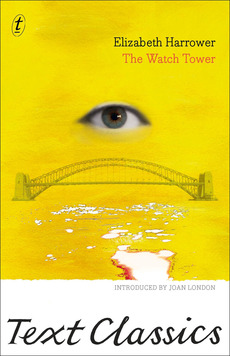
Elizabeth Harrower The watch tower
Cover for The watch tower (Courtesy: Text Publishing)

Elizabeth Harrower’s fourth and final novel, The watch tower, is a rather harrowing (couldn’t resist that) read. It is also an astonishing read, and I wonder why it has had such little recognition over the decades or so since its publication in 1966. Thanks to Text Classics, though, it now has a second chance. It deserves it. In fact, I’d say it is one of the best books I’ve read this year (to date, of course!)

What makes it so is the writing. It has a Patrick White-like intensity – and I can see her influence in writers like Joan London and Shirley Hazzard*. But first, a little about the content. It is set in Sydney and spans roughly the mid-1930s to around 1950. The plot is slim. It concerns two sisters, Laura and Clare, who are abandoned twice – first, albeit inadvertently, by their father (through his death when Laura is about 16 years old, and Clare, 9) and then a few years later by their selfish unloving mother who decides to return to her family in England, without them. What happens to them from this point is Harrower’s subject and it all centres on the ironically named Felix, Laura’s first and only boss, who comes to the rescue, or so it seems, when mother leaves the scene.

Laura had been a girl of dreams with the ability to achieve them. She aspired to be a doctor, but when tragedy strikes and she is taken from school, she’s not overly concerned. She “had read books” and in all but those with “circumstances ridiculously removed from hers, everything ended happily for young heroines.” And yet she also

had a sensation of having mislaid a vital pleasure that she could not remember, or a piece of herself.

Clare is younger and is less affected by having to leave boarding school, but life with their mother is no picnic. She expects her daughters to “take over”, to, in effect, run the house as well as go to school, for Clare, and business college then work for Laura. And so Laura’s life of servitude to one master or another begins, while Clare takes on the role of helper and watcher. Laura gets on with the job, generously and to her detriment, particularly when the misogynistic power-hungry Felix enters the scene. Clare sees what is going on, and expects more of life, but soon realises she

had really nowhere to go. Caught, not safe, cold – There were no reliable people.

From these premises, Harrower builds a story of psychological and physical entrapment in which both girls become caught in Felix’s malevolent net. Laura, ever the Pollyanna who believes noone would be consciously mean or vicious, becomes complicit in the destruction of her self while Clare, physically caught, maintains a vision of something better and does her darnedest to get Laura to see it too.

Harrower develops all this with a slow drip-drip, through language that is tightly pared to the essentials, through a simple but not even chronology that moves in fits and starts, and through a narrative voice characterised by subtle shifts in point of view. The focus is inwards  – on a small number of characters and their relationships with each other that rarely lets outsiders in. The result is a claustrophobic tone – and a slow build up of tension and suspense. Take this description, for example, of the women upon hearing Felix, drunk, coming down the path:

Breaking their poses like trees snapping branches, the women urgently regarded each other, cleared away all signs of work in an instant, examined their souls for defects, in a sense crossed themselves, and waited.

Acts of violence do occur, but are reported in retrospect. This seems to lessen our focus on the specific event and emphasises instead the response of the two young women. Will they decide to leave this time?

Late in the novel a fourth person, 19 year-old Dutch migrant, Bernard, is thrown into the mix, creating the catalyst for the denouement. For Laura, he provides a diversion for “poor Felix” and hopefully another chance for him to show a decent side. For Clare, he shows her that for all her suffering she can still be a useful person. For Felix, he of the “cold smile” and “deaf look”, well that would be telling… And as for Bernard himself, the question is whether he will survive his Felix experience intact.

And this brings me to my final point. While she doesn’t expressly say it, and in addition to her study of power and control, Harrower seems to be exploring ideas about the soul (a person’s essence) and character. Where does one end and the other begin? How do they act upon each other, and is change possible? This is a book I won’t quickly forget.

POST-SCRIPT, 2025: I wrote here about “power and control”, because the term “coercive control” by which it would now be known, was not in public parlance.

Elizabeth Harrower
The watch tower
(with a new introduction by Joan London)
Melbourne: Text Publishing, 2012
335pp.
ISBN: 9781921922428

(Review copy supplied by Text Publishing)

* Hazzard is only 3 years younger than Harrower but her first novel was published, I believe, in 1966, the year this, Harrower’s last, was published.

Monday musings on Australian literature: Twenty Australian novelists in 1947

My Monday Musings of two weeks ago was about the first book in a series of four books on Australian fiction. The books were written by Colin Roderick and published by Angus and Robertson. The second book, which is today’s topic, was published in 1947, two years after the first, and was titled Twenty Australian novelists.

The novelists Roderick chose for this volume are:

Wow! While there were only two or three authors I didn’t know in the first post’s list, there are several I’ve never heard of in this one. Interestingly, the writer in the West Australian on 12 July 1947 commented that “perhaps Katherine Susannah Pritchard (sic), Henrietta Drake-Brockman and other well-known writers have been selected for discussion in one or other of the two remaining volumes which are to complete the series”. Certainly, these two writers, particularly Prichard, are better known today than many in the above list. They must be … They have Wikipedia links and I’m sure most of you have heard of Wikipedia’s notability requirement!

Despite my ignorance, I enjoy seeing which authors a previous generation deems important … and I did learn something interesting. Seaforth Mackenzie apparently died by downing in Goulburn, which is about an hour’s drive from where I live. I knew his name but not that he had a connection to my region. And I haven’t, I’m ashamed to say, read him.

Geoffrey Hutton, writing in the Argus in September 1947, critiqued the book. He started by arguing that Australia had yet to produce:

a figure of the type of Hemingway or Falkner*. You may say God forbid, but the point I want to make about these two writers is that they built a literary style out of the speech-habits and speech-rhythms of the American people, which is as distinct from the metropolitan English style as it is from Hardy’s slow-moving Wessex dialect. Even when they are not talking local slang or describing canyons or skyscrapers, their writing has an un-English, a specifically American taste.

I do love that “You may say God forbid”? It speaks volumes. Anyhow, he went on to state that “Australian-ness” was conveyed primarily through subject matter rather than in “style or method”, and, while he agreed that Colin Roderick was undertaking a job worth doing”, he concluded that:

Mr Roderick’s study of the trees has little reference to the wood, and although you may say that the wood is only the sum total of what grows in it, there is a great difference between a tree that grows on its own and one that grows in company. Specifically, Mr Roderick gives little or no indication of the development of the Australian novel out of the colonial novel; he does not place his novelists or satisfactorily estimate their relative significance. He has done useful work, but the growth of the Australian novel is another story.

I haven’t read Roderick’s book, but my reading of the various newspaper reports and reviews suggests it is more survey (or “panoramic view” as one journalist put it) and anthology than an analysis. Hutton clearly wanted more … I will explore this mid-twentieth century issue of the developing Australian novel a little more in coming weeks.

* What’s that they say about learning something new every day? Today, about to leap in with my proofreading pen, I discovered that William Faulkner was born Falkner. However, the name change was apparently made in 1918, so perhaps I should have used my red pen anyhow!

Acknowledgement: National Library of Australia’s Trove and Newspaper Digitisation Project.

Monday musings on Australian literature: The Australian Novel, 1945 style

Joseph Furphy (Tom Collins)

Joseph Furphy (Presumed Public Domain, from the State Library of New South Wales, via Wikipedia)

Every now and then I like to delve into the newspapers digitised by the National Library of Australia and made available via its website. Last week, I was pottering around researching another topic for Monday Musings (for which you’ll now have to wait) when I came across an article written in 1945 about a series of books,”arranged” by Colin Roderick, being published about Australian prose. The series aimed “at introducing to students the work of Australian writers of prose fiction” but another article suggested that it would be of value to adult readers interested in the subject.

The first volume is titled The Australian novel and was published in 1945. It’s an anthology containing précis and excerpts from the selected works, and some critical analysis, and has a foreword by Miles Franklin. She wrote that:

People settling in new lands need novels and dramas closely concerned with their own time, place and community to support and lighten the great classics and world masterpieces in literature. Certain stories relate us to our own soil, and when such works find universal acceptance, they still retain greater significance for the people of their origin than for other readers by imparting a comforting glow which springs from the intimacy of home … writings, redolent of our own land and our life in it, thus fulfilled one of the functions of imaginative literature by heightening and illuminating everyday life in familiar surroundings.

I love her description of “writings redolent of our own land and our life in it” and their importance to “illuminating everyday life”.

The 19 (strange number, eh?) works were presented in order of their age:

It’s an intriguing list for me. Some of these works and authors I’ve read, and some have been on my list to read for a long time. But there are some here that I have never heard of – such as Brian Penton and Leonard Mann. It makes me wonder which writers from our last half century or so will be no longer well-known in 60 or 70 years. Longevity in the arts is such a fickle thing really, isn’t it?

Next week, I’ll write on the second volume in which Roderick presented 20 significant novelists.

Elia Kazan, Audience tomorrow: Preview in New Guinea (Review)

Photo portrait

Publicity still, c 1960, from the Elia Kazan Collection of the Cinema Archives at Wesleyan University (Photo credit: Wikipedia)

In my previous life I worked in a film library and film archive, so I was drawn to this week’s Library of America offering, “Audience tomorrow: Preview in New Guinea” by film director Elia Kazan*. My interest was strengthened by two more facts. Firstly, the title mentions New Guinea, which I visited twice in the late 1970s. Secondly, it was published in 1945 suggesting it might be about the war, and I am interested in reading about the two world wars. All up, it looked like an article for me.

Kazan, who made some great films including A Tree Grows in Brooklyn, A Streetcar Named Desire, On the Waterfront, and East of Eden, wrote “Audience tomorrow” about his visit to New Guinea during the war as an advisor to the military. “Our mission” he said, as quoted in LOA’s introductory notes, “was to set up self-entertainment units for the soldiers, to keep men from going nuts before they were shipped to other theatres of action or home. The soldiers didn’t think much of the USO shows”. Apparently, they liked the big name acts, but most shows were by “third-rate cabaret entertainers”.

Kazan’s visit to New Guinea was part of a wider Pacific tour. LOA’s notes state that while he was in the Philippines, his most recent film, A Tree Grows in Brooklyn, was screening. He was pleased that his film was being shown and that the soldiers seemed to enjoy it, but he wrote later in his autobiography that he was bothered by the “contrast between the terrible intensity and cost of what was happening around me and the sentimental fairytale I’d made”.

“Audience tomorrow” is a fascinating article, mainly for the insight it provides into Kazan. There’s very little of the horror of war here and it almost sounds like propaganda at times. The young soldiers are idealised:

The boys … were kids from around the block. You kept feeling that you recognised someone. They did not seem like soldiers. Their stance was easy and casual, their smiles shy and fresh, never arrogant or domineering. They were the citizen soldiers of a democracy: tow heads, red heads, Italians, Negroes, Greeks, Irish. The mood was congenial, the night soft, all about was harmony.

Also, “our army is beautifully organised, beautifully equipped”, and, after briefly mentioning the “ambulatory cases” and “the shell-shocked”, he praises the “New Medicine”:

I remembered with a start of joy that 97% of the wounded in our army recover. All thanks to the New Medicine.

He was there, after all, in the employ of the military.

It’s interestingly written. Its opening made me think I was about to read a short story – or a film script perhaps?:

Eddie Moran wasn’t going with us. He had a bad headache, and his bones ached. Someone suggested Eddie might have a touch of dengue fever …

But this is not a story about Eddie Moran, or any other character, in fact. The Eddie Moran reference enabled him to set the context: “the talk about dengue furnished a striking contrast to our ‘cocktails and dinner downtown’ before going to the theatre back in New York”. In other words, they were off to the theatre but one of a very different ilk to his usual experience. It was a “Soldier Show program”, that is, one produced by the GIs themselves. He was surprised about “the degree of hunger with which the men craved entertainment, the eagerness with which they offered to participate in programs”, both in front of and behind the scenes.

He describes the theatre (called “The Medicine Bowl” as it is at a hospital), the attendees (including the WACS who, my horrified feminist brain read, had curfews), and some of the acts in the show. Rain eventually forces the show to end – “there is hell in the bowels of the weather here” – but his article goes on to describe the post-show action in the Officers’ Club. Again he is positive about the quality of the young men whose:

language was highly technical, their faces new to a razor … these kids made me feel out of it. Something had passed me by. Folks, there’s a new generation.

Did I tell you that Kazan was 35 at the time? Anyhow, this “new generation” is the point of the article. He recognises that these men “are citizens, not soldiers” who want to go home. He suggests they have idealised the “States” but fears that the States “can’t hope to live up to the picture these boys have in their mind’s eye”. Interestingly, he argues that:

These twelve million men are potentially the greatest unified body of Public Opinion our country has ever known. They could, if brought together, insist that an organisation be found and made to function that would never permit a repetition and intensification of this nightmare.

This is an aside, though. His main argument is that these “fellows who come back will be demanding” of the entertainment industry. “We’ll have to be good to survive,” he says. “If we’re not, we’ll feel our failure where it really hurts: at the box office”. He concludes the article, which was published in Theatre Arts, with a plea to the industry

to make what is in the theatres a live experience for the people, not merely a kill-time. All the people of the nation have grown some during the war. Twelve million men have grown a lot. Some of us may not know it, but we are being challenged!

Kazan, Tennessee Williams and Arthur Miller went on to give it their best shot.

Elia Kazan
“Audience tomorrow: Preview in New Guinea”
First published: Theatre Arts, October 1945
Available: Online at the Library of America

*Kazan had a stellar but rather controversial film and theatre career. Wikipedia is a good place to start if you’d like to read more.

Willa Cather, My Antonia (Review of eNotated edition)

Portrait Willa Cather 1936

I am a Willa Cather fan, and have read some of her novels and short stories, so was intrigued when eNotated Classics offered me an eNotated version of Cather’s My Ántonia for review. eNotated? That sounded like something worth exploring so, although I’ve read the novel before, I decided to read it again. I wasn’t sorry. It’s still a wonderful read.

My aim here is not so much to review the book, though I won’t be able to resist saying a little, but to explore this eNotated edition that I read on my Kindle. I understand from the website that eNotated Classics produces books for the Kindle, the Nook and iBooks. The company’s aim is to take “advantage of eBook technology to extend and enrich books in a way that increases understanding, engagement and reading pleasure”. Did they achieve this aim for me? That is the question!

I’d say yes and no – and will explain by discussing what I see as the three main components of the eNotated version.

eNotation links

These are underlined text (words or phrases) that you click for added information, which can be dictionary-style definitions, brief encyclopaedic-like descriptions, or interpretations. The eNotations can also be read as a group by clicking a single link at the beginning and end of each chapter, and they appear at the end of the book. In fact, the novel finished at the 77% mark in the book, with the last 23% comprising the eNotations and other material.

I was disappointed that many of the eNotation links contained the same information that the Kindle dictionary contains. Since the latter is faster to access by simply moving the cursor to the word to be looked up, those eNotations were rather superfluous. However, perhaps this depends on the dictionary the e-reader accesses, making the experience different with different e-readers.

There were a few of the more interpretive style and I appreciated those. One concerned the relevance of the play Camille which the narrator Jim sees with Lena. This sort of notation can be useful to students who may not, for example, know the play.

A useful feature is their identification system, which comprises a bracketed number at the end of each paragraph and each eNotation, making them easy to cite and to find. The number is obvious as you read, but you soon get used to it.

Theme indications

Now this one bothered me somewhat. See what you think: here are the first lines of the novel as they are presented in this eNotated version:

Last summer I happened to be crossing the plains of Iowa (TIME) in a season of intense heat, and it was my good fortune to have for a traveling companion James Quayle Burden – Jim Burden as we still call him in the West.

Throughout the novel sentences or phrases are treated like this – formatted in italics followed by (TIME), (NARRATOR) or (ELEGIAC). The “How to read this book” section at the beginning of the book explains that these italicised passages are cited in the relevant theme essay – Time, Narrator or Elegiac – at the end.  These are not really “themes” in the literary analysis sense: “Time” is a theme but “Narrator” relates to voice, and “Elegiac” relates to tone. I did find these a little intrusive and wonder whether they would have been better handled as links to the essay they occur in without the bracketed upper case word to show the way.

Additional information

At the end of the book are several items designed to add value. Most of these are not unique to e-Books. They are the eNotations (which you can click on to go back to the text), the three theme essays, a History of Nebraska, a Willa Cather Timeline, a Key Event Timeline, a Bibliography and Images. These are all useful value-adds. I liked the fact that the 12 images can be enlarged, something I can’t do with maps and images in the travel guide I bought last year. It was fascinating to see an image of a Dugout house in Nebraska, though photo credits next to the captions would have been good.

I’m not a Cather expert, but I found the Theme essays interesting – and expect they’d help both students and general readers. The bibliography is short and looks useful, though the most recent citation is dated 1987 which seems a little old. The novel might be a classic, but scholarship continues …

And now to the book itself

How do I love this book? Let me count the ways! I love its meditation on the past, on how the past intrudes into the present. Jim Burden is, really, “burdened” by his past. He meets Antonia when he is a 10-year-old orphan arriving in Nebraska to live with his grandparents, and she a 14-year-old Bohemian immigrant arriving with her family to settle there.  They end up on neighbouring farms and become friends when her father asks Jim to teach Antonia how to speak English. The novel then follows the next 30 or so years of their lives – the first four “books” cover 10 years from the novel’s opening, while the last “book” jumps to 20 years later. Jim, the narrator, keeps an eye on what happens to “my” Antonia over the years, but the book is as much about him and his inability to move on from the past. He says near the end:

In the course of twenty crowded years one parts with many illusions. I did not wish to lose the early ones. Some memories are realities, and are better than anything that can ever happen to one again.

 I love its language and tone. It’s delicious to read. I’d probably describe it as “melancholic” or “meditative” but I wouldn’t argue with Bedell’s “elegiac”. Here is an early description as Jim arrives in Nebraska from the greener, more lush Virginia:

Between that earth and that sky I felt erased, blotted out. I did not say my prayers that night: here, I felt, what would be would be.

Lovely, simple, spare writing.

And I love Cather’s description of pioneer life, and pioneer characters. Much of what she writes could easily apply to 19th century Australia. The landscape is different – but is similarly bare and harsh – and the ethic mix is different – but the experiences and hardship are universal. It’s a life and environment in which character is writ large – and Cather draws her characters beautifully. Even the minor ones – such as farm hands Jake and Otto who disappear early in the novel – are vivid. Here is Jim on Ántonia, late in the novel:

She lent herself to immemorial human attitudes which we recognize by instinct as universal and true. I had not been mistaken. She was a battered woman now, not a lovely girl; but she still had that something which fires the imagination, could still stop one’s breath for a moment by a look or gesture that somehow revealed the meaning in common things.

This is one of those novels that stays with you and I’d recommend it to anyone. Would I recommend this eNotated edition? Yes. It’s a good attempt to take advantage of the eBook format and, while there are features that didn’t  work perfectly for me, at USD5.99, it’s hard to beat.

Willa Cather
The eNotated My Ántonia
eNotated by Barbara Bedell
eNotated Classics, V1.00 12/1/2011 (based on 1918 edition)
Kindle edition
ISBN: 9780982744864

(Review copy supplied by eNotatedClassics.com)