What do Anna Funder and Amarcord have in common?

Leipzig! It’s funny isn’t it how some person, place, idea (or whatever) that you hadn’t come across in who knows how long suddenly makes its presence felt more than once in a short amount of time. This is what happened to me this week when I attended, on Sunday, a conversation at the National Library of Australia with Miles Franklin award-winning author, Anna Funder, and then two nights later a Musica Viva concert by all-male a cappella group, Amarcord. For those of you who know these people, the Leipzig connection is pretty obvious, but for those who don’t, I’ll explain. Anna Funder’s first book was the non-fiction work Stasiland which explores the impact of the Stasi on those affected by it. And Amarcord was founded in Leipzig from members of the St Thomas’ Boys Choir (which was established in 1212!).

The connection, though, is a little more complex than a purely physical one. In talking about Leipzig and her book promotion tour there, Funder commented on the paradox of being in the building* in Leipzig that the Stasi operated from and that had also been used by some of the world’s greatest musicians such as Bach (who is buried in St Thomas’ Church) and Mendelssohn. Amarcord, during the concert, talked of Leipzig’s musical heritage – of Schumann, Mendelssohn and Bach – but in the programme they also referred to the time under the Stasi:

Living in East Germany required conditioning. You needed to know whom you could trust. I really had to be careful what I said to whom. And then we had the privilege of a choir that was an island of relative freedom of speech and thought. That of course attracted children from families who needed that freedom of speech. Even as a child I felt that atmosphere strongly. In the choir, I could breathe again. (Daniel Knauft, bass)

I won’t say much more about Amarcord except that the concert was magnificent. The program, themed “The Singing Club – Four  Centuries of Song”, comprised music mostly from the Renaissance and Romantic eras, but concluded with a small selection of folk songs from around the world, including Korea and Ghana. It was a beautifully varied program, each of the singers addressed us during the performance to explain the pieces being sung, and the singing was glorious. I love performers that are serious about their music, but don’t take themselves too seriously. That was Amarcord, and if they come again, I’ll be lining up at the door.

But now to Anna Funder. She was a very thoughtful considered interviewee, which is not surprising I guess from someone who took 5-6 years to write her last novel, All that I am. She talked, for example, about how Stasiland had started as a novel but that she’d decided “it didn’t seem right” to use other people’s lives for a fictional purpose. She also talked about the challenge of believability. In All that I am she said she modified the facts because in fiction authors ask readers to jump into a world they create, but she felt there were things about the “real” story behind All that I am that are “unbelievable”, that no-one would believe in a novel! As one who doesn’t find it too hard to suspend disbelief, I was intrigued by the care she takes to make sure her fiction is believable – and she is probably sensible to do so!

While her main concerns, she said, are social justice and what it means to be human, her aim in writing fiction is not “to make an argument” but “to make a beautiful piece of work, a literary artefact”. Every nation, she said, has something in their history that is “disenchanting” (don’t we Aussies know it) but the function of literature is to “enchant us”. I must say I was enchanted by the way she juggled these two conceptual balls, by her clear fundamental commitment to her art and to her moral-ethical world view.

Louise Maher, the host of the conversation, asked her about awards and prizes, and referred to Funder’s letter to Premier Campbell Newman regarding his cancellation of the Queensland Premier’s Literary Award in which she described his action as “a step towards the unscrutinised exercise of power”. She told us that given the book she’d just written – about a totalitarian state – she had to write what she did. Funder clearly supports prizes – and has won a goodly many. She sees them as a “signpost to quality” and said that while they don’t make writing easier, they improve the likelihood of having your next work published.

I did enjoy my little forays into Leipzig this week – and the places they took me.

* Probably the “Round Corner” house, though I don’t recollect her actually naming the building.
Monday musings on Australian literature: Prime Minister’s Literary Awards 2012

National Library of Australia

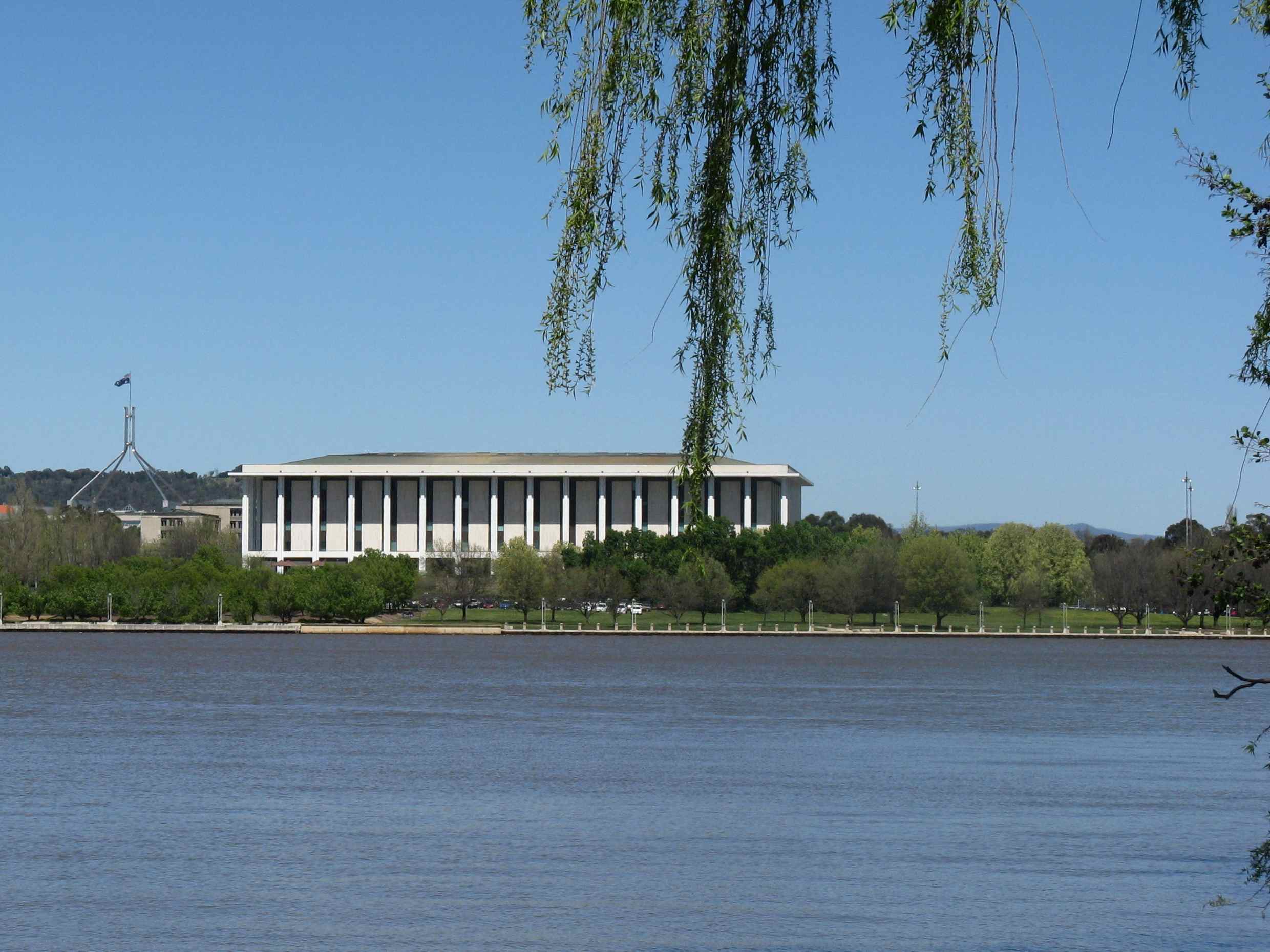
National Library of Australia, viewed from Commonwealth Park on the opposite side of Lake Burley Griffin

Last year I attended and reported on the post-announcement panel for the Prime Minister’s Literary Awards, held at the National Library of Australia. I attended again this year and, since it occurred today, Monday, I’ve decide to devote this week’s Monday musings to it.

First, the winners:

  • Fiction: Gillian MearsFoal’s bread (My review)
  • Poetry: Luke DaviesInterferon psalms
  • Young adult fiction: Robert Newton’s When we were two
  • Children’s fiction: writer Frances Watts and illustrator Judy Watson’s (illus.) Goodnight, mice!
  • Non-fiction: Mark McKenna’s An eye for eternity: The life of Manning Clark
  • History: Bill Gammage‘s The biggest estate on earth: How aborigines made Australia

Last year’s four awards were expanded to six this year by rolling the separate Prime Minister’s History Prize into them and, hallelujah, adding in a prize for Poetry. The awards are, I believe, the most generous of Australia’s publicly funded awards, providing $80,000 to each winner and $5,000 to each shortlisted author.

The panel members were Luke, Robert, Mark and Judy. Unfortunately, Bill Gammage is currently overseas, and Gillian Mears who suffers from multiple sclerosis had attended the announcement but needed to rest before her afternoon engagements. I was disappointed not to see her but of course can’t begrudge her putting her health first. The panel was chaired by local ABC radio announcer Louise Maher.

I won’t summarise the whole panel but just cherry pick a few interesting thoughts and ideas that came out of it. During a discussion about the writing process, in which Robert Newton said that he when he starts writing he rarely knows where his story is going to end, Mark McKenna offered a favourite quote from David Malouf:

I don’t write to record what I know. I write to find out what I know.

I like this. It makes me feel that we readers are on a journey with the author rather than being told what to think by the author.

There was, of course, the usual discussion about the impact of technology on books and reading and, while the responses weren’t quite as conservative as I felt they were last year, there still seems to be some resistance to thinking positively about change. I understand that. Livelihoods – of writers, publishers and booksellers – are at stake BUT, whether we like it or not, the change is coming (is here, in fact) and so our best chance is to embrace it.

Louise approached the question from a slightly different angle by asking how reading, which takes effort and time, fits into contemporary culture. Mark believes that the one-on-one aspect of reading is under threat, due I suppose to competition from other stimuli, and said that awards like these are important because they can bring more readers to books. (This point was, in fact, a bit of a mantra for him.) He suggested that the act of reading, the way we read, is changing and that the solitary experience is becoming rare. He noted that in just a few more decades the majority of people around will not have grown up with books the way we in the audience had. Their experience and expectations will be different, and books are likely to be produced in different formats with content and presentation varying between the formats. Mark also made the significant point that much of the change that is occurring is in the culture around the book rather than in reading itself, and I guess he’s right. The way books are sold – and published – is changing. Electronic books can’t be physically browsed in a bookshop. It’s not easy to lend an electronic book. You can’t get your electronic book signed. And so on …

Rob’s response that reading and technology will have to grow together was a pragmatic one. But he also commented, regarding the effort involved in reading, that he likes “the idea of books making kids work a bit”. Judy talked of inculcating a reading habit with children when they are young, and said she limits her (young) children’s time with technology. I liked Luke’s honesty when he said that attention span is the issue and that he can see it in himself, that he finds himself being drawn too often to “fiddly” little things on the Internet, like favourite blogs, and away from concentrated reading. But, he also said that he believes that our “emotional and spiritual” relationship with words will always be there. That makes sense. The forms and formats might change but our love affair with words and the ideas they express surely won’t! As one person said, we need to respect the new forms but recognise that the story, the empathy, will always be the thing.

There was a question from the floor late in the session regarding what difference the monetary prize would make to their lives. The answers weren’t really surprising but were interesting nonetheless:

  • Luke, who admitted to being more broke now than he has been for many decades, said he will pay off his debts and that the remaining money will give him a buffer enabling him to say no to jobs that he “shouldn’t” be doing, that aren’t, he said a little self-consciously, in response to his muse.
  • Rob said he’d buy a new surfboard and a laptop with working shift and caps lock keys, and that he’d consider taking some time off from his job as a firefighter to write full-time.
  • Mark said it would buy a little financial independence and provide some seed money for his new book, which will tell the history of Australia through some selected places that he will need to visit.
  • Judy also said it would take off some of the financial pressure and allow her to work on what she wants to rather than on jobs “for the money”.

A great session. I thank the National Library for again providing the opportunity for members of the public to “meet” the authors this way, and I thank the authors for giving up their precious writing time to talk with us!

Monday musings on Australian literature: Some Australian Literature online events for 2012

What better way to kick off Monday Musings in 2012 than by heralding some exciting Australian Literature initiatives from around the ‘net. Here they are, in no particular order:

Australian Women Writers Challenge 2012 Badge

Badge (Design: Book'dout - Shelleyrae)

Australian Women Writers Challenge 2012 by Elizabeth Lhuede. Her aim is to promote women writers across all fields and genres of writing. The challenge involves signing up to read books – in any genre – by Australian women writers. You can focus on one genre or many, you can choose a level that suits you. I don’t usually do challenges, but this one is a no-brainer for me since I always try to read a goodly quantity of Australian literature each year and I love to read books by women. Last year I reviewed at least 14 Australian women writers and, in addition, wrote several posts on specific women writers and women’s literature issues. My aim will be to achieve a Franklin-fantastic Dabbler, that is, I’ll read (and review) at least 10 books by Australian women writers in more than one genre.

Australian Literature badge, by Reading Matters

One of the Australian Literature Month badges (by Reading Matters)

Australian Literature Month by Kim of Reading Matters. She plans to read lots of Australian books during her cold northern January (she would leave Australia!) and encourages readers of her blog, to do the same. As an incentive she has created several gorgeous badges for bloggers to attach to their posts reviewing Aussie books. Since seeing a platypus in the wild is on my bucket list, I have chosen her platypus badge for this post.

Australian National Year of Reading 2012 by WeLove2Read. This project is “a collaborative project joining public libraries, government, community groups, media and commercial partners, and of course the public. As well as creating specific new campaigns for the National Year of Reading, we’ll be using our joint efforts to bring together and showcase the wonderful projects and organisations across Australia which already exist to promote reading and literacy”.  (From the website) Keep an eye on the website for activities and events as they occur during the year.

2012 Aussie Author Challenge by Booklover Book Reviews. The challenge is to “read and review books written by Australian Authors – physical books, ebooks and audiobooks, fiction and non-fiction” (from the blog). There are two challenge levels and, like most challenges, a badge to add to your site. (I added this challenge after the post was published, as the result of Tony‘s recommendation. Thanks Tony.)

And so …

As you start your 2012 reading, do consider including some Aussie Lit into the mix and please let the people above know when you do. They will appreciate knowing that their work has hit some paydirt.

If there are other initiatives that I haven’t listed here, please let me know in the comments below and I will update this list.

Winners of the 2011 Prime Minister’s Literary Awards

National Library of Australia, photo taken by ...

NLA, 2004 (Image courtesy John Conway, via Wikipedia, using CC-BY-SA 3.0)

Brought to you straight from the afternoon presentation with Caroline Baum in the National Library of Australia Theatre:

  • FictionTraitor, by Stephen Daisley
  • Non-fictionThe hard light of day, by Rod Moss
  • Young adult fictionGraffiti moon, by Cath Crowley
  • Children’s fictionShake a leg, by Boori Monty Pryor and Jan Ormerod

This afternoon’s panel discussion followed the formal announcement and presentation of the awards this morning. The afternoon session, chaired by journalist and broadcaster Caroline Baum, involved a panel of three winning authors (Stephen Daisley, Rod Moss and Boori Monty Pryor) and one shortlisted author (Laura Buzo).

Baum led off her discussion with a question to the authors about their use of technology. It turned out that they were generally a conservative lot though Pryor did admit to having, and using, a laptop. A later question from the audience brought the response from Moss that while he did not use technology in a sophisticated way he was happy for publishers to apply whatever technology they saw fit to get the works out there. Our audience member was wanting more though. Perhaps aware of the recent apps for TS Eliot’s The waste land and Jack Kerouac’s On the road, he was hoping the authors were thinking more imaginatively about using technology in the creative process rather than for distribution after the fact … but these authors were not quite there yet it seemed.

Another question Baum asked was to Stephen Daisley on writing about place. She said that roughly 50% of authors writing about foreign places say they must visit a place to write about it, while the other half argue that visiting the place isn’t necessary. Daisley admitted that he had not visited all the places he’d written about in his novel Traitor, which of course led Baum to ask how one can write about a place without going to it. Daisley’s answer? One word: Google!

I won’t summarise the full discussion, but will mention one other issue Baum raised, and that was to do with indigenous Australians and the problems they – and we – are facing. Pryor (an indigenous Australian) and Moss (whose book is about his experience as an artist working amongst indigenous Australians) answered along similar lines. Moss suggested that he had no “answer” but that what is missing is “genuine friendship” between black and white Australians. Pryor said that it was up to each person to make their own journey but that a true recognition of the special nature and importance of indigenous language, land, art and storytelling would have a ripple effect. In other words, what I “heard” them both saying – and what I’ve heard others say – is that more important than such things as health and education programs is, simply, the showing (or, should I say, feeling of) real respect. Not lip service, not a “send them here, send them there” attitude, but a true respect for the people and their culture. From that all else should logically flow. A sobering but not negative conclusion to what was a fascinating hour or so spent in the company of some very thoughtful people.

Postscript: Some interesting changes are occurring in the literary prize community. This year the Miles Franklin award and the Prime Minister’s Literary Awards included prize money for the shortlisted books too. This is, don’t you think, a great step, recognising, if in a small way, that such awards do have a strong subjective element. So, in the Prime Minister’s Literary Awards the overall prize money remains the same in 2011 as it was last year: $100,000 for each of the four categories. But this year the winning book in each category will win a tax-free prize of $80,000, and each short-listed book (to a maximum of four in each) will receive $5000. I do hope the winners are happy with their reduced purse!

Monday musings on Australian literature: Guest authors at the Sydney Writers’ Festival

Regular readers of Monday musings will remember that a recent post in the series was inspired by the Qantas flight magazine, The Australian way. Well, I’ve been in the air again … this time for a longer trip, as Mr Gums and I have again left daughter and dog in charge at home, and are holidaying in Japan. Of course I read The Australian way again, and in the May 2011 issue found an article about guest authors who will be attending this month’s Sydney Writers’ Festival. Now this, I thought, could make for an interesting Monday musings post. It’s not really about Australian literature but it is about some writers who’ll be attending an Australian literary event. The premise of the article is that its author, Paul Robinson, asked the authors to share their “literary discoveries”, and so I thought I could share them with you. I’ll say straight off though that I’m not familiar with all the authors mentioned. Would love to hear if you are, and what you think of them.

  •  Ingrid Betancourt, author of Even silence has an end: Mario Vargas Llosa’s The feast of the goat. Having read this one recently, I can concur with this discovery!
  • Fatima Bhutto, author of Songs of blood and sword: Colombian author Hector Abad’s Oblivion.
  • Philippa Fioretti, author of The fragment of dreams: Gay Talese’s The sons (1992).
  • Emma Forrest, author of Your voice in my head: Tom Rachman‘s The imperfectionists. I’ve seen this one reviewed around the blogs and have my eye on it for my TBR.
  • A A Gill, author of Here & there: Collected travel writing: Simon Sebag Montefiore‘s Jerusalem: A biography, and the complete works of H L Mencken.
  • A C Grayling, author of The good book: Dale Peterson’s The moral life of animals, and Michael Shirmer’s The believing brain.
  • Howard Jacobson, author of last year’s Booker Prize winner, The Finkler question: Milan Kundera‘s essay “The curtain”, and Ian Mackillop’s F R Leavis: A life in criticism.
  • David Mitchell, author of The thousand autumns of Jacob de Zoet: Simon Lelic’s The facility.
  • Favel Parrett, author of Past the shallows: Chris Wolmersley’s Bereft. (Ah, someone has nominated an Australian book.)

There you have it. Not much about Australian literature, but these are the people who’ll be speaking about books and writing to Australians this month – and that has to be interesting, hasn’t it?

POSTSCRIPT: This was supposed to have been published on Monday, but I made a mistake in the scheduling, so it is now Monday musings on Wednesday. Traveller’s brain!

Jane Austen: Conservative or progressive?

I must admit that, fan as I am of Jane Austen (of her wit and clear-eyed observation of humanity), I have sometimes been conflicted about whether she is, as this post title asks, conservative or progressive.

She was innovative in terms of the history of the novel – her sure use of the third person omniscient narrator and her psychological and social realism were progressive for her time. But, what about her plots and their resolution? The fact that her heroines tend to marry well? Or, well enough, anyhow. I have often felt ashamed about my sorrow that sensible Elinor in Sense and sensibility did not “catch” as wealthy a husband as her emotional sister Marianne did. It’s not the money so much, but the fairness of it! Elinor deserved … but, she got what she deserved didn’t she? The man she loved!

But, I digress. The point is – and this is what seems to put some readers off – that Austen’s heroines always do marry, and they always marry within their class or slightly higher. They don’t throw it all to the wind to follow some passion; they are usually materially “sensible” even though they also determine to follow their heart. And so, there’s the conundrum. Austen’s heroines are independent of mind enough to hold out for a marriage of affection, but they don’t cast their net outside their kind. They seem to affirm the status quo.

However, as I also wrote in a recent post, I and many others see Austen as a protofeminist: while her plots and their resolution can be seen, superficially, to be conservative, there is something else going on. And this was presented from a fascinating perspective the other night by academic Glenda Hudson who spoke at the public library. Her topic was “Sibling love in Jane Austen, revisited” and was an updating of an article she published in 1989. She explored the role of sibling love and incest in Jane Austen – not that “actual” incest ever occurred in her books, but some of the highly sanctioned relationships, such as Fanny and Edmund in Mansfield Park, and Emma and Mr Knightley in Emma, have incestuous overtones (that are consciously articulated in the books).

Hudson claims that Austen promotes the value of fraternal (sibling) love in her novels – and defines this love as being based on shared moral and intellectual values and ideas. She argues convincingly that in many of Austen’s novels this idea is extended to encompass conjugal love, and that marriage in Jane Austen is presented as a meeting of like minds, as an egalitarian partnership between two people who, through the course of the novel, have come to love and respect each other. In fact, she argues that, through these marriages, Austen redefines gender roles in marriage.

Here is a description of Fanny with her brother, in Mansfield Park:

Fanny had never known so much felicity in her life, as in this unchecked, equal, fearless intercourse with the brother and friend [brother William] who was opening all his heart to her, telling her all his hopes and fears, plans, and solicitudes  … An advantage this, a strengthener of love, in which even the conjugal tie is beneath the fraternal. Children of the same family, the same blood, with the same first associations and habits, have some means of enjoyment in their power, which no subsequent connexions can supply … (Mansfield Park, Ch. 24)

Here is Edmund, realising at the end that Fanny just might be the one for him. It is interesting in to look at in light of the above, since Edmund and Fanny were, from the time Fanny was 10 years old, “children of the same family”:

… it began to strike him [Edmund] whether a very different kind of woman might not do just as well, or a great deal better: whether Fanny herself were not growing as dear, as important to him in all her smiles and all her ways, as Mary Crawford had ever been; and whether it might not be a possible, an hopeful undertaking to persuade her that her warm and sisterly regard for him would be foundation enough for wedded love. (Mansfield Park, Ch. 48)

Hudson’s conclusion is that Austen is both conservative and radical – that she confirms the validity of the traditional family in what was a changing world, but that her vision of that family incorporates something new. I found this argument pretty convincing – but then, of course, it doesn’t take much to convince me that Austen was ahead of her times in thought and writing.

Sarah Waters in conversation with Marion Halligan

Sarah Waters
Sarah Waters, 2006 (Courtesy: Annie_C_2, via Wikipedia, under Creative Commons CC-BY-2.0)

In a delightful coincidence, Sarah Waters was in town tonight for a literary event, just one night after my reading group discussed her novel The little stranger – and so, naturally, those of us who were free turned up to hear her converse with Canberra novelist and literati, Marion Halligan.

It can be very special hearing one novelist interview another – and this was one of those occasions. Marion and Sarah appeared very comfortable together, respectful of each other’s skills, and Sarah was generous and open in her answers – except when it came to the ending of The little stranger! All she said on THAT score was that she left it deliberately open but that she tried to lead the reader to a certain conclusion. She’s been fascinated, she said, by the discussions that have ensued about the ending. Don’t we know it!

That said, she did share some things about The little stranger, and these may or may not throw light on the mystery! Its subject is of course class, and the changes that were occurring in post-war England. She said that her original plan was to use Dr Faraday as a straightforward, transparent narrator, someone who was firmly in the middle class and a friend of the family, and who would chronicle their decline. But as she started writing, she decided to make him more uncomfortable class-wise with some lingering class resentments. A little later, she talked about poltergeists and how they represent the release of unresolved tensions, conflicts and frustrations. Hmmm … if we accept poltergeists, then I think we have to see that more than one “person” is implicated in what happened at Hundreds Hall.

Some interesting issues were raised during question time. I’ll just dot-point the ones that grabbed me in particular:

  • Echoes of and homages to other works. Waters said that she does a lot of research for her novels and that that research includes reading fiction of the era she’s researching. It’s not surprising then, she said, if people see echoes of works like Brideshead revisited, The yellow wallpaper, Rebecca and The fall of the House of Usher in this novel. She doesn’t mind people seeing these in her work.
  • Genre. She was asked how the demands of genre shape her work, and her response was that she likes to see how you can both bend genre and surrender to it at the same time.  You can certainly see her doing that in The little stranger in the way it takes the conventions of the ghost story and yet does not resolve it in any way that you could call traditional.
  • Setting a novel overseas. For some reason, someone asked whether she would ever consider setting a novel outside of England. Her flippant response was that she thought she did well to move The little stranger from her usual London to Warwickshire!  But, then she answered seriously, and I found her response interesting. She didn’t give us that old chestnut about “writing what you know”. Rather, she said she likes “to have dialogues with the traditions of British fiction”. Good for her; she has a PhD in English literature and is clearly imbued with its traditions. The Roger Federer of the literary world perhaps?

Interspersed throughout the hour were some light-hearted interactions between Sarah and Marion. One concerned the fact that Sarah writes historical novels while Marion focuses on contemporary subjects. Marion said she admired all the research Sarah does, and suggested that lazy people write in the present. Sarah quickly rejoined that writing in the present is terrifying. Where, she said, is the security of the research. Vive la différence, I say!

There was more, as you can imagine, but that is the gist of it…except of course to boast that I do now have my very own signed copy of The little stranger.

ANU/The Canberra Times Meet the Author

Conversing with “a slightly shambolic dandy”

Alexander McCall Smith

McCall Smith, 2007 (Courtesy: Tim Duncan via Wikipedia, using CC-BY-3.0 Unported)

“A slightly shambolic dandy” is how journalist Elizabeth Grice described novelist Alexander McCall Smith in Britain’s Telegraph newspaper. Shambolic works to some degree, but dandy? That’s not quite how I would describe him after tonight’s literary event in which he “conversed” with Colin Steele, retired university librarian, long-term bibliophile, and reviewer for The Canberra Times. A better description for the man we saw is, I think, “rumpled and witty literary maharaja” used by Rodenbeck in the New York Review of Books blog – though, can a Scot be a maharaja?

I have by no means read all, or even nearly all, of McCall Smith’s works. In fact, I have only read the books in The No. 1 Ladies Detective Agency series. It has become a family tradition to read the next book in this series during our annual week at the coast. This year’s book, therefore, will be Tea-time for the traditionally built. I am not a reader of series and indeed I can’t recollect any other books-in-series that I have read in my now rather protracted adult life. So, why have I made an exception for these books? One reason is the tradition: having a family reading tradition like this is special. But it is also about the warmth and spirit of generosity conveyed in the books. McCall Smith says that he is often criticised for his “cosy” and positive view of the world but he argues that it is “philosophically defensible” to write about positive things.  There is harshness and bleakness in the world, he said, and literature “must reflect” that, but it doesn’t have to do that exclusively. Fair enough – and so, while my general preference is for more provocative reads, I do enjoy  Mma Ramotswe and I admire McCall Smith for his beliefs and his commitment to putting them into practice.

One of the reasons readers like to attend literary events is to find out something about an author’s writing philosophy and/or reason for writing and/or writing process. We got some of this from McCall Smith, albeit mostly presented through humorous stories than through theoretical pontification. Take, for example, his discussion of how he started the Detective Agency books. He said he didn’t really know what business Mma Ramotswe was going to start when he began the first story. She might just as easily, for example, have started a dry-cleaning business – and he then proceeded to suggest that “the dry-cleaning novel hasn’t come into its own yet” and that here was a niche for the taking that could perhaps replace the vampire novel!

He is, you can see, a funny man. He told us many stories, but I’ll end here with just one more. He spoke in praise of women readers and bookclubs because they “are keeping fiction alive”. However, he said, bookclubs are also frightening for authors because they can be “quite severe” in their criticism, and so he concluded with the following request to bookclub members: next time, he said, that you want to criticise a book, ask yourself whether the author was suffering from gallstones when writing it, and if you think that might be the case you could be a bit charitable. Sir Walter Scott, he said, suffered from gallstones! What do you do with an author like this – except enjoy the experience and be very glad there are people like this in the world…

Jennifer Forest, Jane Austen’s sewing box

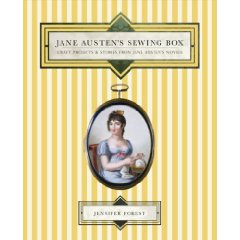
…and so the current Jane Austen juggernaut rolls on. The latest that has come to my attention is Canberra writer Jennifer Forest’s book Jane Austen’s sewing box. Must admit that I was a little sceptical when I first heard of it, but I saw it, bought it, and was pretty impressed. It’s a nicely produced book and represents a genuine attempt to look at the “crafts” of Jane Austen’s time – as well as being a “how to” book.

Jane Austen Sewing Box, by Jennifer Forest, Book cover

Cover from http://www.jennifer-forest.com/sewing-box.php, using Fair Dealing (I think)

The first thing to note, said the author when she attended my Jane Austen group’s monthly meeting last weekend, is that these are not all simply “crafts”. Many are, in fact, women’s work. Women made clothes, including men’s shirts and cravats, bags and purses, bonnets and so on. There was, in fact, a clear divide between “decorative” work and “useful” work and most women, including Jane Austen herself, did both. In fact, Penny Gay, writing in Cambridge University Press’s Jane Austen in context wrote:

Most houses had several sitting-rooms, in one of which the ladies of the household would gather after breakfast to ‘work’. By this is meant needlework, an accomplishment which was both useful and artistic, and which was considered a necessity for women of all social classes. Jane Austen herself was a fine needlewoman… If visitors called, it was often considered more genteel to continue with one’s ‘fancywork’ rather than ‘plain’ shirt-making or mending.

Forest also talked a little about how Jane Austen uses knowledge and skill in this work as part of her characterisation. In Mansfield Park, for instance, the work of the Bertram sisters is deemed not good enough for display in the public rooms (“a faded footstool of Julia’s work, too ill-done for display in the drawing room”) of the house – a clear indication that these girls are not to be admired. On the contrary, Henry Tilney in Northanger Abbey shows himself to be a solid young man and a loving brother by his knowledge of muslin. He could even be seen, many of us think, as the fore-runner of the SNAG (aka Sensitive New Age Guy)!

Forest introduced her talk with the quote that set her thinking about crafts in Jane Austen. It comes from the famous Netherfield scene in Pride and Prejudice in which Elizabeth Bennet, Mr Darcy, and Caroline and Charles Bingley discuss women’s accomplishments. The aways generous Charles Bingley believes all women are accomplished:

Yes, all of them I think. They all paint tables, cover screens and net purses.

CrewelWiki

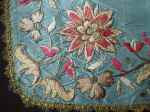
Crewel embroidery (from Wikipedia using Creative Commons CC-BY-SA)

Forest went on to describe these three “accomplishments” and more, such as crewel work, tambour work, and knotting. She also brought along a “show and tell” of the objects she had made in the course of writing the book. There is nothing like seeing and touching a hand-made bonnet or a netted purse to understand just how these women spent so much of their time. I am so glad I was born in the time of labour-saving devices!

This might not be a book for everyone. It is not academic but is nicely researched; and it is gorgeously produced with lovely period illustrations. I do have a quibble though – one that is, to me, quite serious – and that is its index. Why have a Table of Contents listing for “Muff and Tippett” and then have an Index listing for the same. If you want to find out what a Tippett is, you will not find it under T. Try M instead. How silly is that? Overall, the index is idiosyncratic and needs to at least double its existing size to be truly useful. That said, even if, like me, you are unlikely to make the 18  items described, take a look. Its readable discussion of “the accomplishments” of the period nicely illuminates the context of the novels – and this can only enhance our enjoyment of them.

Jennifer Forest
Jane Austen’s sewing box: Craft projects and stories from Jane Austen’s novels
Miller’s Point: Murdoch Books, 2009
224pp.
ISBN: 9781741963748

Flight of the Mind: Day 1, Summary

Geraldine Brooks, 2008 (Photo: Jeffrey Beall, via flickr, under Creative Commons CC-BY-ND-2.0)

Geraldine Brooks, 2008 (Photo: Jeffrey Beall, via flickr, under Creative Commons CC-BY-ND-2.0)

Today I went to the National Library of Australia’s Flight of the Mind conference – and, well, my mind took flight! The conference title comes from Virginia Woolf:

The old problem: how to keep the flight of the mind, yet be exact. All the difference between the sketch and the finished work.

Today’s program focused largely on the nexus between fact and fiction (or imagination). The sessions were:

Session 1: Kenneth Binns Lecture

Geraldine Brooks set the tone – as of course she must, being the key-note speaker – by arguing the value of historical fiction. It’s just as well Inga Clendinnen wasn’t there because, like Kate Grenville, Brooks argues that there is validity in “putting ourselves in someone else’s shoes”. She argued that in historical fiction we get “the constants of the human heart” even though the “material world” might be different. She said that the things that divide us – race, gender, creed, time, place – are less significant than the things that unite – love, pity, fear, compassion, and so on. I like her view of the world! I felt like asking her whether she agreed with Inga Clendinnen’s statement in The history question: Who owns the past? (Quarterly Essay 23) that: “It is that confusion between the primarily aesthetic purpose of fiction and the primarily moral purpose of history which makes the present jostling for territory matter”!! Basically, Clendinnen disagrees that novelists can make a contribution to history through, what Grenville described as, “empathising and imaginative understanding”. I’m simplifying a bit of course but, as I understand it, this is the nub – and I fundamentally disagree with Clendinnen (much as I admire her!)

Session 2: Creating fiction from fact: History as inspiration

The three speakers in this session essentially continued along Brooks’ theme, arguing about the truths that can be explored through fiction, with Goldsmith going so far as to say that as well as creating fiction out of fact, novelists can create “fact from fiction”. Rodney Hall talked a bit about the process of writing historical fiction and quoted Robert Graves who once told him to “write first, research later”. Hall suggested that it is important to get the facts right because once a reader stumbles across something they don’t believe, it interrupts the reader’s ability to lose themselves in the text. Fair enough I think – but clearly there are facts that need to be “right” and facts that can be “toyed with”. Otherwise, how could Hall get away with writing a novel titled The day we had Hitler home in which Hitler comes to Australia? It seems to me then that whichever way you look at it, readers of (historical) fiction need to understand in the end that they are reading FICTION!

Session 3: Recreating a creative life

This session focussed on the challenges of writing biography – of finding information, of making selections regarding what to include, and so on – and there were some interesting issues discussed but I’ll leave those for now.

Session 4: Writing across boundaries

Felicity Packard, who teaches creative writing as well as being a practising writer, made some points which clarified things nicely. She talked about working within the conventions of dramatic writing (such as Aristotle’s classic 3-part structure and the need to focus on just a couple of main questions) and the conventions of form (such as the 13-part television series). The other two speakers also referred to the issue of form. It made me realise that the writer of historical fiction works within two constraints – that of form, and that of the history they are working with. It can’t be easy!

Kevin Brophy also talked about the issue of plausibility. He said that journalism needs to do little to achieve plausibility, while fiction needs artifice to reach the same goal. And this brought me back to Geraldine Brooks’ reference in her key-note address to journalism being “the first rough draft of history”. Journalists, she said, get down the facts that are available at the time; then historians go back later and fill in the gaps using the additional records available to them after the passing of time. After all this is done, though, there are still voids – voices that are missing, such as, for example, those of the inhabitants of the plague village of Eyam upon which her novel Year of wonders is based. The historical novelist is, she said, “the filler of voids, the teller of lies” that convey “the emotional truths … the constants of the human heart”. I do wonder what Clendinnen would have said had she been there…but, in my view, today’s speakers did a good job of balancing “the exact” with their “flight[s] of mind”.

Oh, and if you would like a summary of Day 2, don’t look here. Due to other busy-ness, I only booked to attend Day 1.