Monday musings on Australian literature: Reading Australian literature

Reading Australian Literature is a lecture series inaugurated at the University of Sydney last year by its School of Letters, Arts and Media. The idea is for writers to talk about a literary text that means something to them. Here is how the website describes it:

Writers’ festivals and other popular forums invite writers to talk about their own work and creative practices. But what might they have to say about the books that excite their imaginations? There are few opportunities for writers to substantially engage with literature in the public sphere.

Reading Australian Literature is a series in which acclaimed Australian writers reflect on the Australian books they value. In a thoughtful and engaging public lecture, each writer will discuss a favourite Australian literary text. What has led them to these books? What do they find remarkable about them? Have these encounters with Australian books left an imprint on the speakers’ own writing?

As far as I can gather there were three lectures last year, and they plan four this year. Because I love hearing authors talk about writing and writers, I thought I’d share with you the writers and their chosen texts to date in the series:

  • Michelle de Kretser: Jessica Anderson’s Tirra Lirra by the river. De Kretser, whose Questions of travel I reviewed a couple of years ago, likes this novel, which I read and loved many years ago, because it’s “one of the great novels of place”.
  • Drusilla Modjeska: Randolph Stow’s Visitants. Modjeska chose this “underrated” novel set in the Trobriand Islands because it “remains unsurpassed in outside fiction of our complex near-neighbour”.
  • Fiona McFarlane: Patrick White’s The aunt’s story. McFarlane, whose The night guest I reviewed recently, said that White’s novel “produces a bodily reaction” in her. She reacts to it, she said, “with a kind of horrified, delighted rapture.”
  • Charlotte Wood: Shirley Hazzard’s The transit of Venus. Wood describes Hazzard’s novel, which I have also read, but a long time ago, “as a novel I could return to for the rest my life, each time finding a new experience within its pages.” An edited version of Wood’s lecture can be found online at the Sydney Review of Books. Wood writes here that the novel is “concerned with much deeper moral courage than that required simply to love”. She also sees it as being about self-sovereignty. In my reading notes, I wrote that it’s about the discrepancy between who we might be and who we are, about the failure of many of us to be the best we can because we let ourselves be distracted by superficial concerns.
  • Delia Falconer: Christina Stead’s Seven poor men of Sydney (lecture scheduled for 21 April). Falconer, whose The service of clouds I’ve read, again long before blogging, says she’s come to this book late. She loves its evocation of Sydney in the 1920s’s, but also says she’s impressed by “the intensity of Stead’s artistic vision”. She plans to argue “against the accepted view that this is an uneven book marred by the excesses of a first-time author” because she sees “the astonishing maturity and political sophistication of her use of form”.

How difficult it must be for these authors to choose just one literary work to talk about, but these particular choices are fascinating – not just for the books they’ve chosen but for the reasons they’ve chosen them. Those reasons tell as a lot about their interests as readers and writers. Drusilla Modjeska’s focus on “outside” fiction and Michelle de Kretser’s on place, for example, make sense if you know the sorts of things they write.

Intriguing all the authors so far have been women. It would be good to see male writers in the last two planned for this year.

Just a little post this week, but I thought this lecture series was worth sharing. Unfortunately, it doesn’t seem that the lectures are published online by the organisers, in either oral or written form. What a missed opportunity!

Carmel Bird launches Marion Halligan’s latest at Paperchain

Sometimes blogging brings you little thrills, and I had one a few days ago when Carmel Bird, one of Australia’s literary luminaries, emailed me with the offer to post her launch speech for Marion Halligan’s latest book. Was this out of order she asked? As if! So, I attended the delightful launch, and received the text from Carmel Bird’s hands. Here it is …

Carmel Bird launches Goodbye Sweetheart

I acknowledge the traditional custodians of the land on which we are gathered.

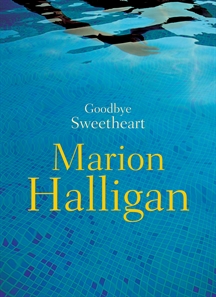
Marion Halligan, Goodbye Sweetheart

Courtesy: Allen & Unwin

For a writer, the so-called literary world is made up, as are many worlds, of friends and enemies. Marion and me, we are friends. You don’t invite your enemies to launch your books. Goodbye Sweetheart is Marion’s twenty-second book, and it’s the first one I have had the honour of launching. I can tell you this is a great pleasure.

Margaret Atwood says she thinks that all narrative writing is motivated by a fear and fascination with mortality. I agree with her. This doesn’t mean the details of the plots are necessarily going to focus on death. But sometimes they do. The publisher’s advertising for Goodbye Sweetheart begins by telling you the main character has just drowned, that the novel is going to explore the mourning of his family. And clearly there is going to be plenty of that other important topic, sex. In fact the two key subjects of fiction – sex and death – are entwined in the title Goodbye Sweetheart.

The blue, blue cover of the book is soothing, until you connect the shadow at the top with the information about the drowning. The story begins and ends with water – William drowns in the luxury pool of a fancy hotel, and ultimately his ashes are scattered in the sea, becoming ‘part of the shredding of the water on the rocks below’. When I talk fancy here, I’m quoting the book. His son and one of his wives then watch the moon on the water – a benign and hope-filled image that lulls the reader as the book is closed.

Novels often pose a question for the reader. Goodnight Sweetheart asks not only how you would behave if you were part of William’s family, but how, in your heart, you would mourn.

The narrator suggests that there are enough births, deaths and marriages, enough anguish here for half a dozen nineteenth century novels. This is a bit of a challenge for the writer. But Marion is up to it of course. The rhythms of her sentences, the precision of her words. One of the wives is advised to seek the joy of grief, the gift of sorrow, but she thinks these are just the threads of words all plaited together making a pattern but having no meaning. Later on she realizes that the true thing is that William loved her, and this will always be true. So there is the ‘true thing’, the good thing, the meaning. And fiction may be motivated by death, but its aim is usually to seek out meaning. To unravel the tangles of lives and to present the reader with a pattern that makes some sense of it all. Another character says ‘Meaning is what we make for ourselves.’ Marion takes a pretty big cast of characters and weaves them – I am inclined to say she stitches them up – into a pattern, and the meaning – the true thing – emerges and stays in the reader’s mind.

Now this is getting to sound rather philosophical and serious – have I forgotten about the sex and death thing? No. I have not. The story unfolds in present-day Australia, in the domestic lives of an extended and muddled family. Early on, a character points out that some of the great traditions of literature had a domestic beginning. This story is going to be domestic, not epic or anything like that. But it will frequently spin the focus round to someone such as Milton or Browning or, in particular George Eliot. For one of William’s sons is a great admirer of Middlemarch. The narrative refers back to the dense narratives of myth and poetry and fiction.

Now a lovely thing, speaking of the domestic again, is the way the titles of the chapters keep bringing you back to the very ordinary everyday. Like no chapter headings you have ever seen. There’s a list of them in the front – ‘The gym is busy’ – ‘Lynette plans a sale’ – ‘Jack goes fishing’. They play so sweetly against the grand themes of death and love and betrayal. Love might be the true thing, but the fabric of everyday life is made up of things such as ‘Helen comes home late’ – and ‘Aurora drinks vodka’. Watch out for ‘Barbara drinks the last of the wine’, though. Of course, people are often drinking things – and eating nice stuff too. Marion never lets a good story get in the way of a fine meal.

Now I want to talk about coincidence. It is such a joyful thing that happens really quite frequently in everyday life. It also happens quite a bit in literature – think of the works of Dickens, for one. It isn’t always easy to make coincidence smooth and acceptable in fiction. But at the end of Goodbye Sweetheart there is a delightful one, and it is part of the melody of the novel, is a graceful gift offered to one of the nicest characters. It will put a smile on your face. Not only is there love, there is hope. Even the title of the chapter in which it happens is a joy – suggesting as it does that the young man is at last on the right path – it’s called ‘Ferdie takes the bus’.

There are also a few ghosts involved along the way, and a rich vein of fascinating short narratives, one in particular that appealed to me – the tale, legend, of a boat that came, once upon a time, into the bay at Eden. It had picked up smallpox in India when it took on a cargo of silk. The infected silk was buried with the bodies of the dead. Then guess what – people dug up the infected silk and sold it, and the ladies of the town made it into dresses. The complex everyday lives of the main characters are threaded with mysterious narratives such as that one. And these narratives form a subtle, dark undertow to the everyday problems of the characters. So while the surfaces of lives are followed in meticulous detail, from the clothes people wear to the food they eat, the wines they drink, the glasses they drink from, the landscapes they contemplate – a darker undertow works away in the depths.

So, William dies. His wife, his two ex-wives, his children, his mistress – I think I’ve got it covered – gradually gather, revealing their own stories, discovering parts of the story of William, until William is ashes in the sea, and the moon moves across the water.

You are going to love reading this novel. You are going to love having it alongside all the rest of Marion’s books. It is my honour and joy to launch it on its way to the open arms of your lucky bookshelves.

– Paperchain Bookshop, Canberra, April 14, 2015

PS Carmel has what she calls a “sleepy blog”, Blue Lotus. She plans to post this speech there also. Do go check her out because there you will find her short story, “When honey meets the air”, which I featured in my review last year of Australian love stories. It’s one of those pieces that has you chuckling, marvelling and puzzling all at once. Carmel’s next book, a collection of short stories titled My hearts are your hearts, will be published by Spineless Wonders later this year.

Marion Halligan’s reponse

No, I don’t have her speech too, but I did make some brief notes! Mostly, of course, she thanked various people – publisher and editors, family, and Carmel. However, she did say a few other things. Responding to Carmel’s comment on chapter titles, she said she has to name, not number, her chapters, because she doesn’t write them in order and needs to recognise them when she comes to shuffling them around! Don’t you love it? I can see why Halligan and Bird are such friends, they such have a wonderfully confident cheekiness about them. (I’m sure you detected some cheekiness in Bird’s speech).

Marion also commented that reading about death isn’t necessarily miserable. Death is something we all have to face up to, some sooner than later, she said (!), so we may as well get used to it. Must say I agree with her. I’m not one to shy away from books that deal with grief and death. I know many people love Joan Didion’s beautiful memoir, The year of magical thinking, but Halligan’s novel, The fog garden, is an equally beautiful book, a novel, about the loss of a loved partner.

Finally, Marion praised the book’s designer, Sandy Cull, who also designed Valley of grace and Shooting the fox. She’s right – I have all three now – and they are all, simply, luminous. It was a delightful launch involving two special Australian writers – and I now have a signed copy of Halligan’s book in my hands, and Bird’s thoughtful speech about this book and fiction in general preserved on my blog for posterity. Thanks Carmel. Thanks Marion.

Monday musings on Australian literature: Story and Poetry Readings

I’ve written several posts in the past about festivals and awards – national and regional – but I haven’t written about ongoing lower-key literary events, sometimes called Readings, sometimes Salons, so today I’m going to highlight this aspect of Australia’s literary culture. I first planned this post a year ago when I read about the Whispers Salon (more anon), but left it in the background until I had time to research other events. Then, last week, author-blogger Dina Ross emailed me about a new Melbourne event, Shorts@45, which finally spurred me into action. As usual with these sorts of posts, I am not presenting an exhaustive list – how could I know what’s going on all over Australia’s nooks and crannies – but giving a taste of what’s happening.

So, here goes, in alphabetical order by name of event:

  • Outspoken occurs in the gorgeous Maleny area of southeast Queensland. It describes itself as “an extended literary festival taking the form of occasional conversations with writers”. It started in November 2010, and they charge $15 for the events. Last year they had authors as diverse as ex-treasurer Wayne Swan and Karen Joy Fowler (whose We are completely beside ourselves was shortlisted for last year’s Man Booker Prize), historical Henry Reynolds and debut novelist Ellen van Neerven. This event is more of a “conversation” than a “readings” event, but I’m including it because it is an ongoing event rather than an annual festival – and I’m sure the authors would read from their works during the conversation! (Website, Podcasts page)
  • Poetry at the Gods is the event I know best. I have written about it at least once before (most recently last year in a post about hearing Les Murray at the event). The event takes its title from the venue, The Gods Cafe/Bar on the ANU (Australian National University) Campus. It is run by poet Geoff Page (whose verse novel, The scarring, I have reviewed here). It’s a monthly event and involves readings by, usually, a couple of poets, sometimes one, sometimes more, starting at 8pm (with meals available for purchase earlier). The cost for the event itself is $20. Page manages to organise many of Australia’s top poets to read (including local poet and winner of last year’s Prime Minister’s Literary Award for poetry, Melinda Smith). I only wish the evening didn’t clash with other commitments because I’d love to attend more often than I do. (Facebook Page)
  • SHORTS@45 is the event Dina Ross emailed me about. It is a new bimonthly series, curated by Ross. Its name, too, comes from its venue, fortyfivedownstairs, in Melbourne. It will comprise readings by authors and actors, and aims to celebrate “the best short story writing at home and overseas”. The event is supported by fortyfivedownstairs, Reader’s Feast Bookstore and Allen & Unwin’s Faber Writing Academy. It costs $20, including a glass of wine. (I like the sound of that!). The first event of the year will be February 9, and is themed Love and Loss, with contributions by Carrie Tiffany, Arnold Zable and Toni Jordan (all of whom I’ve reviewed here). There will also be a reading by actor Paul English, of a short story by Liam Davison who died in the MH17 crash last year. (Webpage)
  • Sunday Poetry (or, Sydney Poetry, or, Poetry Readings at the Brett Whitely Studio) is a free, monthly poetry reading event – held, yes, on Sundays – that seems to be supported by the Art Gallery of New South Wales. “Most months”, they say, “feature a poet from our curated program. At other times there are special open-mic readings”. I can’t locate the 2015 program, but it seems for have been running for at least 3 years, so I am assuming it will run again this year. Last year they had single poet readings (such as Omar Musa), multiple poet readings (Harbour City Poets), and open mic days (Aural Anthology).
  • Whispers Salon is organised by the Queensland Writers Centre (QWC) and is a bimonthly event. It’s free, and the QWC describes it as follows: “Whispers cuts across genre and style – short and long form – to showcase exciting new voices alongside some of Australia’s best-loved authors in a series of dynamic reading events.” The first events were, I believe, held at the State Library of Queensland, but in 2015 the event, they say, will be hosted throughout Queensland. The first event for the year, to be held on February 7, will be at the Fox Hotel in Brisbane, and is titled “A New Day” but it’s not clear exactly who will be reading.

These are just five events but I think they all sound pretty interesting. For an excellent list of Australian literary events, you might like to check Jason Nahrung’s blog page, 2015 Australian Literary Festival Calendar.

Have you been to any of the events I’ve listed – or to similar ongoing literary events like them?

Monday musings on Australian literature: Whither Australian literature in 1927?

Last week’s Monday Musings focused on a plebiscite conducted in 1927 on Australian and New Zealand authors and poets. It was conducted in August as a lead up to September’s Australasian Authors’ Week. I found several articles about this week. Some were primarily descriptive, but a few took the opportunity to comment on the state of Australian literature.

I particularly enjoyed reading the unnamed writer in The Catholic Press. S/he starts:

We hardly know whether the Australian* Authors’ Week, proclaimed by the Booksellers’ Association, to begin to-morrow, is intended as a tribute to the merits of Australian writers, or as a demonstration of remorse, or as merely a gesture, like the Shopkeepers’ ‘Country Week,’ to indicate the stuff that is to be avoided for the other 51 weeks of the year.

Hmmm … this writer continues that it’s not a very original idea, but may divert “the minds of book readers from the notion that Ethel M. Dell, Zane Grey and H.G. Wells are the pillars of the present day literature in the English language and its American offshoot”. I wonder if that “American offshoot” comment is a dig at the language or reflects a prevailing view of the period that they are separate? I’ve never heard of Ethel M. Dell but the Zane Grey comment makes sense. However, I was surprised by H.G. Wells. Maybe his star has risen in the years since 1927?

A young culture

The writer argues against the view that “Australian literature has been an unconscionably long time developing”. S/he suggests that Australia was still a very young country (in terms of white settlement, as we moderns would qualify), at just 14o years old – and that it did not have a significant population for the first half of that period, that is, not until the gold rush of the 1850s. S/he argues that there was little or no American literature for its first 300 years. Hmm … I guess this depends a bit on your definition of “literature”. Later in the article, s/he says that most people narrow the term to “poetry and fiction”, but clearly believes it can encompass more, including history and essays. There was, in any event, political and religious writing in America from its early days but, according to Wikipedia, the first American novels didn’t appear until the late 18th to early 19th centuries.

In Australia, the earliest writings were journals of the early Governors; verses by Judge Barron Field; “the superficial historical work of W.C. Wentworth, an Australian native”; and “dry-as-dust chronicles” by historians. Australia’s bookstalls now, s/he writes, “are flooded with the cheap trash of England and America, which are neither literary nor instructive”.

Literarily … Australian

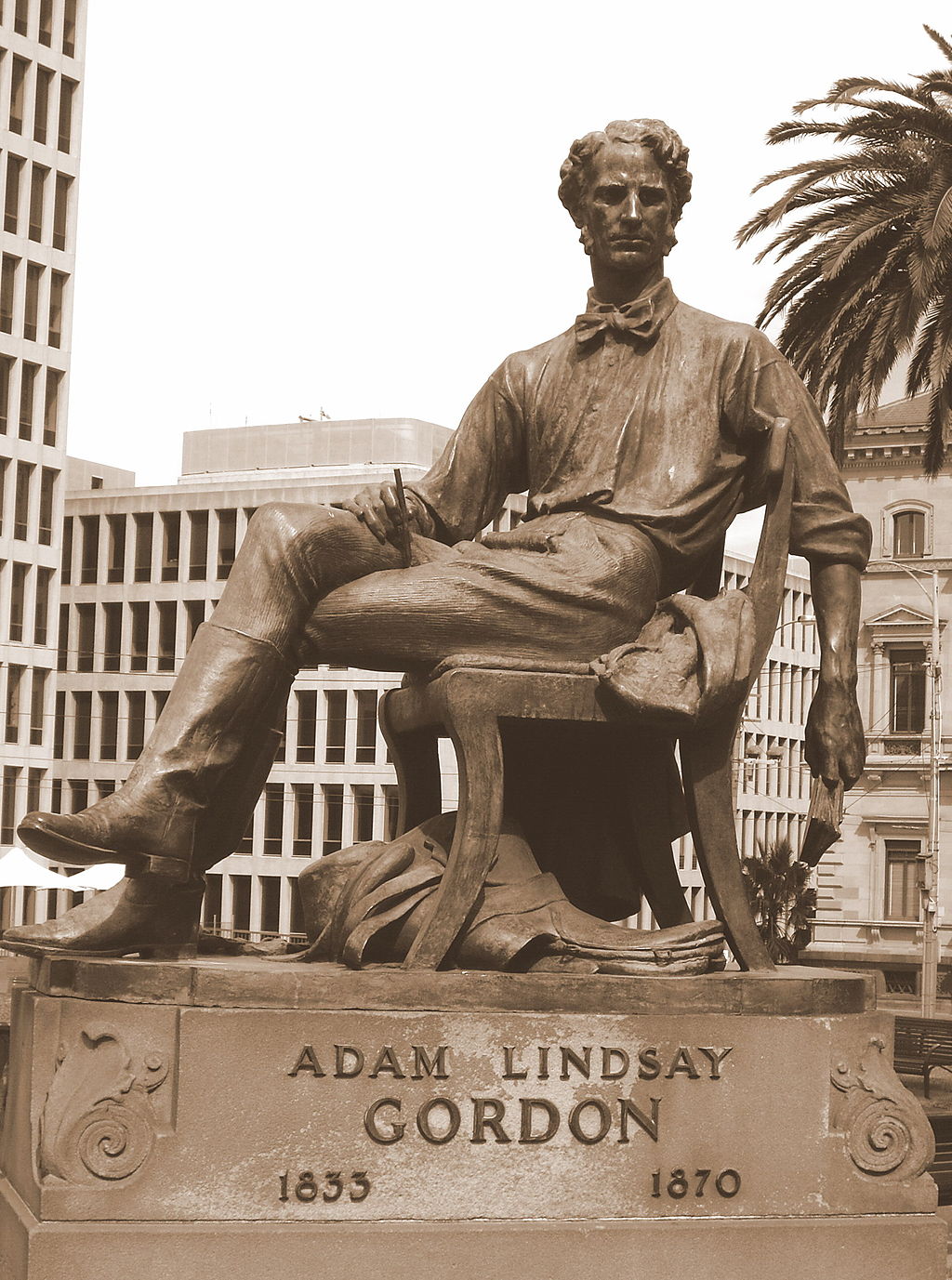
Adam Lindsay Gordon monument (Courtesy VirtualSteve, using CC-BY-SA 3.0, via Wikipedia)

Adam Lindsay Gordon monument (Courtesy VirtualSteve, using CC-BY-SA 3.0, via Wikipedia)

The writer then discusses the plebiscite. S/he states that “it would be too much to expect that such a vote could be considered critical”. “Subconsciously, many honest voters would follow the crowd”, s/he suggests. Very likely, I’d say, given that members of the sponsoring Society had provided their selections in the newspaper at the start of the plebiscite! The writer is not particularly keen on the poet who “won” the plebiscite, Adam Lindsay Gordon, and who, s/he says “had an affection for the ‘gee gees'”. S/he also doesn’t approve of the leader of the prose section, Marcus Clarke, with “his inartistic stuff”, but doesn’t explain this further. Another writer on the week, in The Australasian, reports that Percival Serle**, addressing the Australian Literature Society, said that “the worship of Gordon had done a very great harm to Australian literature”, and that English lecturer F. Sinclaire was similarly critical of Gordon, calling him “pernicious as an influence socially and artistically, besides being in no sense Australian”.

Back now, though, to our Catholic Press writer who argues that “much of Australian literature prior to the so-called ‘Bulletin‘ school has little distinctive character”. S/he suggests that writers like Gordon, Clarke, Rosa Praed, Guy Boothby “may have laid plots in Australia, but failed to get the atmosphere”. I wish s/he’d elaborated a bit more on this, because s/he goes on to name writers s/he sees as “Australian” without defining what s/he means.

Who are they? Well, they include poets Roderic Quinn, Charles Harpur (who wrote “the first genuine Australian verse”), and Henry Kendall. S/he does have a little dig at Kendall’s style – quoting his “notes that unto other lyres belong” – but argues that he is “Australian in sentiment”. Other writers – poets and novelists – s/he names include Rolf Boldrewood, “Banjo” Paterson, Mary Gilmore, Ethel Turner, CJ Dennis, Bernard O’Dowd, Dorothea Mackellar. (F. Sinclaire also names O’Dowd, but adds Furnley Morris***, whom I don’t know at all, and J. Shaw Nielson). As an aside, I can report that all the poets mentioned here – including the maligned Gordon – appear in 100 Australian poems you need to know, published in 2009. It’s not the arbiter of quality, but is a fair indication of the longevity of these writers’ reputations.

S/he then argues that on Henry Lawson’s death, it was argued that “he was the last of the school which began with Gordon”, but s/he believes that “he was the first of the new school, the Hawthorne of Australian literature”. Does s/he mean Nathaniel Hawthorne? I haven’t heard that before.

Overall, s/he is positive about the state of Australian literature. The list, s/he says, “is not unworthy of the first century in a nation, which even now holds less (sic) people than the single cities of London, New York or Paris”. S/he concludes:

If young writers seek characters and episodes in the life around them and avoid imitating the style, decadence and false sentiment of the ‘best sellers’, Lawson, Quinn and Kendall will have worthy successors in a field that still has room for exploration.

The point of all this for me is that while assessments might vary in the particular, most if not all of the writers mentioned in the articles are still known today – some very well, others in more specialist arenas. It reassures me that Australian literature is deepening, as well as broadening.

* Some called it Australasian, some Australian, and others Australian and New Zealand …. Authors’ Week!
** Serle could conceivably be the Catholic Press writer, but I didn’t find any evidence for this.
*** Furnley Maurice, I believe.

Monday musings on Australian literature: Specialist literary festivals

Are you a reader of crime or science fiction or fantasy? Or, perhaps of poetry? A few weeks ago I wrote a post on regional literary festivals in Australia. I focused then on festivals for general and/or literary fiction. But, if you have specialist reading inclinations, there are also likely to be festivals for you. And so today I thought I’d post a selection – just to whet your appetite.

While I was researching that last post, I came across a couple of websites: literary festivals.com.au, which lists Australian festivals, andVampires in the Sunburnt Country, which publishes a literary festival calendar for Australia. They are worth checking out if you want to know whether a festival is coming to a town near you – or, better still, your own town.

As last time, I’ll list a randomly selected few – representing a variety of specialty and location – in the order of their establishment, starting with the oldest.

  • Australian National Science Fiction Convention. Established in 1952, and run each year in different cities by different groups. This year’s festival will be held in Melbourne and run by a group called Continuum.  Arthur C Clarke was a guest at the fourth convention held in 1955.
  • Romance Writers of Australia Conference. Running now for 23 years, this is a big affair. It’s a 4-day event and will be held in Sydney this year, but moves around a bit I believe. It is, really, more conference for practitioners than festival for readers, but with “350 published and aspiring romance writers, editors, agents and other industry professionals” attending, I figured it’s worth mentioning. Romance is, clearly, serious business. And, anyhow, the conference will include a Literacy High Tea, which they describe as a networking event “for librarians, booksellers, authors and readers” that will also be a fundraiser the Australian Literacy and Numeracy Foundation.
  • StoryArts Festival Ipswich. Established in 1995, and originally called the Ipswich Festival of Children’s Literature. It takes place biennially and is organised primarily by the Ipswich Teacher-Librarian Network (in Queensland). Good for them. Their aim is broad: “to increase an awareness of the value of the arts in relation to writing and illustration and help build and maintain increased audiences for children’s literature. We plan to inspire young people to buy and read more books and gain an appreciation of the processes involved in writing and illustrating. We also aim to enthuse teachers and parents about the value of stories and encourage them to promote literature to young people.”
  • Perth Poetry Festival. Established in 2005 as the WA Spring Poetry Festival, and now run by WA Poets Inc. It is one of many poetry festivals held around Australia, including some dedicated to bush poetry and other poetry forms, which suggests that poetry is alive and well(ish) even if poets can’t make a living from their art!
  • Jane Austen Festival Australia. Established in 2008 in Canberra, this is a 4-day Regency Festival which explores the world of Jane Austen. It includes a wide variety of activities and events including dancing, archery, historical costume making, a Jane Austen book club and lectures on literary and historical subjects. The 2014 conference included a half-day symposium on Mansfield Park.
  • Reality Bites. Established in 2008, and run by the Sunshine Hinterland Writers’ Centre (in Queensland). (It may alternate with another festival titled Reality Writes, but the website doesn’t yet have its “About” page functional). It describes itself as “Australia’s premier literary nonfiction festival” and takes place on the last weekend in October each year. It sounds right up my alley but is rather far away.
  • Death in July Festival. Established in 2014 – yes, this is its first year. In my last post I only selected festivals that had some longevity behind them but, Ballarat Writers Inc, which is organising this festival with Sisters in Crime, tweeted me about it. I reckon that deserves a guernsey. It celebrates women’s crime writing and will be held in Ballarat, Victoria, in July. Guests at this first festival will include Angela Savage whose The dying beach I reviewed earlier this year.

As you can see, most of these are pretty recent – though there are some longstanding ones. I haven’t included any play/theatre festivals but there are several of those too. It does seem that literary festivals of all sorts are popular at present – not only in cities but also in regional towns, which clearly hope that festivals will be part of their survival in our economically tough world.

Have you attended any speciality literary festivals? If so, what specialty has taken your fancy!


Monday musings on Australian literature: Regional literary festivals

With the Sydney Writers’ Festival kicking off today, I thought it might be interesting to turn our thoughts briefly to the regions. We (well, Aussie readers anyhow) know the big well-established city festivals, in particular Sydney, Melbourne, Adelaide and Perth, but there are also many smaller festivals, some rural, some suburban. In this post I plan to write about some of the rural/regional festivals. You never know, there might be one near you – or one in a location you’d like to visit for your next holiday. Perhaps we can even lure some people from overseas to our interesting smaller towns and regions!

I’m going to list a randomly selected few in the order of their establishment, starting with the oldest. Most of these festivals are shorter than the big city ones, and usually run over a weekend.

  • Byron Bay Writers Festival. Established in 1997, this festival is on my bucketlist, partly because it is well-established now but mainly because Byron Bay, on the northern coast of New South Wales, is also a great place to visit. In fact, it apparently started, the website says, when a few locals wondered “whether authors might accept an invitation to spend a winter’s weekend in Byron Bay”. They did! It is now well enough established that it can attract significant Australian and overseas writers. This  year’s festival will be held 1-3 August, and one of the featured authors will be Stella Prize winner, Clare Wright.
  • Clunes Booktown Festival. Established in 2007 as a one-day event, converting to a two-day festival in 2008. Clunes in a small town in, roughly, central Victoria. It became the 15th accredited member of the International Organisation of Booktowns in 2012, and is the only booktown in the southern hemisphere. (It’s somewhat of a joke, that we Aussies like to claim the biggest, first, only, etc “something” in the southern hemisphere!). This year’s festival was held over the first weekend in May. It is a little different to the others I’ve listed here in that while it has author talks and events, its main focus is the buying and selling of books. However, it does include a literary program which this year included a special feature on book art, and speakers like novelist Alex Miller and historian Henry Reynolds.
  • Margaret River Readers and Writers Festival. Established in 2009, this festival is Arts Margaret River’s flagship event. The 2014 festival was held last weekend, 16-18 May, with scheduled speakers including Joan London, Peter Goldsworthy and Graeme Simsion. Associated with the festival is a Short Story Competition, which is run in conjunction with Margaret River Press and results in the publication of an anthology of winning and selected stories. Last year, I reviewed the 2013 anthology, Knitting and other stories, and will review this year’s anthology in the next few months. Margaret River, in southwest Western Australia, is also a beautiful location, famous for wine (among other attractions). 
  • Bellingen Readers and Writers Festival. Established in 2011, this festival very specifically frames itself as a “readers” and “writers” festival. It has several aims, including the aspiration to be “unique among other literary festivals in using the region’s rich environmental and cultural heritage and the passions of local writers and readers”. Apparently, Peter Carey is its patron. Like Byron Bay and Margaret River, Bellingen on the New South Wales’ mid-coast, is a gorgeous part of the world, making it yet another one I’d love to attend. This year’s festival will be held over the New South Wales long weekend, 6-9 June, and speakers include Alex Miller, Kristina Olsson and, wonderfully, Yolgnu authors from Arnhem Land.
  • Batemans Bay Writers Festival. The new kid on the block, this festival is being held for the first time this year on the same long weekend as the Bellingen Festival, but for just two days, 7-8 June. It’s only 2-hours drive from my home but unfortunately I don’t think I’ll be making it. It has a good lineup of speakers, though, including Clare Wright, Debra Adelaide and Marion Halligan, which hopefully augurs well for its becoming a regular event.

These are just a few of the plethora of regional literary festivals in Australia. It may be a product of my random selection, but did you notice that four of these five festivals started in the 2000s? Is this indicative of an increasing interest in and support for books and reading? The answer is probably a little more complex than a simple equation, but I hope there’s something in it!

I haven’t included in the list what I would call a subgroup of these which comprises the festivals devoted to a particular writer, such as the Banjo Paterson Festival (in Orange, NSW), Jane Austen Festival Australia which celebrates all things Regency, and surely the grand-daddy of them all, the Henry Lawson Festival (Grenfell, NSW), which is holding its 57th festival this year. There are also festivals devoted to specific literary forms (such as poetry) and genres (such as romance). I may do a post on them another time.

As I was researching this post, I was sorry to discover that the Kimberley Writers’ Festival, which was to have been held for the 10th time this year, will not be going ahead due, says the organiser Jo Roach, to “changes in government grant funding criteria and reduction in spending by local companies”. She hopes, however, to hold it next year. Such is the difficulty of holding specialised festivals, particularly in remote places like Kununurra.

Finally, there is a festival that is not held in Australia but that has strong Australian associations, the Ubud Writers and Readers Festival, which will be held for the 11th time this year. Ubud is in Bali and this festival was established by Australian-born Janet DeNeefe “in response to the 2002 Bali bombings”. She says on her website that “it has been named by Harper’s Bazaar, UK,  as ‘one of the top Festivals in the world’ and by ABC’s Asia-Pacific network as ‘the next Edinburgh Festival of Asia’.” (The “next” Edinburgh Festival of Asia? Is there another one?). Anyhow, this year’s festival will be held 11-15 October. I first heard of it through blogger Bryce Alcock’s 8-post report on the 2011 festival. 

Phew, this ended up being longer than I intended.

Are you a keen attender of literary festivals? And if you are, what makes a good festival for you?


Mansfield Park Symposium, Jane Austen Festival Australia, 2014 (Part 2)

WORDPRESS GREMLIN: Those of you who subscribe to my blog will have received two notifications yesterday of my Part 1 post – as the result of what was rather a nightmare. I published the post. Up popped WordPress’s successfully published screen as usual, and then POOF it all disappeared. It was nowhere to be seen – not publicly, not administratively. It still isn’t anywhere that I can see, though I gather when you click on that first notification, you are taken to a page. Fortunately, I had previewed it not long prior to publishing and still had the preview tab opened, so I was able to copy and past that content and republish! Phew, I was planning to use the two posts as preparation for my Jane Austen meeting this month so would have been devastated (relatively speaking) had I lost it!

Continued from my previous post covering the first two speakers at the Mansfield Park Symposium.

Gillian Dooley, No moral effect on the mind: music and education in Mansfield Park

Dooley, from Flinders University, focused on music, making the point that music played big part in Jane Austen’s own life. She argued that Jane Austen seems to share John Locke’s view that learning (education, I presume she meant) is subservient to qualities developed through upbringing and experience.

Like Neilson, she sees Mansfield Park as being about education, particularly women’s education. She reminded us of Mary Wollstonecraft’s Vindication of the rights of women which was published in 1792, when Austen was 17 years old*. Austen, she said, shows the “larger” passions in Fanny that develop in her along lines of Wollstonecraft. Fanny is not a musician. Her cousins, Maria and Julia, say she doesn’t want to learn music and drawing, but Dooley suggests Austen is showing Fanny’s resilience, determination and her desire not to be showy. Fanny has noticed, Dooley said, that such skills haven’t made them better people and she would not went to emulate them.

Despite their accomplishments, in fact, Maria and Julia are not shown to have much feeling for music. Sir Thomas realises, too late, that “to be distinguished for elegance and accomplishments, the authorised object of their youth, could have had … no moral effect on the mind”. In Chapter 20, just after Sir Thomas has returned home and discovered, to his horror, the acting scheme, emotions are running amok. Music is used ironically it seems to cover up the lack of harmony:

and the music which Sir Thomas called for from his daughters helped to conceal the want of real harmony.

For the Bertram girls, and for Mary Crawford, Dooley said, there is a dependence on material trappings and external appearances, on female trappings, that betrays their lack of the moral character we see in Fanny.

For Mary Crawford, musicality is an important part of a woman’s armoury. Jealously, she asks if the Owen sisters, whom Edmund is visiting, are musical:

“That is the first question, you know,” said Miss Crawford, trying to appear gay and unconcerned, “which every woman who plays herself is sure to ask about another…”

Mary certainly uses music as part of her armoury, Dooley explained. Mary’s appeal is increased when she plays the harp, and she sets out to charm Edmund. As Austen writes:

A young woman, pretty, lively, with a harp as elegant as herself, and both placed near a window, cut down to the ground, and opening on a little lawn, surrounded by shrubs in the rich foliage of summer, was enough to catch any man’s heart.

Dooley argued that the harp symbolises fashionable modernity and wealth. (It comes up in Emma, too, where Mrs Elton suggests Jane Fairfax would be better if she played a harp as well as piano.)

The saga of harp’s arrival tells, Dooley said, of Mary’s belief in the London maxim that everything can be “got” with money, including marriage. She is surprised when country values see her priorities rather differently. But Mary, as Fanny puts it, has “a mind led astray”. She, aligned with city values, is careless as a woman and a friend.

Fanny, on the other hand, is aligned with things country and natural. Early in the novel, she stands at a window looking out into the night, after Mary Crawford has left them to join a glee, and is joined by Edmund:

 “Here’s harmony!” said she; “here’s repose! Here’s what may leave all painting and all music behind, and what poetry only can attempt to describe! Here’s what may tranquillise every care, and lift the heart to rapture! When I look out on such a night as this, I feel as if there could be neither wickedness nor sorrow in the world; and there certainly would be less of both if the sublimity of Nature were more attended to, and people were carried more out of themselves by contemplating such a scene.”

Scenes like this point to Austen’s being on the threshold of Romantic era.

Anyhow, at the end of this scene, Edmund moves towards Mary taking part in the glee, leaving Fanny to her musings..

Austen, Dooley said, is not black-and-white on the issue of music. Mary Crawford truly enjoys music, is not just a coquette, and, while Fanny prefers reading, she also appreciates and enjoy music and dancing. Austen is however critical of the place of music in education. The musicians in this scene are judged as having wasted their time in developing their music skills. Fanny, in fact, says Mary’s faults come from her education. Fanny’s education, on the other hand, had been directed by Edmund (which ties neatly with Neilson’s thesis about “good” education).

At the end of the novel, Austen, through Sir Thomas, praises the effects of the Price family’s hardship – “the advantages of early hardship and discipline, and the consciousness of being born to struggle and endure” – but during the novel we see that much about the Price family is not admirable. Dooley suggests that Austen’s point is probably that the Price family does not value decorative accomplishments. Musicianship, in other words, isn’t condemned but neither is it seen as necessary for a girl.

This paper is, apparently, adapted from her article in the June 2006 issue of Sensibilities.

* We don’t have evidence that Austen read Wollstonecraft, but we know from her extant letters, which start in 1796, that she was a prolific and wide reader. It’s hard to imagine she was not well aware of Wollstonecraft’s work and ideas, whether or not she had actually read the book.

Dr Christine Alexander, The genius of place: Mansfield Park and the genius of place

Alexander, from the University of New South Wales, focused on place, and how it relates to aesthetics and moral values. She commenced by suggesting there are three critical questions to ask:

  • Why is Mansfield Park set in countryside on an estate?
  • Why is the visit to Sotherton important?
  • How does all this relate to Fanny?

The country estate setting, she said, facilitates exploration of the city-country clash. Austen is following here the classical tradition in terms of the town versus country debate, which had flourished in the 18th century. This clash had cultural and aesthetic implications. Changes in agriculture, like that depicted in Downton Abbey (albeit a century or so later), were resulting in the collapse of rural patterns of life.

At the same time, cities were growing. An increase in trade brought wealth to the cities. But, contemporary attitudes were ambivalent. Cities represented art, culture, luxury but they were also characterised by sewers and filth. William Cowper’s most significant work, “The Task” praises country values over what he saw as the dehumanisation of industrialisation in the cities. Dr Johnson said of London that it “sucks in the dregs of each corrupted state”. And so, the Crawfords are seen as bringing to Mansfield Park their contaminated city values. The harp saga epitomises this clash: the harvest takes precedence, rather to Mary’s surprise, over the transport of her harp. Mary’s faith in “the true London maxim, that everything is to be got with money” is tested by “the sturdy independence of your country customs”!

Alexander reminded us of Sense and sensibility, and Marianne’s “feeling all the happy privilege of country liberty, of wandering from place to place in free and luxurious solitude”.  There is a sense here of returning to nature for moral insights and virtue. Similarly, Fanny’s response to sublimity is that nature can inspire virtues, reflecting a Wordsworthian view! Alexander suggested that in the scene in which Fanny and Mary sit in the shrubbery we see the superficial improvement of a woman set against real moral intelligence.

Yet Austen, she said, is not naive about country. The Crawfords reflect the variety and excitement of the city lifestyle, of the temptations of an undefined and unconstructed social space where people can live out their more “dubious inclinations”. The city is also where people acquire aesthetic sensibilities. Generally, in Austen’s novels, the influence of London is regretted while the country house ideal. She quoted Pope and his promotion of the “right use of riches”, of a “life of rural simplicity”. Ostentation, typical of the city, satisfies vanity and pride, in contrast to unpretentious plainness.

Fancy homes, she suggested, often disregard “the genius of the place”, a phrase used by Pope to mean the need to respond to/draw from nature and the inherent sense of a place. But this was a time of absurd grandeur, of conspicuous consumption by Whig magnates. The Mansfield Park community, by contrast, still fulfils country traditions even if some of the behaviours within run counter to those traditions. Sotherton, however, is in more upheaval under its new owner. Rushworth is overturning his mother’s traditions, manifesting the contemporary fashion for improvement.

In fact, Alexander argues, the idea of improvement is a significant part of the novel’s plot and moral structure. Austen uses the characters’ attitudes regarding aesthetic values and improvement to identify their moral values. In Chapter 6, Fanny listens to Rushworth on Sotherton and says nothing until he talks of chopping down trees, at which point she says:

“Cut* down an avenue! What a pity! Does it not make you think of Cowper? ‘Ye fallen avenues, once more I mourn your fate unmerited.’”

Alexander suggested that contemporary readers would have recognised the reference to Cowper’s “The task”. Most readers would have known the next lines: “once more rejoice/That yet a remnant of your race survives.” Edmund’s reaction that:

“… had I a place to new fashion, I should not put myself into the hands of an improver. I would rather have an inferior degree of beauty, of my own choice, and acquired progressively. I would rather abide by my own blunders than by his.”

shows him to be the perfect partner for Fanny.

Jane Austen, we know, approved picturesque views and approves judicious improvement (such as that at Pemberley in Pride and prejudice) and the creation of social spaces (such as Catherine’s bower). But, said Alexander, Austen, like landscaper Uvedale Price, disapproved the cutting down of ancient trees. Note, she said, that Fanny has same surname! In other words, Austen ridicules excessive improvement that fails to account for “the genius of the place”. In Mansfield Park, Rushworth on Sotherton and Henry Crawford on Edmund’s parsonage at Thornton Lacey, reflect this rush to improve. Henry suggests cutting down the trees, and altering the stream, so:

you may give it a higher character. You may raise it into a place. From being the mere gentleman’s residence, it becomes, by judicious improvement, the residence of a man of education, taste, modern manners, good connexions.

Henry’s improvements are not appropriate to Edmund’s role and, thus, argued Alexander, in vey bad taste.

Austen, Alexander suggested, is critical of the changing relationship between nature and artifice. In the visit to Sotherton, Fanny retires to shady trees, after being being sorry to see the dilapidated state of the chapel. Mansfield Park promotes the value of natural process and growth, of necessary improvements made judiciously over time. Alexander suggests that this process applies not just to the landscape, but to Fanny herself.

It’s important to note, though, Alexander said, that the word “improvement” is used contradictorily throughout the novel. You need to notice who is using it or in what context it is being used.

When Fanny returns to Mansfield Park after Portsmouth, she looks at the landscape again. These nature passages, Anderson argued, suggest growth and deepening of Fanny’s character, and reflect both traditional and romantic values. Fanny needs needs nature to recover. The old estate is suffering from spiritual impoverishment. It is not rich in the spiritual or moral values that Fanny is rich in. Fanny acts, she said, by refusing to act – and could be seen as “the genius of the place”. She assumes role of an improver, when she returns: she takes the place of the daughters, she is the faithful remnant of the older order and value system. But, Alexander said, appropriating the past does not mean being dominated by it. It means incorporating the best values as you change over time.

And so, she concluded, Mansfield Park‘s values are conservative, but Austen was trying to engage in a serious discussion about the state of the nation. Emphasising traditional values is part of her moral purpose. This is a conservative Austen “but with promise”. Fanny is open to change, to the romantic aspect of nature and natural beauty, but her idea of change is one attuned to “the genius of the place”, to what is appropriate, perhaps, for the context.

QUESTION: There was a question regarding Austen’s statement that she was writing a novel about ordination. Alexander replied that it is very much about Edmund’s ordination. Sotherton chapel’s dilapidation suggests that it no longer represents the spiritual heart of the estate. Mansfield Park explores, perhaps, where the church stands in relationship to changing values.

* During the Q&A at the end, the point was made that in the movie The King’s Speech reference was made to Wallis Simpson cutting down 700-year-old trees.
Mansfield Park Symposium, Jane Austen Festival Australia, 2014 (Part 1)

The seventh annual Jane Austen Festival Australia, which was held in early April, is establishing itself as a comprehensive affair. Originally focusing primarily on Regency times and activities, it has gradually increased its literary content. This year it introduced a new feature, a half-day literary symposium dedicated to in-depth discussion of the year’s feature novel, Mansfield Park. It hasn’t been given the publicity that Pride and prejudice garnered last year, but 2014 marks the novel’s 200th anniversary.

Six speakers were originally scheduled to speak, but the two male speakers – for family and health reasons – had to withdraw at late notice. That probably didn’t hurt in the end, much as I looked forward to hearing the absent speakers, as the four remaining speakers provided more than enough thoughtful content for a morning.

I’ll report, as best as I can, on the speakers in order … covering the first two in this post, and the second two in a follow-up post.

Janet Lee, Addicted to letter-writing

Lee is a doctoral student at the University of the Sunshine Coast. Her thesis is that sister Cassandra was Austen’s muse. Austen, as many of you know, was a keen letter-writer and most of the letters she wrote were to Cassandra. Consequently, Lee chose letters as the subject of her paper.

Given the importance of letters to Austen, it’s not surprising that she used them in her novels. Indeed, we believe that Pride and prejudice and Sense and sensibility started as epistolary novels. Lee argued that letters drive Mansfield Park. Letters, in fact, are strategic turning points in most if not all of Austen’s novels. Remember Darcy’s letter to Elizabeth after she rejects his proposal?

Back, though, to Mansfield Park, in which letters feature consistently – and touch pretty much all the main characters. Austen uses letters to further the plot, but she also tells us about the politics of letter-writing and their use at the time. Letters, Lee reminded us, are critical in the opening paragraphs of the novel. Angry letters between Mrs Norris and Mrs Price (Fanny’s mother) on the occasion of the latter’s marriage set up a distance between the three sisters and their families that lasts until, many years later, Mrs Price writes another letter requesting the Bertrams take one of her children. This results in the re-opening of relationship between the families. In this way, said Lee, Austen “anchors and orients the novel with letters”.

And so it’s letters, for example, which carry much of the plot development when Fanny is in Portsmouth, bored and waiting for news. It is how she, and we, mostly learn about what is happening at Mansfield Park – but again, Lee demonstrated, we also learn about the art and politics of letter writing. For instance, Fanny receives a letter from Edmund in which he rather off-handedly passes on, at the end, his mother’s gossip about the Grants:

Everybody at all addicted to letter–writing, without having much to say, which will include a large proportion of the female world at least, must feel with Lady Bertram that she was out of luck in having such a capital piece of Mansfield news as the certainty of the Grants going to Bath, occur at a time when she could make no advantage of it, and will admit that it must have been very mortifying to her to see it fall to the share of her thankless son, and treated as concisely as possible at the end of a long letter, instead of having it to spread over the largest part of a page of her own.

This letter, though, conveys unpleasant news for Fanny – Edmund’s continuing fascination with Mary Crawford – so unpleasant that Fanny, who had been pining for a letter from Edmund, thinks “I shall never again wish for a letter to arrive”.

For Lady Bertram, though, things look up because, in the same chapter, she, who Austen tells us “rather shone in the epistolary line”, does get to write a letter of importance – about the illness of her eldest son Tom!

Early in the novel, Edmund talks to Fanny about her writing home and discovers Fanny has no paper. Not only does he furnish her with paper and pen, but tells her that her uncle (his father) will “frank it”. Readers of the time would know that in those days it was normally the receiver who paid for the postage. Edmund’s offer is kind, but it also subtly shows his rank and his power over a poor relation.

In Chapter 6, Mary complains that men, referring primarily to her brother, write poor letters in which all is told “in the fewest possible words”. But Fanny’s brother, William, is quite the opposite, and thus Austen conveys the depth of Fanny’s relationship with her brother versus that between Mary and Henry. And yet, Lee said, Henry Crawford is adept at letters, when he wants to be, and uses them as power over women.

Lee also spoke of Austen’s own letters written at the time she was writing the novel. They show her researching facts regarding ships (to her naval brother), houses, gardens (to Cassandra, about hedgerows). She also reports in her letters some pre- and post-publication responses to the novel, and asks her niece in one “to make everyone at Hendon admire Mansfield Park”.

Lee concluded by referring us to the Jane Austen Fiction Manuscripts website, which includes Austen’s record of people’s reaction to the novel. If you’ve never read them before, do. They make interesting reading, particularly in the light of the ongoing mixed reactions to the novel.

Dr Heather Neilson, Mansfield Park and education

Neilson, from the University of New South Wales in Canberra (aka the Australian Defence Force Academy), commenced by apologising that she had the least experience in the room of Mansfield Park, and had in fact only read it for the first time in the last year.

She began by talking about her own education in Mansfield Park – about reading Edward Said and his critique regarding the significance of Sir Thomas Bertram’s plantation in Antigua, and about her view that Patricia Rozema’s film of Mansfield Park may not be an exact adaptation but is “faithful in concept” (Hear, hear, I said under my breath!).

Neilson’s talk was fascinating and I hope, given the time that has elapsed, that I have managed to remember her main arguments (from my sketchy notes at the time). One of her main points concerned Sir Thomas Bertram’s own education – about his poor education of his daughters. It occurs in the last chapter (48) of the novel. The people who must change the most, Neilson said, are Sir Thomas and Edmund. Like Mr Bennet in Pride and prejudice, Sir Thomas had not done well by his daughters. Neilson argued that his “enlightenment is complete”, that he will live with his regrets for the rest of his life. He has been educated, she said, by the scandalous behaviour of his own children:

Too late he became aware how unfavourable to the character of any young people must be the totally opposite treatment which Maria and Julia had been always experiencing at home, where the excessive indulgence and flattery of their aunt had been continually contrasted with his own severity. He saw how ill he had judged, in expecting to counteract what was wrong in Mrs. Norris by its reverse in himself; clearly saw that he had but increased the evil by teaching them to repress their spirits in his presence so as to make their real disposition unknown to him, and sending them for all their indulgences to a person who had been able to attach them only by the blindness of her affection, and the excess of her praise.

Here had been grievous mismanagement; but, bad as it was, he gradually grew to feel that it had not been the most direful mistake in his plan of education. Something must have been wanting within, or time would have worn away much of its ill effect. He feared that principle, active principle, had been wanting; that they had never been properly taught to govern their inclinations and tempers by that sense of duty which can alone suffice. They had been instructed theoretically in their religion, but never required to bring it into daily practice. To be distinguished for elegance and accomplishments, the authorised object of their youth, could have had no useful influence that way, no moral effect on the mind. He had meant them to be good, but his cares had been directed to the understanding and manners, not the disposition; and of the necessity of self–denial and humility, he feared they had never heard from any lips that could profit them.

Bitterly did he deplore a deficiency which now he could scarcely comprehend to have been possible. Wretchedly did he feel, that with all the cost and care of an anxious and expensive education, he had brought up his daughters without their understanding their first duties, or his being acquainted with their character and temper.

Neilson argued that Austen distinguishes cleverness from moral intelligence, and that Fanny is shown to be guiding her sister Susan with affection in contrast to the way Sir Thomas had brought up his girls. She also referred to Mary Crawford’s less-than-happy upbringing. When Mary’s aunt (and guardian) dies, Austen writes that:

Admiral Crawford was a man of vicious conduct, who chose, instead of retaining his niece, to bring his mistress under his own roof.

Neilson wondered what Mary might have witnessed or even experienced with such a man! Critic Lionel Trilling argues that Mary impersonated the women she thinks she wants to be. She could have been educated by Edmund, but it’s too late. Her past experiences have set her.

Henry, Neilson suggests, is plausible. His devotion to his sister is creditable, he has talent for reading, is intelligent, and wealthy. Mrs Norris and Mary both blame Fanny for the Maria-Henry catastrophe. Neilson argued that we could discount these assessments on the basis of their sources but, she said, even the narrator suggests at the end that Henry would have been better had he succeeded with Fanny. He needed to be more patient, Neilson said – but of course, that’s the very point, he wasn’t. He was, rather, “ruined by early independence and bad domestic example” (like his sister).

Neilson said that Austen makes clear that Henry loves Fanny, but that we are warned against Henry. His reading of Shakespeare “was capital”, but it was from Henry VIII, which could be Austen’s code that he’s an unsafe husband. The novel’s unanswered question is whether a woman like Fanny could reform (educate?) him.

Neilson briefly discussed Austen’s narrative technique. John Wiltshire, she said, argues that in this novel in particular, the narrative moves between the consciousness of the characters. When you are in a character’s head you are more likely to have sympathy for them. Consequently, the fact that we are often privy to Mary’s private thoughts can make us feel at times that she is the heroine. (This adds, methinks, to the complexity of this novel and the fun to be had in discussing it!)

Neilson made some comparisons with Jane Eyre which is also a Cinderella story with two suitors. Both Jane and Fanny move from fringe to the centre but Bronte inverts the Mansfield Park story: Jane Eyre does not end up with her cousin. In fact, Neilson argues, in Mansfield Park the best possible marriages (from an education/reform point of view?) are perverted.

Finally, she briefly referred to Canberran Ros Russell’s recently published sequel/fan fiction novel, Maria returns. She suggested Russell had taken to heart Said’s theory regarding the relationship between Mansfield Park and the Bertrams’ plantations in Antigua, and the implications for British values. I don’t generally read fan-fiction, but Ros will be addressing my local group’s meeting in July, so I will read it for that.

To be continued …

Monday musings on Australian literature: If I were going to the Sydney Writers Festival

I’m afraid I don’t have a real Monday musings today. I’m in the process of packing up to leave Toronto later today, so thought I’d just share with you the program from this year’s Sydney Writers Festival. Once again, I don’t expect that I’ll manage to attend. Its timing is always slap-bang in the middle of family celebration time. You know, birthdays, anniversaries and so on.

I was interested to note, in Festival Director Jemma Birrell’s welcome in the program, that she focuses on international guests, such as Vince Gilligan who wrote the television series Breaking bad and the wonderful African-American writer, Alice Walker. That’s great, and I’d particularly love to see Walker. Perhaps it’s polite to mention the guests first, but you have to read quite a way in to discover any of the headline Australian authors who will be appearing. Cultural cringe? Or, just good marketing? Or, good marketing based on our cultural cringe? Or, am I being over-sensitive?

Anyhow, if I were going to the festival, I’d be particularly keen to see the Aussie authors I’ve reviewed here, including:

  • Michelle de Kretser
  • Richard Flanagan
  • Chris Flynn
  • Anita Heiss
  • Hannah Kent
  • Kirsten Krauth
  • Melissa Lucashenko
  • Alexis Wright

… not to mention others I’ve read before or plan to read. And, yes, of course I’d go see some international writers too. After all, they would have come a long way to be here, and the Festival has lured some great people to our shores.

I hope that John at Musings of a Literary Dilettante and Jonathan of Me Fail, I Fly will blog about the Festival as they have in the past. I’ve always enjoyed their takes.

Apologies for today’s quick post, but a travelling litblogger’s life is not an easy one.

Wrapping in the rain

Mr Gums and I spent last weekend in the lovely historic town of Beechworth staying with two other couples in the gorgeous 1890s Indigo Cottage (owned by one of the couples). Quite coincidentally, we discovered that this weekend was Beechworth’s WRAP Festival. That’s Writers, Readers and Poets, an annual event that has been sponsored by the Beechworth Arts Council since 2011.

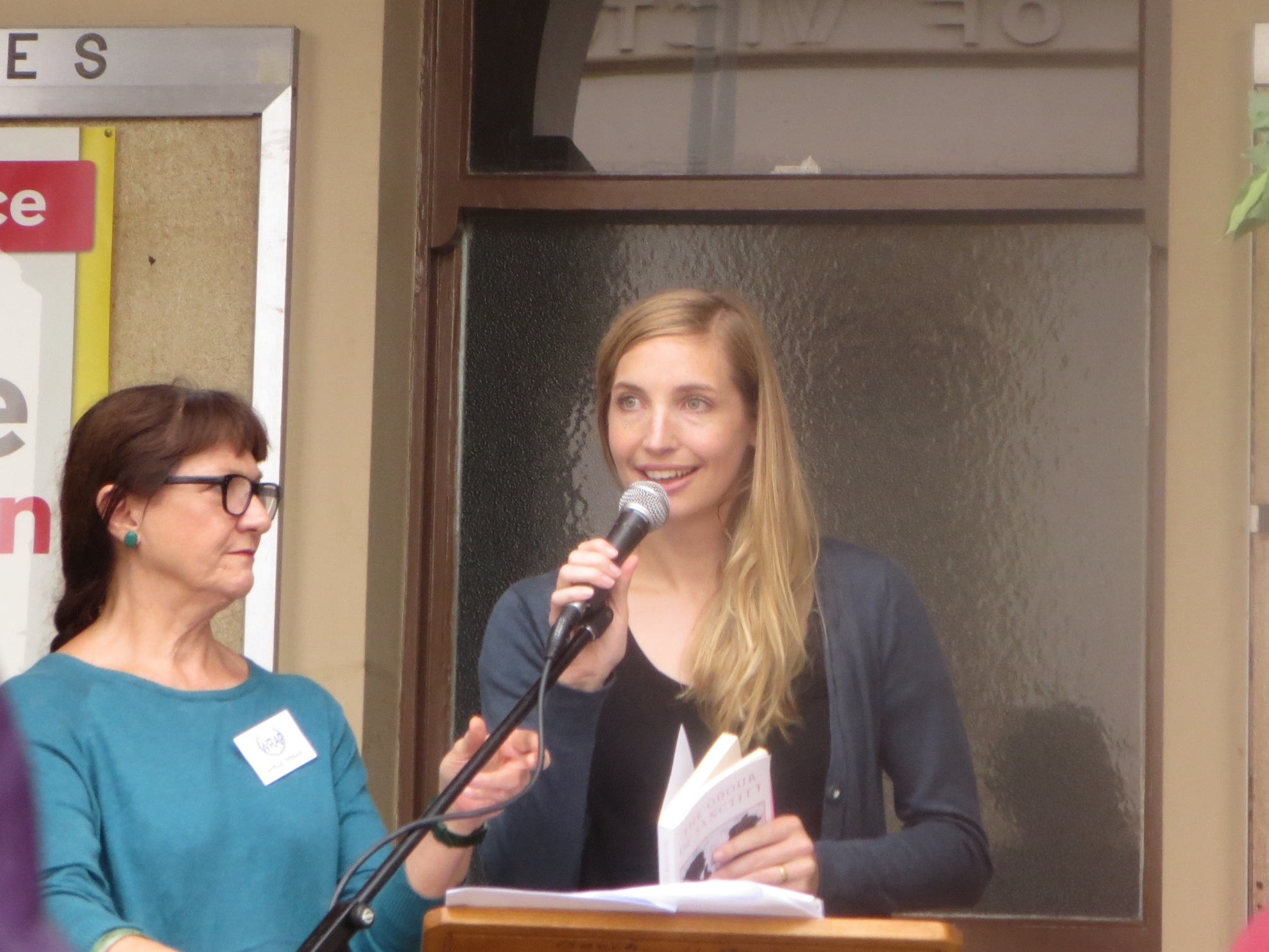
Amy Brown

Amy Brown

Of course, some of us wanted to check it out. I didn’t manage to get to sessions with Tony Birch, author of the Miles Franklin short-listed novel Blood. However, Eric, of Canberra Jazz blog, and I did get along to Poetry at the Post Office where, under umbrellas protecting us from the welcome drizzle, we heard several, mostly local poets read from their work.

They were a varied bunch, some more experienced readers than others, but they all gave us something to think about, from Geoff Galbraith’s political pleas to Lisa Ride’s satires on modern living, from Jean Memery’s tribute to janitors to Amy Brown’s moving poem in the voice of the infant saint Rumwold from her epic poem, The odour of sanctity (published by New Zealand’s Victoria University Press). The odour of sanctity sounds intriguing. She explores “six candidates for sainthood” from the 300s to the 1990s. What a fascinating topic! Anyhow, the session was relaxed, nicely em-ceed by Estelle Paterson, and showed what a local Arts Council can do to support and encourage literature in country towns.

Eric, who juggled note-taking in the rain better than I, has written up the event in more detail on his blog – with photos. Do check it out. Thanks Eric for doing the write up and for standing in the rain with me!