Unbreakable: Conversation with Jelena Dokic

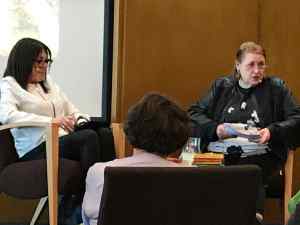
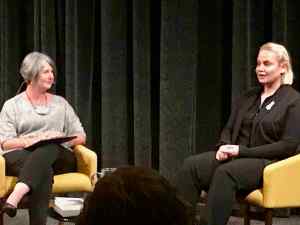
Louise Maher and Jelena Dokic

If you are a fan of professional tennis you will probably have heard of Jelena Dokic who hit the world stage during the 1999 Wimbledon Championships. She was just 16 years old, and, as Wikipedia writes, “achieved one of the biggest upsets in tennis history, beating Martina Hingis 6-2, 6-0. This remains the only time the women’s world No. 1 has ever lost to a qualifier at Wimbledon.” If you were an Australian tennis fan this was very exciting – or should have been. Unfortunately for Croatian-born Dokic, her tennis trajectory was one dogged by controversy, much of it caused by her abusive, controlling father. Her story, which she has documented in her book, Unbreakable, co-written with Jessica Halloran, is a tough one.

An author talk with a sportsperson about a co-written memoir would not necessarily be high priority for me, but if there’s one sport I love, it’s tennis, and Dokic’s story has implications that extend beyond tennis. So, with no competing events on that night, Mr Gums and I decided to go. It was in the form of a conversation between Dokic and local ABC presenter Louise Maher.

Jelena Dokic, Unbreakable

The conversation started with some introductory information. This included that Dokic had reached 4th in the world by the age of 19 years old, and that, due to the Yugoslav wars, she and her family had left Croatia for Serbia when she was 8 years old, and then emigrated to Australia in 1994 when she was 11. By 11 years of age, then, she’d already experienced far more trauma than most her age had experienced. When you add to this the fact that her father – who saw tennis as the opportunity for a good life – started abusing her from the minute he introduced her to tennis when she was 6 years old, you get the picture of a sad and lonely young person. It’s no wonder that the Australian tennis community – fans and players – found it hard to warm to her. No wonder, I say, but that’s no excuse. The failure of duty of care for this young person is clear – and her book has, apparently, got the international tennis world talking.

Now, I’m not going to give a blow-by-blow summary of the conversation, partly because it covered a lot of ground that is covered in the book, as well as in the various stories about her life that you can read on the Internet. Instead, I want to focus on the lessons and messages from the book (well, from what she told us about the book, as I haven’t read it.)

She had a few reasons for writing the book. One was to help others: she hopes by sharing her story, she will increase awareness of abusive parent-child relationships, particularly in sport, and thus help ensure it doesn’t happen to others.

Another reason is a more distressing one, in a way, and that is to enable Australians get to know her better – because the truth is that, due to her father’s abusive control of her, spectators never really got to know her, and as a result, they sometimes gave her a hard time. Some of this was racially or ethnically based – indeed she was told “to go back where you came from” – by several within and without the tennis world. The worst time for her, though, was when her father suddenly withdrew her from Australia, when she was 17 years old, to play for Yugoslavia. Her first major tournament after this was, unfortunately, the Australian Open – and the crowds jeered her. That’s hard enough for any-one, but for a 17-year-old girl who had no say in the matter, who was being abused by her father, it increased her sense of loneliness, of isolation, of having no support.

This issue of having no support is something she repeated several times in the conversation. When Louise Maher pressed her about her mother’s role, Dokic answered that her mother didn’t intervene. She wanted the family to stay together, and trusted her husband knew what he was doing!

Dokic provided various examples of her father’s abusive behaviour towards her, and of her desperation for a little praise that apparently never came (even after significant wins). She finally managed to “escape” home when she was 19-years-old – but life was tough, as she left with nothing, no money, no credit card. This is when, she said, she particularly needed support, but there was none.

I won’t continue, but there are some too-familiar lessons here, particularly the one that I’ll call the “turning a blind-eye syndrome”! There were people, Dokic said, who knew things weren’t right, but they were reluctant to get involved. And the media focussed on her father, enjoying the sensationalism of reporting on his behaviour – “Media thought he was funny, but he wasn’t”, she said. The didn’t pay any attention to what was happening to Dokic, or to the impact of their reporting on her. (I wished, that night, that I’d thought of my question about what she’d have liked the Media to do, before, not after, question-time finished!)

Dokic loved playing tennis, she said, but her father ruined her career. Tennis aficionados will, I’m sure, agree with her. She did look like achieving a come-back in her mid-to-late twenties but injury, illness, and surely the impact of all she’d suffered, meant there wasn’t the fairy-tale ending. Today she does sports commentating, motivational speaking and coaching.

There was a lot lot more – but if you’re interested, read the book!

Meanwhile, there are lessons to be learnt by the media, by spectators, and by tennis organisations about duty of care, particularly when reporting on, watching, or managing young players. What happened to Dokic could not have been completely avoided – its having started at home when she was a beginning 6-year old player – but it should not have gone on for as long as it did if people who knew, or even suspected, things were amiss, did something about it. I do hope this book has the effect that Dokic would like.

(Oh, and sitting next to me at this event was one of the ACT Litbloggers, the lovely Angharad of Tinted Edges. I look forward to seeing her post on it.)

 

Monday musings on Australian literature: Genre Worlds

While reading the GenreCon 2017 twitter feed, which resulted in last week’s Monday Musings, I came across the twitter handle @PopFicDoctors. Intrigued, I checked them out and discovered they are behind a research project and manage the website Genre Worlds: Australian Popular Fiction in the Twenty-first Century. The project is being funded by an ARC (Australian Research Council) Discovery Project Grant, for three years from 2016 to 2018. It involves four academics (the Doctors!) from universities in Queensland, Melbourne and Tasmania. You can read more about them on the site’s Research Team page.

Popular fiction is, they say, “the most significant growth area in Australian trade publishing since the turn of the century” and so their project has been framed “to systematically examine 21st-century Australian popular fiction”. Fascinating. On one level it seems a bit weird to me, with the second decade of the century not even over, to be studying trends in the 21st Century. However, having learnt a lot about Australian popular fiction through my involvement in the Australian Writers Challenge, I can see that the chosen topic – Australian popular fiction – is worth researching. I’ll be intrigued to see what the PopFic Doctors come up with.

They identify their areas of investigation as:

  • the publishing of Australian popular fiction;
  • the interrelationships between Australian popular fiction and Australian genre communities; and
  • the textual distinctiveness of Australian popular novels in relation to genre.

To do this, they will focus on thirty novels in three genres (fantasy, romance and crime) in order to produce “a comprehensive picture of the practices and processes of Australian popular fiction”. (I’d love to see their list but I don’t see it on the website.) The research process involves “detailed examination of trade data, close reading of texts, and interviews with industry figures.” That sounds comprehensive – and, to me, interesting. They have produced a flyer documenting what they achieved in the first year of the project.

GenreWorlds Conference

Now, back to Twitter, I was initially confused about some of their #GCoz tweets because they said they were at “GenreWorlds”. Well, the website explains it. Genre Worlds was a one-day academic conference that was run in association with GenreCon. Its specific areas of interest were: Genre Fiction and New Media, Genre Elements in Play, Industry Developments, Travelling through Time and Space, Genres and Society, and Shaping Genre Fiction.

And so, as I did last week, I’m going to share some of the info I gleaned from that conference’s tweets (#genreworlds17) with the tweeter’s username given in brackets, where not otherwise identified.

Romance fiction

One of the presentations that was popular with tweeters was Dr Sandra Barletta’s on “women of a certain age” in Romance fiction. Claire Parnell tweeted Barletta as saying ‘Romance as a genre for everyone consistently depicts older women as Other’. Other tweets on her paper were:

  • Romance fiction has been at the forefront of acknowledging the importance of diverse representation, but still largely fails to include older women as part of this. (PopFic Doctors)
  • Older women face a double standard in media in regards to fuckability that does not apply to men aka the silver foxes. (Claire Parnell)
  • Romance publishers are starting to seek mature women protagonists … but define mature as 35-45. (Claire Parnell)

So older women are “other” and just 35 to 45 years old! There’s a way to go yet … and Barletta apparently threw out the challenge:

Sandra Barletta’a advice to publishers, writers: Flatter us. Give us something to aspire to be instead of old. Reshape what we see, because what we see matters. Come to the forefront of social change–and make money! (PopFic Doctors)

Other tweets on Romance fiction told me that “Self-published romance has grown substantially from 2010-11 to 2015-16″ (Claire Parnell) and that “Romance far outstrips other genres” (Kate Cuthbert).

And then there was this interesting one about Romance heroes in Harelquin novels versus self-published ones: “@cparnell_c research found Harlequin novels feat. heroes w/ ‘masculine’ jobs – cowboys, officers – and self-pub novels feat heroes w/ wealth-based jobs” (Kate Cuthbert).

Other genres

There were tweets about other genres and sub-genres too. Did you know, for example, that there’s such a thing as Football Fiction? I didn’t, but this tweet informed me: “Representation of female protagonists in YA football fiction is fairly equal. Lee McGowan suggests this is because fiction offers women a place to see themselves in sport when streaming on tv is limited” (Claire Parnell). I think something has been lost in the translation to twitter here, but I’m intrigued that this sub-genre exists.

Jane Rawson, A wrong turn at the office of unmade lists

Disguised Speculative Fiction perhaps?

There was also interest in something called interstitial fiction. Laurie Ormond tweeted “Interstitial fiction (blending literary and genre tropes) has been increasingly visible in the last few years” and Angela Hannah tweeted “Are you reading speculative fiction disguised as literary fiction? Interesting discussion of interstitial fiction”. I’m a bit uncertain about the point being made here regarding “disguise”, but Laurie Ormond, probably reporting on the same presentation, tweeted “Literary works are deploying techniques and tropes of genre fiction to explore climate change”.

And here’s another tweet about the relationship between genre, literary fiction and classification: “Australian noir is closely linked to literary fiction and is not always categorized as noir – Leigh Redhead” (Claire Parnell). Is this implying that Australian noir is/can be disguised as literary fiction?

Oh, and there was also talk of New Adult Fiction, but I don’t have many tweets for that – a topic for another day.

On readers, book clubs and literary fiction

Of course, as a reader, I was particularly interested in tweets about the reading end of the spectrum, and there were a few of these.

It’s so fantastic hearing other academics talking about the significance of book clubs and reader experience. (Caitlin Francis)

A couple of other tweets referred to book clubs and their focus on literary fiction:

  • Vassiliki Veros – ‘literary fiction’ dominates library & online clubs. Q&A: lack of ‘gf book club guides.’ (Lynette Haines)
  • Librarians are cultural gatekeepers, especially when selecting books for book clubs @VaVeros(Beth Driscoll)

I’d love to have heard this presentation by librarian-academic, Veros. My reading group rarely uses book club/reading group guides because we have rarely found the questions relevant to how we discuss books, so it’s interesting to see Haines’ tweet suggesting that the lack of such guides for genre fiction may be one reason for such fiction being less commonly read by reading groups. However, being a librarian, albeit a retired one who didn’t work in this area, I take the point about the gatekeeper role played by librarians. They should be alert to the needs of their readers – that’s their job – but selection is always a juggle.

If there’s one overall thing I’ve gleaned from the tweets, it’s that more will be said about the relationship between genre and literary fiction!

Anyhow, there were other intriguing tweets, including one about genre-tagging by GoodReads’ members, but I think this is enough. I was pleased to read that papers from this Conference will be published in a special edition of Australian Literary Studies. I’ll be looking out for it. You may hear more as a result!

Meanwhile, if you haven’t had enough of genre, I’d love to know if anything here has caught your attention.

Monday musings on Australian literature: GenreCon 2017 by Tweet (#gcoz)

GenreCon 2017 BannerFirst off, no, I didn’t attend this year’s GenreCon which took place this weekend past in Brisbane, Queensland. However, I did see many of the tweets that emanated from attendees (using hashtag #GCoz) and found many of them extending beyond the genre focus. So, I thought I’d pass some on.

Not all tweeters identified the sessions their tweet/s related to, so I’m going to “curate” them under issues that interest me! (I will name the tweeter in brackets after their tweet. Note that the quote marks are for the tweeters’ words, which mostly comprise their summary of what they heard rather than a verbatim quote.)

But, before we get started, I’ll share my favourite tweet. It quotes Garth Nix on being an introvert at conferences:

“I just pretend to be the kind of person who likes to talk to people”. (Aiki Flinthart)

For writers

GenreCon is clearly geared to writers more than readers. Consequently the program included sessions like Writing Through Fear with Anna Campbell and Top Ten Tricks and Traps of Publishing Contracts with Alex Adsett, and discussion panels like What Every Writer Ought to Know about their Book Cover.

Tweeters shared advice on how to work within a “genre”, on the need to “know” your genre and its practitioners, and on what to do when your book is published, but I’ll leave those. You can check the hashtag yourself if you are interested. For readers here I’ve chosen other topics …

Americanising text

This is a controversial issue I’ve discussed with Lisa (ANZLitLovers) recently on her blog when she reported on the AALITRA Symposium. I’m not sure who originated the comment, I’m sharing here, but it makes a point: “Nothing throws someone out of a story like a misplaced thong” (Lynette Haines). Or a rubber! I guess tolerance for “Americanisation” depends on the audience you want to attract.

Book covers

Now this is another issue that can get hackles raised, though this didn’t come through in the GenreCon tweets. However, the point made by Escape Publishing/Harlequin publisher, Kate Cuthbert, is interesting:

“Covers are not about the image, they’re about the emotions they evoke” (Jess Irwin).

Cuthbert also apparently said that “Big W accounts for about 40% of Australian book sales, so if they come back and say they won’t stock a book with that cover, you change the cover” (Josh Melican).

And, most worryingly, Cuthbert said that  “Genre fiction has a representational problem which needs to be addressed. If you put a non-white character on the cover, it doesn’t sell as well. That’s a financial reality, but it’s shit. @katydidinoz [ie Kate Cuthbert] has refused to white-wash covers in the past” (Josh Melican).

Awards

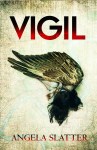
Angela Slatter, VigilAuthor Angela Slatter discussed awards in her plenary address, which she has now posted on her blog. One tweeter wrote: “The talented @AngelaSlatter discusses the ‘award-effect’ (and reminds us that everyone’s trajectory is different and your journey will not be the same” (Tehani Croft). Croft shared Slatter’s slide:

  • Winning an award does NOT make you a better writer
  • Losing an award does NOT make you a worse writer
  • Awards can be useful but your career will NOT die without them

And, just to make sure the point was clear, Slatter also said “Awards garner media attention … on slow news days” (Tansy Rayner Roberts).

The market

A few other points were tweeted about the market besides the Big W figure above. Most came from the literary agent Alex Adsett. She commented on “the energy put into international rights sales by smaller publishers like Text, particularly compared to less active and larger publishers” (PopFic Doctors). I’m certainly aware through overseas bloggers like Kim (Reading Matters) and Guy (His Futile Preoccupations) that Text is active in promoting their books in England and the USA. They are an inspiring publisher.

Adsett also discussed audiobooks, advising that “Authors retaining audiobook rights is becoming a dealbreaker for big publishers over the last 18 months because of how big audiobooks are becoming” (Claire Parnell). PopFic Doctors tweeted that “audiobooks now account for 1% of the market, which is BIG”. One per cent doesn’t sound big to me, but seems it is.

And finally, also from Adsett, is a comment about genre identification: “Many publishers won’t take horror so Alex will pitch as dark fantasy; can genre be spun as literary?” (Rivqa Rafael). Adsett apparently also said that in Australia, writers don’t need an agent, unlike in the USA, but I wonder if authors, on their own, would all know these finer nuances of pitching? As for Rafael’s question regarding whether “genre can be spun as literary”, I’d say yes, but therein hangs a tale for another day I think.

On writing

There were many sessions on the craft of writing, such as writing fight scenes (for women), developing characters, and writing sex and sexuality in the twenty-first century.

American author Delilah Dawson spoke about writing characters: “Delilah Dawson’s cheat sheet of quick ‘charisma points’ for characters: loyalty, wry humour, nice to kids, kind to animals, artistic in some way” (Jess Irwin) and “Delilah Dawson finds out what your characters most want and what they fear most and this feeds into the climax” (Leife Shallcross).

Fiji-born New Zealand writer Nalini Singh’s comment on how to handle hard times in writing was tweeted by many who loved her idea of “squirrels”: “I’m a big fan of having ‘play projects’ aka ‘squirrels’ (you’re working on a hard part in your main project & ‘ooh, squirrel!’) … having these side projects gets you off the treadmill … see where the squirrel leads you … keep it secret to avoid stress.” (Angela Meyer)

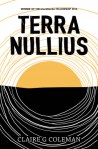
Claire G Coleman, Terra NulliusAnother writer who was frequently tweeted was debut indigenous Australian author, Claire G Coleman (Terra nullius). She clearly had a fresh way of saying things, such as this on inspiration: “A lightning bolt of inspiration is when something in one part of your brain collides with something in another part of your brain and they have babies (Tehani Croft). And this on editing: “Nobody finishes editing. Someone just takes it off you one day” (Narrelle Harris). I can relate to that! I often fiddle with my blog posts long after they’ve been published. Author Emma Viskic also entertained with her comment on editing: “I did kill them, or as I like to say: sent them to the farm to play with other happy words” (Elizabeth McKewin). Love it!

And finally, I liked this one on rules, from the aforementioned Adsett:

“if you’re good enough you can break the rules … but you have to show you know what the rules are” (Tansy Rayner Roberts)

On diversity

Several tweets discussed the issue of diversity. It was clearly a big issue at the conference. There were discussions about Romance fiction, whose popularity is increasing, including more diverse characters. Romance writer Jodi McAlister said that “we’re seeing many more narratives for queer characters beyond the coming out narrative. Queer characters are getting love stories as well as stories about dragons and adventures where it’s not about the character being queer, it’s just who they are” (Claire Parnell). In other words, “You shouldn’t need a reason to include diverse characters…” (Daniel de Lorne)

McAlister also said very pointedly that “Those seen as worthy of love in our love stories tells a lot about what our culture values” (Kali Napier). That’s also worth its own post.

Finally, the issue of how to write these diverse characters came up – relating to that issue we’ve discussed here many times regarding white writers writing black characters. Adsett tweeted Claire G. Coleman’s advice: “Don’t write any diverse character you haven’t had a coffee with, aren’t friends with”.

Creative Native, not an attendee I think, didn’t much like this advice, tweeting: “Plenty of people have ‘had a coffee’ or were friends w[ith] Native, disabled, Bipolar, Autistic, Fat me yet still managed to spout harmful nonsense.” Fair enough. It takes more than one coffee, but I suspect Coleman wasn’t being quite that simple. However, Creative Native did give good advice to writers: “Get a Sensitivity Reader w[ith] the marginalised identity/identites you’re writing about – & deal honestly w[ith] criticism (!!!)”. Which is exactly the approach I’ve come to think best …

Phew, this ended up being way longer than I planned. Hopefully my headings and highlighting have enabled you to pick out what interests you without having to read it all!

Did anything interest you?

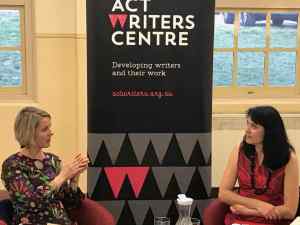
Sofie Laguna in conversation with Karen Viggers

Sofie Laguna and Karen VIggers

Sofie Laguna and Karen Viggers

What a treat it was to witness a conversation between two lively, intelligent Australian women writers in the company of other writers. I mean, as you can see from the post title, Miles-Franklin award-winning author Sofie Laguna and local writer Karen Viggers whose book The lighthousekeeper’s wife has just hit 500,000 copies sold in France!

I must say that I felt a bit like an interloper, given the event was organised by the ACT Writers Centre in their “Developing Writers and their Work” program, but I did enjoy eavesdropping on what writers talk about and want to know!

“I wasn’t ready to win”

The evening started with Sofie (I’m going to use first names) reading from the second chapter of her new book, The choke. Then we got down to business, starting with how Sofie handled her Miles Franklin win for The eye of the sheep (a book which still sits on the pile next to my bed, I’m afraid.) She had a new baby at the time and wasn’t expecting to win. She felt out of her depth. She had no speech prepared, and was suddenly surrounded by media and the press. It was both too much and something you want, she said. However, she felt the prize would be positive for many years to come, and said it made her feel her work was now validated by the literary establishment.

Karen Viggers, The lighthouse keepers wifeKaren then asked her about her experience as a woman in the industry, but Sofie turned this back on Karen – as she did several times during the conversation! Karen, though, was up for the challenge. She commented that she did feel her gender has impacted her career, including such things as the covers of her books.

Sofie agreed that she works in an unfair world, and that women get less attention. She talked about dealing with practical demands of winning the prize and managing a baby. It helps, she said, to trust your instincts. However, “you still have to empty the dishwasher every day”. That got a rueful laugh from many!

“Character IS the plot”

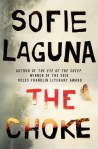
Sofie Laguna, The chokeMany times during the interview, Sofie returned to character. It’s clearly what she writes for, and about.

Karen asked her how she “found” Justine’s voice, the 10-year-old girl living on the Murray with her war-damaged grandfather in The choke. Sofie referred to her training as an actor, and how actors discover that some characters are easier to inhabit than others; she finds young voices easy. Young protagonists, she said, can have a fresh view on the world. Moreover, the more vulnerable voice of child characters frees her to comment on the adult world in a more powerful way.

Sofie then talked about Justine’s Pop. He’s narcissistic. He cares about Justine, albeit not necessarily as he should or could. She admitted that yes, he was another damaged character, but that seeing him that way was too simplistic. Many of us, she said, are damaged in some way. It was clear that she felt there’d been too much focus in interviews on “damage”!

Nonetheless, Karen commented, Sofie did write demanding books, to which Sofie responded that she’d grown up with war-caused loss and damage in her family, something she hadn’t talked about before.

The conversation then returned to Justine, who is dyslexic and generally powerless. Karen asked whether there were ways in which Justine was powerful. Sofie said that while Justine’s in a difficult world, she has the power – can choose – to respond in positive ways. She’s able to form connections. Unlike Pop, she’s not self-absorbed, and can enter other people’s worlds, can empathise. Sofie believes there’s much positivity in the book.

Sofie said that it’s the characters and the tensions between and within them that drive the narrative.

Later, when asked whether her books are character- or plot-driven, whether the plot fits the character or vice versa, she said that character IS the plot.

Place

While character is Sofie’s focus, Karen noted that place is significant in the novel. Sofie described how the Murray River and the Barmah Choke inspired her setting. She said the Murray is brown and gritty which works metaphorically in her story. The choke is where the river becomes narrower. Trees in the choke may look like they’re dying, but they don’t die, they keep growing, which makes a lesson for Justine.

Hope

Sofie believes that hope is important. She quoted a writer’s adage, which is that you want readers thinking:

“I fear she won’t, but I hope she will”

Writing to this tension keeps readers reading. (I love this, and will try to remember it.)

Around here, the issue of writing about disadvantage came up. Sofie said that people living disadvantaged lives often find themselves in self-destructive patterns. And yet, like the women in her book who don’t have much power, they can find ways to survive. However, she said, her subject is the richness of world, not specifically poverty and disadvantage. Her stories would not work if she decided to write about disadvantage. She sees her job as being to endow world with life not to be a spokesperson for marginalisation. Anyhow, privilege doesn’t save people from suicide, crime, etc, she argued.

The writing process

Given that the session’s focus was “developing writers”, Karen concluded by turning to the writing process. A lesser interviewer would have been flummoxed at this point when Sofie responded that she had “no answers for questions about how she does it”. But, of course, she did have answers, and she shared them. She:

  • plunges in with a plan
  • writes millions of drafts
  • doesn’t always write from beginning to end, and sometimes stops when she has more to say which can make it easier to start next sitting
  • has found that, with experience, writing has got faster over the years
  • knows her character’s “soul”, but the rest she gets to know as she writes. She noted that initially she found it hard to differentiate Justine from The eye of the sheep’s Jimmy, but Justine’s character developed as she kept writing
  • prefers one-person to multi-person narratives
  • doesn’t choose to write for a specific audience (i.e. young people or adults) but writes for character, and the audience falls into place
  • likes to have some time and space between books (partly because of the promotion she needs to undertake for the most recent book)

It felt at times that Sofie was discovering more about her book as she discussed it with Karen. Her excitement and Karen’s flexibility in going with it made the conversation fun and engaging. It was one of the liveliest I’ve been to, and we all laughed when Sofie said that she wasn’t like this at the breakfast table! I’m glad I decided to go.

A paradox of empowerment: Kim Scott’s Ray Mathew Lecture

Kim Scott and the whale's eye

Kim Scott and the whale’s eye

Why was Raimond Gaita’s Seymour Biography Lecture booked out, but not Kim Scott’s Ray Mathew Lecture*. Both lectures, held at the National Library of Australia, are endowed by generous benefactors and are free. Don’t get me wrong. I love that Gaita was booked out, but so should double Miles-Franklin-winner Noongar-author Kim Scott have been. His novel, That deadman dance (my review), is a pivotal book in terms of our understanding of first contact and therefore important to reconciliation. I had to see him in person.

Scott’s lecture, titled “A paradox of empowerment”, was described on the National Library page as being about “how reclaiming Aboriginal language and story may offer a narrative of shared history and contribute to social transformation.” And this is exactly what he spoke about, based on his Noongar project.

The evening started with a Welcome to Country by local Ngunnawal elder Tyrone Bell, who explained the tradition behind this practice. It led beautifully into Kim Scott’s talk, which he said was fundamentally about reclaiming Aboriginal language and story.

Looking through a whale's eye

Looking through a whale’s eye

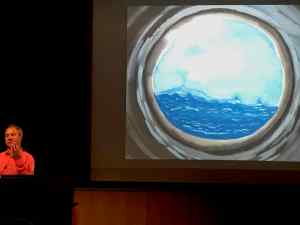
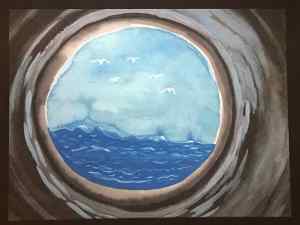
Scott started by explaining the picture on the screen beside him. It’s from a story about a Noongar man entering a whale. He chose it because it represents the idea of seeing things differently. (You could tell he’s a novelist by the way he framed his lecture around imagery to convey his ideas!) For example, is this a porthole? Or are we looking through an eye, or even with the eye, this latter suggesting that the Noongar man has become the whale, has been transformed. This possibility of transformation was the underlying theme of his lecture.

Before he continued though, Scott offered some provisos. He likes, he said, to be particular, to start with the local (which approach also appeals to me). However, he is often criticised, he confided, for being somewhat diffident, hesitant, by which I understood him to mean for not being out there on the political hustings. He’s hesitant, he said for a few reasons:

  • the project – a small community-based language revitalisation project – is insecure. Funding and resources are uncertain, people with the needed knowledge are passing away, and the project is not connected to any institutional infrastructure.
  • it is a regional, provincial activity that may not be relevant elsewhere, although he suspects it is, because the reality is that some of most substantial renaissance work has originated in regional projects.
  • the project produces books – which give status, provide focus, can be used by schools – but books can be accessed widely, which could result in non-Aboriginal people learning the language before its owners do. This would continue the disempowerment the project aims to overturn.

Outside the circle

And here, Scott the novelist turned to again to metaphor. He quoted Governor Phillip who, having been welcomed into Port Jackson by the local people, found their curiosity problematic. He wrote:

‘As their curiosity made them very troublesome when we were preparing our Dinner, I made a circle round us; there was little difficulty in making them understand that they were not to come within it, and they then sat down very quiet.’

Scott used this circle motif as a metaphor for the ongoing exclusion of indigenous people by the settlers. The circle marked a power relationship, an exclusion, that became a defining feature of Aboriginal people’s identity. And yet, he said, researchers like Bill Gammage (The biggest estate on earth) and Tony Swain (A place for strangers) are starting to identify what lay outside this circle – knowledge and skills, an active not passive relationship with the land – that the settlers could have learnt from. This knowledge is still outside the circle, he said.

Noongar language (Daisy Bates)

Noongar language (recorded by Daisy Bates)

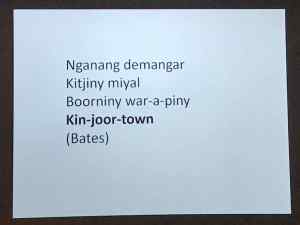
He provided specific examples – many of which he used, in fact, in That deadman dance – of the Noongar’s documented sophisticated, positive response to the first settlers in Western Australia. But still, they were kept outside the circle. He shared, as an example of the Noongar’s open-minded, lively response, a Noongar story recorded by Daisy Bates, which incorporated the name of the new colony’s town, King George Town, into their language.

Changing this circle is, he said, vital to healing. He believes that through projects like his, together with the research of people like Gammage and Swain, things are beginning to change, that Aboriginal culture is starting to be recognised, appreciated, rather than denigrated.

Wirlomin Noongar Language and Stories Project

And so he got to the Wirlomin Noongar Language and Stories Project, a local language revitalisation project that is occurring outside the circle. His argument is that over time, since first contact, Governor Phillip’s original circle expanded, and the world outside it became increasingly impoverished. The Wirlomin language project believes that by recovering language, and the stories that go with it, the circle can be changed.

Proven benefits to social and personal wellbeing emanating from strong attachment to Indigenous cultural traditions. (Kral and Falk 2004, Anderson and Kowal 2012, and others).

He described the project – what it uses, what it produces, and how the knowledge is shared. I won’t detail that here, as you can learn much of it at the website. But I will share his teasing out decisions made, and their political implications. For example, when Kayang (Hazel) Brown took people to a special place in country, told its stories, and then re-covered the marks, her aim was not to practise the same attitude of exclusion, but to establish a protocol of respectful, negotiated relationships for sharing knowledge.

Another example concerned an event the group was organising to present books in language that they’d produced. He said that his view, “as the sophisticated man in the group” was to only invite Noongar, but Aunty Hazel (Kayang Brown) said they should invite some of the local non-Aboriginal people. Scott questioned why, given these people had controlled and spoiled their land, but Kayang responded, regarding one particular person, that “we grew up with him”. So he was invited, was given a copy of the stories, and responded positively, and emotionally. Scott learnt, through this experience, the paradox of empowerment through giving, and what can be achieved by moving into the circle.

All these, he concluded, open up possibilities of healing and transformation, with giving and sharing being the major denominations in the currency of identity and belonging.

This was a wonderful lecture, given by a man who emanated dignity, humility and grace. It was deceptively simple, but the thinking behind it was generous and sophisticated. You had to be there!

Ray Mathew Lecture
National Library of Australia
21 September 2017

* The Ray Mathew Lecture was established in 2009, through The Ray Mathew and Eva Kollsman Trust, created by Eva Kollsman to support and promote Australian writing. The lecture is named for the Australian poet and playwright, Ray Mathew (1929–2002), who left Australia in the late 1960s, and never returned. He spent most of the remainder of his life living in the New York apartment of his patrons, Eva and Paul Kollsman.

Truth, Truthfulness, Self, Voice: Raimond Gaita’s Seymour Biography Lecture

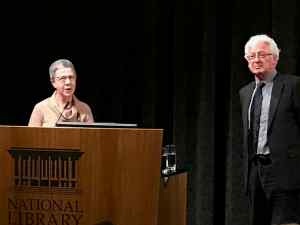
Raimond Gaita and Marie-Louise Ayres

Raimond Gaita and Marie-Louise Ayres, NLA, 2017

This week Mr Gums, Brother Gums and I went to one of the highlights of Canberra’s literary calendar, the Seymour Biography Lecture at the National Library of Australia.  It’s an annual lecture devoted to life-writing, and was endowed by the Seymours in 2005. This is the third one Mr Gums and I have attended, the first in 2015 being given by Robert Drewe, and last year’s by David Marr.

Raimond Gaita is best known to Australians as the author of the award-winning Romulus, my father, which, he informed us, is not-a-biography-nor-an-authobiography. He’s not, he said, a writer like those other Seymour speakers such as David Marr and Robert Dessaix. If we thought he would then go on to expound his theory of biography/autobiography/memoir, as might be expected for a “biography lecture”, we were mistaken, because philosopher Gaita had other plans.

And here is where I come a bit unstuck, because philosophy is not really my thing. I am therefore going to simplify – hopefully sensibly – what was a seriously philosophical argument that I tried to follow while also taking notes. I am going to limit my post to a few points that grabbed me – and that I believe I got right! I must say, though, that even if I didn’t catch all his arguments, I was thrilled to finally see this thoughtful, considered man in person.

“a tragic poem”

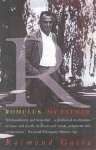
Raimond gaita, Romulus my fatherWhile Gaita didn’t engage, in the expected way anyhow, with the theory of his subject, he didn’t ignore it either. He explained that he doesn’t see Romulus, my father as biography or autobiography because it doesn’t contain “the critical psychological probing” you expect (or, perhaps, that he thinks we expect) in biography. He sees the book, rather, as “tragic poem”, as being about “broken lives” but not “diminished” ones. His described his book as tragedy, which he defined as reflecting “calm pity for the suffering it depicts”.

He wrote it “truthfully” as witness to the values by which his father lived, the father who, he said, gave him his “lifelong moral compass”. He discussed criticisms of his book, those arguments that had he been more ethically critical or more psychologically probing, he would have presented a more understanding picture of his mother. Don’t you love the way people are so ready to criticise what writers don’t do, rather than focus on what they do do? After all, the book is called Romulus, my father! I know, I’m being a bit ingenuous, since writing about his father does necessitate writing about his mother, but I stand by my point nonetheless.

Now, back to Gaita … to explain himself, he quoted Iris Murdoch’s statement that understanding another person is a work of “love, justice, and pity”. However, he said, he was 12 years old when his mother killed herself. He did not know her as an adult, had not conversed with her as an adult. He can, for example, speculate about what his father and his father’s friend Hora might have thought about things, but he didn’t know his mother: she doesn’t have an “individuated presence” for him. He sorrows for his mother (and admits that in writing about her he has put her under “intense scrutiny”) but he knew her only as a boy would.

At this point, he referred to Freud’s describing biography as being “vulnerable to psychological distortions”. Were Christine and Romulus really as he depicted them? Well, not, I understood him to say, in an absolute sense (but yes, he hoped, in his own sense). You ask seven people, he said, to describe a person and you’ll get seven different descriptions. You cannot match/judge these narratives against a single (simple? absolute?) notion that would guarantee “truthfulness” about that person’s life.

Truthfulness, et al

Gaita then went on to say that he is currently writing essays about people who have mattered to him. These essays have to be truthful but they can’t say everything. He hopes, however, that what is left unsaid will not compromise the truthfulness of what is said. He’d like to think that this is a justified hope. I think, in the right hands, it is!

One of his essay subjects is Martin Winkler who taught him German at school, and with whom he maintained contact long thereafter. Winkler is, he said, the wisest man he’s known. Around half of his lecture drew, in fact, from this essay on Winkler. I’m not going to repeat all he that said in detail here, but the essay, from what he shared with us about Winkler’s beliefs and ideas, would be well worth reading when it’s published.

So, just a couple of points. German-born Winkler loved German language and culture, but he was not blind to what Germany did during the war, which “lacerated his soul”. Winkler knew the dangers of following tradition which enables hiding behind respectability and which, in effect, enabled the Holocaust. However, he did not believe this had to diminish his love of Bach, or of German culture. Later in the lecture, Gaita commented that who would have thought that we would be now placing our faith in the Germany of Angela Merkel. (It just goes to show, doesn’t it, that people and/or nations can change. We live in hope!)

Another idea Gaita shared relates to love, ethics and values. For instance, he said, a feeling or emotion such as enthusiasm is ethically neutral, but love is “good”. It, in showing what people love, can be revelatory of value. He quoted Plato’s statement that love never proceeds by force or submits to force. Gaita also shared Winkler’s view that the core of responsibility is to be responsive to the needs of others in the lived context, which I assume means understanding people in terms of their lives rather than via some idea of absolute values.

Around here, if I remember correctly, Gaita returned to Romulus, his father, and in particular to Romulus’ compassion for his wife and her lover, which was evidenced, for example, by his providing financial support for them. Some of Romulus’ friends did not understand this (did not understand his father’s “goodness”). They felt his behaviour – his foolish heart – led him to dishonour himself. In other words, Gaita pointed out, another person would tell a different story about Romulus. So, the question is, was he a good man or a cuckold? There is no ethically neutral ground by which you can weigh the facts of his life to give one right answer or another. (Again, I think I’ve understood his point correctly. At least, what I’ve written makes sense to me, so that’s perhaps good enough!)

(Later, in the single-question Q&A, Gaita elaborated on his ideas of goodness and character. His father’s “goodness”, he said, was completely absent of condescension or superiority, something which many of his compatriots did not see or accept. Gaita, though, believes there should be more of such “goodness” in the world.)

For Gaita, growing up with such a man, seeing such compassion, was a gift. And it’s largely because of this that he did not grow up bitter. To be able to love, he said, is as important as being loved. You can, he said, be morally clear-sighted and at the same time love clear-sightedly. (I like this.)

Around here, we got into a discussion of facts and their meanings. You need, he said, to be truthful about the meaning of facts, which is more important, or relevant, than the facts themselves. (Regular readers here will know how much I liked this idea.) By example, he talked about the final sentences of Romulus, my father and of language choices that can convey different meanings. He could, for example, have written that his father was buried “not very far from” or “close to” or “near” his mother. He eventually chose “close” for its layered meaning – but he worried for a long time about whether the world also conveyed “sentimentality” (which emotion he sees as antithetical to truthful or authentic feeling). In the context, I think he made the right choice.

So, a very different biography lecture to the previous two we’ve attended. But, when you ask a moral philosopher to speak, that is, I suppose, to be expected. In other words, although we got a lecture which did address ideas regarding “truth” in writing about a life, it was also one that extended way beyond this to a discussion of values. My mind was certainly stretched – and is probably the better for it.

Seymour Biography Lecture
National Library of Australia
12 September 2017

Canberra Writers Festival, 2017, Day 2, Pt 3: A panel of millennials

Unfortunately – for me, anyhow – this will be my last post on the Festival, as that cold I hoped (unrealistically) to hold at bay would not be held. Consequently, for both my benefit and that of others, I decided to keep my snivelling self at home on Day 3. I’m very disappointed however, as I was very keen to attend a few events, including one titled Re-imagining Christina Stead. It was a rare session on a “classic” Australian writer and I’d love to have supported it (though hopefully, it didn’t need supporting!) And of course, I wanted to hear what the three panelists had to say.

Griffith Review: the Millennials strike back: Yolande Norris, Cameron Muir, Anna Snoekstra, Frances Flanagan, and Michael Newton

Griffith Review 56

Griffith Review 56

Having last year attended a lively session on the plight of the millennials, I was interested to see another session this year on them – and decided, as a baby-boomer, that I could face another beating! Seriously, though, as a parent of millennials, I am interested in their view of the world, and this session, drawing as it did from the excellent Griffith Review, seemed worth attending.

Convenor Cameron Muir introduced the session by saying that the Griffith Review editor, Julianne Shultz, conceived Millennials strike back edition in lead-up to last year’s Federal election. She wanted not to engage in the generation blame game but simply to give millennials (those born from around 1981 to around 2000) a voice. The issue, like all Griffth Reviews, contains a mix of essays, fiction, poetry and memoir pieces. The panelists all had pieces in the issue:

  • Frances Flanagan (Essay) “A consensus for care”
  • Michael Newton (Essay) “Unpaid opportunities”
  • Yolande Norris (Memoir) “Navigating life in art” (in the online edition only)
  • Anna Snoekstra (Short story) “The view from up here”

Muir then noted that a major theme in the panelists’ pieces (and perhaps in the edition as a whole?) is work, and he asked them to comment. Norris, who contributed a memoir to the edition, talked about the challenge of managing her identity as a mother and as a worker, which is an issue, in fact, that many of us baby-boomers also grappled with. It wasn’t easy then, and it still isn’t now – unfortunately. She wondered what you do when you’ve achieved the “template for life”, house and child/ren.

Newton, whose piece was an essay, talked about the broader structural issues concerning how work is changing. Insecurity (precarity) in work, he said, results in pressure and can engender anxiety, which can breed depression. Millennials in this situation worry about whether to look for another job, whether they can earn a living wage. Why, he asked, are the real structural problems being hidden under arguments about smashed avo and kidadulthood? These arguments dismiss policy concerns of Millennials.

Snoekstra, whose piece is a short story, said that she calls herself a writer in social situations, but in fact she also works as a nanny. She talked about her generation’s concern with buying a house: do they buy a house meaning they can’t go on holidays, have to take a job they don’t like, or do they decide they won’t follow that path?

Flanagan, who like Newton contributed an essay, focused more on the longterm, but also looked back into history, drawing on Hannah Arendt’s division of human activity into three categories: labour, work and action. She suggested this might provide a model for how we view work. She wanted, she said, to meditate on how modern capitalism conceals the action of power. There has been insecure work in past, she said, but there were ways to resolve those, including the introduction of award wages. Today, though, she argues, work precarity is individualised and private. (There are no labour lines, today, for example, just people “waiting for a text message that will signal the prospect of work or its absence.”) Society is no longer offering careers but fragmented work. She then moved onto discussing the kind of work we value – and this is where the title of her essay “A consensus for care” makes sense.

She talked about the cyclical nature of work, writing in her essay:

While our current age is not alone in taking the maintenance of our physical and social spaces for granted, we have certainly given it a twenty-first-century neoliberal spin. Many early childhood educators earn so little that they cannot afford to buy a house or have children of their own, despite significant post-secondary qualifications. Aged carers are paid so poorly they risk poverty. People with jobs in the world of work and action who take time away to care for elderly parents or young children are punished for their ‘choice’, not just once through foregone income but twice as a result of a grotesque superannuation system that magnifies wage gaps in retirement. Through neoliberal goggles, labour is not recognised as the essential foundation for civilisation but rather a cost burden on the public purse that should rightly be turned into a profit-making opportunity. Treasurer Scott Morrison, speaking at the ACOSS National Conference in 2016, said, ‘What I am basically saying is that welfare must become a good deal for investors –for private investors. We have to make it a good deal, for the returns to be there.’

(What can you say to that!) Arendt, she said, would not apply the idea of “returns” to this sort of activity, but to “work” that produces – well – products. Flanagan suggests that we need to look at the kind of society and care we want. She pointed to Norway’s collectivist view of responsibility, and argued that we should put care and education at the heart of our society. We need to look at values, rather than costs, and look back for values to the mid-twentieth century and earlier rather than to the last 30 or 40 years. In other words, rather than to the time during which I spent my working life. Oh, how I remember the dispiriting slide into measuring and costing things which cannot and/or should not be costed. Things like, for example, the cultural collections in our museums, archives and libraries. We saw it happening but felt powerless to change it.

And so the discussion continued, teasing out issues regarding mental health (captured chillingly, said Flanagan, in Snoekstra’s story), the separation of public and private life (in that Millennials seem very public, sharing all, but their worries are private), the need to develop support networks for work, the prevalence of toxic attitudes online particularly from disgruntled men.

On this issue of disgruntled men, Newton commented in the past men assumed they would find a partner without too much effort, but that this is not the same for the current generation of young men which can build resentment. He also noted that the hollowing out of work in manufacturing, caused largely by automation, leaves men having to consider care work. However, they don’t value this “feminised work” so, he said, the whole idea of “work” needs to be rethought.

Muir concluded by asking them what they would say to the next generation:

  • Norris said this was tricky because projections are impossible, but developing and maintaining connections is important.
  • Flanagan said that she would argue that technology is just a tool, and that there are still questions about power. She suggested people should learn from mentors and mentor in turn.
  • Newton started, laughingly, by saying he recently had to explain the significance of Princess Di to his younger work colleagues. Seriously, though, he’d want to say that work is not an end in itself, but that they should look at values.
  • Snoekstra said that she was thinking of writing YA books, and was advised to write short books, with action at beginning, due to shortened attention spans, but then discovered that 12-14 year old girls are reading Nancy Drew!

Q&A

Could unions help? For baby-boomers they facilitated collective bargaining, and gave a sense of empowerment. Flanagan said that Australia has the worst anti-trade union laws in the democratic world. She works for United Voice, a large trade union, and said they need to use social networks to deal with mass desegregation of workforce.

Is the Universal Base Income a workable solution? It was agreed that carers should be remunerated, and the small surveys done to date does not show that it reduces the desire to find other work.

What are the implications of the drive to project yourself, that if it’s not on Facebook, it didn’t happen, that “it’s not ok to be not ok”. Norris felt that there is some pushback to this now, that people are becoming willing to show cracks. Flanagan said that for us to mature we need to create a caring society.

The commentary about housing focuses on Sydney and Melbourne but what about growing regional areas where housing can be cheaper. Is a trend happening? Our panelists generally thought there was, although some of the “trendy” places are quickly becoming expensive or built out. And, Australia is probably likely to remain a largely urbanised, centralised nation.

And there ended, somewhat over time, an excellent session that did not generation blame but that attempted instead to identify the issues and find solutions.

Canberra Writers Festival, 2017, Day 2, Pt 2: Two book launches

At last year’s festival, I attended a few excellent book launches, and so decided to do so again. Authors need all the support they can get after all.

Book launch: Ian Burnet: Where Australia collides with Asia

Burnet and Burdon

Burnet and Burdon

The first of today’s two launches was for a book with a very long title, by geologist Ian Burnet. It’s Where Australia collides with Asia: The epic voyages of Joseph Banks, Charles Darwin, Alfred Russel Wallace and the origin of the Origin of species. I haven’t heard of Burnet before, though he’s written a few books, and nor have I heard of the publisher, Rosenburg Publishing who produce “a small non-fiction list, concentrating mainly on history and natural history.”

So, that was interesting for a start. The book was launched by Sally Burdon of the Asia Bookroom here in Canberra.

I couldn’t possibly share all the information Burnet imparted to us about the four voyages he covers in the book. A lot of it is well-known, so well-known in fact that Burnet had been wanting to write about Alfred Russel Wallace, his hero, for a long time, but he couldn’t find an angle to make it worthwhile. The thing is that I didn’t know who this Wallace was.

The publisher’s website explains his importance. Wallace

realized that the Lombok Strait in Indonesia represents the biogeographical boundary between the fauna of Asia and those of Australasia. On the Asian side are elephants, tigers, primates and specific birds. On the Australasian side are marsupials such as the possum-like cuscus and the Aru wallaby, as well as birds specific to Australia such as white cockatoos, brush turkeys and the spectacular Birds of Paradise. It was tectonic plate movement that brought these disparate worlds together and it was Alfred Russel Wallace’s ‘Letter from Ternate’ that forced Charles Darwin to finally publish his landmark work On the Origin of Species.

This strait is apparently well-known in certain circles as The Wallace Line.

Burnet explained that the aha moment came when he was sailing in the strait and saw melaleucas, one of the unique species that supports Wallace and Darwin’s theory. He realised that this Australian connection was the story he could tell. (He found some other Australian connections, too, including Darwin’s contemplating his ideas about the origin of the species on the banks of Cox River, and the role of ornithologist John Gould in identifying adaptation in finches.)

An interesting point he made – one relevant to my write-up of the historical fiction session yesterday, even though this is non-fiction – is that it was the easiest book to research. Essentially all the critical documents he needed – letters, diaries etc by the main players – are digitised and available online. Way to go librarians and curators!

It was a lovely launch, and I learnt some things I hadn’t known before, which is always a plus.

Book launch: Stephanie Buckle: Habits of silence

I had identified this launch as one I wanted to attend, partly because the book is by a local author but even more because publisher Finlay Lloyd has sent me a copy of the book to review. Julian Davies, Finlay Lloyd publisher, introduced John Clanchy, whose gorgeous short story collection, Six, I’ve reviewed and who works with Finlay Lloyd as a manuscript assessor and editor.

Clanchy did a grand job of launching Buckle’s debut short story collection, Habits of silence. He explained that he met Buckle 10 years ago in a writers’ group, and talked about her achievements: some of the fourteen stories in this collection have been published before, have won prizes, and/or have been in editions of Best Australian stories. In other words, he said, she’s a writer with some cred (though he didn’t use that word.) She has worked at her craft, he said, even rewriting some prizewinning stories for this publication. (Interestingly, in a throwaway line, he mentioned that she has written a novel about the Canberra fires, From the ashes, but I don’t believe it’s been published as this is her debut book.)

Anyhow, Clanchy then discussed the book itself. He talked about the relevance of the low-light, empty urban streetscape on the cover, and said that it and the recurrence of words like “silence” and “wordless” provide a clue to the content. And this, he suggested, revolves around communication, about how it can break down, about the positive and negative impacts of silence. Silence, he said, can be positive, but with Buckle, things don’t stay the same, and smooth waters can turn turbulent.

Silence can be voluntary or involuntary. Two stories are about a stroke, which forces involuntary silence. He read an excerpt from one of these stroke stories. And then read from the second story in the book, “sex and money”, which is about voluntary silence, about silence being used aggressively by a wife who is not receiving the love and attention she desires. Both readings showed a gorgeous insight into human nature, and an ability to present it economically, as you’d expect in a short story.

Davies then returned to introduce Buckle. He reiterated her willingness to work on stories, suggesting this is partly a salute to being older, to the associated ability and willingness to produce stories of psychological subtlety. He then introduced Buckle to the podium.

Buckle said that the book was a long time coming, and that she never thought her first book would be a short story collection, given their general unpopularity. (Thank goodness for small publishers like Finlay Lloyd who take risks on unusual or less popular forms.) However, she loves short stories she said, particularly those of 2,500 to 3,000 words. You can’t hide in short story, and you can tease out a single idea. But, addressing the comment about her working on her stories, she said the hard thing is to know when to stop! I guess most writers – even bloggers – understand that!

She then read from two of her stories, from “us and them” which is set in a 1970s psychiatric hospital, and “the man on a path” which is about an older woman, widowed and lonely, going on holiday to a place she used to go with her husband. As she walks, all she sees are couples, until she sees a man alone walking towards her. The excerpt she read about what happens next was tantalising.

I so look forward to reading this book – but it will be a little while before it reaches the top of the pile.

Canberra Writers Festival 2017, Day 2, Pt 1: A conversation with Tony Jones

Choices, choices. Such a surfeit of riches across such dispersed venues made today a difficult one. In the end I had to make the tough decision to not see Jane Rawson, whose session was across the lake, though it broke my heart. My decision was made harder by the fact that as I was drafting this intro over my lunch break, a tweet came through promoting the event. Wah, but I’m trying to keep a cold at bay so being sensible about rushing around was the way to go.

But now, I’m going to have to try to emulate those historical fiction writers who need to leave out much of their research, otherwise I’ll be here all night – and I have things to do, books to read. Even so, I’m going to break this post into three parts.

Crime: Tony Jones with Krysia Kitch

Kitch and Jones

Kitch and Jones

Writers can’t always avoid controversy, particularly if they are political journalists, and so it was for Tony Jones who was attending the festival to discuss his new book, Twentieth man. Outside the venue was a small group of protesters holding a placard that said “Phony Tony, Propaganda through Plagiarism”. They believe the book is anti-Croatian, and that it plagiarises, writes Ina Vukic on her blog, “a Yugoslav era work of Propaganda titled Dvadeseti čovjek (the Twentieth Man) written by Đorđe Ličina”. I can’t comment on the propaganda aspect, because I haven’t read the book, but in his talk Jones mentioned that there has been speculation that there was a twelfth man in the Bugojno group which carried out an attack in Yugoslavia in 1972. So he decided to create a fictional twelfth man who survived the attack. And that’s all I’ll say about the protest, which Jones referred to a couple of times during the conversation.

Twentieth man is Jones fictional debut, and the first question turned on a favourite topic of mine, genre. Well it’s not that I love “genre” per se but I do enjoy discussions about definitions because they can help us tease out expectations. The question was, is this crime (as it was described for the Festival) or political thriller? Jones skirted answering this decisively by saying that it’s thrilling, it has crimes and it’s about politics! Fair enough. As the conversation progressed, I decided a third genre (or, perhaps, sub-genre) could be considered, historical crime! (Though again that raises the spectre from yesterday’s session about when is “history”.)

We’ll return to history later, but first something about the plot. It starts with the bombing of two Yugoslav Travel Agencies in Sydney in 1972 and ends with an assassination attempt on the Yugoslav prime minister. (Jones told us this so I don’t think it’s a spoiler!) Jones spent some time talking about the inspiration for the novel, at the same time giving us a refresher on fairly recent Australian political history.

Convenor Kitch from the National Portrait Gallery then referred to the Festival’s theme of Power, Politics, Passion and asked Jones what he thought about the power of the past over the present. Jones responded by referring to a quote often attributed to Mark Twain that:

“History doesn’t repeat itself but it often rhymes.”

He then talked more about the historical background to the novel, and about subsequent reporting and actions through the 1980s, 1990s and into the present, which prove that “history resonates again and again, it rhymes”.

Kitch mentioned how the shift of power between individuals is a major part of book. She said she loved his visceral descriptions of fear, and asked how he did it. Jones flippantly responded that he works at the ABC, but then, more seriously, said that he used his imagination … and that he could draw on some tricky situations he’d been in as a journalist.

This led to more conversation about the process of writing, such as his decision to mix “real” people with fictional ones. After all, he said, Tolstoy did it! He said he likes novels which deal with real history and fictional characters, and named James Ellroy’s novel on the Kennedy assassination, American tabloid, and Marlon James’ Booker prize-winning A brief history of seven killings exploring the assassination attempt on Bob Marley.

He also talked about researching and using documentary evidence to support his story, saying that the novel is fictional (of course) “but as close to real” as he could get. He’s not claiming it’s history but hopes it will encourage its readers to “reflect on the past”.

Kitch asked him about pacing – including the role of the moments of solitude for the characters – and also about his use of landscape to support his themes and characterisation.

Jones also mentioned the role of respected Australian publisher and editor Richard Walsh who offered to look over his manuscript. He told Jones there were two or more books there. So, folks, there will be a sequel!

There was so much more but this is getting long and I’ve covered the main issues I wanted to. There was discussion about the passion part of the Festival’s theme. First, Jones is clearly passionate about the topic. But, also, there’s a Romeo and Juliet style love story between the young Jewish journalist and the Croation hero/antihero.

Finally, Jones talked about the role of Canberra in the book, saying the city is “the star of this novel”. He thinks it provides a good picture of Canberra and its inhabitants at the time it is set. This was a blatant pitch to the locals as, he admitted, he’d been told to do!

There were some intelligent questions, but really, I must finish here, and will do so on Jones’ final words that Twentieth man is “a novel, largely a work of imagination but based on real events”.

Canberra Writers Festival 2017, Day 1: A panel and a conversation

It’s on again – the newly revamped Canberra Writers Festival, I mean. Due to a family commitment in Melbourne, from which I only returned at midday today, I didn’t get to some of the first day’s prime events. I missed, for example, a conversation with Graeme Simsion. I also missed a wonderful sounding panel titled Women in the Media, featuring Kathy Lette, Katherine Murphy, Virginia Haussegger.

The Festival’s theme – fitting for the nation’s capital – is Power, Politics, Passion, but my sessions today were more traditional writers festival fare.

Grasping the past: Tracy Chevalier, Amy Gottlieb and Rachel Seiffert in conversation with Gillian Polack

CWF, Polcak, Gottleib, Chevalier, Seiffert

From left: Polack, Gottleib, Chevalier, Seiffert

I chose this session because these writers interest me, as did the topic, historical fiction, which was one of the themes running through last year’s festival.

For those of you who don’t know the panelists, they were:

  • Gillian Polack (convenor): an historian and speculative fiction writer.
  • Amy Gottlieb: novelist and poet, whose debut novel, The beautiful possible, was published in February 2016.
  • Tracy Chevalier: novelist, most famous for The girl with the pearl earring but who has written 9 novels including Remarkable creatures which I’ve reviewed.
  • Rachel Seiffert: novelist, the daughter of an Australian-born father and German mother. She’s published three novels, of which the first, The dark room, was shortlisted for the Booker Prize.

What was excellent about this session is that it didn’t traverse the common issue of plausibility and authenticity. Instead, our jetlagged convenor wanted them to talk about how they transform their research into fiction. She was interested more in the process. It took a little while to get there but the discussion along the way was enjoyable anyhow!

A couple of issues were toyed with as the panelists grappled with the question. One of these related to the label itself. Gottleib, for example, said she didn’t see herself as an historical fiction novelist. It was the marketing people who labelled her book as such – because of its historical setting. Chevalier raised the issue of definition. When is a setting historical, she asked? Is her novel set in the mid 1970s historical? Seiffert agreed with Gottleib regarding the marketers applying the label, and suggested that historical fiction is seen as “more serious”. That intrigued my friend and me – and was immediately picked up by Chevalier who said that in England historical fiction tends to be seen as genre, and in opposition to serious literary fiction!

What came though strongly throughout the discussion is that these writers do not necessarily see themselves as historical fiction writers but simply as writers!

Meanwhile, Polack returned to her question regarding transforming historical research to fiction, by asking a more specific question regarding how they get their food research into their novels. This resulted in a detailed response from Chevalier who talked about her research process. She said that she can’t write about a period until she knows what people eat, how they eat, when they eat, what they sat on to eat, and so on. In other words, she needs to know what her characters would do on a day-to-day basis. And, here’s the challenge! She has to know this detail to create her period but she can’t tell it all in her novel. This is, as she clearly knows, one of the major criticisms levelled at historical fiction writers, i.e., that they can’t resist including their research, whether or not it’s not critical to the story.

Gottleib, though, starts with character. She knows the story – for example her character was going to leave Nazi Germany, travel to India, and then move to America. Once she knows this, she has to apply the scaffolding – to find out how he made this journey. This requires research. Seiffert, on the other hand, starts with the story first, being inspired, for example, by case studies and essays of people who resisted the Nazis.

Polack then asked the panel how they can do that thing that historians can’t, namely they can bring back erased people from past (such as women or servants), they can right wrongs or address flaws in past. How do they do this she asked?

Gottleib reiterated her interest in character, in their motivations, dreams, and longings. The history for her comes later. Chevalier referred to the book she made her name on – The girl with a pearl earring. She said she likes making things up, so she goes for the gaps – in the “real” story – and tries to fill them in. She likes to give voice to others, to their interior or emotional life. She is not about truth and facts, she said but about the emotional truth of the times. Seiffert referred to Kate Grenville’s The secret river and her feeling the need to write Searching for The secret river. It was as though she’d felt she’d “committed the sin of writing historical fiction” which is clearly something Seiffert felt she didn’t need to do.

Chevalier commented at this point that she has a huge respect for historians; she relies on them.

Polack then moved onto the thorny issue of avoiding cultural and historical bias when writing about a time different from their own. Chevalier said she was always on the look out for 21st century attitudes in her characters. She had to remember in Girl that a 17th century maid would have no feelings of social or economic empowerment.

Seiffert, who has written two books about the Third Reich, took this a bit further explaining that her character in A boy in winter doesn’t know the Holocaust is proceeding but the readers do. She had to fight that, showing that he had to make choices not knowing the full story, while the readers do know. You need, in other words, not to give characters foreknowledge.

Gottleib said that she handles this issue by having a narrator. She said that Latin-American fiction and Gabriel Garcia Marquez  got her into writing fiction, because she loved his multiple layering of stories. The narrator is her “out” of this mire.

This led Polack to raise the issue of their narratorial choices – past versus present tense, and 1st, 2nd or 3rd person. These are the most important things a writer must choose, said Chevalier. If they get it right, readers don’t notice. She started writing in first person, because she found it easier, but she said that the ability to handle third person is the sign of a more mature writer!

Seiffert said she wrote two historical novels using the present tense, because she wanted to situate reader in the time of the novel. The most interesting thing, she said, is that even when you don’t act there is a consequence.

Polack asked then about how fiction writers set up a conversation with history. Gottleib said her novel revealed a conversation, and that it turned out to be different to the one she thought she was having. Chevalier said that writing historical fiction can set up “an alchemy or magic that is hard to explain”.

Q&A

There were a couple of questions from the audience but I’ll just share the one concerning whether they have start with ideas they want to explore or whether the themes appear more serendipitously. Gottleib said that yes, hers is a novel of ideas but that she had to work to ensure the ideas didn’t overwhelm the characters. Seiffert said she has done this, as has Chevalier, but she said you have to avoid preaching.

Overall, this was an interesting discussion which explored historical fiction more from the practitioner’s end than from the reader’s response aspect, as I’ve often seen.

COMMENT: My friend and I did discuss the “cultural and historical bias” issue a little. We believe that there have always been iconoclastic thinkers. The challenge for the author, when creating these, is to know they are doing so and be able to justify it.

Authors and agents: Linda Tate and Valerie Parv

Linda Tate and Valerie Parv

From left: Linda Tate and Valerie Parv

I’m not a professional writer, and so don’t plan to employ an agent, but I chose this session – a conversation between author Valerie Parv and her agent Linda Tate – because I am interested in the business of writing, in how writers manage the bigger picture.

It was a very nicely presented session. Tate and Parv clearly know each other well and work well together, but beyond that, it was clear that they’d work-shopped their session so it flowed easily, and informatively without feeling artificial.

I’m not going to summarise it in depth, but will say that they focused on the role of an agent, arguing that the point is not how you publish – indie or traditional, through apps like Radish, or by repackaging older works, and so on  – but that you publish. Agents can help with the publishing aspect of writing. They can help with other business aspects too, such as managing the writer’s diary, ensuring s/he isn’t taken advantage of. They can also free up the writer’s time to do what writers do best – which is write.

One thing writers do need to do, though, they argued is to have a social media presence, and to have such a presence BEFORE they offer a manuscript for publication. Publishers want to know what the writer can offer, above the actual work, because it is these extras which can often sway a publisher. A writer needs a brand, needs to know what s/he wants to be known for, what his or her niche is.

They also warned about contracts, including the importance of IP. Their advice regarding contracts was always consider the worst case, and not to sign anything they can’t live with in the worst case.

This was all teased out with examples, but in the end this was the message – the writer writes, the manager handles the business. As was the point that, no matter how well agent and writer get on, it is a business relationship. The agent can only work for a writer if it’s commercially worthwhile for the agent (obviously!)

Oh, and they gave a lovely plug to the ACT Writers Centre which they described as one of the most pro-active in the country! Nice eh.

A worthwhile session – even for amateur me – although I did notice that there was no discussion of the payment aspect of the relationship.