Meeting Biff Ward

WardMotherAllenUnwinIn her comment on my review of Biff Ward’s beautiful memoir, In my mother’s hands, in which I mentioned that Biff had been present at my reading group, Stefanie (So Many Books) asked if I planned to post specifically about Biff’s presence. While I don’t always do this when authors visit my group – Biff was our sixth author in our 27 years – I did do so for Marion Halligan and Alan Gould. Since our discussion covered a lot of ground that I didn’t include in my review, I figured that this was one of those visits to write up …

The writing process

The most common questions readers ask authors tend to relate to why and how they wrote the book in question. We were no different. And really, I think such questions can be good ice-breakers because “how did you come to write your book” is surely a question most authors can answer without too much angst? For Biff, the answer was quite complex. She said that her father, and others, always assumed that she would write his biography, but she wasn’t interested in biography … and so … WardFatherDaughterGrove
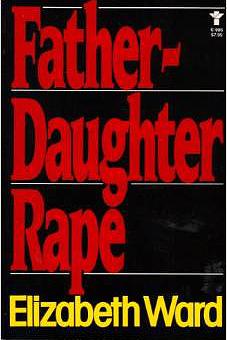
Biff had, she said, been writing for 40 years or more. Her first book was the ground-breaking Father-daughter rape*, published by The Women’s Press in London in 1985. One of our reading group members, a psychotherapist, knows the book and said it is still referred to for its discussion of child sexual abuse. Biff, quite rightly, seemed rather chuffed at this news!

The memoir, though, was written over 15-20 years – in bits and pieces. The first “bit” she wrote was a reminiscence of her mother’s in which she remembered hearing of the assassination of the Romanovs. Uncertain about where Russia was, she asked her father who vaguely said, gesturing, “over there”. For her mother “over there” meant “out of sight beyond the horse paddock”. It’s a lovely anecdote shared between mother and daughter, but it has deeper resonances in terms of her mother’s life, and Biff included it pretty much untouched in the final memoir.

Biff said that she started writing more on the memoir as she transitioned to retirement, but work on it intensified after she attended a writing retreat in Byron Bay in 2009. By the time she presented it to her publisher, Richard Walsh, it was 105,000 words, but it was gradually whittled down to the final 70,000 words. We wondered whether she could publish some good short stories from the bits edited out.

We aren’t, I guess, a very original group because another question we asked is a common one: how did you choose the title? Biff responded that she brainstormed it with her writing group. Her original title had been  Alison, for her parents’ first child who had died at 4 months, but then, through brainstorming, it was decided that the title should refer to her mother. The final challenge was whether to go with At her mother’s hands or In her mother’s hands. We agreed that “In” is better. It feels more inclusive, and less aggressive.

We also talked a little about the sources of her information, but I mentioned some of those in my review. I was intrigued by a reference in the book to how a lover washing her hair brought back childhood memories of her mother washing her hair. It made me wonder what memories don’t come back and the implication of almost serendipitous memory-joggers like this on the final story. I loved Biff’s answer that the “memoir” form is more forgiving than “autobiography”. It is, after all, about memories, so what you do and don’t remember, for whatever reason, is essentially what it’s about.

Writing (and reading) as therapy

If you’ve read the book, or my review, you’ll know that the underlying story concerns mental illness. You won’t be surprised then to hear that the book brought out some painful (but valuable) sharing. It was truly special that we all, including the “stranger” in our midst, felt safe enough to do this – and for that reason, obviously, what was shared in the room will stay there. I can say though that it also brought up the idea of writing as therapy. Biff believes that writing for therapy is valuable – but in journals and diaries, not in published books.

Related to this theme, we asked whether writing the memoir was a painful or traumatic experience but, as Biff mentions in the book, she had undergone extensive psychotherapy so had, she said, worked her emotions through before she came to write the book. We also asked her whether she was angry about her childhood, but she said she was more sad than angry. She said, thinking of her father, that partners can suffer more than children. That’s a generous response I think – but then this is a generous book.

We also talked a little about the way the family had hidden its problems, but we could all relate to the fact that people are generally anxious to say “I’m fine”. People don’t, as Biff discusses in her book, have the words, the language, to express difficult things. Biff did refer, though, to the moment in the book when she and her father had finally been able to talk about “the terribleness” they had experienced. An “odd word” she wrote in the book but it was lovely, she told us, to have been able to be honest about their experiences. Biff’s father had his failings, about which she’s clear in the book, but he was she said “a deeply moral man” and late in his life regretted his less admirable behaviours.

Our reactions

As you will have gathered we all enjoyed the book and deeply appreciated having Biff present for our discussion. We shared our various reactions – profoundly moving, harrowing, kind, a stimulus to remembering our own childhoods, and the like. One member used the word “endearing” for Biff’s portrait of her father, for the way she showed her love for her father while writing “all sides” of him. Biff said she enjoyed finding the words to describe him.

A point that intrigued us was the fact that a country university, the University of New England (UNE), had employed a “communist” academic who had been rejected by the major city universities. Biff told us that UNE had quite a reputation for employing “all the Reds that no-one wanted”! We all loved this.

Near the end of the evening, Biff unveiled the “show-and-tell” she’d brought. It was a beautiful, sensitive portrait of her mother painted when she was in her late 20s. A cropped black-and-white version is in the book (p. 62) but to see the original full version in colour was, well, special. But then again, it was just one more special thing in an evening that was very special.

* Lest you be concerned, this book is not about Biff and her father – there’s no such sexual abuse in the memoir – but about her later research into child sexual abuse after meeting two young abused girls in a women’s refuge.

Talking with Alan Gould

Joseph Conrad
Conrad, 1904, a favourite writer for Gould (Photo: George Charles Beresford, Presumed Public Domain, via Wikipedia)

I didn’t say in my recent review of Alan Gould‘s The lakewoman that Gould attended my reading group’s discussion of his book. I had so much to say – so many thoughts – about the book, that I thought I’d save a report on his comments for another post, so here goes … but first …

Becky of PageTurners wrote a post recently on the impact of having an author attend a reading group discussion of his/her book. She suggested that it can be hard for group members to be honest when the author is present. That’s true of course. Few of us are willing to “attack” an author face to face, particularly when we see what heart (not to mention sheer sweat) has gone into writing the book under discussion. Fortunately, being honest didn’t seem to be a big issue in my reading group’s discussion with Alan Gould. Some found it slow at the start, and some asked him about the resolution, but all seemed to have enjoyed the book and his writing as a whole. For me, having an author present can add benefits that outweigh this honesty concern. See what you think from this report of our meeting with an author, because Gould, like Halligan when she joined us for her book, was articulate and generous in sharing his ideas with us.

Gould on his influences

  • Joseph Conrad (and, before him, Emily Bronte), who taught him about timing, something Gould plays particular attention to in his writing. I particularly liked the timing and pacing in The lakewoman, but I wrote a little about that in my review so won’t go on about it here.
  • Thomas Hardy, who uses coincidence, arguing that it’s coincidence that makes a story a story, if you know what I mean. Gould did say though that Hardy tended to use coincidence in a realist setting, whereas for him coincidence helped create the sense of magic or enchantment. He said his aim was to use coincidence in a way that would be psychologically or practically plausible but that also added a sense of mystery. One of the things I enjoyed about the novel was its somewhat mystical tone – the sense that things were occurring on a slightly “higher” plane than pure logic.
  • Shakespeare, who taught him that the key to writing a novel is to quickly establish “the calibre of the character’s intelligence”, that is what makes that character tick, what his/her mind is like. He gave Iago as an example and explained how Shakespeare establishes early on “who” Iago is. This is certainly what Gould does with Alec Dearborn in the novel. We get into his head quite early and gain a clear understanding of what sort of person he is and why he might be open to Viva’s influence.
  • Roger McDonald, an Australian novelist, who encouraged him to try writing a novel (instead of poetry) by saying that “a novel begins with a sentence”. Gould then talked about a few of his books and how this idea works for him. This first sentence, he said, does not always end up being the first sentence of the book but it is the kernel that gets him going.

Gould on writing novels versus poetry

Gould started as a poet and now writes both. He told us that he writes them alternately, that he can’t write poetry and a novel concurrently, because it’s like “changing from an art form tilted to music to one tilted to history”. He further explained this as being related to “time”. Poetry is a case of “and now and now and now” while novels are more “and then and then and then”. I’d love to hear what you think of this. I found it an interesting concept, though my first reaction was to think “but…” And yet I think I see his point, at least in general terms because of course there are always exceptions. Poetry is, I suppose, often about capturing a moment, while a novel does usually cover a period of time with at least some elements of cause-and-effect (even those novels, like Virginia Woolf‘s Mrs Dalloway or McEwan’s Saturday that take place in a day).

Gould on The lakewoman

And of course, he talked about the book, in particular. It was inspired he said by the poet David Campbell, though Alec Dearborn is not Campbell. Rather, it is Campbell’s combination of physicality (he, like Dearborn, was a rugby player) and “a lyric sensibility” that Gould tried (successfully I think) to capture.

He also wanted to write a “romance” in the old sense of the word. He defines this as being about a hero on a quest, who thinks he knows what he’s about until he meets someone who shakes up this idea. Viva is this catalyst for Alec. She is an utterly practical woman – something we see played out through the novel from the way she saves Alec from drowning at the beginning to how she plans to conceive a child towards the end – and yet she has an aura of enchantment, starting from that first moment when she appears by the lake as he lands from the sky!

He said a lot more – particularly about some of the images and motifs he used in the novel – but I’ve probably written enough, so I’ll just share his answer to my last question, which was about his favourite contemporary writers. After prevaricating a bit on the definition of contemporary, he named the following Australian writers and books: Inga Clendinnen (not a novelist), Helen Hodgman’s Blue skies, Shirley Hazzard’s Transit of Venus, Kate Jennings’ Snake, Christina Stead’s For love alone, Randolph Stow, and Tim Winton’s Cloudstreet. No wonder I enjoyed his novel, he has great taste.

Literary encounters, Australian style

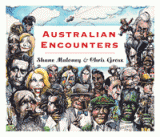
I’ve been remiss. I could have solved some of your Christmas shopping challenges by telling you about two books which would be perfect gifts for readers: Shane Maloney and Chris Grosz’s Australian encounters, and Susannah Fullerton’s Brief encounters. Both have “encounters” in the title, but they use the word in slightly different ways, as you’ll see when you read on …

Australian encounters book cover

Book cover (Image: Courtesy Black Inc)

Maloney and Grosz’s book is the more light-hearted of the two, and just right for the Christmas season. Every encounter involves at least one Australian, but not all are literary. Some are a little tongue-in-cheek and a couple, even, are not between people. Take for example, Esperance and Skylab. (Australians will know what this is about!). Each encounter is given a page, with text by Australian novelist Shane Maloney, and a cartoon illustration by book illustrator Chris Grosz. I’ll choose just three* to share with you:

  • Australian novelist George Johnston and Canadian singer-songwriter Leonard Cohen (1960). Cohen (25 at the time) met Johnston (48) and his writer wife, Charmian Clift, in Greece. Johnston and Clift let Cohen stay in their spare room. Cohen says “They drank more than other people, they wrote more … they helped a great deal. They were an inspiration”.
  • Banjo Paterson and Rudyard Kipling (both of whom have been featured in this blog) (1900).  Paterson (36) sat next to Kipling at a dinner in South Africa, where Paterson was visiting to report on the Boer War. They apparently discussed politics and war, and must have hit it off because they met up again a year later in Kipling’s home in Sussex.
  • Robyn Davidson and Bruce Chatwin (1980). This was an organised encounter, and occurred in London. Chatwin had heard of Davidson (30) and her camel journey across the Australian desert. You can imagine what these two remote-area travel writers talked about, can’t you? Nomads was one topic, but politics was not. Chatwin apparently found politics boring and preferred to talk about (and mimic) people. Despite this, Davidson gave him contacts in Alice Springs which he would later use for his Australian travel book, Songlines.

This is an entertaining book, great for dipping into and discovering fun facts. I would have loved it if sources were provided for the information in the encounter descriptions, but this is not that kind of book. And, knowing now that these encounters took place, I can always research them myself.

Susannah Fullerton’s book, albeit called Brief encounters, is a longer tome and describes visits to Australia by 11 literati between 1836 and 1939. The book has an index and an extensive bibliography, satisfying my historian-self. The first visitor she covers is Charles Darwin, and the last HG Wells. In between are writers such as DH Lawrence (who wrote and set his novel Kangaroo only a couple of hours from where I live), Joseph Conrad, Agatha Christie (the only woman), Mark Twain and yes, even Rudyard Kipling.

Given Kipling appears in both books, I’ll use him as an example. Fullerton describes how Kipling came to visit Australia. It had its roots, she says, in an unhappy childhood and a consequent difficulty in forming relationships with women. He set off from England in 1891:

The ostensible reason he gave for the trip was that he was going to visit Robert Louis Stevenson in Samoa. What he desperately needed was to “get clean away and re-sort myself”.

His first experience of Australia was Tasmania – but only briefly – before he landed in Melbourne on 12 November. On 13 November, The Age newspaper reported him as saying:

This country is American, but remember it is secondhand American, there is an American tone on top of things, but it is not real. Dare say, bye and bye, you will get a tone of your own.

I find this quite fascinating because right now many of us feel there is an “American tone” to things in Australia, whereas back in the early to mid twentieth century the tone was distinctly British. Anyhow, Kipling said quite a bit in this early interview, both complimentary and not. His comments apparently “ruffled feathers” and he worked to smooth them over during the rest of his stay. While in Australia, he also briefly visited Sydney and Adelaide.

Now, here’s the interesting bit that ties us back to Maloney and Grosz’s book. He left Australia, Fullerton writes, rather “unenthusiastic about Australians” but this changed eight years later when he went to South Africa for the Boer War. There he met Australian troops and felt he had discovered “a new nation – Australia”. He is quoted as saying that he had never come across a “cleaner, simpler, saner, more adequate gang of men” and saw Australia as forging its own identity. Oh dear – why it is through war that our identity seems to be formed (at least in the eyes of others)?

Fullerton not only uses memoir, biographies and newspaper reports to track Kipling’s relationship with Australia, but she also quotes from his poetry and stories. One of the most significant of these is the ode he was asked to – and did – write for the Melbourne Shrine of Remembrance. The last verse includes the lines:

Then they returned to their desired land,
The kindly cities and plains where they were bred…

Clearly his view of Australia had softened. Fullerton concludes her Kipling chapter with:

Kipling spent only two weeks in Australia and saw very little of the country in that time. The visit may or may not have achieved his purpose of “re-sorting” himself. But it did leave a rich legacy – an ode, the beautiful poem “Lichtenberg” and a delightful explanation of how Australia’s most memorable animal, the kangaroo, came to look the way it does.

Fullerton’s book is well worth reading if you are interested in the authors she covers and/or in Australia as a literary destination! Lisa at ANZLitLovers agrees.

Shane Maloney and Chris Grosz
Australian encounters
Collingwood: Black Inc, 2010
111pp.
ISBN: 9781863955058
(Review copy supplied by Black Inc)

Susannah Fullerton
Brief Encounters: Literary Travellers in Australia 1836-1939
Sydney: Picador, 2009
396pp.
ISBN: 9781405039505
(Personal copy, signed by the author)

* I have left out the juicy bits – you’ll have to read the book yourself if you want to know those!

Marion on Marion (Halligan)

A few days ago I posted a review of Marion Halligan’s latest book, Valley of Grace, and mentioned that Halligan had attended my bookgroup meeting at which we discussed the book. I didn’t, however, share in that post all of the things that Halligan told us – and I won’t in this post either. Some things are just not meant to be shared! Nonetheless, there are things we asked her that are of general interest to readers interested in writers and writing, and these I will share…

As readers often ask writers, we asked her about her writing process. She started off by saying that she never says she has writer’s block. This doesn’t mean she doesn’t get stumped at times but that when she does she just moves on to other writing she has on the go. Valley of Grace was, she said, written essentially over 20 years. She made notes for it back in 1989 when she was living in that apartment in Paris that overlooked the Val de Grâce church. And then, when she got a little stuck in her novel The point, which was published in 2004, she took out the notes she’d made back then and worked them up into a short story. Sometime later, she realised that it was more than a short story and voilà, we now have the book (though it took perhaps a little more than voilà for her to get from short story to book!).

Hand and pen, from Clker.Com

Hand and pen, from Clker.Com

Now, here’s the interesting bit: Halligan writes by hand! She says that the slowness of the eye-hand-paper process makes you think harder and results, for her anyhow, in fewer drafts. Essentially, she writes the story out by hand and then reads it over crossing out and adding in, etc. She then reads it again – often reversing the changes she’d made! It is only then that she types it into her computer, and the sense we got was that at this point it’s pretty much ready to go. We didn’t – silly us – ask her much about the publisher’s editors.

We talked a bit about the use of imagery, including metaphors. She says that much of this is unconscious, that if you are an experienced writer and you get into your story’s mode, the imagery seems to just come (such as the use of light, yellow etc in Valley of Grace). She talked specifically about the challenge of using metaphor and how writers often don’t think them through. Her example of a poorly thought through metaphor was  one writer’s description of a person’s bottom during lovemaking as “white dunes of sand”! The mind boggles rather. Anyhow, this brought to my mind a statement she makes in one of her more self-conscious books, The fog garden:

That is the trouble with metaphor, it may take you to places you don’t want to go.

She had more to say on writing, such as to beware of using too many adjective and adverbs, and that for her books are not about answers but about questions. In Valley of Grace the over-riding question, really, is about the soul, about what makes us human. Now, it’s hard to get a bigger question than that!

We also talked a little about reading and what we like. Halligan is not keen on issue(ideas)-based fiction: she doesn’t think it’s interesting. This is an issue I have referred to briefly in a couple of my reviews, specifically in This earth of mankind and The workingman’s paradise.

Finally, we couldn’t let her go without asking her about her literary influences. Not surprisingly, given that she’s been writing for a long time now, she couldn’t really say, but she did name some of her favourite writers. These included Margaret Drabble, William Trevor, and John Banville. Interesting, eh, that they are all Irish or English! Clearly, I really must read that William Trevor languishing my TBR pile!

Anyhow, you can probably tell from all this that Halligan was generous with her ideas and her time. It was a real treat having her there…

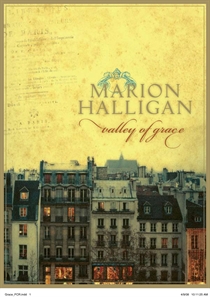
Marion Halligan, Valley of grace

Valley of Grace book cover (Courtesy: Allen & Unwin)

Valley of Grace book cover (Courtesy: Allen & Unwin)

Delicious but sly are the first words that come to mind when I think about Marion Halligan’s latest novel, Valley of Grace. Take this for example:

You know, people think flowers are pretty. Sentimental. Frivolous even. But the fact is, everything begins in the garden. Humans. Society. Civilisation. Evil. Things bud, bloom, weather, age, die. There is as much decay as there is burgeoning. Gardens offer emblems of our passage through the world.

Sly because you know she is alluding to the Garden of Eden here but, without the snakes, apples or trees, the garden symbolism is wider, more encompassing than the simple biblical Fall of Man. Delicious because the language flows so beautifully – and it’s typical of the sure writing that’s found throughout the book. The style is relaxed and flowing, even when it is staccato (if that makes sense). It feels conversational, and yet it is not colloquial. And, it contains Halligan’s hallmarks – wonderful descriptions of food and wine, of home and gardens.

The novel is set in contemporary Paris and chronicles a few years in the life of Fanny and her family and friends. At the beginning of the novel she is 25, single, and working with the gay Luc in his antiquarian bookshop, but very soon she marries builder and restorer of old buildings, Gérard, who is 38. There’s no mystery about this – you can see it coming and it comes. What doesn’t come after that is a baby.

There are no big dramas in this book so if that’s what you like, this is not for you. It is however the book for me, because while I can enjoy a book with drama, that’s not what I read books for. I read them for the very things that I got out of this book: astute observation of humans and how we think and behave, combined with writing that delights, inspires and grabs. Valley of Grace explores all the sorts of things that make up human experience – love and friendship, betrayals, secrets, appearance versus reality, and more besides – but most of all it is about babies and children. The having of them, the not having of them, the healthy and the damaged, the child and the god-child, and the wild child are all covered in this neat little book.

And, in fact, as Halligan told us at our bookgroup meeting tonight (to which we’d invited her and she’d wonderfully accepted), children were a major inspiration for the book. She lived in Paris in 1989 and, from her apartment window, could see the church, Val de Grâce, which was built by Anne of Austria as her part of a bargain with God to give her a child (Louis XIV, no less). This story fed into Haligan’s thinking about fertility (the presence of it and the absence of it) and about how in the past women came to “a bad end” if they didn’t have a baby or had a baby at the wrong time. She said that in the 1960s we thought this would all change but in fact it hasn’t quite turned out that way because women are having babies later and the result is more problems (such as infertility, increased miscarriages, “damaged” babies). This book is, then, her meditation on children – who they are, what they mean to us. And the following will show you just what Halligan thinks they mean:

Taking an angry or maybe anguished baby and changing it from a stiff protesting awkward bundle into a relaxed kitten-like creature seems to Fanny as important a thing as anybody could ever do.

The novel is told in third person but from different perspectives in different chapters – with some wonderful set-pieces, such as the story of Sabine and her arrogant philosopher husband Jean-Marie to whom she delivers “the pavilion girls”. Halligan said that telling the story this way replicates the way life goes – we are the heroes of our own stories, but bit-players in those of others. This makes sense – and certainly works well in the book.

There is a luminous quality to the book, conveyed largely through imagery to do with light and colour (mainly yellows). Mostly it is comforting, but sometimes it is not. Here is Fanny in the Val de Grâce:

She looks up at the immensity of the pale grey stone. Even with all the decoration, the cherubs, the frescos, the marble and gilt columns, it has a bareness, a coldness. It’s the colour of concrete, There’s no stained glass. The light is silvery; when the sun shines, lemony. There is no comfort in it, as there is in her house.

And then in her apartment:

She looks at the graceful space of the apartment. At the light, greenish gold today with summer sun and the fresh leaves on the chestnut trees, their milky white flowers buzzing with bees.

It’s a short book – just under 250 pages – and a rather gentle one. It’s sometimes a little sad, but other times it has a wry humour.  It’s well researched, but the research hangs lightly on it. Its ending is one of the most inspired I’ve read for a long time – but you’ll have to read it yourself to see if you agree.

I have read a few Halligans over the years – Lovers knots, The golden dress, The fog garden and The point – and have enjoyed them all. I’ll close this post with a favourite line from The fog garden because I think it describes this book to a T:

Read a wise book and lay its balm on your soul.