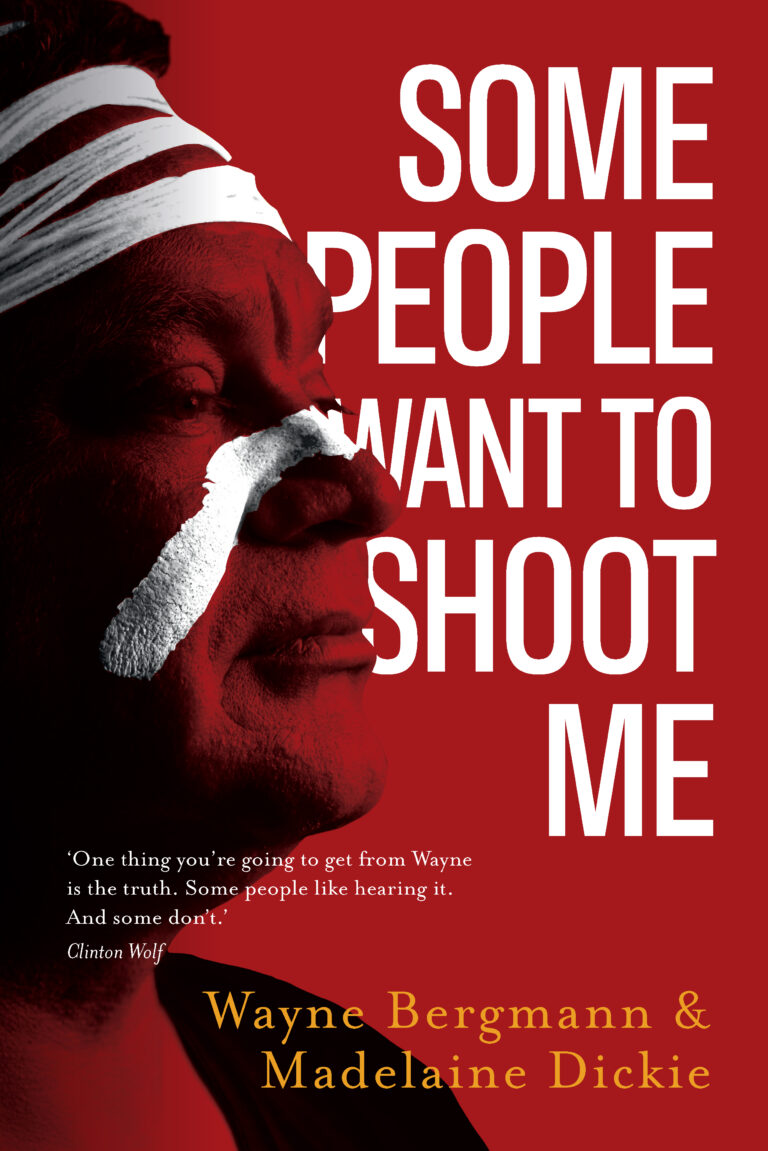
Having finally read Wayne Bergmann and Madelaine Dickie’s Some people want to shoot me, I am not surprised that it has been shortlisted in the Nonfiction category of this year’s Western Australian Premier’s Book Awards. It is moving; it is clearly written; and it is informative about big issues. Wayne Bergmann is a Nyikina* man and Madelaine Dickie a kartiya (white) woman, making this one of those collaborative novels I wrote about recently.
Before I continue, a little on its form. This is a work of nonfiction. It is essentially memoir, written in third person by Bergmann and his collaborator, Dickie. And, being a memoir, it has a specific focus. In this case, it is one underpinned by a powerful sociopolitical message concerning the right of First Nations people to survive and prosper on their own land.
“walking in two worlds”
So … Some people want to shoot me is about a man who realised he must walk in two ways – the kartiya way and the old people’s way, that is the white way and the way of his traditional culture. For his heart and soul he needed to walk the traditional ways, but in his head, seeing the suffering and the social and economic dysfunction caused by dispossession and powerlessness, he had to walk the kartiya way. The book exposes just what a tough balancing act this was – and is. It demanded (demands) strength, bravery, nous, clarity of purpose – and the support of family.
The book opens with a Prologue which sets the scene. It’s 2011 and Bergmann, who is at breaking point after years of negotiating on behalf of Kimberley Traditional Owners, walks out of a meeting with a mining company and heads, with his wife and children, back to country:
to the mighty Martuwarra, the Fitzroy River – lifeblood of Nyikina country, Wayne’s country, his children’s country – made by Woonyoomboo when the world was soft.
From here, the book starts in Chapter 1 the way memoirs usually do – at the beginning. For Bergmann, the beginning is Woonyoomboo who tasked the Nyikina people to look after country. This they did, until the arrival of white settlers in the late 19th century, when things “radically changed”. The first two chapters chronicle some of this change through the lives of Bergmann’s forbears. It depicts a world where the legacy of nuns, monks, ethnographers, pastoralists and miners “was still felt acutely”, where “frontier massacres had occurred within living memory”, and “where justice, under whitefella law, didn’t often grace Kimberly Aboriginal People”. Bergmann, who was born in 1969, saw this, felt this, and took on the pastoralists, mining companies and governments to “upend the status quo”.
Of course, such upending doesn’t come easily, and the people doing this upending aren’t always understood and appreciated, which is where we came in at the Prologue. The book details, chronologically, Bergmann’s work, from his early work with the KALACC (Kimberley Aboriginal Law and Culture Centre) and his realisation that for Aboriginal people to be empowered under Western law and able to make systemic changes, “they needed to understand the kartiyas’ law system inside out”. So, he did a law degree, and then, at the age of 33, became CEO of KLC (Kimberley Land Council) and here is where the really hard work started, and it was not pretty. It demanded every ounce of energy, intelligence and resilience, he could muster.
Bergmann had to be clear about the role, which was, as a native title representative body, “to facilitate a process and follow procedure in accordance with native law to allow Traditional Owners (TOs)” to make decisions “about their country”. This meant consulting with the TOs and ensuring they understood what they were being asked for and what was being offered. When stakes are high, emotions also run high. Some environmentalists, for example, would turn against TOs (and thus the KLC) when their views diverged, but sometimes TOs believed that some development was advantageous to their people. Then, of course, there were times TOs didn’t agreed with each other, or when there was disagreement between TOs and others in their communities. This is to be expected, of course. Do all kartiyas agree? But, it makes for very difficult times, and Bergmann was at the centre. As well as working with the relevant Kimberley TOs, Bergmann was also negotiating with the Western Australian government and, for example, the Woodside mining company, negotiating not only the actual agreements, but for money and resources to carry out consultations so that the TOs could come to the table well informed. All this is explained clearly in the book, making it well worth reading for anyone who has not followed native title cases closely. It’s both enlightening and chastening.
Bergmann made some significant deals, but it was a bruising time, so after a decade, wiser and with a clear view ahead, he moved on to establish KRED Enterprises. A charitable business, wth the tagline of “walking in two worlds”, its aim was (and is) to support cohesive Aboriginal economic development in the Kimberley, to encourage businesses run by and for Aboriginal people. The rest of the book covers Bergmann’s work – under the KRED umbrella and in other areas (including buying a newspaper, the National Indigenous Times) – all focused on the one goal, to pull his people out of poverty and disadvantage, to ensure they have the opportunities available to all Australians, and in so doing to improve their lives and outcomes. Nothing less will do.
We had to create some wealthy Aboriginal organisations, and wealthy Aboriginal people, so we could shape our own future, on our own country.
Woven through the accounts of Bergmann’s work are stories about his personal life, some good times but also the egregious attacks his wife and children faced at the height of his KLC work. We come to see the truth of Dickie’s description of him in her Introduction, as “demanding, smart, intensely political and visionary”. This is a man who puts himself on the line because he is driven to see First Nations Australians prosper.
Some people want to shoot me packs a lot into its 223 pages. That it covers so much, with great clarity and readability, is due to the writing. It’s well structured, and employs some narrative techniques, including evocative chapter titles and the occasional foreshadowing, which keep the story moving. At the end of the book is an extensive list of Works Cited and a Select Bibliography, which provide authority for what has gone before, if you need it.
Meanwhile, here are some words by another First Nations leader, Clinton Wolf:
One thing you’re going to get from Wayne is the truth. Some people like hearing it. And some don’t.
This book tells Wayne’s story, and I did like hearing it. It’s a great read about a great Australian, telling truths we all need to hear.
* First Nations cultures are orally-based, which results in inconsistent spellings when their languages are written. This post uses the spellings that Bergmann and Dickie use in their book.
Wayne Bergmann and Madelaine Dickie
Some people want to shoot me
North Fremantle: Fremantle Press, 2024
223pp.
ISBN: 9781760992378



 Whispering Gums