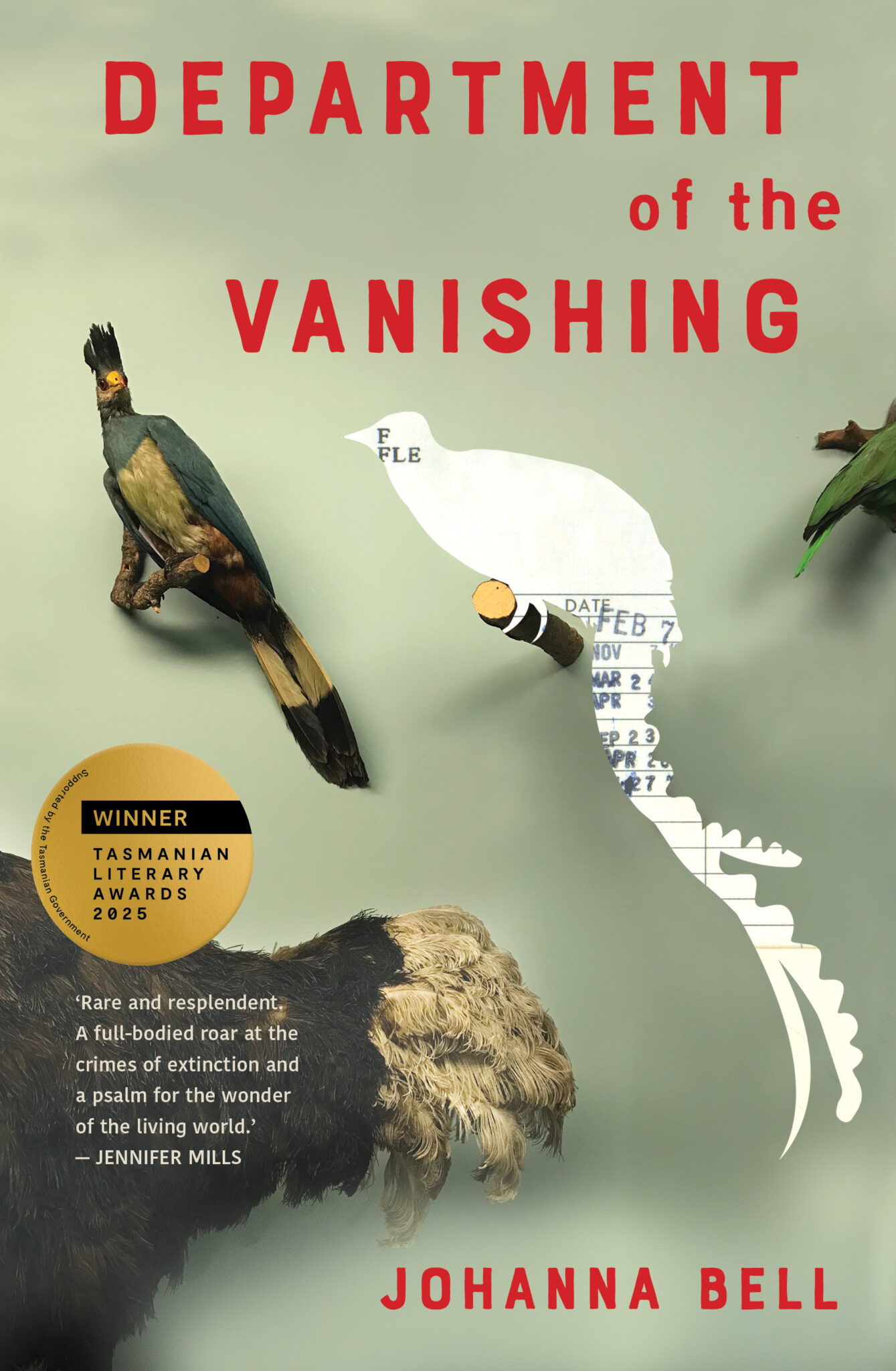
Words can be problematical when it comes to expressing our response to literature, indeed to any of the arts. We are uncomfortable, for example, using the word “enjoy” to express our response to anything that is dark. This is understandable, and yet I think “enjoy” is a perfectly okay word for something that has engaged and moved us. If we say, for example, that we “enjoy” reading good books, then logically, if a good book is dark, as is not uncommon, it should be valid to say we’ve enjoyed it. Shouldn’t it? So, in a similar vein, when I say Johanna Bell’s Department of the Vanishing was fun to read, I don’t mean it was a fun or funny book. It is in fact a deadly serious book about species extinction, but it is so delightfully clever that I enjoyed the reading experience immensely. Let me explain …
Now, I hadn’t heard of Johanna Bell until I saw her listed as a winner in the 2025 Tasmanian Literary Awards – for the unpublished manuscript of this book. So, I searched, and found her website. She describes herself as “a writer and arts worker based in Nipaluna/Hobart”, whose “practice spans fiction, poetry, picture books, audio making and community arts”. She says she is “most interested in projects that encourage experimentation, elevate new voices and challenge the established rules of storytelling”. Well, I can tell you now that she practises what she preaches.
Her website also briefly describes this book:
Set in a time of mass extinction, Department of the Vanishing blends documentary poetry, archival image and narrative verse to explore the vital questions: Can we live in a world without birdsong, and is it possible to create a new opus with the fragments left over?
“cataloguing the dead”
This description gives you an idea of the subject matter, and a vague idea of its form, but what it actually looks like on the page is something else. I would love to have been a fly on the wall when the publisher and book designer grappled with this one. But, I’m digressing. I still haven’t explained how the book actually works. It’s told in the voice of the rather cutely named archivist, Ava Wilde (as in Wild Bird), from January 2007 when she joins DoV (the Department of the Vanishing) to around 2030. Her job is “cataloguing the dead”, that is, documenting and recreating as best as possible extinct bird species from whatever “archival and cultural materials” exist. After some introductory matter to which I’ll return in a minute, the novel starts with Part 1 of a partially redacted police interview recorded with Anna on 10/11/2029. The irony starts here, with her being told that at the end of the interview the “tapes will be sealed up” and “stored in a secure place”. A few pages later we flash back to her commencing work. The interview records are presented in 10 parts that are regularly interspersed through the text, along with various other documents and narratives, to which I’ll also return in a minute. After all, if Bell can mix it up, so can I.
So, the introductory matter. It tells us much, including that this book requires careful reading, not skimming through the bits that don’t look like story. The first epigraph is presented as a little sticky-taped note and it’s from DH Lawrence, “In the beginning, it was not a word but a chirrup”. The facing page comprises an image of museum drawers containing tagged bird carcasses. The next two pages are covered with bird sounds presented in somewhat jumbled text in different sizes and fonts, giving the impression of a cacophony of birdsong. This is followed on the next page by another sticky-taped epigraph from Stephen Garnett, Ornithologist, “After a few days of fourty [sic] degrees plus the country’s just silent”. Then comes the aforementioned police interview.
In other words, before the story starts, we have an idea of how it is going to be presented (through text in various forms, images and graphics) and what it is about (the impact of climate change on birdsong, and an archivist who has done something illegal). From here the story moves, roughly chronologically, through Ava’s working life at the DoV. The main narrative is presented via poetry in her voice, as she recounts her days – which include weekly visits to her dying mother in a hospice – and through lists and bird obits, departmental emails, images, and headlines. Some factoid, some fact. As she chronicles her increasing despair over the extinctions and her inability to keep up, she tries to unravel the story of her naturalist father who disappeared while searching for lyrebirds when she was a child. She describes the one-night stands that dull the despair for a moment or two, until along comes Luke with his bird tattoo. We also have a compassionate chorus from the sex workers in her apartment who take an interest in her wellbeing.
If you are someone who needs to know what is fact and what is not, Bell helps you out. Under her concluding “Notes and references”, she explains that her “intention was to blur the line between fact and fiction” but for those who “enjoy tracing things back to their origins” she helpfully provides six pages of notes about her source materials. When I am reading fiction, I like the blur, but my archivist-librarian self also appreciates author’s notes like this.
“weird, experimental verse novels”
In her acknowledgements, Bell thanks her family. If she could write a bestseller, she would she says, “but for now you’re stuck with weird, experimental verse novels”. Yes, Department of the Vanishing is weird and experimental, though more in form than language. That is, the language is easy to understand, but to glean the full story, you need to pay attention to the details. It is a strong story about an archivist who is unravelling under the pressure of her concern for bird loss and her increasing workload as the extinctions mount and staff numbers are cut. It is leavened by touches of irony and wit, including well-placed library stamps like “CANCELLED” or “NOT FOR LOAN” scattered across the documents.
I was left with some questions, particularly regarding Luke and his intentions, perhaps the product of seeing a story through one pair of eyes? Whatever the reason, they did not spoil the emotional power or reading experience.
Bell draws on some new-to-me writers for the quotes she scatters through her novel, but there are also the expected suspects – Orwell and Solnit for example – and contemporary writers like Jordie Albiston, Victoria Chang, Angela O’Keeffe, and Ocean Vuong. While they may not all write specifically in the eco-lit sphere, they put truth to the idea that much of today’s writing is backgrounded by ecological concerns, which brings me to some lines about a quarter of the way through, when Ava writes of looking at bird carcasses:
I make myself look
at the horrors we’ve madeif no one else does
I will paywith an open gaze
This is why we must read eco-literature.
Johanna Bell
Department of the Vanishing
Transit Lounge, 2026
311pp.
ISBN: 9781923023550
(Review copy courtesy Transit Lounge via Scott Eathorne, Quikmark Media)


 Whispering Gums