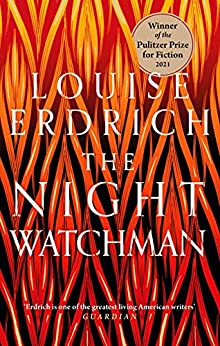
Louise Erdrich’s Pulitzer Prizewinning The night watchman is historical fiction about a community fighting back against a government set on “terminating them”. Erdrich, whom I have reviewed before, is an enrolled citizen of the Turtle Mountain Band of Chippewa Indians of North Dakota and it is the story of this community’s response to something called the House Concurrent Resolution 108 that she tells in The night watchman.
Passed by Congress on August 1, 1953, this Resolution would, says Erdrich in her Afterword, “sever legal, sacred, and immutable promises made in nation-to-nation treaties”. Or, as Wikipedia explains, it would “end reservations and tribal sovereignty” and “integrate Native Americans into mainstream American society”.
As it happens, Erdrich’s grandfather, Patrick Gourneau, was Chairman of the Turtle Mountain Band of Chippewa Advisory Committee at the time and recognised this resolution for what it was. He is the inspiration for Thomas Wazhushk, one of Erdrich’s two protagonists. Thomas is a man of two cultures:
Watching the night sky, he was Thomas who had learned about the stars in boarding school. He was also Wazhashk who had learned about the stars from his grandfather, the original Wazhashk. (p. 17)
Throughout the novel Thomas strategically draws on these two selves in order to perform his role, which is to keep the community safe (or, at least, safer, than they would be if the Government’s plans came to fruition).
This is both a sophisticated and a grounded novel. Grounded in the way Erdrich uses her storytelling ability to create a compelling narrative peopled by a large cast of wonderfully individuated characters. We are interested in them all, and this makes the novel a darned good read. Sophisticated in how Erdrich subtly layers her story to enrich its meaning. The overall structure comprises two parallel but related stories or journeys: Thomas’s fight for his community’s survival, and his niece Patrice’s journey to find both her missing sister and her own path in life. Erdrich’s writing is simple, plain, but also imbued with gorgeous lyricism, metaphor and symbolism. The novel is threaded, for example, with physical holes, wells, caves, ship holds, and falls, which never let us forget the precariousness of these people’s lives.
She also peppers the story with humour, which reminds us no matter how serious things are, people can still have a laugh. There are many laugh-out-loud moments, alongside a recognition of humour’s role in how we navigate the things we confront. In Minneapolis, Patrice finds herself in a strange and potentially dangerous situation, and has
the sort of feeling and thinking that could only be described in Chippewa, where the strangeness was also humorous and the danger surrounding this entire situation was of the sort that you might laugh at, even though you could also get hurt… (p. 131)
“Survival is a changing game” (Biboon)
Overlaying all this is Erdrich’s exploration of how language works, how it can be used to clarify or obfuscate, to inspire or deflate. Her writing embodies this knowledge. So, for example, Thomas receives the Resolution papers and reads them carefully. He sees
their unbelievable intent. Unbelievable because the unthinkable was couched in such innocuous dry language. Unbelievable because the intent was, finally, to unmake, to unrecognize. To erase as Indians … his people, all of us invisible and as if we never were here, from the beginning, here. (p. 79)
His people were being targeted, the papers said,
for emancipation. E-man-ci-pation. Eman-cipation. This word would not stop banging around in his head. Emancipated. But they were not enslaved. Freed from being Indians* was the idea. Emancipated from their land. Freed from the treaties that Thomas’s father and grandfather had signed and that were promised to last forever. (p. 80)
Later, the once dapper but now frequently drunk Eddy Mink cuts to the chase, stunning officialdom with his plain language statement:
The services that the government provides to Indians might be likened to rent. The rent for use of the entire country of the United States. (p. 200)
Meanwhile, as Thomas builds his case, Patrice, who works in the Turtle Mountain Jewel Bearing Plant where Thomas is the titular night watchman, sets off for Minneapolis to look for her sister. Vera had gone there with her new husband but had not been heard of since. What Patrice finds in the city, how people can be exploited, is shocking, and she returns home somewhat wiser but with more to learn about herself and the ways of humans.
Surrounding Thomas and Patrice is a large community of people – family, friends, neighbours, work colleagues, teachers, coaches, visiting missionaries, and even a ghost. The interactions between these people build up a picture of a community that functions despite external stresses and the usual internal disagreements. This makes engrossing reading because these characters are so real, including the two Mormon missionaries who not only add humour and pathos but also represent the naiveté of supporters of a faith – in the form of Utah Senator Arthur V. Watkins – that was driving the Resolution.
Similarly, our protagonists’ interactions with specific individuals make great reading while also advancing the narrative and the ideas. When Thomas is with his father Biboon and Patrice with her mother Zhaanat, we feel their spiritual connection with their culture, and their desire to learn from their elders. When Thomas is with the white teacher and boxing coach, Barnes, we see how little non-Indian society understands the existing situation and the implications of the Resolution. Thomas patiently – and generously – explains to the clueless Barnes why Indians are not, and can never be, “regular Americans”. And, why he, Barnes, cannot be an Indian! Just look at this writing:
“If I married an Indian woman,” said Barnes, “would that make me an Indian? Could I join the tribe?”
He was awed at the possible sacrifice he could be making.
Thomas looked at the big childish man with his vigorous corn-yellow cowlicks and watery blue eyes. Not for the first time, he felt sorry for a white fellow. There was something about some of them—their sudden thought that to become an Indian might help. Help with what? Thomas wanted to be generous. But also, he resisted the idea that his endless work, the warmth of his family, and this identity that got him followed in stores and ejected from restaurants and movies, this way he was, for good or bad, was just another thing for a white man to acquire.
“No,” he said gently, “you could not be an Indian. But we could like you anyway.”
In statements like “he was awed at the possible sacrifice he could be making”, Erdrich conveys more about cultural superiority than just this man’s thoughts.
When Patrice is with her girlfriends and workmates, Valentine and Doris, we see how her goals diverge from their more girlish ones, and when she is with Wood Mountain we see her inner conflict about her chosen direction. As a young person, her journey is more personal than Thomas’s but they coalesce when it comes to saving the community.
“Assimilation. Their ways become your ways.” (Roderick)
I loved spending time with these characters. In fact, so did most of my reading group, as this novel was our September read. We enjoyed her vividly drawn characters – and their perfect names, like Juggie Blue, Wood Mountain, Louis Pipestone, Millie Cloud, and Patrice not Pixie. We teased out the complexity of the storytelling, the way Erdrich seemed to effortlessly incorporate complex ideas into a compelling narrative. This starts right at the title, The nightwatchman, which is both literal, Thomas’ job, and metaphorical, in his role of keeping watch as the community’s Chairman. I was reminded a little of Melissa Lucashenko’s novels, in which tough stories are told with compassion and humour to paint a picture of real people confronting a world that’s against them.
Early in the novel, Thomas moves that the Committee call the Resolution the “Termination Bill [because] Those words like emancipation and freedom are smoke”. This bill heralded what is now called the Termination Era (1953-1968). As Erdrich explains in her Afterword, this is what happened to 113 tribal nations. Although some regained recognition, “31 are now landless” and “24 are considered extinct” (p. 447).
The night watchman is one of those books that hits the spot – the heart spot and the mind spot. Recommended.
* The novel is set in 1953, and Indian is the term most commonly used when the specific Chippewa is not.
Louise Erdrich
The night watchman
London: Corsair, 2020
453pp. (Kindle edition.)
ISBN: 9781472155337





 Whispering Gums