The Pascall Prize is one of those under-the-radar sorts of awards, that is, one that tends not to get much general press. However, that doesn’t mean it’s not significant. In fact, I’ve had it in my list of topics for a couple of years but, having mentioned in my David Malouf birthday post last week that he was a recipient, I decided that now’s the time.
The Pascall Prize has another name which better explains what it is – “The Australian Critic of the Year”. Its aim, defined on its website, is:
to reward a critic or reviewer whose work changes the perceptions of Australians, opens their eyes to a different perspective of their culture, develops a new interest in the subject and is both imaginative and creative.
The Pascall Prize celebrates incisive and well-crafted critical writing in areas including literature, art, architecture, food and wine, music, theatre, film, television, and radio [and now the Internet].
It specifically excludes sport from its definition of culture. Fair enough. I suspect there are significantly more well-paying opportunities for sports writers/analysts than there are for those in the arts, though maybe I’m biassed. I have, for the record, read some excellent pieces of sports journalism. But, enough of that, back to Pascall. The website tells us that it was named after Geraldine Pascall, “a flamboyant journalist” who died suddenly of a stroke/brain haemorrhage in 1983, when she was just 38. (Scary!) She apparently didn’t have a will, so her Estate passed to her father, Fred Pascall. He wanted to establish a memorial to his daughter, and so the Pascall Prize was born. It’s awarded annually, usually I believe at the Sydney Writers’ Festival, and currently provides $15,000. David Malouf is listed as the first recipient, having received the award in 1988.
I could be clichéd and say that the recipients represent a veritable who’s who of Australian critics, but I won’t, although it does – at least as far as I can tell from my admittedly uneven knowledge of the field! Last year’s winner was Kerryn Goldsworthy. The announcement describes her as “a writer, critic, reviewer, essayist, columnist, fiction writer and blogger”. She has reviewed for many of Australia’s most significant publications, for over 30 years. I have quoted her here more than once, the first time being in 2009 in a post on Thea Astley when I quoted Goldsworthy’s reasons for loving Thea Astley. That they happen to accord with my reasons was the icing on the cake. I’ve mentioned her several times since, including recently in relation to her being the chair of the Stella Prize Judging Panel.
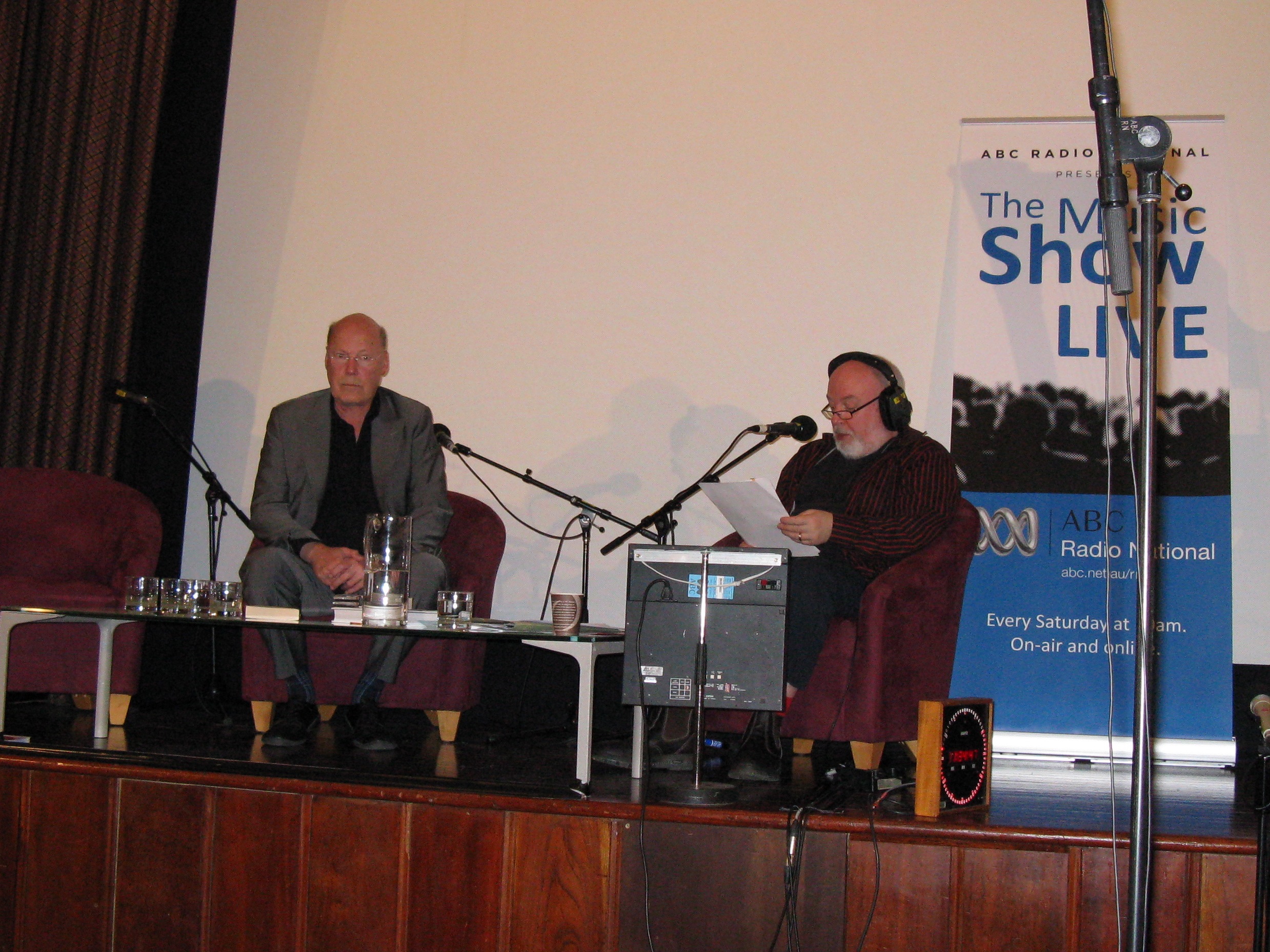
Andrew Ford interviewing Jim Sharman, Voss Journey, 2009
Of the other winners, the best known to me (which says more about me than anything else), include Andrew Ford (1998, music critic, composer and radio presenter), Marion Halligan (1990, critic and author), Andrew Riemer (1990, critic, academic and author), Peter Craven (2004, literary critic and editor), and Geordie Williamson (2011, literary critic). You can see a full list of the winners and the judging panels on the Prize’s Wikipedia page.
I’m not going to ramble on for long about this award, important as I think it is, but I would like to share a couple of comments made by Goldsworthy in her acceptance speech, one about the essence of being a good critic, and the other about the future. Here’s the first one:
in order to be an effective critic, you need a left brain that knows what your right brain is doing. My ideal as a critic is to come up with a rational intellectual response while at the same time continuing not just to acknowledge but to honour those mysterious places of the oceanic deep, the places where you connect most vitally and instinctively and electrically with whatever is going on in a work of art.
It’s a real juggle, and one that many of us bloggers (of whom Goldsworthy has also been one) try also to achieve. It’s what she calls “a critical brain finding ways to articulate the heart’s response”.
Regarding the future of criticism, she says:
There’s a lot of talk as we move into the digital age about what the fate of criticism will be, but I’m an optimist who thinks the that cultural conversation will continue no matter what medium it moves through, or what form it takes. What I worry about more is whether critics will go on being able to balance hearts and minds as the humanities continue to be devalued in the universities, the arts continue to be devalued in government, and fewer and fewer people are formally taught how to expand their knowledge and hone their critical skills as we navigate our way through cultural life.
Being an optimist too, I can’t believe that there won’t always be people ready, willing and able to engage with the arts in a critical way. Life sure would be poorer if there weren’t.
Do you have favourite critics you like to read? And what do you think about Goldsworthy’s left brain right brain approach to analysis?
 Whispering Gums