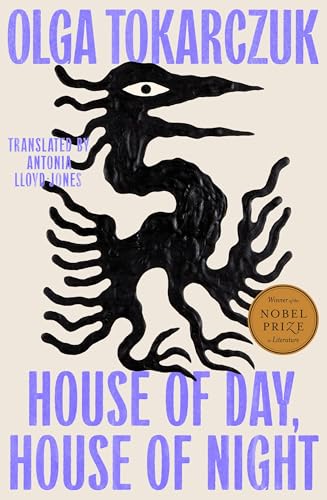
About 30 pages into Olga Tokarczuk’s novel, House of day, house of night, I turned to Mr Gums and said, I have no idea what I am reading, which is unusual for me. I certainly don’t pretend to understand everything I read, but I can usually sense a book’s direction. However, something about this one was throwing me, so …
I had a quick look at Wikipedia, and found this “synopsis”:
Although nominally a novel, House of Day, House of Night is rather a patchwork of loosely connected disparate stories, sketches, and essays about life past and present in … a Polish village in the Sudetes near the Polish-Czech border. While some have labeled the novel Tokarczuk’s most “difficult” piece, at least for those unfamiliar with Central European history, it was her first book to be published in English. [Accessed: 1 October 2025]
That made me feel better! I am more than comfortable with “loosely connected disparate stories” but am only generally-versed in Central European history. So, I decided to relax and go with the flow. From that point on, I started to enjoy my reading more, but it was slow going, because the “disparate stories” demand attention. It’s not a book you whizz through for story, but one you savour for thoughts and ideas, and for the connections you find along the way.
Tokarczuk calls it, in fact, a “constellation novel”, which I understand builds on thinking by the German critic and philosopher, Walter Benjamin (1892-1940). According to academic Louis Klee, who has written on “the constellational novel”, “these novels are recognizable by the presence of a first-person narrator committed to drawing affinities and making connections among disparate things”. They can be non-linear and incorporate various forms of writing from essayistic to lyrical to fragmentary, and encourage readers to find their own connections (like finding patterns in a constellation).
This well encapsulates House of day, house of night. It comprises numerous individually titled chapters (or sections or parts), some just a few paragraphs long, and others several pages. At first it felt disjointed, but it wasn’t long before an underlying structure started to reveal itself, one held together by a first-person narrator, a woman who had come to live in a small Polish village with her partner R – just like Tokarczuk and her husband did – three years before the novel opens. She tells of life in the village, and particularly of the relationship she develops with her neighbour, a somewhat mysterious old woman named Marta, who embodies a wisdom that she sometimes shares but other times must be gleaned from what she doesn’t say.
Interspersed with our narrator’s story, are other stories – some real, some magical, some past, some present – about the region and people in it. There’s a gender-fluid monk named Paschalis who is writing the life of the female saint Kummernis. There’s the unnamed couple who think they have it all, until each is visited by the same lover, a female for “he” and a male for “she”. There’s a religious community called the Cutlers who make knives and believe that “the soul is a knife stabbed into the body, which forces it to undergo the incessant pain that we call life”. There’s the wonderfully named Ergo Sum who had tasted human flesh in frozen Siberia, where he’d been deported in 1943, and believes he is turning into a werewolf. And so on. Some of these stories continue, for several chapters, woven around our narrator’s story, while others stand alone. Some are about people who think they have life worked out, while in other stories, the people don’t have a clue.
There’s more though, because scattered through the stories are ruminations on disparate things like dahlias, nails, comets and grass allergies. And threading through it all are various motifs, usually providing segues between chapters, encouraging us to see links and to ponder their meaning for us. These motifs include dreams, names, time, death, borders, mushrooms (potentially deadly), and knives. The more you read, the more connections you see between them and the stories. Many are philosophically-based, but are not hard to understand. In other words, the challenge is not in understanding, but in how we, individually, process the links we see. You might have already noticed some in my examples above, such as the idea of identity. Even the mysterious Marta, who disappears every winter, is unsettling. Who is she really?
“people are woefully similar”
This is the sort of book you would expect of a Nobel prizewinner. The writing is simple but expressive, and is accompanied by a rich, dark, and often ironic humour. We have border guards who don’t want to deal with a dead body so they quietly shove it to the other side of the border. And Leo the clairvoyant who says “Thank God people have the capacity for disbelief — it is a truly bountiful gift from God”. That made me splutter.
Underpinning all this – the thing that gives the book its heft – is a quiet but somewhat resigned wisdom. It interrogates some big questions – our willingness (or not) to see what is happening in front of us, our relationship to place, how we comprehend time, and who we are. These are explored through universal binaries, not only the night-and-day contained in the title, but life and death, change and stasis, ripening and decay. How do we live with – and balance – these parts of ourselves, of life?
But, House of day, house of night is also set in a particular place and time, southwest Poland, just post World War 2. This area, explains the Translator in her note, was part of the German Reich until 1945, when the Allies agreed to move Poland’s borders west. Many Poles left their old lands of the east (now part of the USSR), and resettled in this once German area in the west, occupying homes left by the evacuated Germans. This specific history is also found in the book, with Polish families hopefully, greedily, digging up German treasures, for example, and Germans sadly returning to see their old places.
House of day, house of night offers no answers, but it sure asks a lot of questions – about how, or whether, we can move forward into more humane, and hence more fulfilling lives.
This brings me to the ending. I won’t spoil it – it’s impossible in a story like this anyhow – but we close, appropriately, on the idea of constellations and finding patterns, and a hope that it is possible to find a pattern that explains it all. It is deliciously cheeky. And, on that note, I will end.
Olga Tokarczuk,
House of day, house of night
Translated from the Polish by Antonia Lloyd-Jones
Melbourne: Text publishing, 2025 (Orig. pub. 1998; Eng trans. 2002)
298pp.
ISBN: 9781923058675
Review copy courtesy Text Publishing




 Whispering Gums