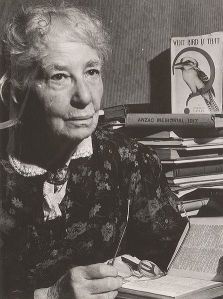
There are two main reasons why I like – actually love – to read Thea Astley. One is her language, her wonderful way with words that may, at times, be over-the-top but that is never clichéd. The other is her passion for the underdog, and thus for social justice in a world where it is often conspicuously absent.

Island with palm, because Penguin will not answer emails regarding bookcover use (Courtesy: OCAL, via clker.com)
The multiple effects of rainshadow is Astley’s second last novel. Its overall subject matter is, as one character says late in the book, “the unmoored behaviour of humans”, an effective image given the book’s central motif is an island. It has a very loose plot which is based on an actual event that occurred on Palm Island in 1930. Palm Island was, at that time, essentially a dumping ground for Indigenous Australians deemed to be “problems”, but the event in question concerned the white superintendent, mad with grief at the recent death of his wife, running amok and setting fire to buildings (including his own home in which his children were sleeping). He was eventually shot (and killed) by an Indigenous man under the (cowardly) order of the white deputy superintendent. The novel explores, through multiple points of view and over a period of around 30 years, the impact of this event on six white people who were present on the island at the time – but interspersed between these voices is the voice of Manny, the man who shot the super. This is, I think, a pretty risky thing to do but Astley is not one to shy away from risks in her writing.
The voices are, in chapter order:
- Manny Cooktown, first person, the indigenous “shooter” and main narrator who commences the story and appears between each voice, but does not conclude the novel
- Mrs Curthoys, first person, landlady on Palm Island at the time of the incident
- Gerald Morrow, third person, writer/editor who had gone to the Island to work as a foreman, for which he had no skill or experience, and who was in fact escaping the Island in a boat at the time of the incident
- Captain Brodie, third person, the Superintendant who ran amok and was shot by Manny
- Mr Vine, third person, a school teacher on the Island at the time of the incident
- Father Donellan, third person, priest who visits regularly from the mainland and is responsible for the Island’s religious “needs”
- Leonie née Curthoys, first person, daughter of Mrs Curthoys and so on the Island at the time of the incident
- Omniscient author who carries the last chapter
Looks complex eh? But in fact it’s pretty straightforward in terms of knowing who is who, as each voice “manages” its own chapter. The chronology is a little trickier as many of the characters (let’s call them that from now on) flip between their present (some are writing from many years after the event) and the past. Did you notice that the first person voices belong to the two groups most recognised by Astley as disadvantaged: women and indigenous Australians? A subtle but clever use of her narrative structure to give them a voice!
The setting is, after all, very much a white patriarchal world, and marriage is seen in that light. Vine, for example, is told to get a wife for
‘The boring bits. You know. Meals. Washing. Shopping. Kids. All that sort of thing. A man hasn’t time for that sort of thing.’
‘Why not a housekeeper, then?’
‘You are green. Cost too much …’
Not surprisingly Mrs Curthoys and Leonie do not find marriage much to their liking. The main underdogs in this novel though are the indigenous people, many of whom are brought to the Island – and therefore separated from their country – as problems, and are treated with disdain at best and real cruelty at worst by most of the white residents (from 1918 when the settlement begins to 1957 when the book closes). Astley offers, I’m afraid, little hope. She is not a cheery writer: her goal is to shock us into attention – and that she does. However, I can imagine some critics accusing her of putting contemporary views about feminism and indigenous relations in characters’ mouths. I would argue though that contemporary ideas do not spring from a vacuum, and that therefore the occasional more sensitive/egalitarian views expressed in the novel are historically valid.
I said at the beginning of this review that one of the main reasons I like Thea Astley is her language, so here are some examples of her imagery:
…whistlestop hamlets scattered along briefly tarred roads that led to further sprawls moated by loneliness … [from school-teacher Vine, heading to a country school]
And I am weary of a Celtic charm that is shaken like spice over any dish within gulping reach. We bore each other rancid. [Leonie on marriage and her philandering husband]
At least I’ll have tried. At least I’ll be learning to decline the gumleaf, conjugate the seasons. [Vine’s “do-gooder” son Matthew]
She also effectively mixes up the rhythm to make points or convey feeling, using short snappy sentences, repetition of phrases (such as Morrow’s “swing dip drag” as he sails across the sea), and punctuation-free streams of consciousness:
There was an unalterable plane geometry to his movements: the clock the tea/toast the clock the bell the classroom the toted piles of exercise books the bell the repeated texts the stale jokes the texts the bell the common-room bitchings the clock the bell … the … the … [schoolteacher Vine]
Astley is often quite self-conscious about the act and role of writing, and this is certainly the case in this novel. I’ll give just one example, the bitter rant of failed writer Gerald Morrow, who is jealous of the success of another, to him, lesser writer:
There must be a million readers out there who crave boredom! Who love the dangling participle! Who wallow in truisms and fatuous theorisings! … Slap in your popular aphorisms, buddy, but don’t make ’em think!
You could never accuse Astley of not making you think, but there has to be some irony here, some little sense of self-deprecation even, in the fact that she put these words in the mouth of a failed writer, as if she knew that for all her passion there’s only so much you can achieve with words. That may be so, but Astley has given it a darned good try!
Thea Astley
The multiple effects of rainshadow
Camberwell: Penguin, 1996
296pp.
ISBN: 9780143180265




 Whispering Gums