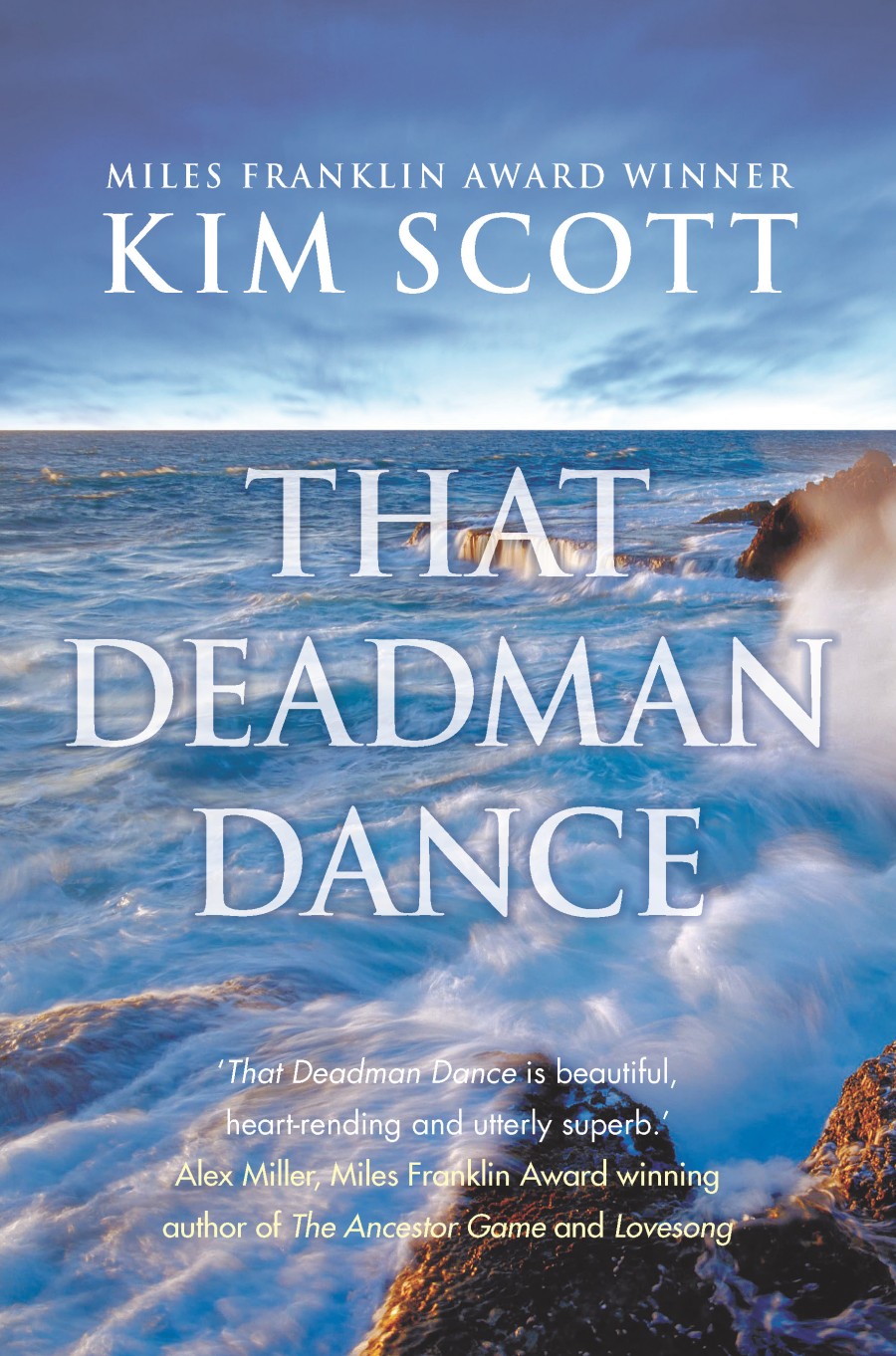
Here is the first of two or more (depending on how the spirit moves me) Delicious Descriptions from Kim Scott‘s book That deadman dance.
My first one presents two excerpts which describe people confronting the new. First, the British settlers during their expedition to find land:
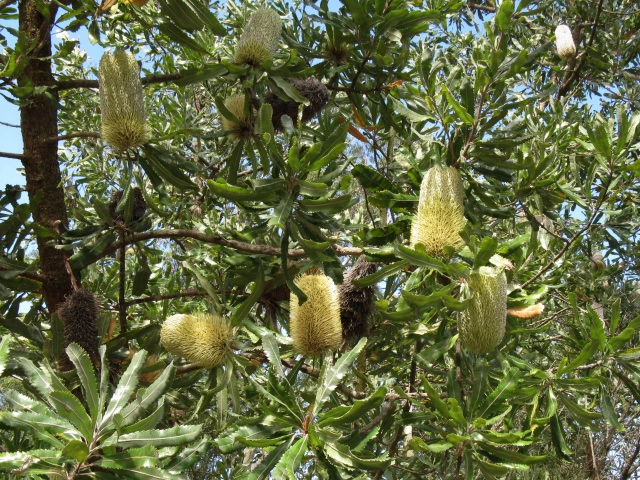
They found a path, rocky and scattered with fine pebbles that at one point wound through dense, low vegetation but mostly led them through what, Chaine said, seemed a gnarled and spiky forest. Leaves were like needles, or small saws. Candlestick-shaped flowers blossomed, or were dry and wooden. Tiny flowers clung to trees by thin tendrils, and wound their way through the shrubbery, along clefts in rock. Bark hung in long strips. Flowering spears thrust upward from the centre of shimmering fountains of green which, on closer inspection, bristled with spikes.
Modern-day Aussies would recognise most if not all of these plants, but I can imagine how strange they would have been to people who came from the soft landscapes of England and Ireland.
By contrast, here is Wunyeran describing his experience on a ship to an elder:
It was hard to describe the food, he said. Some of them had tasted it before on ships, but other tastes too and … all very strange. There were many things … He tried to explain the tube you looked through that brought you close; the scratched markings one of the men made on something like leaves. Book, Journal, they said.
They gave him a good koitj, he said, and showed his people the smooth axe…
Throughout the book we to and fro between the British and indigenous ways of doing, being and seeing … but I particularly loved these two concrete descriptions of people reacting to new sights and experiences.
About a third of the way into Kim Scott‘s novel That deadman dance is this:
We thought making friends was the best thing, and never knew that when we took your flour and sugar and tea and blankets that we’d lose everything of ours. We learned your words and songs and stories, and never knew you didn’t want to hear ours.
And, it just about says it all. In fact, I could almost finish the post here … but I won’t.
That deadman dance is the first Indigenous Australian novel I’ve read about the first contact between indigenous people and the British settlers. I’ve read non-Indigenous Australian authors on early contact, such as Kate Grenville‘s The secret river, and I’ve read Indigenous authors on other aspects of indigenous experience such as Alexis Wright‘s Carpentaria and Marie Munkara’s Every secret thing. Kim Scott adds another perspective … and does it oh so cleverly.
The plot is pretty straightforward. There are the Noongar, the original inhabitants of southwest Western Australia, and into their home/land/country arrive the British. First, the sensitive and respectful Dr Cross, and then a motley group including the entrepreneurial Chaine and his family, the ex-Sergeant Killam, the soon-to-be-free convict Skelly, the escaped sailor Jak Tar, and Governor Spender and his family. The novel tracks the first years of this little colony, from 1826 to 1844.
That sounds straightforward doesn’t it? And it is, but it’s the telling that is clever. The point of view shifts fluidly from person to person, though there is one main voice, and that is the young Noongar boy (later man), Bobby Wabalanginy. The chronology also shifts somewhat. The novel starts with a prologue (in Bobby’s voice) and then progresses through four parts: Part 1, 1833-1836; Part 2, 1826-1830; Part 3, 1836-1838; and Part 4, 1841-44. And within this not quite straight chronology are some foreshadowings which mix up the chronology just that little bit more. The foreshadowings remind us that this is an historical novel: the ending is not going to be fairytale and the Indigenous people will end up the losers. But they don’t spoil the story because the characters are strong and, while you know (essentially) what will happen, you want to know how the story pans out and why it pans out that way.
What I found really clever – and beautiful – about the book is the language and how Scott plays with words and images to tell a story about land, place and home, and what it means for the various characters. His language clues us immediately into the cross-cultural theme underpinning the book. Take, for example, the words “roze a wail” on the first page:
“Boby Wablngn” wrote “roze a wail”. But there was no whale. Bobby was remembering … “Rite wail”. Bobby already knew what it was to be up close beside a right whale …
Whoa, I thought, there’s a lot going on here and I think I’m going to enjoy it. Although Bobby’s is not the only perspective we hear in the book, he is our guide. He is lively and intelligent, and crosses the two cultures with relative ease: just right for readers venturing into unfamiliar territory. He’s a great mimic, and creates dances and songs. The Dead Man Dance is the prime example. It’s inspired by the first white people (the “horizon people”) and evokes their regimented drills with rifles and their stiff-legged marching. There’s an irony to this dance of course: its name foretells while the dance itself conveys the willingness of the Noongar to incorporate (and enjoy) new ideas into their culture.
In fact there’s a lot of irony in the novel. Here is ex-Sergeant Killam:
Mr Killam was learning what it was to have someone move in on what you thought was your very own home. He thought that was the last straw. The very last.
And who was taking his land? Not the Noongar of course, but the Governor … and so power, as usual, wins.
The novel reiterates throughout the willingness – a willingness supported, I understand, by historical texts – of the Noongar to cooperate and adapt to new things in their land:
Bobby’s family knew one story of this place, and as deep as it is, it can accept such variations.
But, in the time-old story of colonisation, it was not to be. Even the respectful Dr Cross had his blinkers – “I’ve taken this land, Cross said. My land”. And so as the colony grew, women were taken, men were shot, kangaroos killed, waters fouled, whales whaled out, and so on. You know the story. When the Noongar took something in return such as flour, sheep, sugar, they were chased away, imprisoned, and worse.
I’d love to share some of the gorgeous descriptions in the book but I’ve probably written enough for now. You will, though, see some Delicious Descriptions in coming weeks from this book. I’ll finish with one final example of how Scott shows – without telling – cultural difference. It comes from a scene during an expedition led by Chaine to find land. They come across evidence of a campsite:
You could see where people camped – there was an old fire, diggings, even a faint path. Bobby was glad they’d left; he didn’t want to come across them without signalling their own presence first, but Chaine said, No, if we meet them we’ll deal with them, but no need to attract attention yet.
Need I say more*?
The book has garnered several awards and some excellent reviews, including those from my favourite Aussie bloggers: Lisa (ANZLitLovers), the Resident Judge, the Literary Dilettante, and Matt (A Novel Approach). Our reviews differ in approach – we are students, teachers, historians, and librarian/archivists – but we all agree that this is a book that’s a must to read.
Kim Scott That deadman dance Sydney: Picador, 2010 400pp. ISBN: 9780330404235
* I should add, in case I have misled, that for all the truths this novel conveys about colonisation, it is not without vision and hope. It’s all in the way you read it.
When I was a child my father told me to be proud I was of “aboriginal descent”. Perhaps it was the silence surrounding his words that made them resonate as they did; I’d certainly heard no such thing anywhere else in my life, certainly not in my reading or schooling. There didn’t seem much in the way of empirical evidence to support my father’s words. A child, and unable to either calibrate injustice and racism or identify its cause, I sensed the legacy of oppression. (Kim Scott in Kayang and me)
Indigenous autobiographies are finally, I think, starting to make their mark in mainstream Australian publishing. The first so-called indigenous autobiography I read was Douglas Lockwood‘s I, the aboriginal. It sounds like an autobiography but in fact it was written about an indigenous man, Phillip Roberts (Wailpuldanya of Alawa tribe), by a white writer. It was published in 1962 – though I read it later in the 1960s – and it introduced me to a world I knew little of but recognised as important to my life as an Australian.
Through the 1970s I read various books about indigenous Australians, but it was the poetry of Oodgeroo Noonuccal, which most conveyed to me the experience of being an Aboriginal Australian. And then, in 1988, came the hugely successful Sally Morgan’s My place which was, I think, the first “real” indigenous Australian autobiography I read. Unlike Kim Scott, Sally was not told to be proud of her “Aboriginal descent”. Rather, it was hidden from her – or, at least, she was oblivious of it though, as I recollect, her sister had cottoned on to something of their derivation. Her family did not promote their background – for obvious reasons in a society where, as Scott says, there was (is) a “legacy of oppression” – but Sally worked her way through it to find her own place as an indigenous woman, writer and artist in Australia.
One of the first posts on this blog was on Boori (Monty) Pryor’s autobiography Maybe tomorrow. It’s a short autobiography by a man who has geared his life towards educating young people – white and indigenous – about what being indigenous means. His aim is twofold – to encourage pride in indigenous people and understanding and respect in white people. In a later post, I referred to Leah Purcell‘s Black chicks talking which tells the lives of a number of indigenous women in Australia. They are written by Purcell but are based on interviews she conducted with the women. Her goal is similar to Pryor’s: she sees her women subjects as role models for young indigenous Australians but also wants white Australians to recognise and understand the lives and achievements of indigenous women. Both books are good reads.
Rabbit-proof fence, including the route taken by the three young girls (Courtesy Wikipedia, using CC-BY-SA 3.0)
The Stolen Generation – that is, the generation/s of Aboriginal people in Australia affected by the government practice of taking mixed-race children away from their families – has resulted in pretty much a whole new genre of indigenous autobiography. The Stolen Generation report itself contained many stories (or case studies) to prove its case. For white Australians, though, the best known Stolen Generation story is Doris Pilkington‘s Following the Rabbit Proof Fence (which was also made into a film). It tells the story of three young girls who, in 1931, escaped the settlement they were taken to, well over 1500kms from their home, and followed the rabbit-proof fence to return to their families. Doris is the daughter of one of the girls – and she, too, like her mother was stolen.
I have only recently come across Hazel Brown and Kim Scott’s 2005 book Kayang and me. Kim Scott is an award-winning Western Australian indigenous novelist and Hazel is his aunty. Together they have written this story of the Wilomin Noongar people in southwest Western Australia. I have only started it, but it is the book that inspired me to write this post. It describes a region of Australia I know little about, so I look forward to making its acquaintance!
I am aware that I have barely scraped the surface of a genre of writing that I would like to delve more into. This will not, I hope, be the last I write on this topic – but, in the meantime, I’d love to hear comments and recommendations from you on the topic.
David Malouf, 2006. (Courtesy: Dariusz Peczek, via Wikipedia, using CC-BY-SA 3.0)
Queensland is the state of my birth, and that makes it special to me! It is a large state and one of our most geographically diverse, ranging from the tropical north to the arid west, from the subtropical south to the temperate inland southeast. It has one of Australia’s most popular tourist destinations, the Great Barrier Reef, and our best-known commercial tourist (and, retirement) mecca, the Gold Coast. It is unlikely, though, to be the first state people think of when asked about Australian writers …
Nonetheless, many significant writers have come from Queensland, including the indigenous poet Oodgeroo Noonuccal.
Of our contemporary writers, though, the best known Queenslander has to be David Malouf. Like most Queenslanders, he “emigrated” from there long ago and has lived in England and Tuscany as well as Sydney, but that doesn’t mean that his ties aren’t strong. Johnno, his first novel and the first one I read, is, like so many first novels, somewhat autobiographical. It describes a young boy growing up in Brisbane in the 1940s and 1950s and, as I recollect, evokes the place and time well. One of my favourite novels of his, Fly away Peter, is partly set in the (above-mentioned) Gold Coast and partly on the Western Front during World War 1. It’s a beautiful novella which explores friendship, love and life, not only against the challenges of war but also of class. And, while his most recent novel, Ransom, re-explores the story of Priam and Achilles, it was inspired by his introduction to the story of Troy in his schoolboy days. It seems, with Malouf, that you can take the boy out of Queensland but you can’t take Queensland out of the boy!
Like Malouf, Janette Turner Hospital left Queensland in early adulthood, and has spent most of her life in the United States and Canada, though she does return down under occasionally. She’s a writer who’s not afraid to take risks, and can push metaphors, sometimes to their limits (as in Charades and Borderline). Her novels range over the countries in which she’s lived, including for example, southern India in The ivory swing. Due preparations for the plague is one of those post 9/11 novels that deals with terrorism, and Orpheus lost also explores what happens when people get caught up, inadvertently for the most part, in political action. Few of her novels are set in Australia, but there’s often an Australian character.
By contrast, Andrew McGahan has remained in Australia, even if not in Queensland. He currently lives in Melbourne (I believe). His first two books, Praise and 1988, are the only books I’ve read in the “grunge” style – and I liked them. His Gen X characters are pretty aimless, and were an eye-opener for baby-boomer me. They are primarily set in Queensland. His novel The white earth won the Miles Franklin award, and is set in the Darling Downs of Queensland. It’s a coming-of-age story in which the protagonist is caught between his (white) uncle’s obsession with land and his growing awareness of indigenous people’s connection to land.
And this brings me to Alexis Wright, an indigenous Queensland writer whose larger-than-life wild-ride of a novel Carpentaria also won the Miles Franklin award. It deals with indigenous disenfranchisement, with how disconnection from the land results not only in conflict with white society but also within indigenous groups. Wright cleverly marries tragedy with comedy, and tosses in a little surrealism and magic, to demonstrate just how complex the situation is. The following excerpt captures something of the tone of the novel:
Old stories circulating around the Pricklebush were full of the utmost intrigues concerning the world. Legends of the sea were told in instalments every time you walked in the door of some old person’s house. Stories lasted months on end, and if you did not visit often, you would never know how the story ended.
That’s probably enough really, except I can’t finish without briefly mentioning two writers who were not born in Queensland but have strong associations with it. One is Thea Astley who wrote several novels set in Queensland including The multiple effects of rainshadowwhich I reviewed some time ago, and the poet Judith Wright about whom I must post in future. Wright used poetry not only to celebrate the landscapes she loved, but to promote issues of concern to her, including indigenous rights and environmental degradation.
Have you noticed the high proportion of women writers in this post? Queensland is often the butt of jokes in Australia for being conservative and yet, without design, I have come up with more women than men to represent writing in this state. Go figure (as they say)!
They all nodded, not knowing what the hell curry* was but getting gist of the story all the same.
Marie Munkara leads us a merry dance with Every secret thing, her first book, which won the David Unaipon Award for an unpublished Aboriginal or Torres Strait Islander writer. What exactly is this “thing” she presents to us? A novel? A short story collection? Well, I think it’s a bit of both. It looks like stand-alone short stories, and can probably be read that way. But, the same characters keep reappearing in the stories and there is a chronological thrust to it with a conclusion of sorts in the final story, so I’d call it connected short stories.
Form, though, is not the only way in which she leads us a merry dance. This is a genuinely funny book – sometimes slapstick or ribald, sometimes more bitter, satiric and/or ironic, but pretty well always funny. However, her subject matter is desperately serious – the destruction of indigenous culture through contact with white culture, specifically in this book through contact with missions and missionaries.
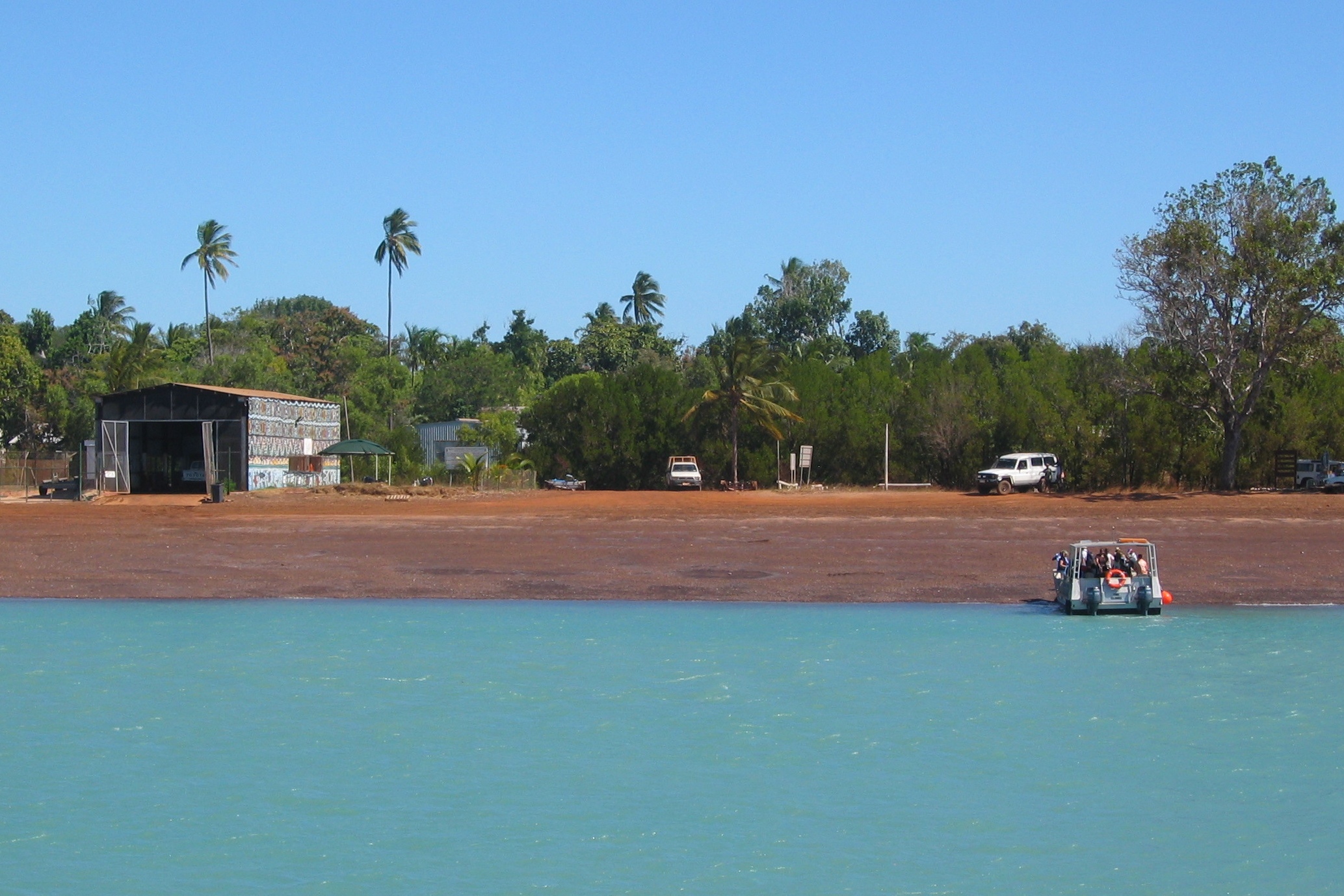
Approaching beautiful Bathurst Island (Tiwi Islands)
Marie Munkara was born in Arnhem Land and spent the first few years of her life on Bathurst Island in the Tiwi Islands. She left there when she was 3 years old, and didn’t return until she was 28. These stories, she says, are drawn from those told to her by friends and family, and are set, I think, in the early to mid twentieth century. She explores a wide range of issues reflective of indigenous-white contact at that time, including education and religion, the stolen generation, sexual abuse, the introduction of alcohol and disease, and anthropological research.
Munkara sees humour in everything (more or less) but her more biting humour is reserved for the “mission mob” because, of course, it is they who wield the power over the “bush mob”. The “bush mob” are shown to be intelligent and resourceful but no match for the power of the muruntawi (white people). Her language draws on a wide range of traditions – including indigenous storytelling, biblical, common clichés – and from these she tells stories that are only too believable. Here she tells us about one of the Brothers:
And so time passed and the natural progression of things came to be and the bullied became the bully, and the bully became the misogynist, and the misogynist became a Brother in a Catholic mission in a remote place in the Northern Territory… (“The sound of music”)
A too familiar story, told in a biblical tone. There is a funny story in which the “bush mob” tries to lead an anthropologist astray by feeding him incorrect information (such as obscene or silly names for ordinary objects), but their victory is Pyrrhic, as the end of the story conveys:
And after all, it was difficult sometimes to tell the difference between the missionaries and the madmen and the mercenaries because their eyes all looked the same and their tongues all spoke the same language of greed. If it wasn’t your soul they wanted, it was something else. Until it became an automatic response whenever a strange muruntani appeared to put out your hand for the specimen bottle to piss into or extend your arm for a blood sample to be taken or for the ungracious thought to pass through their mind that here was yet another who had come to take but as always gave nothing in return. (“Wurruwataka”)
Her stories about the stolen generations are particularly bitter, but again she uses humour. She tells the story of Marigold (née Tapalinga) who’d returned “home” after years away, only to find that she no longer fit, but:
Nor did Mrs Jones want the hussy back as their servant having sprung the little slut underneath Mr Jones in the spare room. The poor man was still traumatised by the ordeal. This wasn’t the first time she’d raped him, he claimed. (“Marigold”)
Only an indigenous writer could write something so patently ridiculous on this topic – and so drive the point home!
Munkara neatly tracks the Bishop’s behaviour and impact on his flock by constantly changing her epithet for him. In the first story, “The Bishop”, he is introduced as “his Most Distinguished” but is then referred to by various names including “his Most Garrulous”, “his Most Impatient” and “his Most Impious”. This changing of names for the Bishop is rather unsubtle humour but it carries a sly comment on the “mission mob’s” disrespect for indigenous culture by insisting on naming indigenous people, completely ignoring the fact that they have their own names. And so, in the first story, we are introduced to Matthew, Mark, Luke and John, to Epiphany, Lazarus, and John the Baptist, to name just a few of the cast of characters populating the book.
Another technique Munkara uses is to pepper her stories with white culture sayings and clichés, such as, “misery loves company alright”, “looking on the bright side”, “but you just can’t please everyone”, and this one:
And so it came to be that for the first time ever, the mission mob found themselves sitting where they’d never sat before – between a rock called ‘you didn’t see that one coming did you’ and a hard place called ‘bush mob’s indifference’. (“The good doctor”)
Overall, this is deceptively simple but clever writing that sets up and undermines its premises every step of the way. First “the mission mob” seems to be winning, and then “the bush mob”. However, while it could be said that “the bush mob” were “clever individuals who had learnt to sit on the wobbly fence of cultural evolution without falling off”, the real truth is that
They didn’t have to die to go to hell because the mission had happily brought that with them when they’d arrived unasked on the fateful shores of the place that was their heaven all those years ago. (“The movies”)
A spoonful of sugar, they say, makes the medicine go down, and that’s certainly true of this book. The sugar is not so strong though that you miss the medicine. Munkara makes sure of that – and the end result is a very funny but also very sobering book. I suspect and hope that Munkara has more … because the missions are only one facet of the history of contact in Australia. There is plenty for her to sink her teeth into.
Australia’s version of the Oscars – the AFI (Australian Film Institute) Awards – was held last night and, as my post title announces, Animal Kingdom (which I reviewed a few months ago) won, deservedly I think, almost every major category . The major awards were as follows:
BEST FILM: Animal Kingdom
BEST DIRECTION: David Michôd, Animal Kingdom
BEST ORIGINAL SCREENPLAY: David Michôd, Animal Kingdom BEST ADAPTED SCREENPLAY: Stuart Beattie, Tomorrow When the War Began BEST LEAD ACTOR: Ben Mendelsohn, Animal Kingdom BEST LEAD ACTRESS: Jacki Weaver, Animal Kingdom BEST SUPPORTING ACTOR: Joel Edgerton, Animal Kingdom BEST SUPPORTING ACTRESS: Deborah Mailman, Bran Nue Dae (also reviewed)
BEST FEATURE LENGTH DOCUMENTARY: Contact
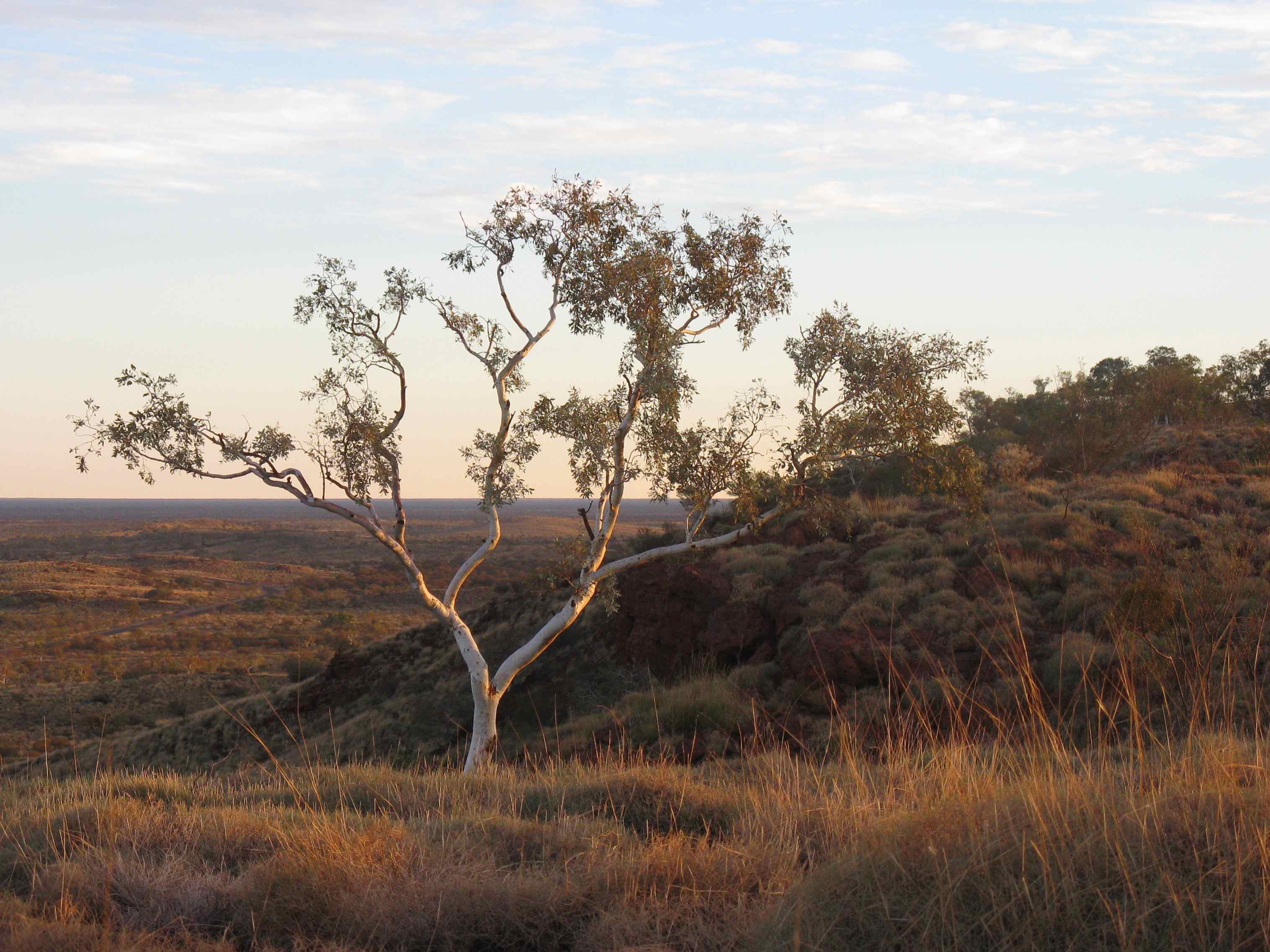
In the Pilbara (part of the homelands of the Martu people) taken by me in April this year.
Animal Kingdom is one of the grittiest films I’ve seen this year, while Bran Nue Dae has to have been the cheeriest. In between these two on the “grittiness” continuum is Bright Star, another favourite of mine from this year’s awards. It received multiple nominations and won in three categories: Best Cinematography (Greig Fraser), Best Production Design (Janet Patterson), and Best Costume Design (also Janet Patterson).
Finally, I was pleased to see that Contact won the Feature Length Documentary award. It tells the story of the first contact a group of indigenous Martu people had with white society in 1964. At the time, they were one of the last – if not the last – indigenous Australians to still be living traditionally with no knowledge of or contact with modern Australia. Amazing, eh? Just shows how big – and empty – Australia is.
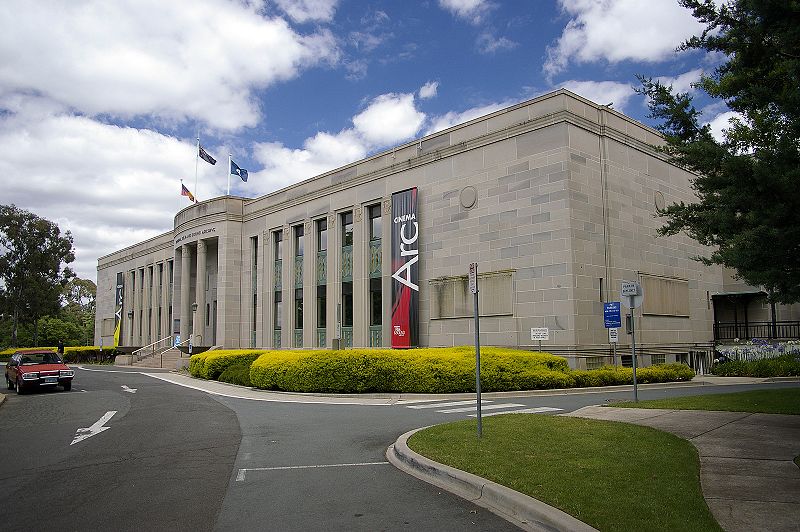
Exterior of my previous home-away-from-home (Courtesy: Bidgee, via Wikipedia, using CC-BY-SA 3.0)
Ok, I know that “synchronicity” doesn’t really scan with “mystery” but it just felt right.
Last night, wearing one of my hats, I attended the National Film and Sound Archive‘s event, Coo-ee: Sound Day: Sounds of Australia 2010. (Phew, that’s a mouthful isn’t it?). Sounds of Australia is an NFSA initiative aimed at creating a register of recorded sounds that Australians deem significant. These sounds can be songs, speeches, jingles, sporting announcements, and so on. Anyone can nominate, and the final selection for each year’s additions is made by a judging panel.
Well, I was astonished (but pleased) to find that one of this year’s additions is Oodgeroo Noonuccal reading one of her most famous poems, We are going. This poem appeared in her first 1964 anthology as well as in My people which I listed in this week’s Monday Musings post. It was one of the poems that I remembered from my youth and considered using in that post. You can hear her, clear and strong, online at the Sounds of 2010 website – scroll down to 1986. Here are the last lines of the poem:
The scrubs are gone, the hunting and the laughter.
The eagle is gone, the emu and kangaroo are gone from this place.
The bora ring is gone.
The corroboree is gone.
And we are going.
Tara June Winch (Courtesy: Friend of subject, via Wikipedia, under CC-BY-SA 3.0)
It’s important I think that my third post be on our indigenous writers. Again it’s going to be pretty idiosyncratic as my reading in this area has been scattered, not for lack of interest so much as the old “so many books” issue that we all know only too well. I was first introduced to indigenous writing at high school where I had two inspirational teachers who encouraged us to think seriously about human rights. It was then that I bought Oodgeroo Noonuccal’s (or Kath Walker as she was then) book of poetry, My people.
In my first Monday Musings post, I mentioned David Unaipon who is generally recognised as the first published indigenous Australian author. However, it was Oodgeroo Noonuccal, with her book of poetry, We are going (1964), who heralded contemporary indigenous Australian writing. So let’s start with her.
Noonuccal’s poetry is largely political. She wrote to right the wrongs which indigenous Australians confronted every day: the racism, the white-colonial-slanted history, the lack of land rights, and so on. Much of her poetry is therefore strong but accessible “protest” poetry. My people collects poems from her first two books and includes new works as well. Here are just a few lines to give you a sense of what she was about:
… Do not ask of us
To be deserters, to disown our mother,
To change the unchangeable.
The gum cannot be trained into an oak.
(from “Assimilaton – No!”)
Gumtree in the city street,
Hard bitumen around your feet,
Rather you should be
In the cool world of leafy forest walls
And wild bird calls.
(from “Municipal gum”)
I love the way she uses gums to represent her people – who they are, where they should be. Some of the poems are angry, some are conciliatory, and others celebrate her culture. I loved the book then, and I still value it now.
The next book in my collection, chronologically speaking, is Sally Morgan’s memoir My place. Sally Morgan is primarily an artist but her memoir became a best seller when it was first published. In it she chronicles how she discovered at the age of 15 years old that her colour did not come from an Indian but an Aboriginal background, and her subsequent investigations into her family’s rather controversial story. I don’t want to go into the controversy here. Rather, the point I’d like to make is her story-telling: it is warm, funny, and thoroughly engaging.
Women of the centre (1990, short life-stories); Black chicks talking (2002, short life-stories produced in film, book, theatre and art)
Telling stories is an intrinsic part of indigenous Australian culture. It’s how traditions have been passed on for 40,000 years or more. It’s probably simplistic to draw parallels between traditional story-telling and the telling of stories in general. After all, we all love stories. Nonetheless it is certainly clear from the little experience I’ve had and the reading I’ve done, that story-telling is an intrinsic part of indigenous Australian culture and is becoming an important way of sharing their experience with the rest of us. This was powerfully done in Bringing them home: The stolen generation report of 1997 which contained not only the history of the separation of children from their parents and recommendations for the future, but many many first person stories which drove the drier points home.
Two books that I’ve read which contain personal stories by indigenous women are Women of the centre and Black chicks talking. The introduction to the former states that its aim is to help we non-Aboriginal Australian readers to understand lives that are so different from our own and “to provide personal written histories for the descendants of the women involved”. This latter is becoming an urgent issue in indigenous communities today – the capturing of story before more is lost. In Black chicks talking Leah Purcell interviews nine Aboriginal woman – some urban, some rural, some well-known, some not – about their lives. Another wonderful read.
Life stories/memoirs represent, in fact, a significant component of indigenous literature. Another work worth mentioning, though I’ve only seen the film and not read the book (shame on me!), is Doris Pilkington’s “stolen generation” story of her mother’s capture and subsequent escape involving an astonishing trek home, Follow the Rabbit-Proof Fence.
Finally, a brief mention of three recent fictional works, two of which I’m ashamed to say are still in my TBR pile. These are the two David Unaipon Award winners by Tara June Winch and Marie Munkara. If you are interested in the latter, please check Musings of a Literary Dilettante’s review.
I have though read Alexis Wright’s Miles Franklin Award-winning Carpentaria. It’s set in a fictitious place, tellingly called Desperance, in northern Australia. Its focus is colonialism (ie European invasion of the land), and conflict within black communities about how to respond. To explore these, Wright touches on lot of ground, including land rights, deaths in custody, mining rights, boat people, and petrol sniffing to name just a few. She flips between the real and the magical, she uses language that is image-rich and often playful, and she tells some very funny stories. It’s a big, wild and rather complex read that manages in the end to be hopeful despite itself.
This is just a small introduction to the wealth of Australia’s indigenous literature. It won’t be the last time I write about it. I will also in the future post on white Australians who have written about Aboriginal Australians, writers like Thomas Keneally who wrote The chant of Jimmie Blacksmith but who now says he wouldn’t presume to write in the voice of an indigenous Australian. A vexed question really. I believe there should be no “rules” for writers of fiction and yet, sometimes perhaps, it is best not to appropriate voices not your own. But that is a question for another day…
Meanwhile, back to Alexis Wright – and stories:
Old stories circulating around the Pricklebush were full of the utmost intrigues concerning the world. Legends of the sea were told in instalments every time you walked in the door of some old person’s house. Stories lasted months on end, and if you did not visit often, you would never know how the story ended. (Carpentaria, p. 479)
In my recent on the literary road post, I referred briefly to Indigenous Australian stories. Rather coincidentally, I have just spent three days at a conference titled Information Technology and Indigenous Communities, hosted, primarily, by the Australian Institute of Aboriginal and Torres Strait Islander Studies (AIATSIS) with the aim of exploring “the ever-increasing use of IT to access, create and collate tangible and intangible cultural information and heritage”. That’s the background – now onto more the interesting stuff!
A warning and a story: Narbulwinjbulwinj is a dangerous spirit who eats females after killing them by striking them with a yam
As I said in that literary road post, indigenous Australians have a rich story-telling culture. Theirs was a non-written culture and so stories and traditions were passed on orally and via art, music and dance. All these forms of communication have continued post-contact but, due to breaks in contact with country, many stories and traditions have, tragically, been lost. It was consequently encouraging to hear, at the conference, about how remote indigenous communities are using modern digital technologies to tell stories – traditional and modern – and thereby re-engage with and reinvigorate their culture.
I hope this doesn’t sound paternalistic because it is not meant to – and I hope it also doesn’t suggest that the real problems don’t exist – but it was exciting to hear positive stories about these communities because most of what we, living in predominantly white urban Australia, hear are the negative – and hopeless sounding – stories of substance abuse, domestic abuse, and the awful health problems that are resulting in unacceptable disparities in life expectancy.
We were given a wonderful taster of what is being produced at the film night held on the first evening of the conference. We saw films by professional artists such as Warwick Thornton and Tracey Moffatt and by makers from various remote community projects. You can see a couple of these on the internet:
Muthi Muthi (live action music clip, the Mulka Project)
If you’d like to see more, here are a couple of sites, both providing access to self-produced and home-grown audiovisual content:
Mulka Project from the Yolngu people in northeast Arnhemland – and to see some of the variety of their work, using live action, animation, archival footage, check their YouTube site
IndigiTube, which contains media produced by a number of remote indigenous groups. If you click on Watch Videos you will see on the right hand side the variety of topics the videos cover from informational to “creative”, from traditional to modern.
But none of this is easy:
resources are minimal, so people spend way too much time writing grant applications – not just to run projects but for their very existence;
training is difficult and tends to be organised in-house often by people already stretched too thinly; and
access to the Internet is expensive, usually slow, and flakey or non-existent – the digital divide is a fundamental problem. (This was well demonstrated at the conference when they could not get a Skype session to work from a remote community in central Australia but could for a speaker from Montreal).
In other words, the challenges are immense, but the commitment and creativity are inspiring. There’s a long way to go and what culture has been lost is unlikely to be found, but the opportunities digital technologies offer for people to re-engage with each other, their communities and their culture are immense. It was a privilege to be able to there.
Last month, Mr Gums and I holidayed in the Top End (of Downunder). I’m not quite sure where the Top End ends as it is a loose description for the northern part of Australia’s Northern Territory, but I believe it encompasses all the areas we visited. For ten days, we explored Katherine and Nitmiluk National Park for the first time, and re-visited Kakadu National Park and Darwin. Besides the fact that we love exploring Australia, it provided a good opportunity to escape the cold. The maximum in our city the day we left was 7.8degC. In Darwin, that same day, it was 32degC. A little different, n’est-ce pas?
Gorgeous gorges in Nitmiluk National Park
Landscape
The landscapes here are ancient (dating back 1650 million years and more) and are home to some weird and wonderful flora and fauna, of which the crocodile is probably the most (in)famous. Like most landscapes, they have inspired many artists: writers, painters, songwriters, filmmakers (thinkJedda and Crocodile Dundee for a start) and so on. And there is a rich and fascinating indigenous culture to learn about.
Jedda Rock, Nitmiluk National Park, taken from a helicopter
We didn’t really spend much time tracking white culture in the area, as I have in my other “literary road” posts, so I will just mention Charles Chauvel’s film, Jedda. Jedda (1955) is notable for a couple of reasons. Firstly, it was the first Australian film shot in colour. But, more significantly, it was the first to use indigenous actors in leading roles – and to confront some of the implications of white colonisation on indigenous Australians. It was shot on location in the Northern Territory, with the final tragic scene being shot at what is now called Jedda Rock at Nitmiluk. However, that footage was lost in a plane crash, and the scene was re-shot in rather different landscape – the Blue Mountains just west of Sydney! As a retired film archivist, it was special to me to see this rock.
Indigenous culture
There are stories here ...
We took as many opportunities as we could to learn more about indigenous culture, as there are far fewer prospects for doing so down south.
The best way for short-term tourists like us to do this is to join tours, particularly those which have indigenous guides – and so this is what we did. The most interesting of these tours were:
Through these, we added to our slowly growing knowledge of how indigenous people relate to country and of their food and cultural practices. We dug for yams, threw spears and ate green ants. It was all good!
As KevinfromCanada wrote in one of his posts, indigenous people tend to have a strong oral story-telling tradition, and this is the case with indigenous Australians. No only did we hear some of their creation stories – and saw rock art depicting these stories – but we also heard more recent life stories, some humorous, and some not so. This story-telling reminded me of a rather infectious book recently reviewed at Musings of a Literary Dilettante, Every secret thing by new Australian indigenous writer, Marie Munkara. I have dipped into it, as it’s currently next to my bed, and it reads like an orally told story. Anyhow, it was a real privilege to have these stories shared with us.
… and in conclusion
...but he can smile at you!
This was our second trip up north and won’t be our last. I could ramble on more about sites seen and lessons learnt but I’d rather leave you wanting… And so, because you know I like a bit of nonsense, I will finish here with the following, rather apposite words for the Top End:
Never smile at a crocodile!
No, you can’t get friendly with a crocodile;
Don’t be taken in by his welcome grin;
He’s imagining how well you’d fit within his skin!
Never smile at a crocodile!
(Words by Jack Lawrence)




 Whispering Gums