Melissa Lucashenko, The silent majority (Review)

I have reviewed many individual short stories by Americans (through the Library of America), but not by Australians. Time to rectify that a little, and why not with a short story by Melissa Lucashenko, an Australian writer of European and indigenous Australian heritage. She is an award-winning novelist and an essayist, but I hadn’t read her – until now.

You might be wondering why I chose her and this story? But it’s obvious really. I was pottering around the web and came across this:

It is a truth universally acknowledged, Jo decided, that a bored teenager with a permanent marker is a pain in the bloody neck.

How could I go past it? I had to read it to see what it – and Lucashenko whom I was keen to read – was all about. It’s a short, short story, well suited, I suppose, to publication in a magazine like the Griffith Review. Jo is a single mum of indigenous heritage and during the course of the story is mowing the grounds of the cemetery in the small northeastern NSW town of Mullumbimby. Her teenage daughter Ellen is supposed to be babysitting her young nephew Timbo while Jo does her mowing but, like a teenager, gets bored and “tags” Timbo with slogans such as “Better Conditions or I ring DOCS*” and “Pay me a living wage”. The daughter is needling her mother, but there is of course double meaning for the reader in these slogans, messages about the conditions many indigenous Australians face.

The story mainly comprises Jo’s thoughts as she gets on with her mowing. She reflects on those who lie in the ground beneath her – the Protestants and Catholics, in their separate sections. They are the literal “silent majority” of the title, and she wonders about their stories, now lost with the erasure by time of their details on the gravestones. Jo wonders about

These stories that had once been so important to the town, that had needed carving in granite: where were they now.

Stories, though, are important to Jo – and, in my experience, are an important treasured part of indigenous Australian culture. Jo is a little worn by her “previous life and its discontents” in which an Eeyore-like man Gerry kept dragging her into “his tight white world”. In fact, she appears not to have much time for people, with her “favourite humans living in the pages of books” and her preferred living creatures being horses. She quotes Walt Whitman – I found that interesting – on horses:

They do not sweat and whine about their condition.
They do not lie awake in the dark and weep for their sins.
… not one is demented with the mania of owning things.

Hmmm … this certainly conveys to me a sense of cynicism about humans, of all colours. But the real point of the story comes in the third last paragraph, with her pondering on what the land was like before, when it was

not yet doomed by the axes and greed of men who – months and years from anything they thought of as home – had tried to slash and burn their way to freedom here.

So what we have here is a meditation, in a way, on stories and their importance, on animals and land, and on walking a line between white and indigenous culture. It’s not all melancholic, as what I’ve said here might suggest. There are some touches of humour. Overall, I was intrigued by her writing and I liked the story, though it felt a little undeveloped. I understand that Lucashenko’s next novel is set in the Mullumbimby area. I wonder whether this story is part of it – or, at least, whether Jo appears in it. I hope so.

Melissa Lucashenko
“The silent majority”
Published in the Griffith Review, Edition 26, November 2009
Available: Online at the Griffith Review

*The Department of Community Services which is feared by struggling parents for fear their children will be taken away.

Jeanine Leane, Purple threads (Review for Indigenous Literature Week)

What I especially like about Jeanine Leane’s book, Purple threads, is how well she draws the universal out of the particular. That she does this is not unusual in itself. After all, this is what our favourite books tend to do. The interesting thing about Purple threads, though, is that the particular is an Indigenous one. Even as I write this post my mind is flicking back-and-forth between thinking about the Indigenous Australian themes in the book and the more universal ones about family and relationships. More on that anon. First, I want to say a little about the book’s form, because ….

I’m not sure whether to call Purple threads a novel or a book of connected short stories, except I don’t think it matters much. What is significant is that the stories revolve around a mostly female-only Indigenous Australian family living on a small piece of land in the Gundagai area of New South Wales in the 1950s to 1960s. The main characters run through the whole book, and the stories are told pretty much chronologically. There could even be a plot line or two, but they are not strong and are not what drive us to read on. This form had an eerie familiarity as I was reading and I realised it was because it reminded me of another David Unaipon Award winning book I have reviewed here, Marie Munkara’s Every secret thing. Is this a coincidence – after all, there are similar books by non-Indigenous writers – or should I go out on a limb and wonder whether this form reflects an Indigenous Australian way of story-telling? In addition to this similarity in form, these two books share a particular style of humour. Munkara’s is probably more belly-laugh, and is definitely more gut-wrenching, but both have a self-deprecating element, a willingness and ability to laugh at themselves, to see the absurd. It’s a form of humour we also see in Alexis Wright‘s Carpentaria. Okay, enough of that, back to the book itself.

The stories are told first person by Sunny (Sunshine) who lives with her sister Star, and her grandmother, Nan, and aunts, Boo (Beulah) and Bubby (Lily). Her mother, father, grandfather, more aunts and uncles, and others in the community, also appear in the book, but these five named characters are the focus. They are well differentiated. Nan is the down-to-earth matriarch of the group who doesn’t know how to read but “sure as hell know[s] how ta think”. Boo is independent and feisty, the one who takes action when action is needed. She loves the ancient Romans, particularly Empress Livia “who knew how to work behind the scenes”. Bubby, on the other hand, is the gentle, romantic one, who loves Emily Bronte and Wuthering Heights. The stories chronicle the first two decades of Sunny’s life in this female-dominated household. There are anecdotes about walks with Aunty Boo, about spoilt Petal (Sunny and Star’s mother), and about interactions with neighbours, teachers and others in the community. Most of the stories are light, albeit with a good degree of bite, but some are dark, such as the story of the young white neighbour, Milli, who is regularly beaten by her husband. This story, in fact, forms a minor plot line in part of the book.

The universal themes are about the way families comprise different and sometimes conflicting personalities and yet manage to love and support each other to ensure their joint survival. The particularity, though, has to do with being Indigenous, with being lesser, in a rural community. Leane handles this cleverly, using, for example, the Christian symbol of “the black sheep” throughout the book to tease out the ironies and complexities packed into this idea when it is played out in a sheep-farming community. The symbol is explicitly introduced to us in “God’s flock” where Sunny talks about going to church and being taught the story of “the black sheep”:

‘ … But Jesus, if we pray to him [the priest says], will find all the lost sheep and return them to the fold, even the black sheep that no one  else wants or loves.’

At least this bit made sense to us. Apart from Jesus, we didn’t know any other sheep farmer who loved black sheep. Most hated them, in fact. That’s why every year my Aunties always ended up with a few black lambs to raise ….

Leane shows how Nan and the Aunties navigate life in a world where “black was not the ideal colour” and in which “women livin’ by themselves are always easy targets”. They navigate it with dignity, often by pretending to go along with white society’s ways while staying true to their own values, which involve respecting and caring for other people and creatures and for their little bit of land.

Purple threads, apparently drawn from Leane’s life, provides an engaging but uncompromising insight into a life most Australians know little about. I hope I’m not being too pompous when I say that we need more books like this, and they need to be read by more people, if we non-Indigenous Australians are to have a chance of truly comprehending the experience of being Indigenous in our nation.

Read for ANZLitLovers Indigenous Literature Week, for which Lisa has also reviewed it.

Jeanine Leane
Purple threads
St Lucia: University of Queensland Press, 2011
157pp
ISBN: 9780702238956

(Review copy supplied by University of Queensland Press via ANZLitLovers blog giveaway. Thanks Lisa. Thanks UQP)

* I have assumed copyright permission for this cover on the basis that the book was provided by UQP

Monday musings on Australian literature: Kimberley dreaming

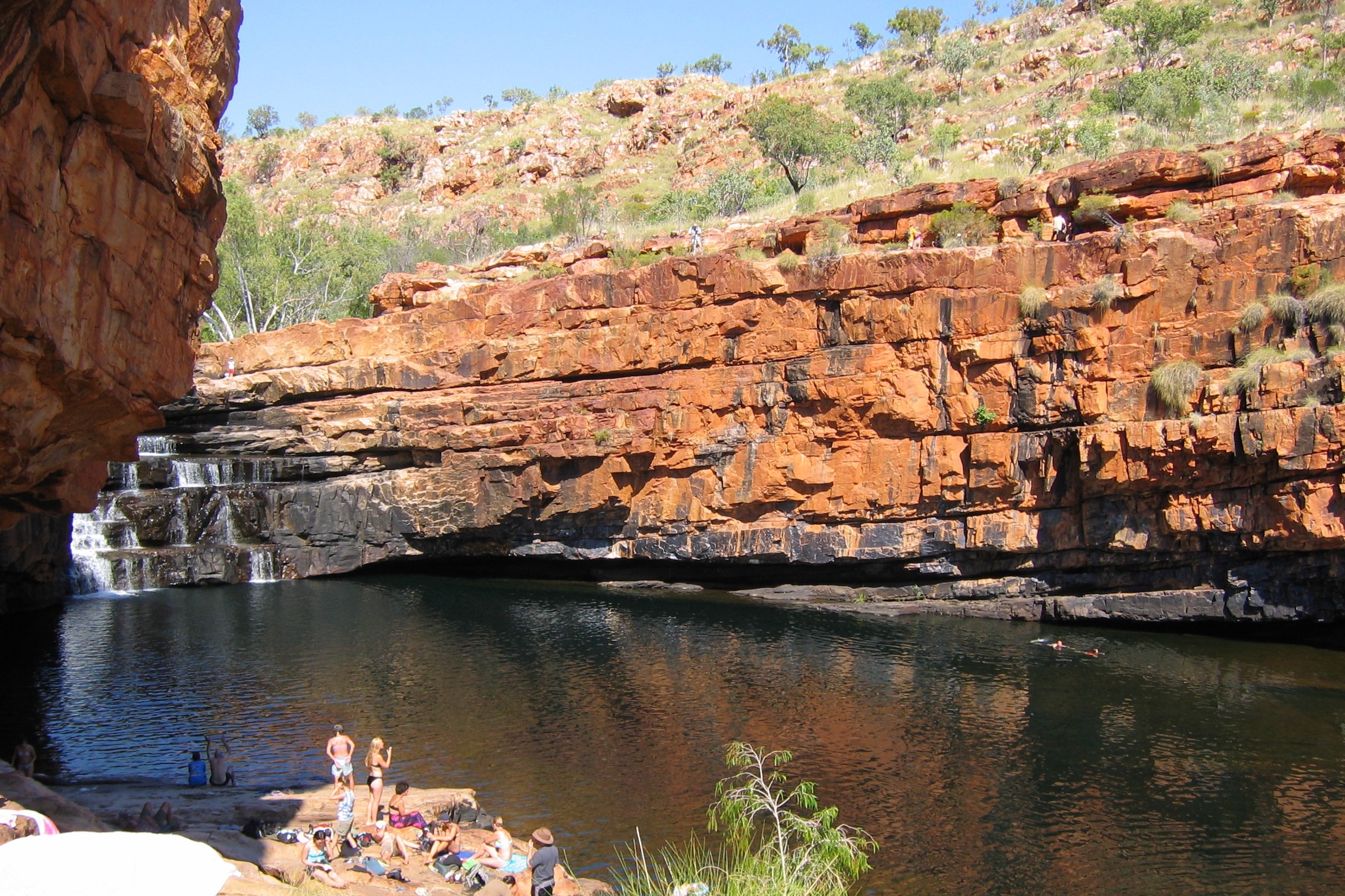
Waterhole in the Kimberleys

Waterhole in the Kimberleys

The Kimberley region of Australia is a place of dreams. The most enduring and significant of these are, of course, those belonging to its indigenous inhabitants who have been there, it is believed, for around 40,000 years. Jump forward to recent centuries and we find new dreamers – the pearlers, the gold prospectors, the pastoralists,, the farmers (with their ambitious Ord River Scheme), the miners and, most recently, the tourists.

It is a huge region occupying an area that is about three times the size of England and it is beautiful, with its beaches, gorges, waterfalls, rivers, lakes and stunning sandstone and limestone rock formations. It has a long and rich indigenous culture and a fascinating, if not always admirable, colonial history. In other words, it’s a region that is of much interest, historically, culturally, socially and geologically.

The most famous book about the region is, surprisingly, a history,  Mary Durack‘s Kings in grass castles (1959), which chronicles her family’s story from their migration from Ireland in the mid-19th century to their life as Kimberley pastoralists in the mid-20th century. Durack wrote other histories, as well as novels, children’s books, and articles. She wrote sympathetically about the indigenous inhabitants and provided practical help and support to indigenous writers and artists.

Many Australian writers, including some I’ve mentioned in recent Monday Musings like Ion Idriess and Henrietta Drake-Brockman, have set writings in the area. Novelist Dora Birtles describes the town of Wyndham:

Wyndham lay flat under the moonlight, its main street, its corrugated iron roofs, its mud flats by the mangrove edges, drawn into main relief, in highlight and dark shadow like the strong, rough contrast in a lino-cut, white and black. The salt pans glittered sharp as ice. It was not without beauty in its starkness…

Other writers who have written about the area include Leslie Rees and Randolph Stow, who worked at a mission for several months and used this experience in his novel To the islands.

A more recent Australian writer who has set writing here is Tim Winton, in Dirt Music. In an interview he said:

Lu gets to see something of the endurance and power of Aboriginal wisdom. For someone like him, a southerner if you like, with farming connections, he’s mostly been exposed to indigenes as victims, and being in the remote parts of the Kimberley he sees more power, more confidence, more evident, extant culture that resonates, educates him in an oblique way.

But I’ll conclude with a poet I don’t know, because his description conveys a wonderful sense of the region, some of which reflects my own, admittedly brief, experience:

Fire-red mountains, fissured and caverned,
lilac-hazed ranges, red-purple ravines,
have reared round, receded, and reappeared
all  day through my vision. This is the region
of baobab trees, of monstrous obese
baobabs squatting in chaos of sun-fired,
sun-blackened boulders in the ranges’ ravines.

— Ronald Robinson, “Kimberley Drovers”

Thanks to Peter Pierce’s The Oxford Literary Guide to Australia, Oxford: Oxford University Press, 1983, for the bulk of the literary background in this post.

unDISCLOSED, the second national indigenous art triennial

Indigenous Australian art has, over the last few decades, become big business in Australia and overseas, and for good reason. It is unique and it is beautiful. Most Australians, I suspect, only know of the “traditional” dot painting style of the Central Australian Desert and perhaps the wood carvings of the Torres Strait Islands. However, contemporary indigenous artists are producing works across the whole art spectrum from traditional painting to modern sculpture, from digital photography to video installations, and it is this variety that is currently on exhibition at the National Gallery of Australia in its second national indigenous art triennial titled unDisclosed. The first triennial was titled Culture Warriors and was, I understand also exhibited in Washington DC.

The exhibition is organised thematically, with the themes speaking to traditional relationships with country and people as well as to more modern concerns regarding identity and the ongoing effects of oppression. They are:

  • Family, Ritual and Country
  • Invisibility, Silence and Memory
  • Belonging
  • Manifesting Presence
  • Revelation

Twenty male and female artists spanning a wide age range are represented. While there wasn’t a piece of work I didn’t enjoy, the works that spoke most to me were those in which political comment was woven into gorgeously conceived art with an indigenous sensibility.

Particularly clever are two works about colonisation by Michael Cook, Broken Dreams featuring a woman and Undiscovered featuring a man. Each work comprises 10 photographs that comment on indigenous experience of colonisation in a surprising and mind-bending way. In Broken Dreams, a beautifully dressed indigenous women is pictured in England of the late 18th century. As the sequence progresses, moving across the sea to Australia, she is gradually undressed. In the second last photograph, she is bound by rope. The photos are simple – in their muted tones and uncluttered composition – and complex in their iconography. What, for example, is the role of the colourful lorikeet which accompanies the woman on her journey? This is the sort of work that invites conversation.

Another mesmerising work is Christian Thompson’s Heat which comprises a “large-scale three-channel projection of three young Aboriginal women, sisters, each on a separate screen”. We see only their heads and bare shoulders against a plain background. They stare into the camera – and therefore at us, the viewers – with only the occasional blink. Sometime during the projection, which runs for a little over 5 minutes, wind catches their hair which becomes alive and waves about their heads and faces, while they maintain their steady stares. (How they didn’t sneeze, I’ll never know!) The symbolism of the hair is complex and invites us to consider women’s hair, personally, historically and mythologically. It makes us think about the relationship between hair and wildness, beauty and, of course, the power held by and over women.

My third selection, for the purposes of giving you a flavour, is Nici Cumpston’s set of four large landscape works which were created by combining photography with inkjet printing, watercolour and pencil. The images all depict aspects of Nookamba Lake (aka Lake Bonney to “the interlopers”) which is part of the damaged Murray-Darling River System. The lake, now stagnant, was once part of a flourishing system supporting a rich indigenous life. Cumpston’s stark images – with their muted colours – contain evidence, if you know where to look, of that past life while also conveying the current degradation. And yet, paradoxically, the images are beautiful too. I sometimes wonder whether such beauty – though admittedly stark – can undermine the message?

The exhibition’s curators, on an the interpretive panel, describe Heat as saying:

 We are here; We are strong; We have survived.
And that is, indeed, what the whole exhibition says, loud and clear, and with a confidence that is inspiring. It is well worth seeing … I wonder if the triennial could turn into a biennial!

(Note: I have not included images of any of the artworks here for copyright reasons)

Monday musings on Australian literature: Noongar/Nyungar, and the importance of place

Conceptions of home and understanding of place are the central issues in Noongar author Kim Scott‘s Miles Franklin award winning novel, That deadman dance, which I reviewed last year. From the opening pages of the novel Scott explores notions of home, as the white settlers confront the indigenous inhabitants of the land they are trying to colonise.

Here is the main indigenous character, Bobby:

And then Bobby found a sheet of granite, and a small rock hole covered with a thin stone slab and filled with water.  He crouched to it, touched the stone, and sensed home. Something in the wind, in plants and land he’d at least heard of, and increasing signs of home. There were paths, and he knew where there’d be food […] Bobby closed his eyes, felt the wind tugging at his hair and rushing in the whorls of his ears. Breathed this particular air. Ngayn Wabalanginy moort, nitjak ngan kaarlak … Home (pp. 235, 238)

And here is the main would-be pastoralist settler, Chaine:

With no boat Chaine felt his loneliness … It was land he’d hoped for – pastoral country, with good water and close to a sheltered anchorage. But he had tried and been disappointed. It deflated him. (p. 239)

These occur during a long trek which Chaine and Bobby make when Chaine’s boat hits a reef and founders. Chaine thinks Flinders’ journal will provide the guidance he needs while Bobby, in country unfamiliar to him, relies on his understanding of the land’s clues. “This way, we go this way, follow the creek away from this spring and this estuary”, says Bobby, while Chaine insists “they keep to the coast … so he could catch sight of the sea every now and then”.

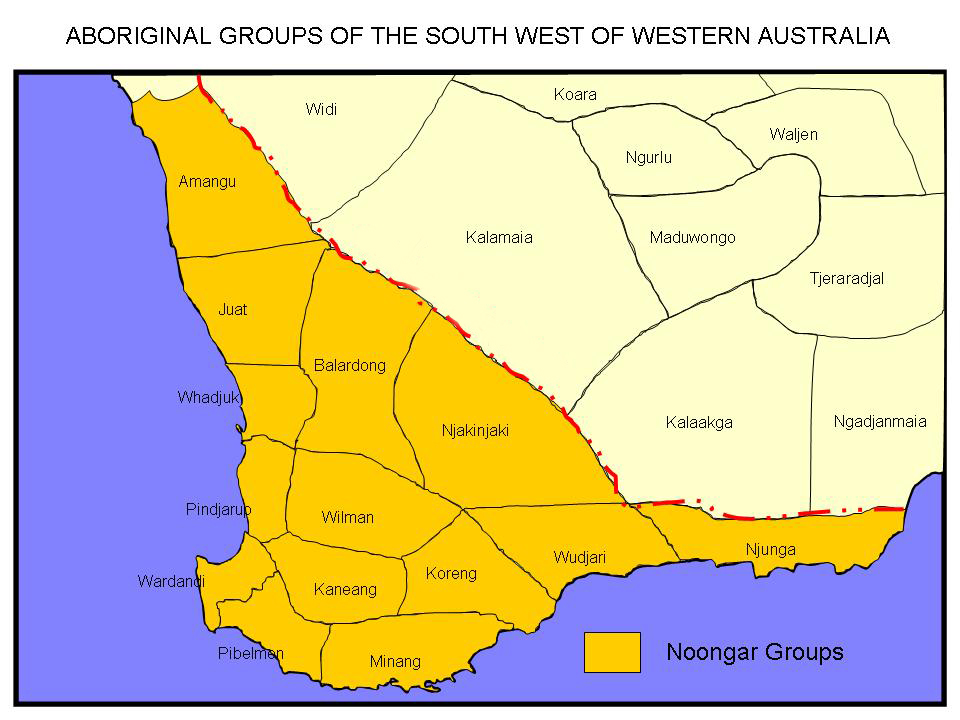
noongar1

Courtesy John D Croft, English Wikipedia, using CC-BY-SA-3.0, via Wikimedia Commons

All this is to introduce a fascinating seminar I attended today, at the Australian Institute of Aboriginal and Torres Strait Islander Studies. It was given by Associate Professor Len Collard, a Nyungar* scholar researching Nyungar place names, using an ARC research grant. The English title of his talk was “I am creating the knowledge of Country place names: from the past to now and into the future”.  His aim is to document Nyungar place names in Western Australia’s southwest on the basis that naming place confirms or establishes “ownership”. The project aims at

  • supporting reconciliation,
  • encouraging environmental understanding,
  • helping tourism ventures, and
  • “closing the gap of Australianness” by creating a common understanding of local indigenous geography.

You’ve probably noticed the alternative spellings I’ve been using to name the people of this area. Alternative spellings are a significant challenge for both indigenous and non-indigenous people studying indigenous culture.  Collard made an interesting point regarding variant spellings. He says that a common reason given is that  the Nyungar (like many indigenous people) encompass several language groups and that the different spellings could therefore have come from different pronunciations, putting, in a sense, the onus of problematic spelling at the feet of the indigenous people. However, he suggests there is another possibility. His project is based on post-colonial historical records produced throughout the 19th and 20th centuries by settlers from a wider variety of countries – England, Ireland, Holland, France, and so on. The different spellings, he suggests, could be due to the way these recorders transcribed, using their own linguistic knowledge, the word/s they heard.

Early in his talk he talked of the “history of constructing the negative” in which indigenous people have been reduced to the role of sidekick in post-colonial Australia. The reason for variant spellings could be read as an example of this. Another is the attitude to indigenous trackers. Their knowledge, Collard said, was critical to the survival of the colony and yet, as Scott shows in his novel, this knowledge was either used ungraciously or, at worst, ignored.

I thoroughly enjoyed the talk, not only for its specific content but also for the way his scholarship intersects with contemporary indigenous literature. Home, land, place … they are important to all of us … recognising and respecting that is a good place to start. I’ll conclude with Bobby near the end of the novel:

On time we share kangaroo wallaby tammar quokka yongar wetj woylie boodi wetj koording kamak kaip … Too many. But now not like that, and sheep and bullock everywhere and too many strangers wanna take things for themselves and leave nothing […] And now we strangers in our special places.

Monday musings on Australian literature: Louisa Atkinson, and indigenous Australians

Louisa Atkinson (1834-1872)

Louisa Atkinson (1834-1872) (Courtesy: Artist unknown, via Wikipedia)

Time for another Monday Musings highlighting an Australian literary pioneer, this time Louisa Atkinson. I came across Atkinson a few years ago when I was researching Australian women writers for Wikipedia. She’s one of those women who achieved much in her field but who, I believe, is little known. She was a journalist, novelist and naturalist. She was born in 1834, in the Southern Highlands of New South Wales, just a couple of hours’ drive from where I live.

There’s a good general biography of her online at the Australian Dictionary of Biography, but here is the gist:

  • She collected and painted plant specimens for well-known scientists of the time including Ferdinand von Mueller, and she is commemorated in the Atkinsonia genus as well as several plant species.
  • She was a rebel when it came to clothing. While, as is typical of her time, she was highly religious, she shocked the good women of her rural neighbourhood by wearing trousers for her naturalist ramblings and pony-riding.
  • She was a well-regarded botanical artist. Twentieth century Australian artist Margaret Preston described her drawings as having “unexpected elegance and extreme accuracy”.
  • She was the first Australian woman to have a long-running series of articles in a major newspaper. This was her natural history series, A Voice from the Country, which ran for 10 years from 1860.
  • AND she is credited as being the first Australian-born woman to publish a novel in Australia. It was titled Gertrude, the emigrant girl: A tale of colonial life (1857). This and her second novel, Cowanda: A veteran’s grant (1859), are available as etexts from the University of Sydney’s excellent SETIS project (to which I’ve linked the titles). Gertrude tells the story of a young immigrant girl hired to be a housekeeper in a country house by Mrs Doherty who, to give a sense of Atkinson’s style, is described in the first chapter as “a small woman, with a brown careworn countenance; the index of generous emotions, strong passions, and acute griefs, which had worn her straight features into sharp outlines, and given a restless keenness to her small dark eyes”.

I have only dipped into Atkinson’s novel, Gertrude, to get a sense of her writing so I won’t write any further on that. What is interesting to explore a little is her experience of indigenous Australians. Elizabeth Lawson in her book on Atkinson, The natural art of Louisa Atkinson, wrote that her father created a model farm, but

Oldbury’s promise was clouded by its exploitation of the convict system and by its dispossession of the local Gandangara people, a dispossession the family at least recognised. And just above the house on a natural terrace of the mountain rose a great Aboriginal grave-mound with carved funeral trees which Louisa was later to sketch. This mound and its increasing desolation stood in silent rebuke of Oldbury’s enterprise, of its new English place-names and all they signified.

Nonetheless, Lawson writes that Atkinson befriended, and retained life-long friendships with Aboriginal people both at Oldbury and in the Shoalhaven area where she spent some time. That she had sympathy for them is clear from one of her columns for A Voice from the Country (22 Sept 1863) in which she wrote:

These unhappy races have become rather a tradition, than a reality, already in many districts …

She describes their lives, their homes, their hunting with a naturalist’s, and sympathetic, eye:

On one occasion, when the remnants of three different friendly tribes had assembled for a grand corroboree or dance, I made plan of the encampment; each tribe was slightly apart trom the other, divided by a sort of street. Thus, the inviters (?) were clustered in the centre, having, I think, seventeen camps; the Picton tribe on the right hand, five camps, and the Shoalhaven on the left, comprising ten or eleven gunyahs, consecutively forming a village.

She also writes:

The men were severe to their wives, striking and even killing them – when under the influence of anger, but I believe these cases were far less frequent when they had not lost virtues and acquired vices from the so-called Christian people who invaded them.

Interesting, and sensitive, observation. She talks of the problem of drinking:

Intemperance is one of the vices so sadly prevalent among them, they know what its fatal results are, lament them, but have not courage to resist. How frequent is the paragraph in the country paper of an aborigine’s death from this cause, how many have sunk unrecorded. A great sin lies on us as a people, for much has been done to injure, and little to benefit the poor original possessors of our farms and runs.

And thus she confirms that thinking about indigenous Australians with a humane and clear-eye did not pop up suddenly in the mid to late 20th century!

Louisa Atkinson tragically died not long after (but not due to) the birth of her first child, when she was only 38. What a lot she achieved in a rather short life – and what an interesting person she would have been to know.

Monday musings on Australian literature: Australia’s first Children’s Laureates

Australian Children's Laureate logo

Logo Courtesy: Australian Children's Laureate

It has been so busy here at Monday Musings that I am late with this announcement … but that doesn’t mean it’s not worth making! On December 6th, 2011, the idea of an Australian Children’s Laureate was inaugurated with the appointment of not one, but two, children’s authors to the role. They are

Alison Lester and Boori Monty Pryor

and they will be our laureates for two years, 2012-2013. I understand that the idea of a Children’s Laureate was instigated in the United Kingdom in 1999. In 2008, the Library of Congress inaugurated a similar role, but called theirs National Ambassador for Young People’s Literature. What’s in a name, eh? The main point is that these initiatives promote reading among children. The Australian program is organised by the Australian Children’s Literature Alliance and on their Laureate website they describe the laureate’s role as follows:

The Children’s Laureate will be an Australian author and/or illustrator of children’s and/or youth literature who is making a significant contribution to the children’s literature canon of this country. The Laureate will be appointed on a biennial basis and will promote the transformational power of reading, creativity and story in the lives of young Australians, while acting as a national and international ambassador for Australian children’s literature.

So, a little about Australia’s inaugural laureates …

Alison Lester (b. 1952)

I became aware of writer-illustrator Lester through my own children when, like most parents who are readers, I sought out good books to read aloud to them. Lester is an author/illustrator best known for her picture books, though she has also written a couple of young adult novels. My favourites were two of her picture books, Imagine (1988) and Rosie sips spiders (1989), and the “chapter” book (as new readers like to call them) Thingnapped, written by Robin Klein and illustrated by Lester. She has a lovely sense of fun while also conveying important values to children (such as respecting difference, a critical value at a time when rejecting other seems to be on the rise again.)

Boori Monty Pryor (b. 1950)

I did not know of Boori Monty Pryor – writer, artist, performer, storyteller – when my children were growing up. In fact, I only heard of him a couple of years ago when a friend lent me his memoir Maybe tomorrow which I reviewed in the early days of this blog. I came across him again last year when he was on the Prime Minister’s Literary Awards panel I attended. He impressed me – in both “meetings” – with his strength, his humour, and his ability and willingness to overcome his anger at the way his people have been treated. He’s an indigenous Australian, and he’s committed to forging good relationships among all Australians while at the same time shoring up traditional culture and values among indigenous people. No easy task, but his appointment to the laureate role is testament to his achievements.

To conclude, I must note that our inaugural laureates are a woman and an indigenous Australian. I’m sure there are many worthy white male contenders out there, but I believe that Lester and Pryor were not token appointments. They are worthy recipients who have proven track records in the quality and significance of their contributions to encouraging reading, story-telling and self-expression among Australian children.

Monday musings on Australian literature: Asian Australian writers

Brian Castro

Brian Castro (Public Domain, via Wikipedia)

Australia is an immigrant country, with the first immigrants, the original Aboriginal Australians, believed to have arrived 40-60,000 (there are arguments about this!) years ago via the Indonesian archipelago. They established what is now regarded as one of the longest surviving cultures on earth. Today, though, I’m going to write on some of our more recent immigrants – those from Asia. The first big wave of Asian immigrants came from China, during the Gold Rush in the mid 19th century. Since then people from all parts of Asia have, for various reasons, decided to call Australia home – and have enriched our culture immeasurably.

I’m not going to focus on the political issues regarding acceptance, promotion and encouragement of Asian Australian writers because, like any stories to do with immigration, it’s too complex for a quick post here. I hope that things are improving, but only the writers and communities themselves can really tell us that.

As has been my practice in these sorts of posts, I’m going to introduce 5 Asian Australian writers to get the discussion going. After that, I’d love you readers to share “immigrant” writers you know and love …

But first, a definition. My focus here will be on writers who emigrated from Asia, rather than those from subsequent generations. I will not therefore be discussing writers like Shaun Tan and Alice Pung.

Brian Castro (Hong Kong born in 1950, emigrated 1961)

Castro is one of the most prolific and most awarded writers among those I’m listing today. He came here as a child, and started writing short stories in 1970. He has, to date, published 9 novels, many of them winning major Australian literary awards. Lisa at ANZLitLovers suggests he is a contender for Australia’s next (should we ever have another one) Nobel Prize for Literature. In 1996, in the Australian Humanities Review, Castro said this about Australia and Asia:

The situation currently is that Australia needs Asia more than Asia needs it. While the West seems to have run out of ideas in the creative and cultural fields, relying on images of sex and violence, reviving old canons and dwindling to parody and satire in what can already be seen as one of the dead ends of postmodernism, the Asian region is alive with opportunities for a new hybridisation, a collective intermix and juxtaposition of styles and rituals which could change the focus and dynamics of Australian art, music and language.

Strong words – but they make you think! My sense is that Australia is now seeing (accepting?) some of this hybridisation that he speaks of – not only from Asia but also from our indigenous authors like Kim Scott and Alexis Wright. I wonder if Castro agrees?

Yasmine Gooneratne (Sri Lankan born, emigrated 1972)

Gooneratne is one of the first Asian Australian writers I read. I have chosen her for that reason and for some sentimental reasons: she holds a Personal Chair in English at my alma mater, Macquarie University, and she is the patron of the Jane Austen Society of Australia! Long ago I read her first, appropriately named, novel, Change of skies (1991). Like many first novels, it has an autobiographical element and explores the challenges of changing skies, of migrating to another place. It was shortlisted for the Commonwealth Writers Prize. She has, in the last decade, received a number of awards here and in the South Asia region for her contribution to literature.

Michelle de Kretser (Sri Lankan born, emigrated 1972)

Like Castro, de Kretser emigrated to Australia in her youth (when she was 14) and made quite a splash with her debut novel set during the French Revolution, The rose grower. Her second novel, The Hamilton case is set in Sri Lanka and represents she says her “considered” farewell to her country of birth. Her third novel, The lost dog, is set in her home-city (now) of Melbourne, but its main character migrated to Australia from Asia when he was 14 and struggles to find his identity. Her books are not self-consciously migrant but tend, nonetheless, to be informed by the experience of dislocation.

Nam Le (Vietnamese-born, emigrated 1979)

Nam Le is our youngest migrant in this list, arriving here when he was less than 1! His debut book, the short story collection, The boat (2008), won multiple awards and is remarkable for its diversity of content (setting and subject matter) and voice. I, like many others, am waiting to see what he produces next.

Ouyang Yu (Chinese born, emigrated 1991)

To my shame I hadn’t heard of Ouyang Yu until relatively recently, but I do have an excuse. He has only written three novels in English and two of them very recently: The eastern slope chronicle (2002), The English class (2010), and Loose: A Wild History (2011). He is, however, a prolific writer, of, apparently, 55 (yes, 55!) books of poetry, fiction, non-fiction, and translated works in English and Chinese. He’s translated Christina Stead, no less, and even Germaine Greer’s The female eunuch. If this is not contributing to cross-cultural understanding I don’t know what is.

I’ll close with some words from an interview with Michelle de Kretser in which she articulates rather nicely I think the experience of being a migrant (using the character Tom from The lost dog):

But I think that like a lot of people who come to Australia, Tom is trying to escape something. You know, people come here often because they’re trying to get away from war, or poverty or persecution — or merely from perhaps difficult family situations. And I think Tom coming here as a child simply delights in the kind of freedom and anonymity that Australia offers him, which is a classic experience of people moving countries, or indeed if you go back to the 18th century people moving from the city to the country; the city at once offers this kind of blissful possibility of inventing yourself anew, a kind of wonderful freedom from inherited ways of thinking and being identified and categorised. On the other hand that is also simultaneously — can be — a very lonely and disconcerting experience, again.

Alexis Wright, Carpentaria

Alexis Wright‘s Carpentaria won the Miles Franklin Award in 2007 and I read it back around then but it’s a book that keeps coming back to me so I thought it was time I shared why. This won’t be my usual review, but rather random comments on the ideas that float around my head.

First though, you do need a bit of an idea of what it’s about. It’s a wild novel and the plot is complex with its interwoven stories of the inhabitants of a fictional town called Desperance (great name!) in northwest Queensland. The local Indigenous people, the Pricklebush mob, are engaged in a number of disputes – amongst themselves (the Westend and Eastend groups) and with various non-Indigenous people and groups including local police, government officials, and the large multinational mining company operating on their sacred land. But it’s also about personal soul-searching as some of the main characters work to resolve their place in the world. There’s a large array of colourful characters, including Normal Phantom (the ruler of the family), Mozzie Fishman (religious zealot), Will Phantom (activist and Norm’s son, who undertakes a spiritual journey with Fishman), Elias Smith (mysterious outcast saviour), Bruiser (by-name-and-nature town mayor), to name just a few.

It is fundamentally, but not only, about black-white relations in a small town. It doesn’t polarise the issue the way books dealing with this topic often do. The whites are presented pretty negatively, but the Indigenous people are not painted as saints either. They are flawed, and have conflicts within their own community as well as with the white occupants of the town. I like the honesty of this. Some of the problems within the Indigenous population are due to the European invasion and the impact of dispossession, but some are clearly just because they are human with all the normal arguments, jealousies, power plays etc that are found in any family or community. Wright is most interested in conveying the complexity of black culture: its struggles to cope with the colonisation, and the conflict within black communities about how to respond. Consequently, the novel touches on many contemporary issues – land rights, deaths in custody, mining rights, boat people, petrol sniffing to name just a few. It could almost be seen as the contemporary corollary of Kim Scott‘s That deadman dance.

Towards the end of the novel comes this:

Old stories circulating around the Pricklebush were full of the utmost intrigues concerning the world. Legends of the sea were told in instalments every time you walked in the door of some old person’s house. Stories lasted months on end, and if you did not visit often, you would never know how the story ended.

It’s from Will who is sitting on top of the pub, waiting for the cyclone to do its damage. I like it because it rather describes the way the novel is told – circularly more than linearly, and certainly rather disconnectedly. I am always interested in structure, and structure is one of the main challenges of the book. I suspect the structure has something to do with the Aboriginal world view and way of seeing stories – and that understanding this structure better might help better understand the book. It’s both circular and multilayered.

The centre or heart of the novel comprises Elias’ burial at sea and Norm’s being tested. The notion of ‘trespass’ is introduced specifically here. It’s a critical notion in Christian religion. It also alludes to European civilisation trespassing on Indigenous land and culture. And, of course, Indigenous people have their own sense of trespass. In some (many?) ways, trespass is a core theme of the book:

Pausing momentarily, he [Norm] tried again to recite the prayer, before stopping to linger once more on the perplexing word trespass. Trespass had been a big word in his life. It protected black men’s Law and it protected white men. It breathed life for fighters; it sequestered people. The word was weightless, but had caused enough jealousies, fights, injuries, killings, the cost could never be weighed. It maintained untold wars over untold centuries – trespass.

What makes the book special is its language, which is often playful. I chuckled many times as I read it: the wordplay, and the comic set pieces in particular were well done. The set pieces include Angel Day’s retrieval of a Virgin Mary statue from the town dump, and Elias Smith’s emergence from the sea. Popular culture and language (such as clichés) are incorporated, both through allusions and simply as part of the rather colloquial text. Added to this, is the mix of biblical (parting of the waters/mist, big flood, feeding with fish) and traditional imagery and symbolism. I don’t completely understand the meaning of the traditional imagery/symbolism, but it’s there, and can be felt even if it can’t be fully articulated by us who are not part of the culture: water (sea, lagoons, rivers), fire, fish, birds (seagulls, pelicans and others), serpents, land, music, and so on. It’s interesting how many of these images work in both cultures. The novel teems with imagery, most of it worthy of further exploration.

And while I’m talking of language, the names are highly evocative: Desperance, Uptown and Pricklebush, Normal Phantom, Angel Day (Agnus Dei?), Truthful (the cop), Bruiser (the town mayor), Mozzie Fishman, Joseph Midnight, Will (a very wilful young man), and Hope.

There is also surrealism (or is it magical realism?) mixed with the real, which adds to the challenge and fun of reading this book: it is sometimes hard to tell what is ‘real’ and what is ‘dream’ or ‘myth’ or ‘imaginings’. Much of this aspect of the novel explores connections between Indigenous and Christian religions and cultures, which makes sense given the strong role missionaries played in the first century or more of contact.

This is one of those novels that begs comparison with others and yet it is so itself that any comparison does neither it nor the other book justice. However, I’m going to throw a couple of ideas out there anyhow: Tim Winton‘s Cloudstreet, and Gabriel Garcia Marquez’s One hundred years of solitude. All three deal with family on an epic scale and with a level of inventiveness that can make you high.

Without giving the conclusion away, I will say it ends on a positive image for Indigenous people, on the idea of “singing the country afresh”. There is no simple solution, and many unanswered questions are left hanging, but there is hope – which is just about how a book like this should end.

Alexis Wright
Carpentaria
Melbourne: Giramodo, 2006
519pp.
ISBN: 9781920882174

Delicious descriptions from Down Under: Kim Scott on confronting the new

Banksia

Candlestick-shaped flowers aka Banksia

Here is the first of two or more (depending on how the spirit moves me) Delicious Descriptions from Kim Scott‘s book That deadman dance.

My first one presents two excerpts which describe people confronting the new. First, the British settlers during their expedition to find land:

They found a path, rocky and scattered with fine pebbles that at one point wound through dense, low vegetation but mostly led them through what, Chaine said, seemed a gnarled and spiky forest. Leaves were like needles, or small saws. Candlestick-shaped flowers blossomed, or were dry and wooden. Tiny flowers clung to trees by thin tendrils, and wound their way through the shrubbery, along clefts in rock. Bark hung in long strips. Flowering spears thrust upward from the centre of shimmering fountains of green which, on closer inspection, bristled with spikes.

Modern-day Aussies would recognise most if not all of these plants, but I can imagine how strange they would have been to people who came from the soft landscapes of England and Ireland.

By contrast, here is Wunyeran describing his experience on a ship to an elder:

It was hard to describe the food, he said. Some of them had tasted it before on ships, but other tastes too and … all very strange. There were many things … He tried to explain the tube you looked through that brought you close; the scratched markings one of the men made on something like leaves. Book, Journal, they said.

They gave him a good koitj, he said, and showed his people the smooth axe…

Throughout the book we to and fro between the British and indigenous ways of doing, being and seeing … but I particularly loved these two concrete descriptions of people reacting to new sights and experiences.