This will be my last post on our Japanese adventures (unless something specific inspires me to write again – always leave yourself an out is my motto) and I’m going to share a few particular experiences, so here goes.
Our prime reason for going to Matsue was to visit the Adachi Museum of Art, and its famous garden. However, Matsue is also famous for having one of Japan’s best original castles, so we visited that on the day we arrived – and then explored the castle environs. And here we found a house and museum devoted to Greek-born Irish writer Lafcadio Hearn (1850-1904). He only lived in Matsue for a short time, but he met his wife there and the town has taken him as their own. I have downloaded the eBook version of one of his best known books, Glimpses of unfamiliar Japan (1871) which was published just a little earlier than Isabella Bird‘s Unbeaten tracks in Japan.
For now though, I’ll just share two little tidbits that attracted my attention in the museum. The first is that Lafcadio Hearn was apparently the person who introduced the word “tsunami” to the rest of the world. He wrote, in 1897:
From immemorial time the shores of Japan have been swept, at regular intervals of centuries, by enormous tidal waves – tidal waves caused by earthquakes or by submarine volcanic action. These awful sudden risings of the sea are called by the Japanese “tsunami”. The last one occurred on the evening of June 17, 1896, when a wave nearly two hundred miles long struck the northeastern provinces of Miyagi, Iwaté, and Aomori, wrecking scores of towns and villages, ruining whole districts, and destroying nearly thirty thousand human lives. (from “A living god”)
The second is another quote the museum included from Hearn, this one on Japanese gardens:
Now a Japanese garden is not a flower garden, neither is it made for cultivating plants. As a rule a Japanese garden is a landscape garden. Another fact of prime importance to remember is that, in order to comprehend the beauty of a Japanese garden, it is necessary to understand – or at least to learn to understand – the beauty of stones. Not of stones quarried by the hand of man, but of stones shaped by nature only. (From “Glimpses …”)
He’s right, though I hadn’t quite thought of it that way, but stones are a significant part of Japanese gardens and you can’t help but notice and ponder them when you stroll around gardens here. At Korakuen in Okayama, an English-speaking guide told us that stones represent “prosperity” and would often be given as gifts.
Okayama and folk tales
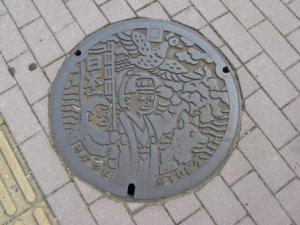
Momotaro and friends on Okayama manhole covers
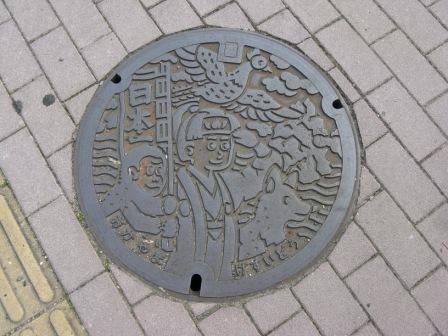
Japan, like many countries, is rich in folktales, and we came across several during this trip. There was one particular story, though, Momotaro, the Peach Boy, that I think is somewhat known in the west – at least, I came across it when our children were young – so it was rather meaningful to meet him in his home, Okayama. The Momotaro story involves his fighting marauding demons with the help of a dog, monkey and pheasant. The demons may, according to Wikipedia, have been from the island of Megishima – and we did visit the demon cave there some days later (but that’s a whole other story). What I want to introduce here instead is the topic of Japanese manhole covers. Each town seems to have its own design (or two) – and if you search Flickr you will find a goodly number of them. They are appealing and are just one of those little details that make Japanese travel fun. Anyhow, for Okayama the design is based on the Momotaro story.
One of the most surprising literary experiences of the trip was finding, within sight of the lighthouse on the little island of Ogishima, a beautifully polished marble stone monument engraved with the three verses of John Masefield’s famous poem “Sea fever” . I haven’t been able to find out what Masefield has to do with Ogishima, and perhaps it’s simply that it’s an applicable poem for a little sea-focused island, but with Japan’s close relationship with the sea I would have thought it had its own famous sea poems to use in such a situation. Whatever the case, this westerner rather enjoyed coming across something familiar in an unfamiliar place.
Onomichi and the Path of Literature
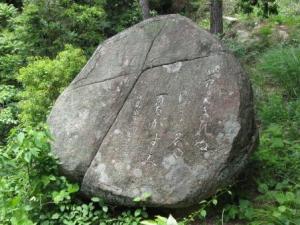
Suiin Emi's stone on the Path of Literature
There is, as the Rough Guide to Japan will tell you, a long temple walk you can do in Onomichi, that takes you up and down the hillsides that line this little port town. We decided to follow the Rough guide’s advice and just do selected components of the walk, which happened to include the Path of Literature. According to an Onomichi Travel Guide the path was developed because Onomichi is known to have inspired many poets/writers because of its “beautiful scenery and quiet life style”. The walk contains 25 stones (stones, again), each inscribed with some words from a particular writer and each accompanied by an interpretative sign which includes the writer’s name in English. (Nothing else was in English, but the name’s a great help for later research.)
I have chosen the Suiin Emi stone to illustrate this post because he was born in nearby Okayama. Basho is, of course, represented … as he is also in the little fishing town of Tomo-no-ura.
An apparent incongruity
Japan is a country of contrasts, paradoxes even you could say, and so I thought I’d illustrate this with something from our second day in Japan when we visited the quiet little town of Obuse (which I mentioned in my first post for its Hokusai connection). We walked out of the station and across the rather empty little street to discover what appeared to be a restaurant (albeit closed at the time) with the following sign on its door:
We have NO relation with Yakuza.
We are still pondering that one …


 Whispering Gums