Reading my Kindle Touch

Now, here’s the thing … although I am onto my second Kindle, I still do most of my reading in print form, which might make you wonder why I’m onto my second Kindle!

I upgraded to the Kindle Touch last year for one main reason, the Touch.  Because Touch is quiet whilst my Kindle 3 (aka Kindle Keyboard) would make a clicking sound whenever I turned pages and made notes. This rather disturbed Mr Gums when he was trying to sleep. As part of this upgrade, I also decided to buy the cover with the built-in light. I liked my old Kindle, but I love my new one – it’s quiet and I can read in bed without having a light on. However, I still mostly read printed books. Why?

Well, the main reason is that sense of the physical book and knowing where I am. Yes, the Kindle tells me I am 64% through the book, but as most Kindle readers have discovered I’m sure, that’s a bit fallible because it counts to end of the book which may include a lot of end matter. Frequently I discover I’ve finished the book when I thought I was only 92% through. I find it all very disconcerting not “knowing” where I am. And then there’s that thing that many readers do: you know, we’ll say “I’ll turn the light out/go clean the bathroom (sure!)/do my homework – when I’ve finished this chapter”. It’s easy to flick through a book to see how long the current chapter is, but a far more fiddly thing to do with the Kindle – until now.

Why now? Because, silently, wirelessly, those Kindle folk have updated my Kindle and one of the updates is that the Kindle will assess how fast I am reading and then report at the bottom left of the screen the “time left in chapter”. The percentage read is still there at bottom right. I have no idea when this was done, but I’ve only just noticed it! I love it … there are still aspects of the physical book, of being able to flick through it quickly, that I miss, but this is an excellent upgrade. Not only is it now easy to decide whether to read the next chapter, but I have a new game: Can I finish the chapter faster than it thinks I will!

And now, over to you Kindle owners out there:

Do you prefer your Kindle to print? Or do you still prefer print? What changes to the Kindle would sway you further towards it?

Andrew Blackman, Nights on Fair Isle (Review)

You probably know by now that I occasionally like to review short stories that are available online, most often those published by the Library of America.  So when author and blogger, Andrew Blackman, recently posted that one of his stories had been published online, I thought I’d check it out.

“Nights on Fair Isle” is, he says, the first time he has had a short story available free on the internet, but he expresses uncertainty about the value of reading online and asks his readers’ opinions. Good question and one I’d like to answer … somewhat anyhow, and then bat it on to you. I don’t as a rule read fiction online. I read novels on an e-Reader but I don’t think that’s the same as online, or is it? And I read short stories and essays that are made available online. But, here’s the rub. I don’t read them online. I print them out and read the hard copy instead. This might just be the product of my babyboomer-dom… I could in many cases, I suppose, download stories and essays onto my e-Reader, but mostly I think what’s the point. It’s just as fast to print it out.

Anyhow, the story. It’s a little story … And I mean that literally in terms of its length not as a comment on its quality. In just three pages (in my printout version), Blackman tells a tightly controlled story of loneliness and how one woman goes about soothing her soul to enable her to keep on going day after day in a big city, London to be exact. We don’t know where Aurelia is from, but we do know that she wasn’t an English-speaker when she arrived in London. Not long after her arrival, she stumbles on the shipping  forecast on the radio and hears a “gentle male voice intoning” words like “Low, Fastnet, nine seven three, falling slowly”. Each night she tunes in to the same words, and thinks it’s a nightly prayer that she’s hearing. Eventually of course she’s put right, but she goes on tuning into the forecast for its soothing sound …

And for the way it reminds her of her mother’s “sweet lullabies … that chased away the shadows and fears”. Blackman neatly segues from the shipping forecast to the sea and Aurelia’s favourite sea-based fairy story, and effectively uses the paradoxes inherent in sea/water imagery to convey both fear and calm. I won’t relate more of the story though … after all it’s short enough for you to read yourselves via the link below. I’ll just say that I liked the way Blackman gently explores the power – and limit – of dreams and reverie to keep you going. It’s a realistic rather than grim or depressing story.

Meanwhile, do you read online? And if so, do you think it changes the way you read, or what you read?

Andrew Blackman
“Nights on Fair Isle”
SolquShorts, 2012
Availability: Online

Willa Cather, My Antonia (Review of eNotated edition)

Portrait Willa Cather 1936

I am a Willa Cather fan, and have read some of her novels and short stories, so was intrigued when eNotated Classics offered me an eNotated version of Cather’s My Ántonia for review. eNotated? That sounded like something worth exploring so, although I’ve read the novel before, I decided to read it again. I wasn’t sorry. It’s still a wonderful read.

My aim here is not so much to review the book, though I won’t be able to resist saying a little, but to explore this eNotated edition that I read on my Kindle. I understand from the website that eNotated Classics produces books for the Kindle, the Nook and iBooks. The company’s aim is to take “advantage of eBook technology to extend and enrich books in a way that increases understanding, engagement and reading pleasure”. Did they achieve this aim for me? That is the question!

I’d say yes and no – and will explain by discussing what I see as the three main components of the eNotated version.

eNotation links

These are underlined text (words or phrases) that you click for added information, which can be dictionary-style definitions, brief encyclopaedic-like descriptions, or interpretations. The eNotations can also be read as a group by clicking a single link at the beginning and end of each chapter, and they appear at the end of the book. In fact, the novel finished at the 77% mark in the book, with the last 23% comprising the eNotations and other material.

I was disappointed that many of the eNotation links contained the same information that the Kindle dictionary contains. Since the latter is faster to access by simply moving the cursor to the word to be looked up, those eNotations were rather superfluous. However, perhaps this depends on the dictionary the e-reader accesses, making the experience different with different e-readers.

There were a few of the more interpretive style and I appreciated those. One concerned the relevance of the play Camille which the narrator Jim sees with Lena. This sort of notation can be useful to students who may not, for example, know the play.

A useful feature is their identification system, which comprises a bracketed number at the end of each paragraph and each eNotation, making them easy to cite and to find. The number is obvious as you read, but you soon get used to it.

Theme indications

Now this one bothered me somewhat. See what you think: here are the first lines of the novel as they are presented in this eNotated version:

Last summer I happened to be crossing the plains of Iowa (TIME) in a season of intense heat, and it was my good fortune to have for a traveling companion James Quayle Burden – Jim Burden as we still call him in the West.

Throughout the novel sentences or phrases are treated like this – formatted in italics followed by (TIME), (NARRATOR) or (ELEGIAC). The “How to read this book” section at the beginning of the book explains that these italicised passages are cited in the relevant theme essay – Time, Narrator or Elegiac – at the end.  These are not really “themes” in the literary analysis sense: “Time” is a theme but “Narrator” relates to voice, and “Elegiac” relates to tone. I did find these a little intrusive and wonder whether they would have been better handled as links to the essay they occur in without the bracketed upper case word to show the way.

Additional information

At the end of the book are several items designed to add value. Most of these are not unique to e-Books. They are the eNotations (which you can click on to go back to the text), the three theme essays, a History of Nebraska, a Willa Cather Timeline, a Key Event Timeline, a Bibliography and Images. These are all useful value-adds. I liked the fact that the 12 images can be enlarged, something I can’t do with maps and images in the travel guide I bought last year. It was fascinating to see an image of a Dugout house in Nebraska, though photo credits next to the captions would have been good.

I’m not a Cather expert, but I found the Theme essays interesting – and expect they’d help both students and general readers. The bibliography is short and looks useful, though the most recent citation is dated 1987 which seems a little old. The novel might be a classic, but scholarship continues …

And now to the book itself

How do I love this book? Let me count the ways! I love its meditation on the past, on how the past intrudes into the present. Jim Burden is, really, “burdened” by his past. He meets Antonia when he is a 10-year-old orphan arriving in Nebraska to live with his grandparents, and she a 14-year-old Bohemian immigrant arriving with her family to settle there.  They end up on neighbouring farms and become friends when her father asks Jim to teach Antonia how to speak English. The novel then follows the next 30 or so years of their lives – the first four “books” cover 10 years from the novel’s opening, while the last “book” jumps to 20 years later. Jim, the narrator, keeps an eye on what happens to “my” Antonia over the years, but the book is as much about him and his inability to move on from the past. He says near the end:

In the course of twenty crowded years one parts with many illusions. I did not wish to lose the early ones. Some memories are realities, and are better than anything that can ever happen to one again.

 I love its language and tone. It’s delicious to read. I’d probably describe it as “melancholic” or “meditative” but I wouldn’t argue with Bedell’s “elegiac”. Here is an early description as Jim arrives in Nebraska from the greener, more lush Virginia:

Between that earth and that sky I felt erased, blotted out. I did not say my prayers that night: here, I felt, what would be would be.

Lovely, simple, spare writing.

And I love Cather’s description of pioneer life, and pioneer characters. Much of what she writes could easily apply to 19th century Australia. The landscape is different – but is similarly bare and harsh – and the ethic mix is different – but the experiences and hardship are universal. It’s a life and environment in which character is writ large – and Cather draws her characters beautifully. Even the minor ones – such as farm hands Jake and Otto who disappear early in the novel – are vivid. Here is Jim on Ántonia, late in the novel:

She lent herself to immemorial human attitudes which we recognize by instinct as universal and true. I had not been mistaken. She was a battered woman now, not a lovely girl; but she still had that something which fires the imagination, could still stop one’s breath for a moment by a look or gesture that somehow revealed the meaning in common things.

This is one of those novels that stays with you and I’d recommend it to anyone. Would I recommend this eNotated edition? Yes. It’s a good attempt to take advantage of the eBook format and, while there are features that didn’t  work perfectly for me, at USD5.99, it’s hard to beat.

Willa Cather
The eNotated My Ántonia
eNotated by Barbara Bedell
eNotated Classics, V1.00 12/1/2011 (based on 1918 edition)
Kindle edition
ISBN: 9780982744864

(Review copy supplied by eNotatedClassics.com)

All that holding, lifting and turning … the future of the book

Sense and sensibility book covers

Printed and e-Books for Jane Austen's Sense and sensibility

Back in May while I was travelling in Japan, Jennifer Byrne (host of The First Tuesday Bookclub) convened one of her special Jennifer Byrne Presents panel discussions, this one on “The future of the book”. I finally got around to watching it this week. Her panelists were Richard Watson (writer and strategist on the future!), Kate Eltham (writer and Executive Officer of the Queensland Writers Centre) and Richard Flanagan (award-winning novelist). You can read the transcript or watch the show on the ABC website.

I’m not going to analyse it in-depth, but Byrne kicked off the discussion by asking the panel for their response to “the theory that our connectedness with the net is actually impacting on our capacity to read and think deeply”. In exploring this and related questions, the panel talked about:

  • the pros and cons of distractions: do they, for example, encourage creativity or destroy our ability to concentrate?
  • the nature of writing and book production: will the novel (as we now know it!) survive in the new digital, web-based, more interactive environment?
  • the nature of reading: is it a social activity or a private act?
  • writing: will the (apparent) democratisation of writing and publishing make it impossible for writers to make a living out of writing – and if that happens what will happen to the novel (literature)?

But, the most entertaining point came late in the program from Jennifer Byrne:

I’d like to read from the Institute for the Future Of The Book. This is someone who wrote in last month and I think gives us an idea of the problem that does face print ahead. ‘Cause this is a guy… He says he reads almost exclusively on screen, he’s got a kindle, an iPad, an iPhone, a Blackberry, a laptop… ‘But this weekend I did something radical and old-school. I checked a big, thick book out of the library.’ This is the bit I love. ‘The physicality of the book, having to hold it open then lift and turn each page…’ (Laughs) ‘..was a lot more exhausting than I remembered.’ ‘That holding, lifting and turning distracted me from the book.’ What’s happening to modern people?

I’m not sure that we can generalise from this comment to “modern people” but this did make me laugh. And then I thought, hmmm, I do like to read on my Kindle. It is easy to hold (very much like a book), but it is the same (light) weight whether I am reading Ford Madox Ford‘s novella The good soldier or Leo Tolstoy‘s War and peace. I no longer need to have multiple books on the go: the one to read at home because it’s too heavy to lug around, and the smaller, lighter one that I can carry in my bag. Perhaps the comment is not quite as silly as it first sounds?

The program provides no answers. How could it?  And some of the opinions presented are, really, just that, opinions, based more on personal preferences and anecdote than research. But for those of us interested in the future of the book – of the novel, of the experience of reading – it’s yet another interesting discussion to ruminate on.

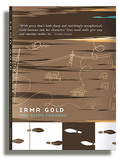
Irma Gold, Two steps forward

Irma Gold's Two steps forward Bookcover

Irma Gold's Two steps forward (Courtesy: Affirm Press)

Irma Gold’s* Two steps forward is, apparently, the last release in Affirm Press’s Long Story Short series. I have reviewed two others previously – Gretchen Shirm’s Having cried wolf and Leah Swann’s Bearings – but, before talking about this book, I must say how much I love the books themselves. I am starting to read eBooks. I recognise they are likely to be the future and they do offer advantages over print books. They take up less space, for a start. You can change font size to suit your eyes. And, eReaders have inbuilt dictionaries which can be useful when you are reading while out and about (or are just too plain lazy to get off your seat to find the dictionary). But, this doesn’t mean I don’t like print books – especially lovely ones to look at and hold like this Affirm Press series. I like their slightly smaller size and their simple, clear, modern design. The three I’ve read also have very stylish monochromatic covers. There’s little, in fact, not to like about them.

Now, though, the book. This is one of those short story collections, like Swann’s Bearings, that has its own title rather than one drawn from one of the stories within. I like that – and the title of this book, Two steps forward, is a particularly clever one, because of course it immediately calls forth the complete saying “two steps forward one step back”. This concept works well for the stories in Gold’s book.

Irma Gold is a writer and editor. She has been published in various journals, such as Meanjin and Island, but this is her first published collection. Well done her, because it’s an engrossing collection. Gold’s writing is clear and warm, and she demonstrates in this collection an ability to handle a range of voices and points of view. There are 12 stories in the book: five are told 1st person, two 2nd person, and the other five 3rd person. Her protagonists are mostly women, but there are a few male voices too. The stories could be described as “scenes from a life” (well, lives, really). Her characters include a single mother hoping for love (“The art of courting”), an empathetic woman working in a refugee detention centre (“Refuge”), a father experiencing his first access visit, after two years, with his 8-year-old daughter (“Tangerine”), an emotionally-neglected teen girl living in a caravan park (“Sounds of friendship”), an old homeless man (“Great pisses of Paris”), and so on. The characters are authentic. You know who they are, what they feel, and what they are confronting:

You notice how thin your lips have become, how the flash of greasy fuchsia looks almost crude. You pull at the loose skin on your neck, and the spongy puffs around your eyes filled with lines, the skeleton veins of a dead leaf. (“The art of courting”)

I want to touch him, but the space between us is fractured. (“Refuge”)

I compose sentences in my head, but none of them work. (“Kicking dirt”)

Says they can’t afford to waste cash on stuff they don’t need, though apparently alcohol is essential. (“Sounds of friendship”)

There’s a painful vulnerability to her characters, as they confront their particular challenges, such as visiting a terminally ill friend (“The visit”), facing a miscarriage (“The third child”), or trying to reconnect with a young daughter (“Tangerine”). Their lives are finely observed, so much so, in fact, that you feel you’ve been there – even if you haven’t. Their triumphs, when they have them, are hard won.

I also liked Gold’s use of imagery. It’s apt, evocative, and is not overdone or pushed too far – which suggests careful writing, good editing, or both:

 A day leaking away with a spill of apricot. Air stung with lavender. (“The art of courting”)

… and Abby catches the cold-barrelled words Mick fires at her mother. (“Sounds of friendship”)

But it was all icing slathered over stale cake. (“The anatomy of happiness”)

The tone doesn’t vary much, but this doesn’t spoil the experience. The stories, overall, have a somewhat melancholic air, as the characters struggle to keep a forwards momentum in their lives ahead of a backwards one. And, there are touches of humour (mostly wry) and some occasional irony (such as a reference to our anthem’s “boundless plains to share” in “Refuge”) that provide relief.

Endings are always hard … at least that’s what E. M. Forster told us in Aspects of the novel … but Irma Gold has handled them well. Keeping with the title, most of her stories have more hope than not – but none are fully resolved. Like life really.

Irma Gold
Two steps forward
Mulgrave, Vic: Affirm Press, 2011
(Series: Long Story Shorts, 6)
192pp.
ISBN: 9780980790474
Also available in eBook format

(Review copy courtesy Affirm Press)

* I was tickled to note in her Acknowledgements that Gold spent some time at Varuna Writers’ Centre.

Monday musings on Australian literature: Bookseller turns publisher

Book Stack

Books anyone? (Courtesy: OCAL, from clker.com)

Bookseller-as-publisher (and vice versa) is not an original idea but, in our digital environment with its plethora of production and distribution technologies, this combination clearly offers new possibilities – one that the Australian bookchain, Dymocks, has announced it is going to try. Its aim? To “support Australians with stories to tell” … and, of course, “grow the book industry”.

Dymocks is calling its new publishing arm D Publishing. (Original eh?) Chief executive Don Grover said they do not see it

as building an operation to compete with standard publishers, and he said the systems and service it offered would separate it from other self-publishing companies.

These services include “editing, design, production and printing of finished books”. It’s not, in other words, big-end-of-town publishing, nor is it exactly self-publishing, but something in between …

The service is expected to start in October. According to the news report in Bookseller and Publisher, it is web-based and will work like this. Writers will:

  • upload their manuscript online
  • choose features for their book, including cover design, editing and typesetting
  • decide how to publish: print version using a print-on-demand option and/or e-book

It’s not clear how much input there’ll be from experts in, for example, this editing and design aspect. And there is a bit of a catch. Distribution. Grover does not guarantee that books published through this arm will be sold by Dymocks, and sees it all still as a bit of a work in progress:

It’s something that will evolve over time [and] will start as a tool for people who have a story to tell. As far as distribution is concerned we will wait to see what the market brings forward.

So, what say you? It all depends on the economics, of course, but I can see possibilities for local authors publishing local histories for their communities, family historians producing family histories, schools and local writers’ groups producing collections of writing … as well as of course the novelist or poet (or other writer) trying to break into the market. It sounds exciting but history tells us that it’s not that easy. To what extent will this new model with its more immediate technology make the whole business of getting your story out there easier? Time will, I suppose, tell.

For more on this, read blogger Megan Burke who got to talk to Grover and ask him some questions.

Monday musings on Australian literature: Project Gutenberg Australia

I don’t imagine Project Gutenberg needs any introduction to bloggers and blog readers, but I’m not sure how many are aware of the Australian sister site, Project Gutenberg Australia. This site is not formally connected with the original Project Gutenberg but, like the original, it provides access to international texts that are in public domain – specifically, in public domain in Australia. This means you’ll find George Orwell‘s Animal farm here, F Scott Fitzgerald’s The great Gatsby, and so on. But, due to different copyright legislations (prior to the US-Australia Free Trade Agreement), it also means that you’ll find some texts not yet available via Project Gutenberg, such as Margaret Mitchell’s Gone with the wind,.

However, Project Gutenberg Australia’s main value is that it provides an entrée to Australian material, through various pages (sections) which organise the content by subject/type. One of these sections is the Library of Australiana containing:

ebooks by Australian writers, or books about Australia. There is a diverse range; from the journals of the land and sea explorers; to the early accounts of white settlement in Australia; to the fiction of ‘Banjo’ Paterson, Henry Lawson and many other Australian writers.

It is an excellent resource.  Some of the explorers whose journals are available include Gregory Blaxland (who, with Wentworth and Lawson, found a way over the mountains west of Sydney in 1813), William Bligh (famous, or is it infamous, for the Mutiny on the Bounty), and James Cook (who claimed our Great South Land for England back in 1770).

But, my main reason for writing this post today is that for readers here who find it hard to locate classic Australian fiction it’s a treasure trove. Some of the writers and works available are:

Coastal view south of Bermagui

South of Bermagui

The Library of Australiana also includes books by foreign authors but set in Australia, such as DH Lawrence‘s Kangaroo. Lawrence completed this novel while living in Thirroul, on the south coast of New South Wales. This is the coast nearest to my inland city, so I’ll conclude with an excerpt from another foreign writer on this coast, Zane Grey:  

It seems, as the years go by, that every camp I pitch in places far from home grows more beautiful and romantic. The setting of the one at Bermagui bore this out in the extreme. From the village a gradual ascent up a green wooded slope led to a jutting promontory that opened out above the sea. The bluff was bold and precipitous. A ragged rock-bound shoreline was never quiet. At all times I seemed aware of the insatiate crawling sea. The waves broke with a thundering crash and roar, and the swells roared to seething ruin upon the rocks. Looking north across a wide blue bay, we could see a long white beach. And behind it dense green forest, “bush,” leading to a bold mountain range, and the dim calling purple of interior Australia. (American angler in Australia)

Grey captures perfectly the reason I, whose preference is for mountains over coasts and who has no interest in fishing, love the south coast. It’s beautiful. And so is Project Gutenberg Australia (in function, if not in look!). Try it next time you are looking for something Australian that is in public domain. There’s a good chance you’ll find it.

Monday musings on Australian literature: eBook publishing in Australia

Sense and sensibility book covers

Printed and eBooks for Jane Austen's Sense and sensibility

First off, the disclaimer: I don’t know a lot about what is happening with eBook publishing in Australia, so my goal here is as much to find out more from readers of this post as it is to impart knowledge.

I thought a good place to start would be the Australian Publishers Association (APA) but didn’t find a lot to excite me. The Association has 11 committees, but a search on “electronic” on the page listing these committees brought up only two which include electronic publishing in the description of their goals/activities – the Tertiary and Professional Publishers, and the Scholarly and Journals Publishers! Oh dear that’s not looking very proactive. Maybe they just haven’t updated their info on the APA website?

Because trade publishers are producing electronic versions of their books. Text Publishing, for example, told us in their February newsletter about the eBooks service being offered by independent Melbourne bookseller, Readings. Text wrote that:

In collaboration with local software developer Inventive Labs and SPUNC (the Small Press Network about whom I’ve written previously), Readings is now able to offer Australian ebooks that are readable on any device, from phone to PC to dedicated ereader.

Readings was, apparently, the first independent bookshop in Australia to offer locally published eBooks to its readers. This means, for example, that works by such Text authors as Peter Temple, Kate Grenville, Kate HoldenToni Jordan, and Madeleine St John can now be bought from Readings in electronic format (using, as I understand it, the book.ish service. This is a bit of a problem for Kindle users who, I understand, can only access book.ish eBooks online).

Back to publishing though. A year ago, in July 2010, a report by Jenny Lee titled Digital Technologies in Australia’s Book Industry was published. It was prepared for the Book Industry Strategy Group and is 72 pages long. I have only skimmed it. It looks at the whole supply chain – Authors, Agents, Publishers, Printers, Distributors, Retailers, Libraries, and Readers – but my focus here is on publishers because, arguably, they are the critical point in the chain. What Lee found regarding publishers – a year ago so things may have changed – was that electronic publishing (and delivery) is strongest in the scholarly and higher education area. Well, that’s not surprising given what I found at the APA website is it? Regarding trade publishing she wrote:

Publishers of consumer/trade books have generally been hesitant about producing ebooks because of concerns about piracy and price, but many are now producing a selection of books in electronic form and in some cases making them available through their websites.

And so, it is starting, albeit slowly and moving from publisher websites to sellers like Readings.When the Kindle first appeared, we Australian readers complained about the lack of suitable content, particularly Australian content. More Aussie content is available now, but I’d love to know what readers here think. Is enough available? How do you know what is available? Is it available on the format you want and at a price you are happy to pay? I expect to return to this issue, but would love to know what people are finding now (here and in other countries).

Weekends with TS Eliot

Reading TS Eliot's SELECTED POEMS

Reading TS Eliot's Selected poems (Image: Courtesy RubyGoes via Flickr, using CC-BY 2.0)

Breakfast in bed is my weekend treat. It’s when I kick back with a book and simply relax – except this weekend and last I kicked back instead with my iPad and app for TS Eliot‘s The waste land. What fun I am having and intend to have over a few more weekends.

So, what have I been doing?

Fiona Shaw’s performance

Well, last weekend I pottered around the app checking out what’s there and how to navigate it, trying a couple of the readings (but not listening to the whole), and so on. And then I listened to/watched Fiona Shaw‘s performance of the poem. This is a performance rather than a reading. She uses gesture and limited movement (around the upper storey room in a house in Dublin somewhere) to convey the drama, humour and mystery of this rather tricky poem. If you hold the iPad in landscape orientation, Fiona Shaw’s performance fills the screen. However, if you rotate it to portrait orientation, the poem appears below the image with the text synchronised to the performance. This is what I did and, being a textual person, I preferred it this way. I loved seeing the words played out on the screen – and she was almost word-perfect.  I didn’t time it properly but it took, I’d say, 15-20 mins. I’d recommend this as a good way to start re-acquainting yourself with the poem if, like me, it’s been an embarrassing number of decades since you last read it.

Perspectives, from Seamus Heaney, Paul Keegan, Jim McCue and Craig Raine

I said above that I am a textual person and that’s true but, paradoxically I suppose, the thing that most grabs when I’m reading is rhythm and sound (something I’m loving in my current read, Kim Scott‘s That deadman dance, but that’s for later). And so, I have always loved TS Eliot:

In the room women come and go
Talking of Michelangelo
(from ‘The love song of J. Alfred Prufrock”)

And now a gusty shower wraps
The grimy scraps
Of withered leaves about your feet
And newspapers from vacant lots.
(from “Preludes”)

We are the hollow men
We are the stuffed men
[…]
This is the dead land
This is the cactus land
(from, of course, “The hollow men”)

Here is no water but only rock
Rock and no water and the sandy road
The road winding above the mountains
Which are mountains of rock without water
(from “W. What the thunder said” in The waste land)

…  and so on. Staccato or sing-song, repetition or not, rhyming or not. It gets into your bones.

This weekend I decided to explore the Perspectives section of the app which is where various luminaries talk about aspects of Eliot and the poem. I listened to/watched Irish poet Seamus Heaney, poetry editor from Faber and Faber Paul Keegan, Eliot expert Jim McCue, and English poet and academic Craig Raine …. and I gained some new perspectives! I’m not going to comment on all they say since you really should explore this app yourself (if, that is, you have access to an iPad). I’ll just focus on an aspect that most comment on, one way or another – Eliot and sound.

Heaney comments on the “musicality” of the poem. Paul Keegan goes a little further. He suggests that
“acoustic things, tonalities” are what attracts people more, today, to the poem than the “monolithic meanings”. These “acoustic things” though do convey meaning, don’t they, particularly when the allusions elude us. I do not, I admit, “get” all the allusions, but I love the sound of the poem and can sense his concerns even if I may not be able to articulate them in an analytical way.

Somewhat related to this, Keegan argues that Eliot showed it was possible for a poet to write without knowing exactly what larger meanings he was conveying. He suggests that Eliot didn’t necessarily know what he was getting off his chest and that he was more interested in “what poems do than in what they say”. This rather ties back to sound doesn’t it? Or, it does for me. What his poems “do” to me is complex – they move me emotionally but can often mystify me intellectually. They can sound at times like nonsense and yet you “feel” or “hear” something profound. How does he do that? Anyhow, Keegan expands his point, suggesting that Eliot’s poetry encouraged a new fearlessness about poetry “having to make sense, forensic sense”. It freed up, he says, some of those questions*.

Jim McCue’s contribution is a short but interesting one on the history of the poem’s publication. And then, Craig Raine takes up the sound issue again, but from a slightly different perspective. He describes Eliot, the American born English poet, as, really, a world citizen. The waste land is full of “voices” – something conveyed well by Shaw in her performance – from around the world including, most obviously, Germany, France and India. It’s like, Raine says, changing the radio dial (which was still a fairly new technology then.) He also describes the poem as “a fantastic operatic selection”, a not surprising description, I suppose, for a poem which Eliot considered titling “He do the police in different voices”!**

A technical (sort of) note

The app doesn’t always behave exactly as I would expect or like. Changing the orientation will sometimes bring a surprising result and take you away from where you were. It’s not hard to get back as there’s always the Home icon available at the bottom, but it can be disconcerting.

* I will though come back to meaning in my next post after I’ve finished the “Perspectives” section of this App.
** From Dickens’ Our mutual friend

Amazon: The good, the bad and the …

Book Stack

Books, where next? (Courtesy: OCAL, from clker.com)

Well, let’s not go there because, really, we all want convenient, economic access to good books don’t we? And Amazon has done a great job of forging/championing a whole new world of book distribution – both through their online service for  selling traditional books and then their development of the Kindle and eBook distribution. (I know Amazon was not necessarily the first in all these services, but it has certainly brought them into the mainstream.)

This is not to say I haven’t had my grumbles –  about such things as freight costs (no supersaver deals for we downunder) and the more limited availability of eBook titles for our market – but I am glad such online services exist. I have been able to purchase books that would previously have been difficult if not impossible to get any other way. Similarly, readers overseas (that is, over the seas from me!) who find it hard to locate Australian literature can purchase Australian titles from Amazon, including more obscure works like those from Sydney University Press‘s Australian Classics Library. Now that’s what I call a good Amazon deal! And then there’s the fact that people living in remote areas where bookshops don’t exist and housebound people have been able to purchase books far more easily than they could before. There is a lot to like.

But of course, it’s not all good. What change is? Monopolies (and near-monopolies) are rarely beneficial in the longterm (for consumers anyhow), so the news of an Amazon-Book Depository merger is rather concerning. But it’s not a fait accompli (yet). And the continuing loss of traditional face-to-face book stores is also disappointing – but I don’t understand the economics enough to know where and how this one can be resolved. We like to browse bookshops but we also like the convenience, and sometimes cheaper prices, of online and/or eBook purchase. Can we have our cake and eat it too? If someone knows the answer to this one, I’d love to hear it.

I am not defending Amazon per se. Nor am I cheering on their Book Depository merger plans. We should feel concerned. We are right to question. But, I’d like to recognise what Amazon has achieved and what we have gained. I (selfishly) wish I knew how we can keep the industry (authors, publishers, distributors) strong so that we readers can get what we want, when we want it, at a price that is reasonable for all. Ideas anyone?