Delicious descriptions: Fiona Wright on writing and hunger

Fiona Wright, Small acts of disappearanceIn my recent review of Fiona Wright’s Small acts of disappearance, I focused on her analysis and her experience of anorexia, but, as I mentioned in the review, she was, already, a published writer. An award-winning poet for a start: her poetry collection, Knuckled, won the Dame Mary Gilmore Award for a first collection. Her poetry and essays have been published in several literary journals. Consequently, it’s not surprising that writing makes an appearance in Small acts …

In her essay, “In Hospital”, she writes:

I know now that the impulse I have to starve comes from exactly the same place as my impulse to write: hunger, like writing, is a mediator. It stand between me and the world, between my self and the things that might cause it harm. Hunger is addictive, and it is intensely sensual, pulling the body between extremes of hyper-alertness and a foggy trance-like dream state. And like writing, it lets me stand clear, separate and intact; it lets me stand on the outside. I spent years determined to stay on the outside.

Is this a common experience of writers, that it separates them from the world, I mean? I guess so, in a way, because writers tend to be observers – and it is hard to observe and be part of something at the same time, isn’t it?

In “In Miniatures”, she discusses how the enjoyment of miniatures involves narrowing one’s focus and attending to detail. However, “detail-oriented thinking” is psychologically related to hunger because the malnourished brain becomes intensely focused: the world shrinks, and becomes small enough to handle, to not be a threat. The trouble is, she writes:

detail has for so long been the stuff and substance of my poetry, my craft: the accrual of small, odd things, contradictory things, the things that undercut or illuminate the social world. It has always been detail that I’ve thought makes the worlds we write specific, poignant and, in essence, poetic. And it’s hard to contemplate that my writing, the thing I feel has kept me sane, may very well have been based on nothing more than cognitive pathology.

Hmmm … That “nothing more” is perhaps her being harsh on herself. I suspect that even if “detail-oriented thinking” is part of the anorexic pathology, Wright’s writing comes from a bigger part of herself too. But her fear that in losing hunger she may also lose her writing is palpable.

And then, in “In Group” she writes at length about John Berryman’s Recovery/Delusions, two books in one – his unfinished novel, Recovery, and a collection of poems, Delusions. Recovery is an autobiographical novel about an alcoholic man in a psychiatric hospital. Wright writes at length about Berryman’s character’s experience of group therapy and her own, and in so doing also discusses writing, its impulses and sources. I won’t share any more of this: it’s better that you read her book, rather than my ramblings on it!

Instead, I’ll conclude on one little point. Recovery is unfinished because John Berryman committed suicide while writing it. Wright comments:

the novel simply stops, in a suspension … Part of me thinks this is exactly as it should be: an unintentional but radical inconclusiveness, a denial of the three-act structure that biography is often made to fit …

Novel, biography, the same thing in the context of narrative, I suppose. Anyhow, this reminded me once again of EM Forster’s wish (in Aspects of the novel) for novels to be able to end when the novelist gets “muddled or bored”. Instead, he says, “most novels do fail here – there is this disastrous standstill while logic takes over the command from flesh and blood.”

Wright concludes her essay with her own intriguing idea about “logical and fixed conclusions” versus “the unfixed and uncontainable”, but I’m leaving it here. If you’re interested, you know what to do.

Delicious descriptions: Helen Macdonald on nature

Before I share the couple of quotes I saved for this post, from my review of Helen Macdonald’s H is for hawk, I want to mention one more idea that I considered including in my ever-lengthening review, and that’s the idea of a journey. I’m mentioning it now because Claire (of Word by Word) mentioned it in her comment on my post and because it was also mentioned in my reading group discussion. I sort of covered it when I said that the book could also be seen as a quest story, but I had planned to point to a specific reference Macdonald makes: “for years,” she says, “I’d scoffed at White’s notion of hawk training as a rite of passage”. She realises that there’s truth in his statement and that she too was trying to rebuild something. This, this “passage” from one mode of being to another is, in effect, a journey – and it is, in the end, the fundamental thing that the book chronicles.

(This is a good point to note the value of rereading! Macdonald, in the light of her current experience, reads White’s Goshawk very differently from the way she’d read it when she was a child with a child’s view of the world. I love it.)

Northern Goshawk

Northern Goshawk (Photo: Norbert Kenntner, Berlin, via Wikipedia using CC-BY-SA 3.0)

But now, Macdonald’s nature writing. The book abounds with descriptions of the nature – of the landscape, of the creatures within it. It’s intensely evocative, and sometimes confrontingly visceral. The first chapter, as well as the title itself, tells us that nature will be a significant aspect of the book. “Forty-five minutes northeast of Cambridge is a landscape I’ve come to love very much indeed” is the opening sentence. The last line (the postscript), too, is a natural description, albeit a more symbolic one worthy of the last line of a grief memoir! Nature, in other words, plays a complicated role in the book. It has a literal role, that is, it exists for its own sake. She clearly loves the natural world around her, has her “magical places”. But it has other roles too: complex, psychological ones, political ones*, as well as the more expected symbolic ones (like, you know, “the world itself started to grieve. The skies broke and it rained and rained”).

I touched on the psychology in my review when I referred to her starting to think and see like a hawk, seeing this as a way to escape her grief. But that’s just one aspect of her exploration of the relationship between psychology and nature. There’s TH White and what she calls his “moral magic trick”. It relates to his determination not to give in to his cruel urges – he never beat his students at Stowe school, for example. She says that animals played a “curious role” in his keeping this goal:

For White it was a moral magic trick, a way out of his conundrum. By skilfully training a hunting animal, by closely associating with it, by identifying with it, you might be allowed to experience all your vital, sincere desires, even your most bloodthirsty ones, in total innocence. You could be true to yourself.

In other words, you could shed, perhaps, your “perpetual disguise”.

Often though, she describes nature for its own sake – how it looks, how it feels, her experience of it. It’s a lived and earthy beauty:

It’s turned cold: cold so that saucers of ice lie in the mud, blank and crazed as antique porcelain. Cold so the hedges are alive with Baltic blackbirds; so cold that each breath hangs like parcelled seafog in the air. The blue sky rings with it, and the bell on Mabel’s tail leg is dimmed with condensation. Cold, cold, cold. My feet cracks the ice in the mud as I trudge uphill. And because the squeaks and grinding harmonics of fracturing ice sound to Mabel like a wounded animal, every step I take is met with a convulsive clench of her toes. Where the world isn’t white with frost, it’s striped green and brown in strong sunlight, so the land is parti-coloured and snapping backwards to dawn and forwards to dusk. The days, now, are a bare six hours long.

And here is Mabel in this season:

… Mabel has eaten nothing but quail for a week, and it’s made her a hot-tempered, choleric, Hotspur-on-coke, revenge-tragedy-protagonist goshawk. She is full of giddy nowhere-to-go desire. She foots her perch. She gets cross. She jumps in the bath and out again, and then in again. She glares …

So evocative, so drawn from experience – and such an inspiring command of language.

Macdonald’s England is pretty wild – full of brambles and thorns, of predators and prey – something I didn’t quite expect given my image of green pastures and tamed hedgerows! Towards the end she shares the lesson of her experience, which stems from the idea that we should not imbue nature with meanings from our human experience of the world, and then use that to “shore up our own views of the world”:

And I have learned, too, the danger that comes in mistaking the wildness we give a thing for the wildness that animates it. Goshawks are things of death and blood and gore, but they are not excuses for atrocities. Their inhumanity is to be treasured because what they do has nothing to do with us at all.

Nature is to be valued, respected – and preserved – for itself.

You won’t be surprised to hear that Helen Macdonald is “a writer, poet, illustrator, historian and affiliate at the Department of History and Philosophy of Science at the University of Cambridge”.

* I may address this one in another post – if I can maintain the energy!

Delicious descriptions: Gerald Murnane’s landscape and imagination

A couple of years ago I reviewed Gerald Murnane’s The plains. I found it a mesmerising book, but a challenging one to fully get my head around, to grasp and hang onto what I’d grasped. Then a couple of days ago, I reviewed his memoir, Something for the pain: A memoir of the turf. It was quite a revelation – and among those revelations were some ideas that seemed to flesh out The plains, though he doesn’t specifically address those ideas to the novel in his memoir.

The main revelation relates to his feelings about landscape. Murnane hates the sea and doesn’t much like mountains either. What he loves are plains. In chapter 6 he refers to his “lifelong dislike of travel”, initially developed when he was still a boy. He also, as a boy

settled on what would be my ideal landscapes for the rest of my life: the green and mostly level countryside of south-western Victoria.

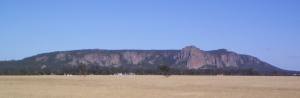
Mount Grapples

Mount Arapiles, Western Victoria (released on Wikipedia to Public Domain, without conditions)

Plains, in other words. In chapter 15, he talks about a horse owner P.S. Grimwade. (An aside. In this, as elsewhere in the book, he focuses on what he “imagines” Grimwade to be like, stating that he suspects he wanted “to keep in mind the ideal man rather than have in sight the actual man”! “Perhaps”, he writes, “I wanted to think of him as someone for whom racing was better imagined than experienced – someone such as myself”.) Anyhow, he goes on:

I would have envisaged P.S. Grimwade as owning an extensive property in what I consider the centre of the universe, in the quadrilateral bounded by Ballarat, Ararat, Hamilton, and Camperdown in the Western District of Victoria, which is a landscape of plains and low hills and vast skies. I’ve never felt comfortable when surrounded by steep hills, and I’ve always tried to keep away from mountains.

In fact, Grimwade, he discovered, lived in a different part of Victoria, one he’d never visited – but, it’s telling I think that he places this horse owner, who fascinates him, in a place comfortable to him. He writes that he’s entitled to his imagination about Grimwade:

In the unlikely event that this book should be read by some or another descendant of a man named P.S. Grimwade, and that the descendant should wish to tell me that my account of the man is untrue, inaccurate, preposterous, whatever, I urge that descendant not to waste energy, time, or ink on the matter. Nothing will keep me from revering my saint as he was revealed to me.

Are you getting the picture of this memoir? It’s the imagination that’s important …

Then we get to chapter 22, “Sir Flash and the Borderers”, the chapter that gave me a big ah-so moment. Early in the chapter, he writes again of his ideal landscape:

… the ocean itself repelled me, and I’ve kept well away from it all of my adult life. During my brief holidays on my grandfather’s farm in the 1940s, I was more interested in another sort of ocean. Whenever I stood on a tall cliff above some or other bay, I got inspiration not from the blue-green Southern Ocean reaching away towards the South Pole but from the yellow-brown ocean of land reading towards places I had seen only from a distance, if at all: the plains of the Western District to the north and the north-east of Warrnambool or, away to the north-west, a mostly level landscape …

This discussion introduces a story about a group of horse-owners and horse races in what he calls the Border District. It’s here that I was reminded of The plains, because of the way he imbues the Border Country – and the Borderers who live there – with a sense of “otherness”. These people and their horses came from a real part of Australia, obviously, but it’s a part that was unknown to him when he came across them, so he unfolded a map and “set not only my eyes but my imagination also roaming”. He gives it and its people the aforementioned names, and he awards the people – imagines, in other words – certain characteristics, including “the usual amount of shrewdness and sagacity attributed to people living far from the capital cities”. I won’t tell you all that he ascribes to them – it makes for wonderful reading – but here’s the final bit that brought The plains to my mind:

I would not have my Borderers thought of as wholly devoted to gain, however. They numbered among them many a man who wore his hair bunched above his ears and on his neck and who stood out on a racetrack on account of his elegant dress and proud bearing. Such a man owned a vast cattle or sheep property and lived in a mansion with a veranda on three sides and groves of deciduous trees all around. His mansion included a library and a study. The walls of the study were covered with photographs of the finishes of races won by his own horses. The walls of the library were covered, of course, with books …

This imagination, this creation of a place that seems both in and separate from the Australia we know, a place populated with people who have dreams and an artistic sensibility, is very reminiscent to me of The plains. Rightly or wrongly – but I hope the former – I now feel I understand Murnane a little more, his aspirations, how his imagination works and the absolutely fundamental role it plays in his life.

Many years later, Murnane moved to live in this very landscape – in Goroke where I believe he lives now – and discovered the people aren’t quite as he imagined. But that’s another story.

Delicious descriptions: Emma Ayres on music

If the bicycle trip gives Emma Ayres’ travel memoir Cadence its chronological spine, it is music which provides its skeleton.

However, before I discuss music, I need to respond to those commenters on my review who noted that “cadence” is also a cycling term. As I’d heard the book rather than read it, I couldn’t quite recollect her mentioning this but felt she must have. I have now checked the book itself and indeed she did. For example, near the end of the book is a paragraph which starts:

Cadence on a bicycle is a vitally important thing. Turn your pedals too slowly, with too hard a gear, and you wear out your muscles and your chain. The trick is to have a light, quick cadence, an allegro cadence, not andante, one where your lungs do the heavy work and your muscles hardly have to strain at all …

But, see how even here some musical imagery slips in! Anyhow, she talks about cadence on the bicycle at other times too, such as the “perfect cadence” when riding downhill one day in Pakistan.

It’s all about the keys

The book’s chapters are named for groups of keys starting and ending with C major/minor, the simplest keys. She writes at the beginning of the last chapter:

Here we are, back at the beginning. The flats have gone and the sharps are yet to come. It is a moment of stillness, before the journey begins again.

This is the aspect of the book that was least familiar to me. What playing one key versus another means to a musician, and how playing different keys varies from instrument to instrument, are not things I can experientially relate to.

That didn’t stop me, however, finding many of her descriptions interesting, if not moving at times. Here she is on C sharp major/minor/D flat major/minor:

This is it. It’s the end of the road for the sharp keys. Every single note is a sharp – FCGDAEB … We have travelled all the way from simple open G major, through the brightness of E major to the unearthliness of B major, and we have arrived in a key that stretches and strains on every instrument, even somehow the even-tempered piano. Music written in C sharp major has a wildness to it, a frenzy even. C sharp major is used by a composer who has seen a new super reality from an escarpment. They are looking through a high window. It’s a shocking key at first, but ultimately I find it very spiritual. It is an extremely brave and rare key.

I suppose it makes sense, then, that this is one of the keys she uses for her trip through Pakistan, the country she’d been warned against, and the one she fell in love with. Another key in this chapter, D flat major, is, she writes, great for the piano:

Easy, like breathing out.

I felt like Pakistan was the right key for me. I didn’t want to ever leave Pakistan, or at least lose the feeling Pakistan had given me.

It helped, of course, that much of her time in Pakistan she travelled dressed as, and was in fact believed to be, a man, Emmett. As a woman, she may not have found it quite so easy, as she implies through one of her musical analogies:

Women in Pakistan, though, were like absent notes in the scale. D naturals in a D flat world.

On composers

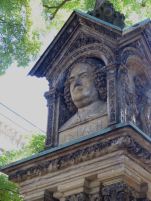
Bach statue in Leipzig, where he wrote the violin pieces!

Bach statue in Leipzig, where he wrote the violin pieces!

Accompanying Ayres on her trip was Aurelia, a 3/4-sized violin, because, she says, “you never feel truly alone, anyway, if you have an instrument with you”. She decided she needed a musical journey to parallel the cycle one. Her choice? To learn Bach’s cello suites, violin sonatas and partitas.

Consequently, throughout the journey she gave little impromptu Bach concerts. It seems Bach is loved the world around. She shares wonderful stories and gives insights into all sorts of composers, not just Bach, but the one I want to share here is Shostakovich. She spends a few pages on his 13th quartet, which was written in B flat minor. She writes, and I’m excerpting furiously:

His thirteenth, though, depicts the horror of life in a way that is unrelenting from beginning to end. In our life, the police often protect us from knowledge of the most horrific crimes, but in this B flat minor work Shostakovich offers us no protection. If you are going to listen to this piece, make sure you have a friend to call afterwards. Seriously.

… This piece is written in one dreadful movement. Listening to and playing this piece dozens of times, I can find no moment of joy, no moment of exhilaration, no relaxation, no optimism.

[…]

… it is a hell on earth. It is a hell of small-minded, picky, tight-mouthed people, people who decide matters of life and death and art; a hell of the violins as they pick out mean, starved sounds from their instruments while the others around them mock and sneer; a hell of music for all the ugly-souled, unthinking, self-serving people in the world, of whom many had power over Shostakovich. This hell never ended for him, neither in his life nor in this piece; it just kept on getting worse.

And she says more – about Shostakovich’s life and this piece. I loved reading these sorts of insights from a practising musician. I also enjoyed her explanations of the modern composers many love to hate, Webern and Schoenberg. She talks of Schoenberg using music’s power to unsettle, and Webern distilling emotion (even if reading a Webern score is “like poring over an ordnance survey”!)

Viola to Violin to Cello to …

The other musical thread I wanted to mention is her discussion of her musical career. The book starts with her mother asking her “the most important question of my life”. What was it? It was to ask her what instrument she wanted to play! She chose cello, but got a violin! Paralleling the story of her cycle journey is the story of her musical life: how she started with violin, then moved to viola – her professional instrument at the Hong Kong Philharmonic Orchestra – but always hankering for the cello. She returned to the violin for the trip, after which she eventually got to play cello. I won’t tell you where, after all that, she has ended up …

I will tell you, though, that for Ayres music saves people’s souls, and it saved her. As a musician, she says, you take people into your care. You won’t be surprised, then, to hear that “to share the value of music is the resolve of my life”.

Ayres is warm, yet fearless, a woman who marries action with reflection, all of which make Cadence the excellent read my friends told me it was.

Delicious descriptions: Stephen Orr’s farm family

When I reviewed Stephen Orr’s farm-set novel, The hands, last week, I didn’t share many quotes as the post was getting rather long. I decided I’d use my Delicious Descriptions series instead! So, here are three excerpts to show you more of what I so enjoyed about Orr’s writing.

One aspect I really enjoyed was his dialogue, but it’s tricky choosing something that works out of context. However, here’s a discussion between parents Trevor and Carelyn, and their eldest son Aiden about whether he continues school to Year 12. Young brother Harry is there too:

‘Maybe there’s no point starting Year Twelve,’ Aiden suggested, looking at his parents.
‘Why not?’ Trevor asked, not entirely surprised.
‘Not if I’m gonna fail things.’
‘Why are you going to fail?’ Carelyn asked.
‘Maybe not fail, but get through with Cs.’
She crossed her arms. ‘You’re not a C student.’
‘It’s getting harder.’
‘So? You work harder. Year Twelve is minimum for anyone now.’
‘But what’s the point if —’
‘You. Will. Continue.’ She decided  against the lecture. How he (Yes, you, look at me when I’m talking to you) was, for seven years, the best student in his School of the Air class; how he used to finish maths worksheets in minutes and spend half an hour waiting for others; always scored an A on tests and had a spelling age five years above his actual age.
‘It’s only another year,’ Harry said to his brother.
Aiden gave him his shut up, Shit-for-brains look. ‘It’s none of your business.’
‘You’re meant to set a good example.’

I don’t know about you, but I love this. It’s so “true”. I love the “gonna” for Aiden, and the “going to” for his Mum; I love big brother’s condescending-irritated-but-love-you-all-the-same “shit-for-brains” response to  his brother; and I love the whole set up of the argument regarding the importance of education.

And here, without spoiling anything, is a description of what comes after an affair:

… It was more a case of what came next: the small wedding, in a small park; the moving van; the bathroom reclaimed by lavender soap and fresh towels; her, inserted into his life like a deep splinter; opinions floating through the air and settling on the floor like talc; fine words butter no parsnips; her laugh; bright dresses on the line beside their overalls and pyjamas …

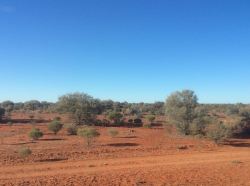
A little north of Orr's "Bundeena" but you get the picture.

A little north of Orr’s “Bundeena” but you get the picture.

But finally, of course, you need a description of the land:

Bundeena was marginal country. It could carry cattle, sparsely. To Trevor, this was where Australia became desert, where man — following the east-west railway, before it seriously set its sights on the Nullarbor — had given up on agriculture. Most men, at least. Except for them: sixth generation Beef Shorthorn producers who’d wrestled with the land for 130 years. This was country that hadn’t asked for farmers but had got them anyway. On the southern edge, the railway line, and to the north, nothing. They had neighbours to the east and west, but they may as well have been living in New Zealand.

So evocative.

Delicious descriptions: Emily Bitto’s The strays

In my recent post on Emily Bitto’s The strays I commented on the quality of the writing but didn’t really exemplify it – so I’m doing so now. But just sharing without in-depth commentary, as I’ve been tied up this week with family matters.

Here is a description of Evan Trentham, the leading artist in the Melbourne Modern Art Group:

Evan Trentham was put together from mismatched stuff. The sinews were too short for the long bones. The tendons behind his ankles and the bald stones of his knees stuck out, hard as catgut on a tennis racquet. He was like a rubber band stretched tight and close to snapping. He wore blue work pants cut off at the knee and a white undershirt that was yellow beneath the armpits. He was paint-stained and sweat-smelling.

A taut, highly strung artist?

And here is a description of the night of on of the Trenthams’ bohemian parties:

The night that followed was a slip down the rabbit hole. Summer was taking up its place like a chestnut seller setting up his stall, lighting the coals and letting the scented smoke drift down the street before he begins to call out to passers-by. It was not too hot by the fire in the centre of the garden clearing, nor too cold away from it in the darker, leafier peripheries.

Interesting imagery here given when chestnut season is, but I like the scene she is setting.

Then there’s her description of Helena Trentham’s three daughters:

I believe she envied her daughters their relationships with one another, just as I did. And so she brought three girls into the world and let them roam it without telling them to fill the pockets of their pinafores with bread and to leave a trail of crumbs that would lead them, in a crisis, home.

Love the allusion to Hansel and Gretel here.

And finally (though it appears some time before the above quote in the book), Lily describes that moment that comes in most girl friendships when puberty reaches one before the other:

She’s leaving me behind, I thought. I felt tricked. With Eva, I had given no thought to the world of adulthood that awaited us. But she had crossed some secret threshold while I was facing the other way, absorbed still by the childish fantasies she had cultivated for us: our talk of travelling the world together […] Now, I saw so clearly that all of that had been a silly game. She had a lover, presumably, while I did not even truly know what this vague and glamorous term entailed. She had become a woman, with no thought to warn me that I should be packing away my own childhood, dismantling it piece by piece like a rotten treehouse, and preparing myself for the new world.

I remember the feeling!

Overall, I thought Bitto’s writing was nicely evocative, without being overblown.

Delicious descriptions: Danielle Wood on mothering

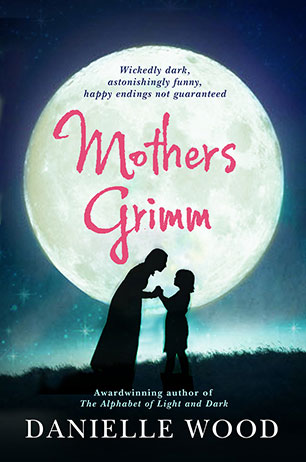
Danielle Wood, Mothers Grimm, book cover

Courtesy: Allen & Unwin

In my post on Danielle Wood’s Mothers Grimm I focused on how mothers feel about being mothers, but the book is also about the need to BE mothered. So, I thought I’d share a couple of short excerpts from the book about this aspect. It will also give you a better sense of Wood’s wry but resigned tone, which is part of what made the book for me.

June Wishart was – to Liv – a kind of first position, the default against which mothers of all other sorts were defined. If Liv sometimes looked hungrily at the mothers with long, messy curls and jeans – the ones who kissed and hugged their grown daughters and made easy, stupid jokes with them, borrowed their earrings and shoes – it was only with an understanding of how far they deviated from June Wishart with her ash blonde hair that rolled under, quite naturally, at her jaw, who always wore skirts and never went out with our pantyhose, whose public manner towards her daughters was just one or two notches more intimate than the cheerful, well-brought-up formality with which she treated everyone else. (“Sleep”)

Liv, you might remember from my review, is the teen mother.

The other excerpt I’ve chosen comes from the last story. Stella’s mother died soon after she moved west. She, and her nurse friend Reggie with whom she’d moved, both marry within a year. Reggie makes the better marriage on pretty much all measures, but for Stella there’s really only one that counts:

Of all the things Reggie had and I didn’t, it was her mother-in-law I might almost have been jealous about. Mrs Kingsmith … managed her own angora stud and I had it from Reggie that she also did clever things with buying and selling shares. She treated all us young ones as if we were somehow her business, and I thought her warm and wise. It seemed all wrong to me that the daughter-in-law she’d been given to love was Reggie, who had a mother of her own still, while I had only Mrs Palfrey, who wanted nothing I had to give. When Colin and I told his mother that we were expecting Mark, she nodded resignedly and went back to worrying in the gloom behind her curtains. (“Nag”)

I might almost …! Love it. Anyhow, this made me feel very sad. It reminded me that you don’t stop mothering just because your children have grown up. How lucky I am that my mother knows and my late mother-in-law knew that.

Delicious descriptions: Kate Llewellyn on Aussie authors

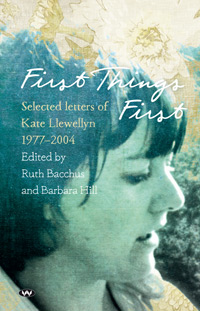
Ruth Bacchus and Barbara Hill, First things firstSince I couldn’t cover everything in my review of Kate Llewellyn’s lettersFirst things first, edited by Ruth Bacchus and Barbara Hill, I decided that a follow-up Delicious Descriptions on a specific aspect of the book, her discussion of her reading, would be in order. I’m making the assumption that, like me, you’re interested in what writers think about the work of other writers.

Llewellyn mentions many writers – poets and novelists – in her letters, and is generally positive. I can’t (and shouldn’t) share them all, of course, so have selected a few that particularly interested me.

Christina Stead

I was tickled to find myself reading Llewellyn’s letters in which she was reading Christina Stead’s. It twas in a letter dated 19 June 1992, so I think she was reading R.G. Geering’s Christina Stead, a life in letters, which was published in 1991/1992. Llewellyn writes – all the three-dot sets are hers (and not my ellipses):

I have three books, Angela Carter’s last … and C. Stead’s Letters … really, a wonderful book … she is a wizard … so queer, mad, right, sweet, hopeless … not unlike Jean Rhys in some ways … you know, the hopeless, feckless, blighted genius who good things avoid in spite of her almost starving … but gracious, always gracious … a bed-sitter, no money … Basically, Christina is a woman who married her father and who was mad, mad as you know, who had a funny kind of genius to boot … cruel to women … feminist and scathing of that same thing … fawning to men in a way that is quite painful to read in the letters … but generous, encyclopaedic, lusty and full of paradoxes … her husband Bill Blake was in the fur business for a time … can you believe it … and she left money to the conservation foundation … plus had a white ermine coat … Basically, Bill was a wonderful loving brilliant man whose books did not sell and who had a wife and child for thirty years of their life (his and Christina’s) together while she longed to marry … sound familiar …

Well, that’s rather a breathless flow, but it captures quite a lot about what Llewellyn gleaned about Stead from the letters, about Llewellyn’s reaction to that, and about Llewellyn herself. In another letter, in 1993, she comments on a negative drawing of Stead in The Australian which described Stead as “monstrum extremum”. Llewellyn’s response to that was a “4,000 word piece on Stead and the way Australia treats its artists”. Go Llewellyn, eh?

Elizabeth Jolley

Elizabeth Jolley (Photo: Courtesy Fremantle Press)

Elizabeth Jolley (Photo: Courtesy Fremantle Press)

Llewellyn clearly admires Jolley, as I do. On 3 July 1992, she writes:

I read Cabin Fever at 3am and felt like you … I like this strange book … I wrack my brains to trace how it is done … but I am lost … I need a writing class … I long for one …

Besides the fact that she so loved a Jolley book, I was fascinated to read about a writer admiring another writer so much she wanted to do a writing class to improve her own writing. It reminded me that we never stop learning or wanting to hone our skills.

Robert Drewe

I haven’t reviewed Drewe here, though I have a book of his short stories next to my bed, The body surfers, that I love. I like his writing, but I was fascinated by the strength of Llewellyn’s comment (in a letter on 7 July 1992):

I am reading R. Drewe’s A Cry in the Jungle Bar (Picador). I am not mad about this book but will read anything of his to see how he arrived at Our Sunshine … We had a talk at the book fair and I told him how sorry I was he did not get any of the prizes (the Banjo was announced that day) for Our Sunshine. He said he needed the money … When he is dead the country with laud him to the skies and sell his book by the thousands and make a film of it and maybe his son will benefit … but until then, it is slim pickings for him.

Our Sunshine is Drewe’s novel about Ned Kelly, and is a book I’m keen to read. The 2003 Ned Kelly film was based on it, but it wasn’t exactly an adaptation. Anyhow, here again is the issue of writers struggling to survive. I know there are those who are uncomfortable about literary awards but they clearly have practical value to many writers.

Marion Halligan

Halligan is the recipient of some of the letters in the book, including the one I’m going to quote from, written on 5 August 1992. Halligan also wrote the Foreword to the book. I tell you this, because it suggests a relationship between the two. I don’t, however, think this undermines the validity of Llewellyn’s admiration of Halligan’s writing. In this letter she talks of Lover’s knots, which was my first Halligan (and which inspired me to read more):

Really, Marion, you know I admire your writing because the thing has a will of its own … […] … because long before I ever met you, I said so in print … and you just get a firmer and firmer grip on your style and wide range … no, range wider and wider … also your quite encyclopaedic knowledge is impressive, but not just that, as that would be a bore if it was only that, but it is illuminating and lovely to read and I learn and that’s a real pleasure … mictouricious (?) or some such word … from micturition … the verb to pee … no micturate is the verb I suppose … I barely went to school and it constantly shows … music and spelling were on the days I didn’t go.

How better to end this post than on praise of our wonderful local writer, Halligan, that is written with such generosity and self-deprecating humour. I’m sure you can see why I enjoyed reading this book.

Delicious descriptions – and other thoughts: Peter Carey’s Amnesia

CareyAmnesiaHamishOne of the pleasures in reading Peter Carey’s Amnesia comes from his language, so I do want to share examples of that, but first I want to say something about the style and structure because I didn’t get to discuss it in my review. One of the criticisms I’ve heard about the book is that it’s disjointed. Some really like the beginning but then find they lose interest. I didn’t find this, but it’s interesting because there is something about the structure of the book that might create this response.

Amnesia is divided into two very distinct parts. Part 1 is told first person in Felix’s voice. It’s here that the story is set up. We learn about the Angel Worm, we learn a little about the four main characters, and Felix starts to realise the import of the challenge he’s been set. Part 2, the longest part, is told third person as Felix, first in a primitive shack on the Hawkesbury River and then in a motel in Katoomba, listens to tapes in which Celine and Gaby tell their stories while he tries to fashion it all into a book. Carey switches between telling us what Felix is thinking, experiencing or up to, and letting us hear Celine and Gaby on their lives and how Gaby turned into the “hacktivist” she is. There is no set pattern to the switching between these three lives, so the reader does need to pay attention, but overall I found the transitions clear.

Why did Carey change to third person voice in Part 2? I’m not sure. Perhaps it’s to reflect that Felix is not master of his own fate, that he is the pawn, or client, of those who are moving him around, just as Australia is a “client state” of the USA. Is this too fanciful? Or, is it to do with the fact that the novel is not just about politics, but also about storytelling, about whose version is most real, most relevant, to be trusted? Who is editing whom, we wonder? Felix editing Celine and Gaby’s stories, or the mysterious publisher editing Felix’s version of the story? As we are told in the last few pages:

As always, the omniscient narrator had a very wobbly grasp of what was happening.

As much as I enjoyed the book, I must say that without a re-read, I will admit to also having a wobbly grasp of some of the novel’s finer points, but I believe I got the gist.

Anyhow, I wanted to share some of Carey’s writing with you, but what? As I look through the book, I find so many parts that I loved. Some work best if you know Melbourne, others if you know the political situation, and still others if you know the plot. This one though might work. It’s a description of Coburg, the working class suburb in which Gaby’s father buys a house, to her mother’s dismay:

The street had a snotty name but the trees were weedy, starved of love, survivors with hessian bandages. Gaby was shocked by the cracks in the concrete, the lonely quiet, the little houses shrunk inside their borders, alone, disconnected. They saw a malevolent cluster of boys like rats with mullets, operating on a Datsun 240Z, roaring, revving, sending oily smoke across the intersection. One lay on the mudguard, deep into the engine, his plumber’s crack shining at the sky.

This is a little – and comparatively straight – example, but I like it.

Delicious descriptions: Dymphna Cusack’s Sydney

I said in my recent review of Dymphna Cusacks’ debut novel Jungfrau that I’d share some of her descriptions of Sydney because her evocation of the colours, the light, the sounds and the scent of the city are just gorgeous. Sydney, as you probably know, is regarded as one of Australia’s most beautiful cities with its harbour, beaches and surrounding bush. I spent my high school and university years there and while I left it because I’m not a big city gal, I do appreciate its beauty and enjoyed a rush of recognition from Cusack’s depiction of it.

I grew up on the North Shore so my beaches were not the well known Bondi and Cronulla, but those around Palm Beach. Cusack’s characters spend a memorable weekend there, “paired up” in a way that disgusts our upright, religious Eve. Here is Cusack on the place:

The stone piazza glowed pale yellow in the sunlight  and the sea spread in a shining silver plaque under a cloudless sky. Below, the surf on Whale Beach rippled with the hue of chrysoprase, and the road to Palm Beach wound in a glowing golden thread along the top of the ridge.

Scarred and dark, the low coastline curved north along the open sea and westward to the shores of the Hawkesbury estuary. Intricate wooded hills receded to lose themselves in unsubstantial cloudlike stains against the sky.

[…]

Around them the jacaranda broke in a purplish shower, motionless, airy and unreal, as though all the bright morning was caught up in a fragile net of blossom.

Hmm … well, our characters are caught up in a fragile net. Terry loves Thea, but she dreams of someone else. Oswald wants Marc but she “pairs up” with John, in whom Eve is interested. A fragile net!

And here is a description of the city as Eve walks Thea home after Thea has confessed her predicament:

The palms swayed under the light like green fountains in the wind, and their shadows danced grotesquely on the walls of the Public Library.

Again, the description of beauty is undercut, reflecting the mood of the characters.

And finally, here is Thea, walking alone, and desperate about her predicament:

Never had the sea glowed with so pure a lustre—a perfect unbroken turquoise from the cliffs of Ben Buckler to the sandhills of Cronulla. Never had the great dome of the sky seemed so luminous, so tender, nor the earth quickened into such a riot of blossoming. The long waves curled against the rocks far below, impersonally, as they had done for thousands of years and would go on doing for thousands of years more. The trees, the grass and the flowers burst into new life, but everything was remote—outside her—beyond human feelings and passions. “Shut out—shut out—shut out of life—”

Throughout the novel the descriptions are gorgeous and evocative of the places they refer to but they also mostly, if not always, convey additional meaning – sometimes ironic, but often simply hinting at what is going on in the characters’ lives. In this last quote, the irony derives from descriptions of the onset of spring and of the permanence of the earth, just as Thea is most at risk of leaving it.