Vale Pete Seeger

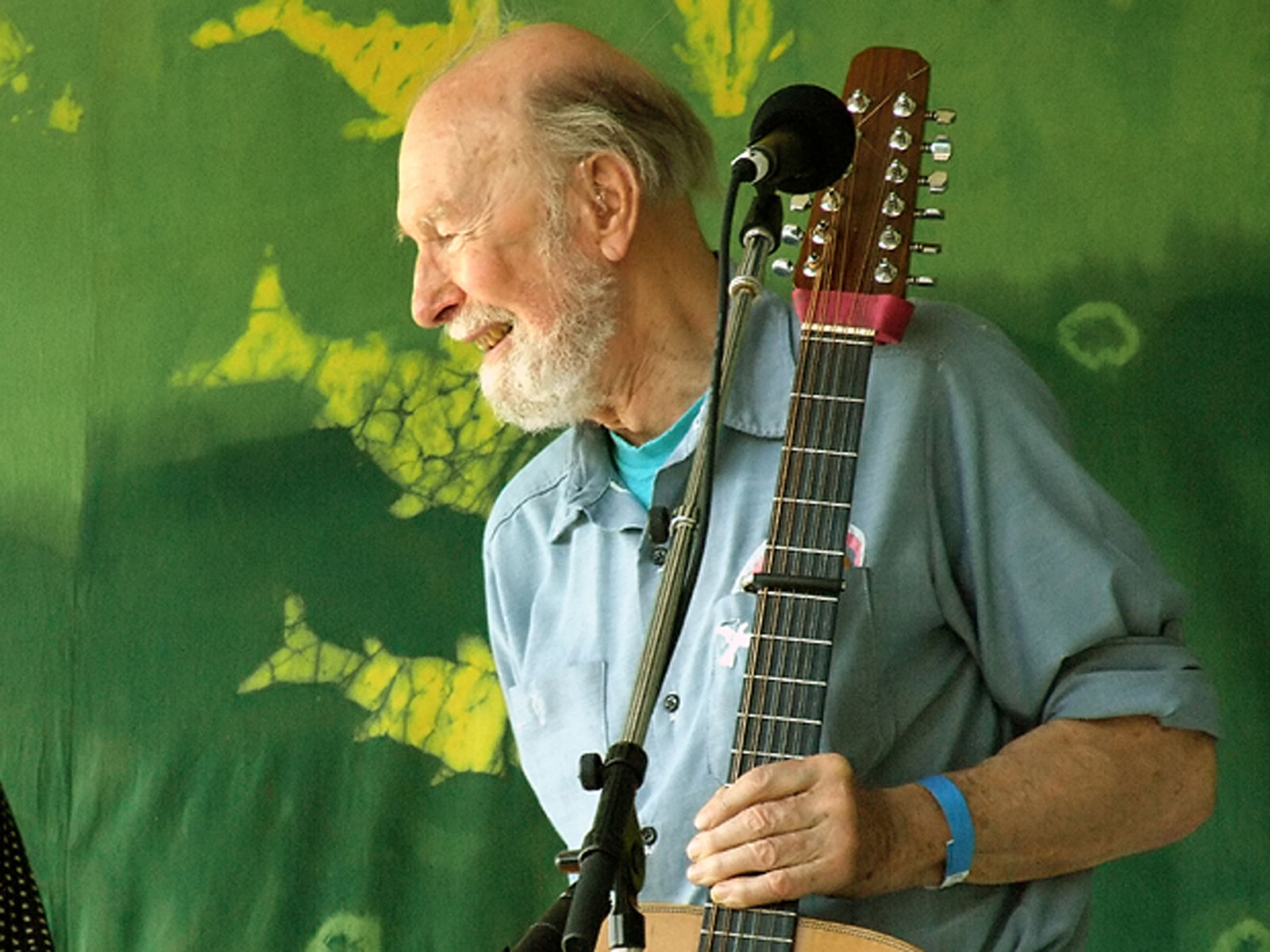
Pete Seeger, 2007 (Photo: Anthony Pepitone, using CC-BY-SA 3.0, via Wikipedia)

Pete Seeger, 2007 (Photo: Anthony Pepitone, using CC-BY-SA 3.0, via Wikipedia)

If music is powerful, and words are powerful, what power can words set to music have? Pete Seeger knew, but I don’t need to tell anyone that do I? What a legacy he has left us from his 94 years on this earth!

I’m an Australian of course, but Seeger, who first came to me through Peter, Paul and Mary singing “If I had a hammer”,  introduced me to folk music, or, more specifically, to folk music as protest. Later, I got to hear Peter himself – not live, unfortunately – and others like Joan Baez, Judy Collins who sang Seeger’s songs, and were inspired by him.

Anyhow, in memory of Seeger, I thought I’d share my favourite memories:

  • singing “If I had a hammer”, “This land is your land”, and “Where have all the flowers gone”, with such feeling, in my youth;
  • choosing Ecclesiastes 3:1-8 as the bible reading at our wedding because I loved the song “Turn! Turn! Turn!“;
  • falling in love with The Weavers whose heyday was a little before my time when I saw the 1982 documentary The Weavers: Wasn’t That a Time (and then buying the CD);
  • being surprised every time I discover that yet another song I love was either written by Seeger (including those named here) or popularised by him (such as Malvina Reynolds’ “Little boxes” and the traditional hymn “We shall overcome”).

The LA Times obituary quotes Bruce Springsteen as saying that Seeger was:

a living archive of America’s music and conscience, a testament to the power of song and culture to nudge history along, to push American events towards a more humane and justified end.

Seeger himself is quoted as saying “My religion is that the world will not survive without dialogue”. I’m no Seeger expert, but everything I’ve ever heard about the man has either inspired me or made me feel good.  So, vale to Pete. His influence may have been greatest in the USA, but it sure was nice knowing he was around, singing his heart out and doing his best to make the world a better place to live in. Thank goodness we still have the songs.

Forgiveness or Revenge, Love or Hatred?

This rather personal post departs somewhat from my usual fare – and replaces my usual Monday Musings, for a reason that will become obvious at the end.

Last week I saw the film The Railway Man. For those of you who haven’t seen or heard of it, it is about Eric Lomax, a British soldier who was fearfully tortured when he was a POW on the Burma Railway. Many years later he met and befriended the Japanese interpreter involved in his torture. I admit that I haven’t read his 1995 autobiography (also called The railway man), upon which the film is based, but in the film he says (and, in interviews, his second wife has quoted him as saying):

Sometimes, the hating has to stop.

I so admire this – this ability to stop hating and to forgive instead – just as I admired Izzeldin Abuelaish’s I shall not hate (2010), which I reviewed a couple of years ago. Abuelaish is the Palestinian who lost three daughters and a niece in an Israeli bomb attack on his home in Gaza. I quoted him in my review:

I believe in co-existence, not endless cycles of revenge and retribution. And possibly the hidden truth about Gaza can only sink in when it is conveyed by someone who does not hate.

Nelson Mandela would of course agree. In his autobiography, The long walk to freedom (1995), he wrote

No one is born hating another person because of the colour of his skin, his background, or his religion. People must learn to hate, and if they can learn to hate, they can be taught to love, for love comes more naturally to the human heart than its opposite.

Martin Luther King Jr

1964 (Courtesy Nobel.Org via Wikipedia)

There are many others – writers, philosophers, “ordinary” people who have suffered extraordinary things and, of course, Gandhi – who have spoken similarly, but I’ll end with the person I always name when I’m asked to name my “hero”. It’s Martin Luther King Jr – and today, Monday 20 January, is a federal public holiday in the USA dedicated to his memory, Martin Luther King Jr Day. One of the many things he said on the subject of hatred is:

Returning violence for violence multiplies violence, adding deeper darkness to a night already devoid of stars. Darkness cannot drive out darkness; only light can do that. Hate cannot drive out hate; only love can do that.*

“Civilisation and violence”, he said in his Nobel Prize acceptance speech, “are antithetical concepts”.

None of these people, from what I’ve read, came to their positions easily. It was hard work but, as Gandhi said, “the weak can never forgive. Forgiveness is the attribute of the strong”. I readily admit that I have never been tested in the way the people I’ve quoted here have been – but I hope that if ever I were, I would rise to their challenge, that I would turn hatred into love, or at least forgive rather than strive for vengeance!

If you are interested in the subject of forgiveness, particularly in reading about people who are its embodiment, you might like to check out The Forgiveness Project.

* This quote abounds on the web, but I took some time to track down its source. I eventually found the following: From “‘Where Do We Go From Here?’ as published in Where Do We Go from Here : Chaos or Community? (1967), p. 62; many statements in this book, or slight variants of them, were also part of his address ‘Where Do We Go From Here?’ …  A common variant appearing at least as early as 1968 has ‘Returning violence for violence multiplies violence…’ An early version of the speech as published in A Martin Luther King Treasury (1964), p. 173, has : ‘Returning hate for hate multiplies hate…'”

Reading difficult literature

I seem to have been reading a lot in recent weeks about reading, the end of reviewing, the future (or not) of the book, and so on. All interesting, though many revisiting familiar territory. One, though, particularly caught my eye. It was a post in Book Riot, by magazine editor/blogger/reviewer Greg Zimmerman, and was titled Our reading lives: Why I like difficult novels.

It’s not a long post. Zimmerman starts with David Foster Wallace’s notoriously difficult Infinite jest. He loved reading it, and says:

Readers read for dozens of different reasons. One of my favourite is to be challenged. Certainly, I don’t want most (or even 2 percent) of the novels I read to be as tough as Infinite jest. But I think spending a good amount of time with a book, really putting in some effort to piece it together, and coming out on the other side feeling like you’ve accomplished something is just so gratifying.

I’m sure you, like me, know exactly what he means. He next mentions Thomas Pynchon’s Gravity’s rainbow – which he found “really, really tough” – and then Eleanor Catton’s The luminaries. My eyes popped out at this point, as that’s the book I was about to start (and have, indeed, now started). While I knew it was long, I didn’t know it had a reputation for being difficult, but Zimmerman quotes others as saying it’s “long and demanding”, baffling”, even “an ingenious ourobouros“. Had I, I thought, left myself enough time to read it in time for reading group? Time will tell. Zimmerman took two weeks, he said, and that’s about how much time I’ve given myself.

The point I want to make though is that Zimmerman says that its difficulty is different. It’s “not like Pynchon because it’s really readable. And it’s not like DFW because it’s not digressive or purposefully superfluous”. Its difficulty comes from “the number of characters, how they’re all involved in the plot but from different perspectives and with different motivations, and the way the plot folds back upon itself several times”.

This got me thinking – not about The luminaries, as I’ll deal with that as I read it – but about my definitions of difficulty in novels. Dificulty is, I think, in the eye of the beholder, so I’ve come up with a few, not mutually exclusive definitions, which I thought I’d share (or, at least document for my own benefit!):

  • language and/or ideas are obscure and/or complex. A recent example for me is Gerald Murnane’s The plains (my review). It’s a short book but it demanded my complete attention. Miss a sentence and I was lost. I’m not sure I fully understood it, but I loved the challenge of trying to work out what Murnane was on about. Most of the world’s difficult books – those by Joyce, Pynchon, Faulkner, Woolf et al – probably fall into this category. These books may have little or no plot. They are the books in which you wonder “what the hell is going on?”
  • structure is complex or disconnected or full of digressions, making it tricky to pin down things like where, when and/or who at different points in the book. Some readers found this with Kim Scott’s That deadman dance (my review). They found all the shifting around, particularly in the beginning, disorienting. Laurence Sterne’s Tristram Shandy fits here, though it’s a long time since I read it. This point is closely related to the first one, and most of the authors I listed there spill over here too, I think.
  • large cast of characters (often combined with complex or convoluted plot). This is apparently the case with The luminaries. David Mitchell’s The thousand autumns of Jacob de Zoet (my review) is not overly convoluted but it has a large cast of characters, and keeping track of them is a challenge. Mitchell’s Cloud Atlas would fit here too, and in several of my categories I reckon.
  • unflagged transitions between “reality” and “magic” or “dream” or “spiritual” worlds. Gabriel Garcia Marquez, Haruki Murakami and our own Alexis Wright (my review of Carpentaria), to name a few, can trip us up with the way they slide between worlds. Alexis Wright, however, would argue that this only a problem if you have a western mindset. My solution is to go with the flow – and usually all will be revealed.
  • emotionally confronting, that is, the story is distressing or grim. This is not something that usually bothers me. While I do become emotional about characters and what happens to them, I like that literature lets me explore things I hope I never have to experience in life. Rohinton Mistry’s A fine balance is a novel that wears some readers down. For some it’s too depressing, and they give up. I found it ultimately uplifting, despite it all. JM Coetzee’s Disgrace fits here, as do Cormac McCarthy’s The road and Blood meridian, not to mention many Holocaust novels.
  • boring. It’s really hard to read a book that bores you. This is what put me off Great expectations when I first tried to read it in my early teens. I just couldn’t get interested. When I finally faced it again years later, I loved it. I think this might be the reason many readers give up on Louis de Berniere’s Captain Corelli’s mandolin. I loved the opening chapters, but he does take a while to get into the story proper.

Do you read “difficult” literature? If so, what do you find difficult and do you have any hints about how to approach such reading. Oh, and for a list of really tough books, check this list out.

Monday musings on Australian literature: Top Aussie book sales in 2013

This is, I suppose, another end of year round-up post – but one about bookselling in Australia, which is something I don’t usually write much about. However, since many of us love lists, I thought I’d share with you Australia’s top selling books for 2103:

  1. Jeff Kinney: Hard luck: Diary of a wimpy kid (UK, children’s)
  2. Jamie Oliver: Jamie’s 15 minute meals (UK, cookbook)
  3. Dan Brown: Inferno (US, fiction)
  4. Jamie Oliver: Save with Jamie (UK, cookbook)
  5. Andy Griffiths and Terry Denton: The 39-storey treehouse (Aus, children’s)
  6. Matthew Reilly: The tournament (Aus, fiction)
  7. Guinness world records 2014 (UK, reference)
  8. Sarah Wilson: I quit sugar (Aus, nonfiction)
  9. Ricky Ponting: Ponting at close of play (Aus, memoir)
  10. Jodi Picoult: The storyteller (USA, fiction)

It’s good to see some Aussies there, including popular children’s author Andy Griffiths and illustrator Terry Denton. I haven’t read Matthew Reilly but he has a reputation as a good story-teller in, mostly, the action and thriller genres.

Jason Steger, the Literary Editor of The Age and a regular panelist on the First Tuesday Bookclub, says of this year’s top ten:

The pulse rates of Australian readers were probably a bit slower last year, as the boom in erotic and dystopic fiction vanished, and old favourites such as Jamie Oliver, Jeff Kinney, Dan Brown and Matthew Reilly returned to dominate the national bestseller lists.

He is of course referring to the 2012 phenomena of E.L. James’ Fifty Shades of Grey trilogy, and Suzanne Collins’ Hunger Games. Apparently, without these juggernauts, overall sales were down in 2013 over 2012. According to Steger, the overall number of books sold dropped from 56.6 million to 54.1 million, resulting in a drop in value from $978 million to $917 million. Interesting isn’t it? What does this say about reading behaviour? That some people only read when a “huge” book appears on the scene. If everyone’s reading it, they will too, but otherwise reading is not for them? Is that the conclusion to draw from those figures, or am I missing something?

I can’t seem to find the fiction top ten for the year. I’m assuming that you have to pay Nielsen to get this information, but it seems telling that, while newspapers have reported (via journalists Blanche Clark and Jason Steger) on the overall top 10, no-one has listed, at least as far as I can find via Google, the fiction-specific list. The best that I could find was Steger, again, who reported that Tim Winton’s Eyrie (which I’ll be reading this year) was the best-performing literary novel. That says something about the Winton’s pull, as Eyrie wasn’t published until mid-October. Steger also reports that the Australian debut novels, Hannah Kent’s Burial rites (which I’ll also be reading this year) and Graeme Simsion’s The Rosie project (my review), both made the fiction top ten.  This is not surprising as they were probably the two biggest buzz books in the Australian literary firmament this year. However, I’m assuming that Steger’s singling out of these three books means that they are the only Aussies in the top to fiction list – and this means that the Miles Franklin award winning Questions of travel is not there.

None of this is earth shattering. We literary fiction readers know that the books we read rarely make general top 10s. It’s always interesting, however, to see what does. Were there any top 10 surprises in your neck of the woods?

Villainesses thriving in Canberra

Now I know many Australians see Canberra, their national capital, as a soulless, boring, sliced-white-bread sort of place but not so. There is life here. Art is happening – and it’s fresh, vibrant and young. Not all our young people have left (yet!).

Last night Mr Gums and I went to the opening of a collaborative exhibition organised by a group of twenty-somethings. The theme was Villainess. It was chosen, as one of the collaborators Georgia Kartas wrote in the foreword of the accompanying booklet,

for its surface-level but nonetheless undeniable badassery. Heroes have quests, villains have motives.

This is not a politically-focussed feminist exhibition as its name could suggest – though by its very existence it makes a statement about young women and their sense of self, their confidence, their willingness to get out there and do something for themselves. No, in fact it’s a fashion photo shoot exhibition. It is fun, clever, wicked – and it is stylish, as you’d expect from a fashion shoot. You can read something about its origin and the creation process at hercanberra and at Georgia Kartas’ redmagpie blog.

The collaborators were Elly Freer (photographer), Laura McCleane (make-up artist), and Georgia Kartas (fashion editor). The clothing, the hairpieces, the props were all sourced locally.

The photographic subjects are – of course – villainesses and they were chosen by the models – Elly, Laura, Georgia and their friends. There are ten villainesses, and they come from literature, popular culture and mythology, ranging from the very modern, such as Elle Driver from Quentin Tarantino’s Kill Bill, to the very classic, like Medusa.

We loved the exhibition. The photographs are beautiful, and exude a delightful, but intelligent, irreverence which characterises the ethos of the exhibition. A lot of thought has clearly gone into the event, including the production of an accompanying booklet which contains written responses to the villainesses by local writers. These responses give the exhibition an extra dimension – reflective, and often satirical, or tongue-in-cheek. I particularly enjoyed Eleanor Malbon’s response to Elle Driver who was modelled by Elly Freer (what a coincidence in names here!) in which she manages to spoof both Quentin Tarantino and James Cameron (Avatar):

… All together, the problems of the world make a charge at Driver.

Flesh meets steel as she wields her swords. Elle Driver dunks soil erosion in a bucket full of gypsum. She rips the mask off charity programs to reveal their reinforcement of material inequality. Her bullets fly through the heart of the underlying causes of biodiversity loss.

You get the picture I’m sure. The booklet itself, designed by Sheila Papp, is a lovely piece of art and a fabulous memento of the exhibition.

Yep, a good night in which we saw the next generation of artists-creators strutting their stuff. What fun!

Villainess
Kaori Gallery, Cnr London Circuit and Hobart Place, Civic
7-9 November, 2013

Disclosure: I have known the photographer since she was a baby. Go Elly!

The Role of the Arts Critic: a Childers Group Public Roundtable

Last week, I reorganised my Friday Lunch Group’s schedule in order to attend a public roundtable on the role of the arts critic organised by the Childers Group. This group, formed in late 2011, describes itself as an “independent arts forum … committed to the long-term viability and vitality of the arts”. It aims to advocate for the arts across government and private sectors. Last week’s roundtable was, I think, the third public forum they’ve held. All have been well-attended, which hopefully bodes well for the arts!

The event ran for two hours and featured a large panel of local critics/reviewers, administrators and practitioners in a wide range of the arts. They included the universally well-known, like Robyn Archer and Marion Halligan, and more local luminaries such as arts critic Helen Musa and Canberra Times editor-at-large Jack Waterford. It was emceed by writer and arts administrator Yolande Norris, who put questions herself and managed contributions from the audience. The ideas and viewpoints flowed – with a lot of concordance but some differences as well. Below is my summary.

Trader in ideas

Lucy – with a self-deprecating “I’m a poet so you won’t know me” – Alexander made the point of the day, for me. Late in the panel, she (from the audience) suggested that the critic is a trader in ideas. By this she meant that, in looking at a work, the critic picks up the ideas contained within it, weighs them, and explores what they might mean for people.

Another arts practitioner from the audience said, along similar lines, that she values information and insight into what is going on – into what the creator may have intended and what the critic actually “read”.

Somewhat related to these ideas, Marion Halligan said earlier in session that she regularly reads reviews (or criticism) of books, plays etc, she doesn’t expect to see or read, because “a critic tells you what’s going on” and gives you “a sense of the arts landscape”. A critic, therefore, she and others said, needs to be able to write (or speak) authoritatively and engagingly.

All this neatly sidestepped discussions about negative and positive criticism and got to the nub – to my mind anyhow – of the real value of criticism. While negative or constructive “criticism” of a work may be useful for the creator, Alexander’s point captured the bigger picture value of criticism. And it reflected, I think, what Robyn Archer meant at the beginning of the session when she suggested that “the arts” comprises three prongs: artist, audience, and the dialogue between them. These three need to be in balance she said for there to be a strong culture.

There was some discussion about the form of this dialogue, with film critic Cris Kennedy suggesting that dialogue is easier in the digital age. Robyn Archer queried the role of expertise in the digital age. She was concerned about the rise of “a new cultural democracy” – the world of “likes” and “unlikes” – and the resultant attitude that “if it’s popular it’s good”. I suspect there has always been this tension – but I guess it’s increasingly visible in our social media dominated world, isn’t it?

Overall, it was agreed, at least as far is there was agreement, that the critic should be knowledgable, that criticism should be “artful”, but that the important thing is opening dialogue.

What is criticism?

There was, of course, quite a bit of discussion about what criticism is. The point was quickly made that a review or criticism does more than describe. It takes up broader questions relating to the art form being reviewed, and should involve a studied reaction drawing on knowledge. It should illuminate and “bind things together” and requires a “critical” frame of mind. This was contrasted to “opinion” which seemed to be defined as “judgement” without a firm basis of knowledge.

Jack Waterford suggested that a lot of cultural discussion is occurring, such as on local ABC radio, but that this isn’t necessarily the same as criticism. Related to this, an audience member mentioned the issue of public art in Canberra, suggesting there’d been a lot negativity in the news pages and not enough criticism in the arts pages of the newspapers.

There was discussion about the need for disinterest, and that this was tricky to achieve in a small arts community like Canberra. (Marion Halligan suggested most arts communities are small – take England, she said, where the writers all review each other!)

One contributor suggested that food criticism is currently leading the way, and that the arts could look at what’s happening there! (There wasn’t discussion, however, on what this criticism entails and how it is leading the way.)

Who is criticism for?

The general view was that criticism is for the reader, though who the reader is wasn’t fully teased out. Those writing for papers and journals clearly see the reader as their public, and feel a responsibility to inform. One panel member made the point that criticism written for, say, a specialist dance journal should be different to that written for a general newspaper. An audience member pointed out that in the online world, the audience is international, and that this can (should) impact style and content.

There was also some discussion about creators and the role of criticism for them. Many appreciated constructive criticism, but quite a few said they use trusted friends to vet criticism, as negative criticism (that written from a point of ignorance) can be destructive. Criticism is also affirmation that people are looking at their work. As Marion Halligan said, the worst thing is silence. No review, she said, is worse than a bad review.

What is the aim of criticism?

In addition to the ideas implied above – contributing to the culture, informing the consumer and increasing people’s knowledge, providing constructive feedback to creators – it was also suggested that “the critic is a cog in the marketing machine”. I wouldn’t like to think that “marketing” per se is the critic’s role – and I don’t think that’s quite what was meant. But the critic does help promote the culture, can function as an advocate – in both cultural and political spheres.

This is certainly how I see my blog – as an advocate for Australian (in particular) literature . Of course, I’d like to think my reviews encouraged people to actually buy books, but my specific goal is to raise awareness about Australian literary culture.

Conclusion

Hmm … this is the hard part. Did the roundtable come to any final agreement or resolutions? No, I wouldn’t say it did. But I assume the organisers will take away the ideas presented and feed it into their future activities.

Near the end, it was suggested that it’s time to start populating the digital media with criticism and dialogue. This is an area that was not really tackled – that was just played with around the edges – and is possibly a good subject for the Childers Group to take up for their next roundtable.  What is happening in the online world and how can it best be harnessed to support and promote the arts. What impact does the growth of the amateur reviewer/critic have? Is there a difference between reviewer and critic?

Finally, returning to the opening idea of the critic as a “trader in ideas”, I liked the related suggestion that arts criticism is about the big things, about living and who we are. Can’t say better than that, eh?

A big thankyou to Nigel Featherstone and the Childers Group for holding this roundtable.
What is literary fiction? A personal manifesto!

I was pottering around the Internet last night, as you do, and found myself on a State Library of Victoria page titled Novels: Finding Literary Reviews and Criticism and there I saw this definition of Literary Novel:

Literary fiction focuses on the subjects of the narrative to create introspective, in-depth studies of complex characters. The tone of literary fiction is usually serious, it has layered meanings and the pace is slower than lighter fiction. Much of this literature remains relevant for generations, even centuries.

There’s no source for this definition – though it may have been partly drawn from Wikipedia. This definition is followed by one for Popular or Genre Novel:

Usually the plot is important in the popular novel, the pace is faster and the characterisation is uncomplicated. Action is more important than reflection. Murder/mysteries, thrillers and romances fall into this category.

Help Books Clker.com

(Courtesy OCAL, via clker.com)

Now, I’m particularly interested in this topic at the moment because I’m coordinating the “Literary” category for the Australian Women Writers’ Challenge. Each month I write a round-up of the previous month’s reviews for literary fiction (and literary non-fiction, but that’s not my topic here). The first thing I do is review the reviews (ha!) to see what has been categorised as “literary” – and each month I change a few, mostly by adding “literary” to some titles that haven’t been so classified.

My challenge is to have some basis for making these decisions. Fortunately, it’s not brain surgery so, while feelings may be hurt at times – though I really hope that doesn’t happen – no-one is going to die if I do or don’t label a book as “literary”. Phew!

I don’t fully agree with the State Library of Victoria’s definition, though it has some validity. Being multi-layered, particularly in terms of meaning, and being universal or likely to have longevity are valid criteria – and they certainly play a role in my categorisation. Characterisation is a bit trickier. Genre fiction can have complex characters, though perhaps not quite so much complex characterisation, if that makes sense.

Risky business …

But, the defining characteristics for me have to do with language and with innovation. Fiction I classify as “literary” uses language that challenges its readers. This isn’t to suggest that “genre” fiction is badly written, but that the focus of “genre” fiction is something else, usually plot or character. It also doesn’t suggest that genre fiction writers can’t have a message or serious intent. They can, but they want to convey that primarily through the story, rather than through linguistic devices.

Fiction I classify as “literary” also tends to be innovative. That is, it may play with voice, narrative structure, grammar and syntax, with imagery, form, tone, and/or expectations. This doesn’t mean that “genre” fiction can’t also be literary. It can, but I would call it literary when the writer manipulates or diverges in some way from the expectations of the genre.

Literary fiction, in other words, tends to take risks. Take some (mostly Australian) examples:

  • Courtney Collins’ The burial (my review) is historical fiction, perhaps even historical crime, but I’d label it literary for a number of reasons, one being its voice. It is told in the voice of a dead baby, who operates mostly as an omniscient narrator but who, occasionally, injects her own feelings.
  • Carrie Tiffany‘s Mateship with birds (my review) could also be labelled historical fiction but I’d label it literary on multiple fronts, one being form. Interspersed with the main narrative are a log book documenting the life cycle of a kookaburra family, a nature journal, various lists, a bit of a diary, to name a few departures from straight story-telling. These are not just there for the sake of it; they enhance the meaning.
  • Martin AmisTime’s arrow (read before blogging) is a Holocaust novel that plays big-time with narrative structure. It’s graphically told in rewind – and, in doing so, manages to increase the horror.
  • Markus Zusak‘s The book thief (my review) is another Holocaust novel. It plays with tone (and related to that, voice). It’s humorous – a Holocaust novel humorous? – and is narrated by Death. Shocking! And therein lies its impact.
  • Peter Carey’s True history of the Kelly Gang (read before blogging) and Louis Nowra’s Into that forest (my review) disobey the rules of grammar and syntax to create unique voices for their protagonists, the uneducated Ned Kelly for Carey, and a feral child for Nowra. Doing this risks alienating readers but, on the other hand, increases the realism.

But, do we want to classify “literary fiction” …

I think we do, mainly because many readers do have reading preferences. If we don’t have a “literary” category, how would readers like me find the sorts of books we like to read? And, where would those books that don’t seem to fit any “genre” go? Bookshops differ of course. Some categorise the main genres – crime, fantasy, etc – and lump the rest as general fiction. Others don’t categorise at all and simply shelve alphabetically, while others do have a literary fiction section. They may not always get it right – by my definition – but I appreciate that they try.

The point is, this is not about snobbery. It’s not about good-versus-bad. That’s a completely different judgement, one that can occur as much within as between genres/categories – and is why there are genre-based awards, as well as literary awards. No, it’s simply about making it easy for readers to find the sort of books they like – and surely, that’s a good thing?

Do you have thoughts on the subject?

Monday musings on Australian literature: The History of Emotions

I had something else planned for today’s Monday musings, but it can wait, because this afternoon a member of my Jane Austen group brought something rather interesting to my attention. It’s the Australian Research Council Centre of Excellence for the History of Emotions.

Here is how it describes itself:

Emotions shape individual, community and national identities. The ARC Centre of Excellence for the History of Emotions uses Historical Knowledge from Europe, 1100-1800, to understand the long history of emotional behaviours.

How fascinating. It’s one of those joint ARC projects involving a number of universities: the University of Adelaide, the University of Melbourne, the University of Queensland, the University of Sydney, and the University of Western Australia. Given the cutbacks to tertiary studies in the humanities over recent years, I’m thrilled to see something like this being supported. The Centre was established in January 2011.

Lithograph of Cremorne Gardens in 1862

Lithograph of Cremorne Gardens in 1862 (Photo credit: Wikipedia)

They divide their research areas into four programs: Meanings, Change, Performance and Shaping the modern. There’s a lot going on, but under Shaping the Modern I found an interesting current project being undertaken by Dr Katrina O’Loughlin, titled ‘A certain correspondence’: intellectual sociability and emotional community in the eighteenth century.  She’s interested in the “global early modern world” – seventeenth and eighteenth century Europe – and the explosion in trade and travel that led not only to movement of people and objects, but to “a lively exchange of ideas”. Her specific research interest is the “affective dimensions” of the “intellectual bonds” that were forged as people shared ideas – in salons, theatres, coffeehouses, pleasure gardens and so on.

I guess you know what this made me think of: how our current global communication explosion is resulting in a similar sharing of ideas – virtually – and how this too is having an affective dimension, both positive and negative. From my forays into online communities – starting with internet bookgroups operating via listservs in the mid to late 1990s – I have been thrilled by the sharing of ideas that I’ve been involved in but, just as importantly, also by the friendships that have developed as a result. I have also, as have any of us who’ve spent a lot of time online, experienced or witnessed a range of other, more negative, emotional behaviours. These emotional behaviours and patterns can clearly impact us as individuals, but the interesting thing is whether or how they impact society (or community) as a whole. For example, has (or will) our global sharing lead to improved understanding of “other” and therefore greater peace? Hmm … Anyhow, I’d love to see what conclusions O’Loughlin reaches, and how applicable they might be to the 21st century.

I suppose this post has a tenuous link to Australian literature but, looking at it broadly, the research being undertaken will add to the body of Australian academic literature, and I reckon that’s a good enough reason for writing about it in my Monday Musings series. And anyhow, isn’t emotion at the bottom of everything we read?

You can Like the Centre on Facebook to be kept informed about activities/events/research that are historically emotional or, is that, emotionally historical!

Impressive reading initiative from the University of Canberra

How proud am I? Not that I had anything to do with it, but the University of Canberra, in my city, has launched an inspiring initiative which it calls the UC Book Project. This is a project whereby every student (yes every student) who commences a course (yes any course) at the University of Canberra in 2013 will be given the same book, in print or electronic form, and will be required (yes required) to read it!

The aim of the project is, according to the University’s website, “to enhance the first-year experience of students, increase their knowledge of contemporary and global issues, and foster a sense of community among students”.

Have you ever heard of such a thing? I hadn’t, but apparently, according to the project’s major proponent Professor Nick Klomp*, many universities around the world have a “freshman or common reading program”. How can a university manage to ensure that every student in every course read one particular book? Well, the website says that:

Different courses will incorporate the concepts and content of the book in different ways, and there are several activities planned for the year for which students will need to have read the book.

The University will also encourage students to engage in an online discussion about the book. Anyone will be able to read the discussion but only staff and students will be able to post comments. Fair enough.

Ok, so what’s the project’s inaugural book? Just wait, it’s coming, but first I want to tell you that it was selected by a panel comprising Deputy Vice Chancellor Nick Klomp, Professor of Arts and Humanities Jen Webb, Director-General of the National Library of Australia Anne-Marie Schirtlich, Patron of the National Year of Reading William McInnes, and local award-winning author (whom I’ve reviewed twice in this blog) Nigel Featherstone. What fun they must have had trying to choose one book!

Anyhow, enough rabbiting on. It’s time to tell you the book: Craig Silvey‘s Jasper Jones. This Western Australian novel made quite a splash when it was published in 2009 and is, I think, a great fit for the purpose. It’s readable and not too long; it has a good plot that draws you along, and some wonderful dialogue; it’s a coming-of-age novel but is not specifically young adult; and, without it or me being crass, it ticks some boxes relating to multicultural and indigenous Australia. In a word, it’s real in a way that should appeal to a wide range of students. I read and reviewed Jasper Jones here (early in my blogging career).

Congratulations to the University of Canberra for a truly wonderful initiative and many thanks to Nigel Featherstone for bringing it to my attention. I can’t believe how hard Nigel works for literature in the ACT region (and Australia) while still managing to write himself. I dips me lid to ‘im!

* And, readers, would you believe that Professor Klomp is a scientist!? I dips me lid to ‘im too!

Poor novellas?

Having just reviewed two novellas in succession – Nigel Featherstone’s I’m ready now and Gerald Murnane‘s The plains – I was intrigued to receive an email this week from AbeBooks titled “The best novellas: Literature’s middle child”. It linked to an article which starts:

Poor novellas. They are the middle-child, the Jan Brady of the book world – too short to be novels, too long to be short stories.

Joe Fassler in The Atlantic earlier this year also used a family-based metaphor to describe novellas:

Longer than a short story but shorter than a novel, the form has been the ugly stepchild of the literary world.

So, are novellas poor? Are they “the ugly stepchild”? Well yes, in some ways they are because, as I understand it, publishers are not keen to publish them. Fassler confirms this, stating that novellas are “an unfairly neglected literary art form that’s been practiced for centuries by celebrated writers” and yet face “an ongoing struggle for commercial viability”. One of the problems seems to be that they “hog too much space to appear in magazines and literary journals, but they’re usually too slight to release as books”. This made me wonder whether the the e-Book might result in a greater acceptance of novellas. You can’t, after all, see that you’re taking home a slim volume can you!

Things are changing, though, says Fassler. American publisher, Melville House, decided in 2004 to publish a series of classic novellas by such writers as Joseph Conrad, Fyodor Dostoevsky, James Joyce and Virginia Woolf. They were apparently derided in the industry for publishing novellas and for using plain covers. Had the critics never heard of Penguin?  But, the novellas sold – and sold – and kept on selling.

There is a catch, however: they’re classics. Apparently, it’s not so easy to sell contemporary novellas. They are more expensive to produce because their authors are alive and need to be paid. Fair enough, eh, Nigel and Gerald? So, people will buy classic novellas because they are by well-known authors and cheap, but are not so keen to buy contemporary ones. Melville House is not giving up though. They are apparently looking at using the electronic media (told you!) and adding curated materials “to extend the experience”. They’re starting with some classics, but plan to move onto contemporary works.

Joe Fassler ends his article with a definition – always the challenge – which goes like this:

a narrative of middle length with nothing wrong with it, an ideal iteration of its own terms, that can [be] devoured within a single day of reading. I think I’m not alone when I say this is the kind of reading I like best. On a summer Sunday, sometime. We fall under the book’s spell in the morning. A friend knocks, the phone rings, the mail clunks through the mail slot. There won’t be any stopping until there’s nothing left to read. The tempo builds until the pages turn with feverish speed, the sun burns hot and starts to dim. Finally, we’re released sometime before dinner. The spell lingers on all through the evening until, at night, we dream.

Good one, but I also rather like John Clanchy’s definition which novella writer Nigel Featherstone quotes in his blog:

Whatever we call it, the novella isn’t a novel that’s run out of puff; it isn’t a short story that’s meandered beyond its natural length and lost its way. I like working with the novella because it shares some of the most attractive features of the novel – its expansiveness, its multiple layers of theme and plot – at the same time constraining them with features normally associated with the short story: intensity of focus, singularity of narrative voice and architecture, discipline of length. But all the while remaining a distinct species, not a hybrid.

Funnily enough, Melville House’s new novella initiative is called Hybrid Books. Ah well, each to their own … I don’t care what novellas are called really as long as they continue to be written and published because, as I’ve said before, I like the form.