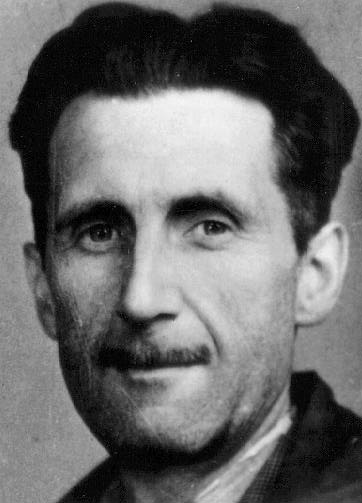
George Orwell, 1933 (Presumed Public Domain, from Wikipedia)
In a comment on my review last week of Kate Grenville’s One life, Lisa (ANZLitLovers) asked “Where’s Australia’s George Orwell?”. This was in reference to the idea that more novelists should write about climate change to help change public opinion. Interesting question, I thought, and one that I could explore in a Monday Musings. You might all be relieved, in fact, to have something different from my recent list-focused musings.
Before I answer the question – and then throw it open to you – it would be sensible to clarify my understanding of the question. (See, I’ve been well-grounded in essay skills: first, define your terms!) To put it simply, I believe Lisa was asking where is the Australian author who is driven to identify injustice, oppose inhumanity, and promote social conscience? That is, an author like Orwell – the man who coined terms like “cold war”, “big brother” and “thought police”, the man who used satire, allegory and other rhetorical devices in his fiction and non-fiction to show us the error of our ways. I hope this is what Lisa meant; this is, anyhow, how I am reading her question.
An Australian Orwell?
Well, a name did pop immediately into my head – Thea Astley. Of course, she’s dead, but so is George Orwell. I suspect Lisa was looking for a living Orwell to speak to us right now on “now” topics”, but, bear with me anyhow.
Astley, like Orwell, wrote in multiple forms – novels, short stories, essays – though Astley didn’t write the sorts of personal experience memoirs that Orwell did in books like Down and Out in Paris and London, The Road to Wigan Pier and Homage to Catalonia. And, unlike Orwell who travelled far and wide, physically and with his pen, Astley’s works were firmly based on Australia. But, like Orwell, she had an acerbic eye and a satiric pen, and she used it to good effect.
Ashley was also a wordsmith, albeit of a different sort to Orwell. She used words that frequently sent (and still send) her readers to the dictionary, and her passion was to “carve a good sentence”.
So far so good. However, having considered Astley, I’m now going to, reluctantly, reject her as our George Orwell. Not because she isn’t a satirist because she is, but because her satire isn’t as explicitly political as his. She was interested in the treatment of outcasts and misfits, regardless of the reason for their “otherness”, which could be race, religion, economic status, age, gender, and so on. She satirised suburban and small town life, particularly in her first novels. She also tackled more political issues such as white Australia’s treatment of indigenous people in A kindness cup and It’s raining in mango. In Coda she satirised the treatment of ageing. And in her last novel, Drylands, issues like gender, power, modern technology, and sport attracted the attention of her sharp pen.
Astley was surely aware of the political implications of the issues she targeted, but she didn’t explicitly focus on the politics. She was, I think, more interested in the social, cultural and personal ramifications of the behaviours she put before us.
We certainly have political satirists, but they tend to be performers rather than authors.
In 2013, the Sydney Writers’ Festival included a panel discussion titled The Satirists, which asked the question:
If Australians claim to be anti-authoritarian rabble-rousers, where is the canon of contemporary satirical novels reflecting this stereotype? What are the satirical traditions in Australian literature?
The panel included novelist David Foster, actor/novelist/memoirist William McInnes and poet Alan Wearne. I haven’t read Foster (my bad, I know) or Alan Wearne. And, I don’t think McInnes’ brand of humour, entertaining though it is, is quite what Lisa was asking. Contemporary writers I’ve read included Peter Carey and Richard Flanagan who have written some satirical novels but they are not known primarily as satirists.
So, is there anyone else – writing now – who is making it his or her business to tackle the big questions of our time, questions to do with refugees, indigenous dispossession, climate change? In Australia, or elsewhere?
POSTSCRIPT: I had just scheduled this post for publishing when up popped a blog post from today’s The Guardian. Written by Sam Twyford-Moore and titled “Why so serious: does Australian literature have a funny person problem?”, it starts with the following:
Australian authors show off their satirical chops on social media every day. So why doesn’t more of that wit spill on to the published page?
Of course, not all satire is “funny”, but, regardless, he doesn’t have an answer.

 Whispering Gums