Sarah Kanake and Down syndrome in literature

Sarah Kanake, Sing Fox to meIn the media release accompanying my copy of Sarah Kanake’s Sing fox to me (my review), we are told not only that Kanake’s brother has Down syndrome but that she has a PhD in creative writing from the Queensland University of Technology “on the representations of Down syndrome in Australian literature”.

As far as I know her thesis hasn’t been published. However, she has written about her interest elsewhere, including, most accessibly for us, at The Conversation. Her essay, which I’ve just found today, is titled “On telling the stories of characters with Down syndrome” (and you can read it online.) It’s an excellent essay, and I’ll come back to it in a minute.

When I wrote my review of Sing fox to me, I referred to Samson’s Down syndrome but I didn’t feature it. I chose to focus on other elements of the novel, namely the Gothic aspect, and the theme of loss. However, I did note that I’d like to come back to her characterisation of a person with Down syndrome, so I’m very pleased to have found her essay, which was published, in fact, the same day I published my post.

In the novel, Samson is presented as being very aware of his difference. He feels weighed down by his “heavy extra chromosome” which is how he characterises the impact of the syndrome on his life, particularly when he feels that impact is negative. It’s negative when his movements are limited (you can’t go beyond the fence, your brother must hold your hand when you cross the road, you can’t make toast for yourself); when people talk about him, in front of him, as though he isn’t there; when people ignore him, assuming he’s got nothing to contribute. All these happen in the book. But Samson does think, feel, know things. Just because he’s disabled doesn’t mean he’s stupid; it’s just that “the extra chromosome … sometimes slowed him down.”

By using multiple (third person) points of view, Kanake also portrays the responses of others to Samson. Jonah is resentful of his parents’ expectations that he’ll care for and be responsible for Samson. Mattie’s mother Tilda, kind as she is, doesn’t want Mattie to be introduced to Samson, she doesn’t want Mattie to be “stuck with disabled kids just because she’s deaf”.

In her essay, Kanake discusses our culture’s low expectation of people with Down syndrome, and how this translates in literature depicting them. She talks about how literary representations too often use characters with Down syndrome as plot devices, as points of conflict for the narrative. Indeed, she quotes Mark Haddon, author of that book featuring a character with autism, The curious incident of the dog in the night-time, as saying that he uses disability “as a way of getting some extremity, some kind of very difficult situation”. Kanake also discusses how narratives involving characters with Down syndrome are mostly told through the perspective of the parents not the person him/herself. Characters with Down syndrome, in other words, rarely have “a voice and agency within the narrative”.

Consequently, in writing Sing fox to me, Kanake says

I was extremely conscious of representing and dissolving boundaries around my protagonist with Down syndrome, Samson Fox, in order to create a narrative where Samson was free to move, evolve and change.

At the end, without giving anything away, Samson, overlooked by others, decides, quietly but determinedly, to take matters his own hands:

Quietly, and without asking Murray or his granddad, he gathered up everything he would need and packed it carefully into his school port […]

Samson crossed the lawn to the gate. He was going to find his brother. No one would stop him or tell he couldn’t. Not Murray or Clancy. This time Samson could choose, and he chose to go beyond the house and beyond the fence and beyond the gate …

Breaking down barriers in other words!

While the novel resolves some of the challenges faced by its characters, the ending is not simplistic and much is still left unresolved on the mountain (as you’d expect in a “true” Gothic novel, I think.) Samson is just one part of this. Down syndrome does, yes, define, and sometimes limit, him, but it is not the crux of the novel – which is why, really, it was not the focus of my review. I think that means Kanake has achieved her goal?

Monday musings on Australian literature: Miles Franklin Award, the first decade (1958-1967)

Miles Franklin

Miles Franklin, c. 1940s (Presumed Public Domain, via Wikipedia)

This month we expect to see the announcement of the Miles Franklin Award longlist. While it’s no longer Australia’s richest literary prize, it is still the best-known and, if you can measure such things, our most prestigious. It is managed by a Trustee using the estate left for that purpose by author Miles Franklin. It was first awarded in 1958 for a novel published in 1957. Until the late 1980s, the award was dated for the year of publication, not the year of granting the award as now.

Given that we are now in April and interest in the award will be hotting up again, I decided to potter around Trove and see what commentators and/or authors thought about it in its first decade. (See the Award’s official site if you’d like to see a complete list of winners.) My intention is not to give a potted history or a thorough analysis of the award’s early days but to share some interesting snippets which provide some insights into the life and times … Ready? Here goes …

Politics and the award

Where there’s kudos to be had, you’ll usually find a politician. It’s not surprising, therefore, that the first prize, worth £500, was given by the Prime Minister of the day, R.G. Menzies. That first winner was – fittingly, really – Patrick White’s Voss. I say fitting because White is also our first (and only to date) Nobel Prize Winner for Literature. Anyhow, The Canberra Times of 3 April reported on the ceremony:

Mr. Menzies said the novel in Australia was reaching maturity in a “turbulent activity of blossoming world literature.”

He said with the small encouragement being given by the Commonwealth literary board, “a career of art and literature” was an increasing possibility.

What do you think “turbulent activity of blossoming world literature” means? And, did careers in “art and literature” become more possible? I think the “Commonwealth literary board” refers to the Commonwealth Literary Fund, which underwent some changes in Menzies’ time.

In 1959, the award was won by Randolph Stow’s To the islands. Once again, there was a political response, albeit an indirect one. The Canberra Times of 24 April reported on Mr. Haylen (Labor MP for Parkes) speaking in the House of Representatives during the debate on the Universities Commission Bill:

He said it was a sorry state of affairs that of the 17 books that had been considered for the Miles Franklin award for 1958, only five had been printed in Australia.

The winning novel had been printed in England.

He said further assistance should go towards the establishment of a subsidised university printing press, similar to the Oxford and Cambridge University presses in England.

Fascinating. I have written before on the wonderful work done by our university presses. He also said the Commonwealth Government should support the establishment of a chair of Australian literature in every Australian university.

A posthumous award

The third book to receive the award was Vance Palmer’s The big fellow. Lisa (ANZLitLovers) has read it as part of her Miles Franklin reading project. She feels it’s not up to the standard of the first two winners, and wonders whether it was one of those lifetime achievement awards. Certainly, the Palmers were significant supporters of and contributors to Australia’s life of letters in the 1930s to 1950s.

The award was accepted by Palmer’s wife Nettie at the Adelaide Festival of the Arts, quite a contrast to the first award ceremony being “a literary gathering in the Rural Bank building” in Sydney.

Multiple wins

Patrick White Terrace

Patrick White Terrace, National Library of Australia

Several writers have won the award more than once, with two writers – Thea Astley and Tim Winton – winning four times. By the end of the award’s first decade, two writers had won it twice – Patrick White and yes, Thea Astley. In addition to his Voss win, White won the 1961 award with Riders in the chariot, and Astley won the 1962 and 1965 awards with The well dressed explorer and Slow natives.

The Canberra Times of 21 April quotes the judges on White’s Riders in the chariot:

 After reading, and re-reading this book, we have no hesitation in saying that it is a great novel, a novel that moves us to admiration for the creative impulse that has produced it. Its philosophy may not be original, but its people, their environment, and their actions are indisputably so.

They also describe what they believe to be its message, asking “is it not legitimate to expect a message from a work of this poetic and philosophical cast?” Yes, I think it is!

On Thea Astley’s second win, The slow natives, The Canberra Times of 22 April quoted the judges as saying that she was “A brilliant novelist with an inimitable style of her own”. But it was this in newspaper’s report that I found particularly interesting:

Most of the novels were well worth reading, and it was noted with interest that more writers than usual dealt with urban or country town themes, fewer with the outback and the aboriginal problem. There was more satire, more wit, and a considerable flavour of sophistication.

Noted by the judges I presume. Fewer dealt with “the outback and the aboriginal problem”. What to say to that except that it’s probably good to see writers moving onto more town and city themes than the outback, given where most people live, and, presuming that most of the writers were white, it’s also probably a positive thing that there were fewer books about “the aboriginal problem”! The thing about reading these older newspaper reports is the insight they provide into past attitudes.

The lesser-knowns

As always with awards, there are wins, like Vance Palmer’s, that haven’t remained in the public eye. I’ll share two others from the first decade. First is George Turner who shared the 1963 award with the better known Sumner Locke Elliot. Turner’s novel was The cupboard under the stairs. Once again Lisa comes to our aid with a review (and she liked this one better!). The Canberra Times wrote an article on 13 July a couple of months after the announcement. There is a reason for this belatedness. Apparently at the time of winning the award “it was impossible to obtain a copy in Australia”. Indeed, they say, “the first printing sold out so quickly that no copies ever reached Canberra”. This makes me think of MP Mr Haylen, and his desire for university presses, because Trove shows that Turner’s novel was first published in England. At least we don’t have that problem now!

The Canberra Times liked the book, which is about a farmer’s nervous breakdown. It has some faults they say, but overall “it is a compelling story, and as a study of madness it explores ground rarely covered in Australian literature.” Madness. That’s language we wouldn’t use now, isn’t it?

The other is Peter Mathers Trap, which, yes, Lisa has also reviewed. She found it hard going, but how wonderful that we have a review available online. Bloggers provide such an important service when they review older books! Thanks Lisa. Anyhow, according to The Canberra Times of 21 April, Mathers was living in London when his win was announced, and expressed surprise that he had won. Its story is pessimistic, Lisa says, pitting Melbourne’s slums and pubs against “glittering” society, and its main character, Jack Trap, is of mixed background, including indigenous Australian. Most reviewers, it seems, saw it as satire. However, Mathers, The Canberra Times says, “preferred not to call the novel a ‘satire’, but a ‘comic novel’ in the tradition of Irish writers from the 18th century down to Flan O’Brien, who died recently.” Hmm, an Australian Flan O’Brien. That has piqued my interest – in addition to the fact that I hadn’t heard of Mathers before (besides seeing him in Miles Franklin lists, that is).

… and finally

I did not specifically look for articles in The Canberra Times! It just so happens the most interesting articles that popped up in response to my search terms came from it. A comment on the quality of The Canberra Times or something to do with what papers have been digitised?

National Eucalypt Day

After writing my Monday Musings on World Poetry Day this week, I was surprised to discover that today, Wednesday 23rd March, is National Eucalypt Day. I had no idea we had such a day, which is probably not surprising as this is only its 3rd year. It is an initiative of the Bjarn K Dahl Trust and its aim is “to further raise awareness of eucalypts and celebrate the important place that they hold in the hearts and lives of Australians”.  I love that, of course.

The Bjarn K Dahl Trust is a philanthropic fund, that, according to their website, was “established from a bequest by Bjarn Dahl, a Norwegian Forester, who developed a true affinity with the Australian bush, and a particular love for the Silvertop Ash, Eucalyptus sieberi, and left his entire estate to establish the Trust”. Wow, eh? (The date of 23rd March was chosen for National Eucalypt Day because it was Dahl’s birthday. I wonder if he’s related to Roald Dahl?)

My quick Google search suggests that the day is taking off somewhat faster than poor old World Poetry Day – well, I found three events anyhow. Here in Canberra, the Australian National Botanic Gardens are celebrating Eucalypt Week, but today, THE day, they presented a talk titled “As Australian as a gum tree : An historical look at eucalypts in Australian culture”. (Unfortunately I was otherwise engaged, or I would have been there). The Royal Botanic Gardens in Victoria offered a Walk with an expert eucalypt botanist. Back in Canberra again, I discovered that, for some reason, the National Arboretum celebrated National Eucalypt Day on 18th March, with “a variety of short walks”. Better early than never, I suppose!

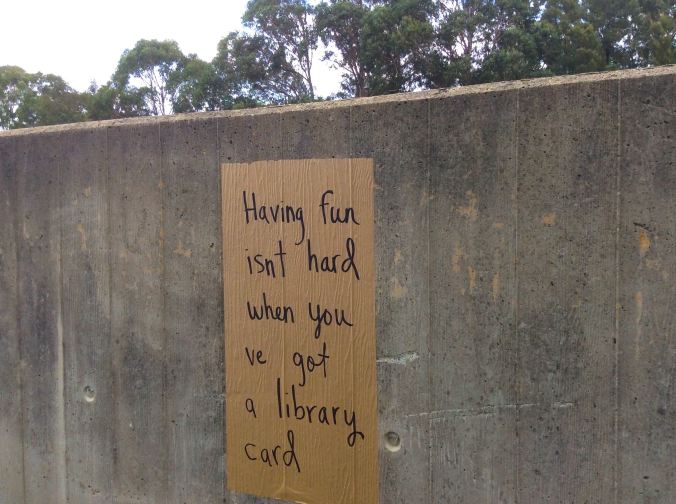
I have written about gum trees (our popular name for eucalypts) several times on this blog, so am not going regale you with more right now. Instead, I’m going to share a photo I took today in a carpark in Canberra’s NewActon Precinct. Peeping above the wall are, yes, eucalypts.

Library Card poster Nishi Car Park

Not the best photo – the light wasn’t great – but the conjunction of library-love and eucalypts was too good to resist.

Happy National Eucalypt Day everyone (and especially to the Resident Judge of Port Phillip whom I was meeting for drinks right after taking this photo! It’s been years since we caught up – and it was lovely).

Helen Macdonald, The human flock (Commentary)

I know, I know, I sound like I’m obsessed with Helen Macdonald. I’m not, but I am interested in nature and landscape, and she has thought and researched at length about the topic. I’ve called this post a commentary, because it’s not a review. Rather, I’m going to draw on both an On Nature column she wrote for The New York Times Magazine and her book H is for hawk (my review) – and look at a political issue she raised in both writings.

I’ll start with a comment that occurs near the beginning of H is for hawk. Early in her hawk training sessions, she takes Mabel out walking in the streets of her town, but almost no-one speaks to her. They all saw her, she says, how could they not, but “they just pretended they hadn’t”. Except for those who did. A man from Kazakhstan saw her. They discuss Kazakh falconers, and he tells her “I miss my country”. A Mexican cyclist “skids to a halt” and admires Mabel, saying he’s never seen a hawk so close, only high in the sky where they are “free”. And then she realises

that in all my days of walking with Mabel the only people who have come up and spoken to us have been outsiders: children, teenage goths, homeless people, overseas students, travellers, drunks, people on holiday … I feel ashamed of my nation’s reticence. Its desire to keep walking, to move on, not to comment, not to interrogate, not to take any interest in something peculiar, unusual, in anything that isn’t entirely normal.

I thought, interesting, but moved on, with her, to the next part of her story.

Then, late in the book, she’s out walking with Mabel again, and runs into a retired couple she knows. They exchange pleasantries, including discussing the beauty of a herd of deer they’d all seen. Their conversation concludes with:

“Doesn’t it give you hope?” he says suddenly.
“Hope?”
“Yes,” he says. “Isn’t it a relief that there’re things still like that, a real bit of Old England still left, despite all these immigrants coming in.”

Helen is horrified, but says nothing. However, as she walks home she thinks

… I should have said something. But embarrassment had stopped my tongue. Stomping along, I start pulling on the thread of darkness they’d handed me.

She thinks of why and how people and creatures move between countries, of Göring’s desire to move Jews from Germany, of Finnish goshawks in England, of a Lithuanian mushroom gatherer in England who couldn’t understand why English people didn’t know which mushrooms in their woods were and weren’t edible. She says:

I think of all the complicated histories that landscapes have, and how easy it is to wipe them away, put easier, safer histories in their place.

Today’s “Old England”, for example, is not, actually, the England of 100 years ago, let alone 400 hundred years ago, given the impact of settlement and agriculture on the land and its “natural” inhabitants. And those deer? Well, they and the hare are “legacies of trade and invasion”, albeit back to Roman times. Immigrants in their day, in fact. She suggests that instead of fighting “for landscapes that remind us of who we think we are”, we should “fight, instead, for landscapes buzzing and glowing with life in all its variousness”.

Starling murmuration

Starling murmuration, by Walter Baxter, using CC BY-SA 2.0, via Wikimedia Commons

This brings me to the article, “Human flock”, she wrote for The New York Times Magazine. It’s about waiting and watching at a lake in Hungary for a flock of Eurasian cranes on their southward migration. Are you catching my (her) drift now? She talks of various migrating birds, sandhill cranes, snow geese, and starlings. She describes a murmuration, the collective noun for a flock of starlings. She discusses why these birds flock. The reasons include for protection (out of fear), to signpost where they are to other starlings, and for warmth. These flocks, though, are also made up of “thousands of beating hearts and eyes”, of individual birds in other words..

As she watches and thinks, her mind turns to “more human matters”, to the “razor-wire fence” built by the Hungarian government to keep Syrian refugees out. She writes:

Watching the flock has brought home to me how easy it is to react to the idea of masses of refugees with the same visceral apprehension with which we greet a cloud of moving starlings or tumbling geese, to view it as a singular entity, strange and uncontrol­lable and chaotic. But the crowds coming over the border are people just like us — perhaps too much like us.

The flock made her realise that “in the face of fear, we are all starlings, a group, a flock made of a million souls seeking safety”. But flocks can also be transformed into “individuals and small family groups wanting the simplest things: freedom from fear, food, a place to safely sleep”. It’s a powerful statement for humanity. And I like the way it picks up ideas she touched on but didn’t explore at depth in H is for hawk.

Nature, or, more accurately, exploring its meaning for us and our relationship to it, is clearly an ongoing project for her. I’ll be interested to see how her ideas develop – but for now, you may be pleased to know, I’m moving on to other books and ideas!

PS Helen Macdonald gave the closing address at the 2015 Sydney Writers’ Festival on “On looking at nature”. She gets into nature, history, culture and diversity. It runs for around 38 minutes, and makes for great listening.

Helen Macdonald
“On Nature: The human flock” in The New York Times Magazine, December 6, 2015.
Available: Online

Jane Austen on history and historians

Jane Austen, we know from her letters, was a keen reader. She read novels, sermons, plays and poetry, magazines and, of course, histories. Did you know, though, that she also wrote a history? This is her juvenilia piece, The history of England from the reign of Henry the 4th to the death of Charles the 1st (online text), illustrated by her older sister Cassandra and completed in November 1791, the month before Jane turned 16.

It’s not, however, like any history you’ve read before, except perhaps Sellar and Yeatman’s 1066 and all that. Published in 1930, this book, Wikipedia tells us, is “a parody of the style of history teaching in English schools at the time”. Well, interestingly, scholars argue that Austen’s History is a parody of the histories being taught in the schools of her time, in particular, Oliver Goldsmith’s History of England from the Earliest Times to the Death of George II (1771). The parody starts on her title page where she tells us “N.B. There will be very few Dates in this History”. She also identifies the author of her history as “a partial, prejudiced, & ignorant Historian”, satirising Goldsmith’s claims to be objective. “It is hoped the reader admits my impartiality” he wrote in his Preface, but many readers, including our Jane, would not admit this at all given some of his pronouncements!

Mary Queen of Scots, by Cassandra Austen, believed to be modelled on Jane

Mary Queen of Scots, by Cassandra Austen, believed to be modelled on Jane

And so, as you’d expect in a parody, Austen is unashamedly subjective in her History, usually promoting the opposite to the prevailing view of her times. She is, for example, partial to the Stuarts, and particularly to Mary Queen of Scots, and is critical of Elizabeth I, “that disgrace to humanity, that pest of society”. She continues:

It was the peculiar misfortune of this Woman to have bad Ministers —— Since wicked as she herself was, she could not have committed such extensive Mischeif, had not those vile & abandoned Men connived at, & encouraged her in her Crimes. I know that it has by many people been asserted & beleived that Lord Burleigh, Sir Francis Walsingham, & the rest of those who filled the cheif Offices of State were deserving, experienced, & able Ministers. But oh! how blinded such Writers & such Readers must be to true Merit …

If you know anything about Austen scholarship, you won’t be surprised to hear that her History has been the subject of intense theorising, with various perspectives being explored, in addition the parody/satire angle. Other perspectives include that it

  • explores ideas about historiography, and the blurring of fact and fiction; and/or
  • reflects Jane and her sister Cassandra’s maternal line’s Jacobite/Stuart sympathies (which were not shared by the men of the family) or, conversely, it reflects their anti-mother attitudes; and/or
  • supports a feminist reading of her work; and/or
  • conveys Austen’s irreverence towards authority.

My aim is not to discuss these here, though, because I want to refer briefly to Northanger Abbey, the first version of which was written around 1798–99 (that is, only a few years after the History). It is famous for its defence of the novel, but it also contains references to other sorts of reading including, yes, history. I want to share some of these, which make interesting reading in the light of her History. The references come from heroine Catherine Morland’s conversation with Henry Tilney and his sister Eleanor.

When you read Austen, you need to know whether Austen approves of the characters who are speaking, as this affects how we are meant to read the character’s pronouncements. Now, in Northanger Abbey, Catherine is our heroine, but she is also young and a little naive. As the novel progresses, she is “taught” by the somewhat older and wiser, Henry Tilney, but he can also be a little pompous. So, I think we can read the following comments with some respect for Catherine’s position, as well as for Henry’s.

“That is, I can read poetry and plays, and things of that sort, and do not dislike travels. But history, real solemn history, I cannot be interested in. Can you?” [Catherine]

No, not necessarily, Austen is perhaps suggesting:

“… I read it a little as a duty, but it tells me nothing that does not either vex or weary me. The quarrels of popes and kings, with wars or pestilences, in every page; the men all so good for nothing, and hardly any women at all—it is very tiresome: and yet I often think it odd that it should be so dull, for a great deal of it must be invention. The speeches that are put into the heroes’ mouths, their thoughts and designs—the chief of all this must be invention, and invention is what delights me in other books.” [Catherine]

We hear you Catherine! And we think back to Austen’s History where, surely with tongue in cheek, she refers her readers to “inventive” writers for authority, such as Shakespeare (“whereupon, the King made a long speech, for which I must refer the Reader to Shakespear’s Plays” or “he afterwards married the King’s daughter Catherine, a very agreeable Woman by Shakespear’s account”) and Sheridan:

Sir Walter Raleigh flourished in this & the preceding reign, & is by many people held in great veneration & respect — But as he was an enemy of the noble Essex, I have nothing to say in praise of him, & must refer all those who may wish to be acquainted with the particulars of his Life, to Mr Sheridan’s play of the Critic, where they will find many interesting Anecdotes …

Cheeky Jane!

And so the discussion continues, with the reasonable Eleanor Tilney stating that she likes history but is happy if historians, such as Austen’s revered David Hume, embellish speeches to make them readable.

“Historians, you think,” said Miss Tilney, “are not happy in their flights of fancy. They display imagination without raising interest. I am fond of history—and am very well contented to take the false with the true. In the principal facts they have sources of intelligence in former histories and records, which may be as much depended on, I conclude, as anything that does not actually pass under one’s own observation; and as for the little embellishments you speak of, they are embellishments, and I like them as such. If a speech be well drawn up, I read it with pleasure, by whomsoever it may be made—and probably with much greater, if the production of Mr. Hume or Mr. Robertson, than if the genuine words of Caractacus, Agricola, or Alfred the Great.”

Ah Eleanor, I hear you. The scene concludes with Catherine making some concessions while suggesting that she used to think all historians did was to write “great volumes … for the torment of little boys and girls”, and Henry Tilney teasing her about this idea of historians aiming to “torment” rather than “instruct”.

Reading or studying history appears in other novels too, particularly in Mansfield Park, where, for example, Austen tells us Fanny, her heroine, had to “read the daily portion of history” but where she also says of Fanny and her sister, Susan, that “their conversations, however, were not always on subjects so high as history or morals”.

I’ve barely touched the surface of Austen’s discussions of history and what we might make of them, but I hope at least that I’ve shown why students (and lovers) of Austen never run out of ideas to think (and argue) about!

Monday musings on Australian literature: Regional differences in Australian English

Thredbo Village

Thredbo Village

While dining in Thredbo this weekend, we were served by a waiter who, when I asked for a certain ingredient to be excluded from my dish, repeated it back with the order, “and no to-mAY-to” she said. Her accent wasn’t strong but this stood out, so when she returned to our table, we asked whether she was from North America. Yes, Vancouver, she said, but sixteen years ago. She thought she’d covered her origins up but, when we explained, she realised she’d make a slip and pronounced that she would not make that mistake again! What a shame I thought …

When we watch movies or television programs from countries like England and the United States, we tend to be very aware of accents and linguistic differences. Is this set in the north of England, we ask? Or, oh, she’s a New Yorker, we’ll say. The accent is a big part of it, but vocabulary and expressions also contribute. Interestingly, despite Australia’s geographic expanse, with some populations quite remote from others, such differences are far less pronounced.

There are some differences, of course. Indigenous Australians can often be distinguished by a particular way of speaking, as can country versus city people. Traditionally, South Australians have had a reputation for sounding more English, for rounding their vowels in words like “dance” and “branch”. (South Australia was not a convict colony like most of the other states!) These differences tend to be subtle, and are probably not well noticed by those from other countries.

Linguistic differences in Australia are, though, something I’ve been aware of, largely because I’ve experienced the impact. You see, as an early teenager, I moved from living in northwest Queensland (Mt Isa to be exact) to the big smoke in New South Wales (aka Sydney). I learnt very quickly to say “recess” at school, not the childish sounding “little lunch” for the first break of the day. I learnt that the bag I took to school was a “case” or “bag” not a “port”. (These days I suppose it’s a “backpack”!). And I learnt that my “togs” were “swimmers”.

I was therefore fascinated to read a recent theconveration.com article titled “Togs or swimmers: Why Australians use different words to describe the same things”. It was written by three linguists at the University of Melbourne, Jill Vaughan, Katie Jepson and Rosey Billington. They provide some maps showing different word usages around Australia, swimwear being one. (If you are interested, they include a link to more maps on their Linguistic Roadshow site).

What is particularly fascinating about this from my point of view is not so much the differences but the fact that different states agree on different words. For example, with some words there’s general agreement in Queensland and New South Wales (“ice-block”) but not Victoria (“icy-pole), while for another word Victoria and New South Wales will concur (school “canteen”) with Queensland (the “tuckshop”) the odd one out. How did/does this happen? The authors don’t cover it – though perhaps they do in a longer academic article.  They do, however, note that some usages align quite closely with state lines, and that this can be observed in border towns, like Albury-Wodonga. Words, they say, become part of one’s regional identity and so Wodonga residents are more likely to use the Victorian-preferred “bathers”, while those from Albury will use the New South Welsh “swimmers”.

The thing is, of course, that vocabulary usage varies (and changes) over time as well as space. When we read Australian novels, it’s the change over time that I suspect we notice, more than the regional ones. One of the aspects I enjoyed in Madeleine St John’s 1950s-set The women in black (my review) is St John’s recognition of new words being introduced to Australians via post-war European immigrants, words like “salami” for example! She also used the word “reffos” which was contemporary Australian slang for “refugees”. Salami is here to stay, but “reffos” has been replaced by new slang.

Current writers like Tim Winton and Christos Tsiolkas very self-consciously, I think, closely reflect contemporary vernacular in their novels. It’s important to the milieu they are describing. Kristen Krauth’s just_a_girl (my review) is replete with contemporary teenage vernacular, including Americanisms like “skanky”, reflecting America’s influence on contemporary Australian English (if not on contemporary English!). In indigenous Australian writing, we hear the different rhythms and language of (to generalise somewhat) indigenous people. “Deadly”, meaning “great” (and similar), is an obvious example.

Hmm … I’ve moved a little away from what inspired this post but it did get me thinking about how I read Australian writing and what I notice. Works which use contemporary language – words, expressions, grammatical constructions – can seem fresh and alive, and very specifically of their place and time. Historically, but I’m generalising here and it’s a matter of degree rather than being absolute, the vernacular was (and is?) more common in genre writing than in literary works, that is, the works that go on to become “classics”. There are exceptions, of course. Some of Barbara Baynton’s stories in her Bush studies collection are nigh impossible to read for the vernacular she uses, and yet are deemed classics. And CJ Dennis’ Songs of a sentimental bloke remains popular despite its colloquial language.

I’d love to know what you think about the use of vernacular – as against more formal writing – in the fiction you read. When does it engage you, and when not?

My encounter with Encounters

I rarely write about museum exhibitions, and when I do it’s usually in the context of a travel post, but I do want to share with you our National Museum of Australia’s current exhibition, Encounters. Subtitled “Revealing stories of Aboriginal and Torres Strait Islander Objects from the British Museum”, it is described by the Museum as “one of its most important exhibitions”. That could sound, of course, like your typical promo-speak, but in this case I’m inclined to agree. Encounters is a very interesting and, yes, important exhibition – one that is not without its controversy.

The foundation pieces of the exhibition are 151 Aboriginal and Torres Strait Islander objects, including masks, shields, spears and spearheads, didgeridoos, baskets and head dresses, which were collected by a wide range of people – settlers, explorers, administrators, and so on – between 1770 and the 1930s, and which are now held by the British Museum. Complementing these are 138 contemporary items, some specially commissioned for the exhibition. The objects are supported by excellent interpretive labels which convey both the history of the objects and contemporary responses to them. The end result is a conversation between past and present that is  inspiring and mind-opening.

I’m not going to formally review the exhibition. You can read a thoughtful one published in the Sydney Morning Herald last month, including a discussion of the repatriation controversy. (Thanks to brother Ian for pointing me to this review). Instead, I’m just going to comment about its impact on me. So, here goes …

One message I took from the exhibition is not a new one at all, really, but more a confirmation: it’s that indigenous people, like all of us, are not one! It is way too easy for us (no matter who “us” are) to simplify “other” (no matter who “other” are). We tend to think that “they” all think the same, but obviously, like “us”, “they” don’t! This is made patently clear in Encounters where we see different responses by different indigenous communities to the objects. Some are adamant that their objects should be returned to them. Others may agree with that, but that’s not their priority (perhaps because they realise such a goal may not be realistic, in the short term at least!) They, such as Robert Butler, a Wangkangurru man from the Birdsville area, believe that the objects should not have been taken in the first place but recognise that the fact that they were now means they are available once again. Still others argue that the important thing is not the object itself, but the knowledge and skill they can obtain from it. Obtaining knowledge and practising skills that can be passed on, they argue, are the crucial thing, because they are critical to indigenous people’s identity and mental health.

I was consequently interested, for example, in a comment from the Noongar community regarding objects that had been collected by a young Englishman Samuel Talbot in the 1830s. He made detailed notes about the objects, demonstrating his keen interest in understanding Noongar culture. Present day Noongar woman, Marie Taylor, says:

I want to acknowledge the white people who sat down with the Aboriginal people, who wrote the stories down, who collected this information that still exists today. Down here in Noongar country, we may have lost all of that had it not been for many of these people.

Talbot is one of many such people. Lieutenant Dawes, about whom Kate Grenville wrote in her historical novel The lieutenant (my review), is another. Taylor’s response is, though, a generous one, since had there been no white people, they would not have lost (or been at risk of losing) their culture in the first place!

Bagu figures, contemporary objects from the Girringun Aboriginal Art Centre, Cardwell, north Queensland

Bagu figures, contemporary objects reflecting the past, from the Girringun Aboriginal Art Centre, Cardwell, far north Queensland

A very different story comes from far north Queensland. The panel that accompanies a shield, club and basket is titled “Guerrilla warfare”. The objects were collected in the 1860s by settler John Ewen Davidson at Rockingham Bay. He’d gone there, we’re told, “in 1866 to establish a sugar plantation. He began as a shocked observer of the violence of the occupation, yet within six months he was part of it”. Coincidentally, this story reminded me of another Grenville novel, The secret river, in which her fictional protagonist commenced with the aim of being peaceful but he too got caught up in violence.

Then there’s a comment that touched me on a more deeply personal level. It comes from Aunty Barbara Vale, a Dieri elder in South Australia. She says:

When I visit Killalpaninna I get a strong feeling of belonging. It’s our land, Dieri land. I feel safe and relaxed and always come away feeling good for having been there.

Now, I know my connection to the land is nothing like that of an indigenous person’s sense of belonging to and responsibility for their country, but Vale describes perfectly how I feel each year when Mr Gums and I go to Kosciuszko National Park – safe, relaxed, and a lovely sense of well-being. I don’t presume at all that my feeling is the same – it’s not – but her statement did give me a sense of connection, and, in that, of the validity of my own “truth”.

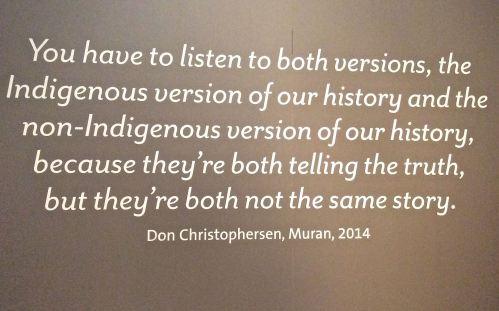
Towards the end of the exhibition, I came across a recent statement by Don Christopherson, a Muran man. He said:

Christopherson

And that is the spirit I’d like to think we all have in Australia today. It is surely the only real way we can move forward. Objects like the ones in this exhibition are crucial to this process, because, as one elder said, they bring the past into the present, which then enables us to move into the future. And, I’d say, they provide an excellent basis for a conversation.

A wonderful exhibition that I’ll try to visit again.

POSTSCRIPT: Here is a link to short films included in the exhibition. Many depict the way contemporary indigenous Australians are making objects today – some making traditional objects, some making modern ones commenting on contemporary relationships and concerns (like the ghost net project on Darnley Island – Erub – in the Torrest Strait).

Books given and received for Christmas, in 2015

I did a “books given and received post” last Boxing Day, and decided to do it again. It’s a useful record for me to keep, and may just interest you, so, here goes.

  • For Mr Gums, who is often up for a walk: Walking and cycling Canberra’s Centenary Trail
  • For Ms Gums Jr, in her stocking: Anna Funder’s The girl with the dogs.
  • For Mr Gums Jr, in his stocking: Richard Flanagan’s Short Black The Australian Disease: On the Decline of Love and the Rise of Non-Freedom.
  • For Ma Gums, who has worked as a lexicographer: Mary Norris’s Between you and me: Confessions of a comma queen (inspired by a review by Stefanie at So Many Books) AND, in her stocking, Elizabeth Gaskell’s The old nurse’s story.
  • For Brother Gums, lover of nature and good writing: Tim Winton’s Land edge: A coastal memoir
  • For Sister-in-law Gums, who loves art, nature and is interested in women’s lives: Louisa Atkinson’s nature notes (a selection of sketches and writings by this nineteenth century Australian naturalistDanielle Wood, Mothers Grimm, book cover.
  • For Gums’ Californian friend, who indicated in a comment on my post that she’d like to read this book: Danielle Wood’s Mothers Grimm.
  • For Gums’ Californian friend’s daughter, who’s busy studying for her law degree and might like some little interludes: Paul McDermott’s Fragments of the hole (my review) and Cassandra Atherton’s Trace (two fl smalls).
  • For Gums’ Californian friend’s other daughter, who’s developing quite a passion for baking: Delicious Bake.

As for what I received, a lovely, eclectic bunch:

  • From Ma and Pa Gums: Elizabeth Harrower’s In certain circles, in readiness for my reading group doing it in 2016) and Betty Churcher’s The forgotten notebook (about trips she made in the 1990s arranging loans of art of a blockbuster exhibition at the National Gallery of Australia).
  • From my Californian friend, who knows what my New Year’s resolution is going to be: Marie Kondo’s Life-Changing Magic of Tidying Up: The Japanese Art of Decluttering and Organizing (oh dear, now I’m really going to have to do it). Carolyn, that’s her name, wrote about it in her letters this year and, quite coincidentally, I read about the same book in Travellin’ Penguin’s blog. The title is slightly different but that’s just different editions I believe. She and Carolyn did make me laugh with their discussions of applying this book to their own decluttering projects.
  • From “old” Canberra friends: Tom Griffiths’ Endurance, historical fiction about photographer/explorer Frank Hurley (and they gave us a book gift voucher too. Lucky, us).

What about you? Any Christmas book news you care to report?

Monday musings on Australian literature: More on small books

Why is it that when we humans see change, we tend to prognosticate doom? I’m thinking how it was argued that TV would be the end of radio, and videos the end of cinema. It hasn’t happened has it? These older industries may have had to rearranged themselves a little but they have survived. Then a few years ago, with the advent of e-books, it happened again with commentators forecasting the end of the printed book. That hasn’t happened – yet, anyhow, and I really don’t think it will happen anytime soon. What drives all this? Fear I suppose. Enough of that, though, as my aim here is not to philosophise about change. Rather, I want to talk about the small book …

Yes, I know that I wrote about them only a couple of weeks ago, but since then I’ve come across more discussion of them, and more initiatives. Short books, it seems, are gaining in popularity – or at least a number of publishers seem willing to give them a go, and not just for publishing cheap classics which they can expect to have an audience. No, as I wrote in my previous post on the topic, some are publishing contemporary material, sometimes specifically commissioning or putting a call out for contributions or even holding competitions.

Giramondo, an independent Australian publisher, started their Shorts program back around 2012. Giramondo Shorts is, they say:

a new series of short form, short print run books, designed to take account of the new technologies of digital printing, and to appeal to a community of literary readers. The series carries a quote from Les Murray’s poem ‘The Dream of Wearing Shorts Forever’: ‘it is time perhaps to cherish the culture of shorts.’

There are now 8 books in the series, and the books have an unusual square format. At $19.95 each, they are priced a little higher than many small books, but the fact that they are continuing suggests some level of success. It seems like digital printing technologies are enabling Giramondo to produce their books more efficiently.

One of the reasons that I decided to write this follow-up post was because in my role as Literary and Classics coordinator for the Australian Women Writers Challenge, I came across Jonathan Shaw’s review (for his blog Me Fail? I Fly!) of the Going Down Swinging Longbox. This is a set of  “five slim books” containing pieces the literary magazine had rejected for publication in its magazine. Shaw calls this little collection “a beautiful artefact”. It is for this reason that I particularly wanted to mention it, because not only are these small books, but beautiful design is an important part of their production. In other words, they are a long way from the cheap Penguin 60s initiative. After all, there’s nothing like holding a beautifully designed book is there – something that is hard to experience in the e-format. (Going Down Swinging is a literary magazine that has been publishing in print, and later also online, since 1979.)

Finally, for this post anyhow, there’s Griffith Review’s novella project. Including this is a bit of a cheat, really, because in this case the book itself is not especially small, and these two posts have been focussed on physical smallness, not just smallness (or shortness) of content. However, I thought it was worth mentioning because it represents a commitment to the novella form, which as you know is a favourite form for me. Here is what they say:

In 2012, Griffith Review 38: The Novella Project played a major role in enabling Australian and New Zealand authors to gain a foothold in the English language revival of the novella underway internationally. In 2014, Griffith Review 46: Forgotten Stories – The Novella Project II published five novellas with an historical dimension in a confronting, moving and provocative collection.

And so, Griffith Review 50: Tall Tales Short – The Novella Project III has just been published. It contains five novellas which were selected in a blind-judged nationwide competition.

The printed book, in other words, looks to me like it’s not going anywhere soon. There might be a bit of a shake-down as publishers explore what is going to work best and for whom, but it is exciting to see them continuing to explore the possibilities of print, including producing short works in new forms and formats.

Monday musings on Australian literature: Where is Australia’s George Orwell?

George Orwell, 1933 (Presumed Public Domain, from Wikipedia)

George Orwell, 1933 (Presumed Public Domain, from Wikipedia)

In a comment on my review last week of Kate Grenville’s One life, Lisa (ANZLitLovers) asked “Where’s Australia’s George Orwell?”. This was in reference to the idea that more novelists should write about climate change to help change public opinion. Interesting question, I thought, and one that I could explore in a Monday Musings. You might all be relieved, in fact, to have something different from my recent list-focused musings.

Before I answer the question – and then throw it open to you – it would be sensible to clarify my understanding of the question. (See, I’ve been well-grounded in essay skills: first, define your terms!) To put it simply, I believe Lisa was asking where is the Australian author who is driven to identify injustice, oppose inhumanity, and promote social conscience? That is, an author like Orwell – the man who coined terms like “cold war”, “big brother” and “thought police”, the man who used satire, allegory and other rhetorical devices in his fiction and non-fiction to show us the error of our ways. I hope this is what Lisa meant; this is, anyhow, how I am reading her question.

An Australian Orwell?

Well, a name did pop immediately into my head – Thea Astley. Of course, she’s dead, but so is George Orwell. I suspect Lisa was looking for a living Orwell to speak to us right now on “now” topics”, but, bear with me anyhow.

Astley, like Orwell, wrote in multiple forms – novels, short stories, essays – though Astley didn’t write the sorts of personal experience memoirs that Orwell did in books like Down and Out in Paris and London, The Road to Wigan Pier and Homage to Catalonia. And, unlike Orwell who travelled far and wide, physically and with his pen, Astley’s works were firmly based on Australia. But, like Orwell, she had an acerbic eye and a satiric pen, and she used it to good effect.

Ashley was also a wordsmith, albeit of a different sort to Orwell. She used words that frequently sent (and still send) her readers to the dictionary, and her passion was to “carve a good sentence”.

So far so good. However, having considered Astley, I’m now going to, reluctantly, reject her as our George Orwell. Not because she isn’t a satirist because she is, but because her satire isn’t as explicitly political as his. She was interested in the treatment of outcasts and misfits, regardless of the reason for their “otherness”, which could be race, religion, economic status, age, gender, and so on.  She satirised suburban and small town life, particularly in her first novels. She also tackled more political issues such as white Australia’s treatment of indigenous people in A kindness cup and It’s raining in mango. In Coda she satirised the treatment of ageing. And in her last novel, Drylands, issues like gender, power, modern technology, and sport attracted the attention of her sharp pen.

Astley was surely aware of the political implications of the issues she targeted, but she didn’t explicitly focus on the politics. She was, I think, more interested in the social, cultural and personal ramifications of the behaviours she put before us.

We certainly have political satirists, but they tend to be performers rather than authors.

In 2013, the Sydney Writers’ Festival included a panel discussion titled  The Satirists, which asked the question:

If Australians claim to be anti-authoritarian rabble-rousers, where is the canon of contemporary satirical novels reflecting this stereotype? What are the satirical traditions in Australian literature?

The panel included novelist David Foster, actor/novelist/memoirist William McInnes and poet Alan Wearne. I haven’t read Foster (my bad, I know) or Alan Wearne. And, I don’t think McInnes’ brand of humour, entertaining though it is, is quite what Lisa was asking. Contemporary writers I’ve read included Peter Carey and Richard Flanagan who have written some satirical novels but they are not known primarily as satirists.

So, is there anyone else – writing now – who is making it his or her business to tackle the big questions of our time, questions to do with refugees, indigenous dispossession, climate change? In Australia, or elsewhere?

POSTSCRIPT: I had just scheduled this post for publishing when up popped a blog post from today’s The Guardian. Written by Sam Twyford-Moore and titled “Why so serious: does Australian literature have a funny person problem?”, it starts with the following:

Australian authors show off their satirical chops on social media every day. So why doesn’t more of that wit spill on to the published page?

Of course, not all satire is “funny”, but, regardless, he doesn’t have an answer.