What do Di Gribble and Steve Jobs have in common?

MabBookPro

My current beloved MacBook Pro - aging but still fine

You probably think it’s strange to put these two luminaries together – one a lesser-known Australian publisher and entrepreneur and the other an international icon in personal computing. But the thing is, you see, that besides the fact that they both died this week – from cancer – Gribble and Jobs both entered my life in the mid 1980s. And their impact was significant. I have consequently decided to add my cyberspace tribute to these two people.

Di Gribble first. With Hilary McPhee, Di Gribble established a significant small Australian publishing house, McPhee Gribble. That was in 1975, but the real impact for me was about a decade later when I returned to reading Australian literature with a renewed enthusiasm – and it was through imprints like McPhee Gribble that Aussie literature was encouraged and promoted. McPhee Gribble were, in fact, the first to publish Helen Garner, Murray Bail and Tim Winton, all of whom I have reviewed here. Wonderful Australian writers, and we’ll surely be seeing tributes from them in the coming days and weeks. The company was sold to Penguin in 1989, with Gribble and McPhee going onto other things – but remaining in the Australian literature fold. Gribble’s post-McPhee Gribble ventures included the publishing company Text Media (later also sold, and still going strong as Text Publishing) and the independent digital media publishing company Crikey. She was, as they say, a goer – and we, in Australia at least, will miss her.

(You may also like to read Lisa’s tribute at ANZLitLovers)

And now Steve Jobs. Our first personal computer was one home-built by Mr Gums in the late 1970s. It was a great little computer – and as a librarian I was of course drawn by its possibilities, particularly for information management and retrieval. Our first database was one to manage our wine cellar! An excellent joint project to test the possibilities. This computer was, however, not particularly user-friendly. Mr Gums, the engineer, was well into DOS command lines but the computer didn’t easily engage we laypeople. Then along came Jobs, and Mr Gums, always on the lookout for improved technologies, saw the new world of personal computers coming. So, in 1985, we bought one of the first Macintosh models available in Australia – and I was hooked. The mouse, the GUI  interface with its WYSIWYG style, the continual improvements, not to mention the gorgeous designs (I even loved my often-maligned little clamshell laptop) have kept me in the orchard. Apple products are just so delicious! As most of my friends know, it is hard to separate me from my Mac (not to mention other Apple products, such as my latest gadget, the iPad2). Thanks Steve, we’ll miss you too.
Whither dictionaries?

Dictionary

Look it up (Courtesy: OCAL via clker.com)

I’m always a bit suspicious of writers who nay-say some new development. You know, like television will be the death of cinema, the book is dead, and so on. The latest I’ve read is in an article from the Independent that appeared in our local newspaper. The article*, “Death of the dictionary” by John Walsh, bemoans the end of the printed dictionary (and along with it the plethora of reference books we all used to love, such as Roget’s Thesaurus, Fowler’s modern English usage and Brewer’s dictionary of phrase and fable. Hands up if you have these on your shelves). He has a point. Libraries are fast weeding their reference shelves, preferring to handle users’ enquiries via online means. Is this a problem? Are we the poorer for it?

Sales of printed dictionaries have been in decline for some time. He writes that:

If they go the way of reel-to-reel tape recorders, vinyl records and camera film, we’ll have lost a substantial source of intellectual delight – the reference shelf.

I’m not sure that this analogy is quite apposite. And I think his arguments are only partly valid. He suggests that:

Online dictionaries do not encourage browsing

resulting in a loss of that “serendipitous joy in finding arcane information when turning the pages in search of something else” BUT many online dictionaries and thesauri/thesauruses do hyperlink to other words, thereby encouraging exploration. How serendipitous this is depends on the sites we click on and how we use them once we’re there. It’s in our hands.

Online dictionaries do not provide a sense of a word’s derivation or associations

BUT many online dictionaries do in fact provide some etymological information AND, if you don’t limit your search to dictionaries, you can find all sorts of fascinating information about a word. Take Walsh’s example of  “shibboleth”, for example. Search on “shibboleth definition” and your hit list includes not only dictionary hits but others including Wikipedia. Click on the Wikipedia article and at the bottom, under External Sources, are further links to the internet including Etymology of “shibboleth” where you’ll find a pretty thorough well-cited discussion of the word by an informed layperson.

Old words are being removed from dictionaries

He quotes the removal of obsolete words like “charabanc” and “aerodrome” (now that one makes me feel old!) from Collins print dictionaries. This is pretty understandable. There is clearly a point at which a print dictionary becomes too unwieldy and does need to be pruned of words rarely looked up. An online dictionary, though, can retain old words pretty well indefinitely. How many megabytes, after all, does a word and its meanings (and derivation) consume? Here is charabanc at freedictionary.com. It comprises (albeit fairly basic) definitions from the American Heritage Dictionary and the Collins English Dictionary, as well as thesaurus entries from Princeton University’s Wordnet.

New words (neologisms) are being added into the lexicon too quickly

without the usual thorough lexicographical verifications. He cites “globesity” in the new edition of Chambers Dictionary and wonders, tongue in cheek perhaps, if it was “invented by a smart young lexicographer working at Chambers HQ …”. A Google search on “globesity definition” brings a number of hits including a blog post (again by a non-linguist) “Globesity is here” which suggests the word has been used by the World Health Organisation, and a definition from the freedictionary.com which defines it as a “neologism for the global epidemic of obesity”. But that’s not my point really. We will always argue over neologisms … the thing is that the internet provides a wonderful opportunity to explore them, to find out where and how they have been used. The internet is not infallible, it has its limitations, particularly in terms of the data that is available to us at no cost …

but, those who want something more thorough, more lexicographically authoritative can subscribe to the great dictionaries online: the OED, the Macquarie (if you’re Australian), and so on. The way I see it, the online world, used with sense and discretion, is the ideal way to handle our reference queries. My previously much-loved but now dust-covered reference books are, I must say, on borrowed time. What about yours?

* By the way, the original article was published under the title “No, we shouldn’t just Google it”

How do you handle Copyright on your blog?

Copyright notice by Open Source

Copyright (Courtesy: Joshua Gajownik, opensource.com, using CC-BY-SA-2.0)

Since the beginning of this blog I have been concerned about Copyright, and have worked through it in stages. I’m not a copyright expert and have no legal training, but I thought I’d share – in case it helps others – some of my thought processes over the last two years or so of my blog:

  1. I worried, in the beginning, about using other content on this blog, specifically images. I am careful about clearing the use of book cover images with publishers, and I check copyright statements for any other images I use on the blog. I attribute as best I can the creator of these images, and have found that creators (or copyright owners) are usually pretty easy to identify on sites such as Wikipedia and Flickr. But, there are many images that I have not used because I could not clarify their copyright situation.
  2. I then realised that I hadn’t made the situation clear about my own images and so, many months into the blog, I added a Text Widget for Copyright on Images. In this I stated my policy regarding my use of images from other sources, and I applied a rather loose Creative Commons licence statement for my own images.
  3. And then it occurred to me that I hadn’t properly clarified copyright on the rest of my content. Under Australian Copyright, anything I publish is automatically copyrighted to me, that is, I do not need to register for copyright in order for my content to be protected under copyright. However, as a (retired) librarian/archivist, I know how frustrating copyright can be  – in terms of knowing who owns copyright and how the copyrighted material can be used – and so today I have added a formal Creative Commons license to my blog (in the permanent sidebar) by using the Creative-Commons-Configurator and then adding the resultant html code to a WordPress Text Widget.

My Creative Commons Licence

Because I believe in collaboration, in sharing thoughts and ideas, my goal in choosing a licence was to make it easy for people to use my work without going through major hoops but to retain some rights for myself. The  licence I’ve chosen allows others to use my work (text and images in the case of this blog) under the following conditions:

  • Attribution. My work can be copied, distributed, displayed, adapted as long as it is attributed to Whispering Gums, with a link, where possible, to this blog.
  • NonCommercial. My work can be copied, distributed, displayed, adapted for non-commercial purposes only. Those who wish to use my work for commercial purposes must contact me for permission (wg1775[at]gmail[dot]com)
  • ShareAlike. Others may use my work in theirs, as long as they only distribute them under the same Creative Commons license that I’ve used for my work.

Note: None of these conditions overwrite rights protected under relevant copyright laws, such as fair use rights and moral rights. It is simply a licence by which I make clear how I, as a copyright owner, allow my work to be used.

Acknowledgement

I thank the Creative Commons people for the work they’ve done over the last 10 years in trying to both simplify and free up copyright for those of us who just want to create and share. May their work continue … as the world of creation, repurposing and distribution becomes more diverse and complex.

On pathologising fictional characters

Jane Austen's Mr Darcy, illustration by CE Brock

Mr Darcy, illus by CE Brock (Presumed Public Domain, courtesty Wikipedia)

Was Mr Darcy autistic? Phyllis Ferguson Bottomer, a Canadian speech pathologist, suggests that he was in her book So odd a mixture.  Her theory has not been taken seriously, but it throws up an issue I’ve confronted before, the pathologising of fictional characters.

Take M.J. Hyland for example. I have read two of her novels and must admit that, as I read them, the word “autism” did cross my mind more than once. I did not, however, define the characters as such in my reviews, though I did footnote my temptation to do so in my post on This is how. I didn’t succumb to the temptation because I’m not sure it is relevant or helpful to ascribe to a fictional character a condition that the writer him/herself has not identified.

And, as it turns out MJ Hyland herself has something to say on the matter, at least as far as her works are concerned. She said in an interview on Slow TV that many people suggest her characters have autism but she does not, she said, want to “pathologise” her characters, she does not want such a neat cause and effect. She explains this further by saying that she does not want to present her characters as victims but rather, she wants them to be “as complicated as we are”. I like that … her characters are highly complex and would become immediately less so if she identified them as having a diagnosed condition.

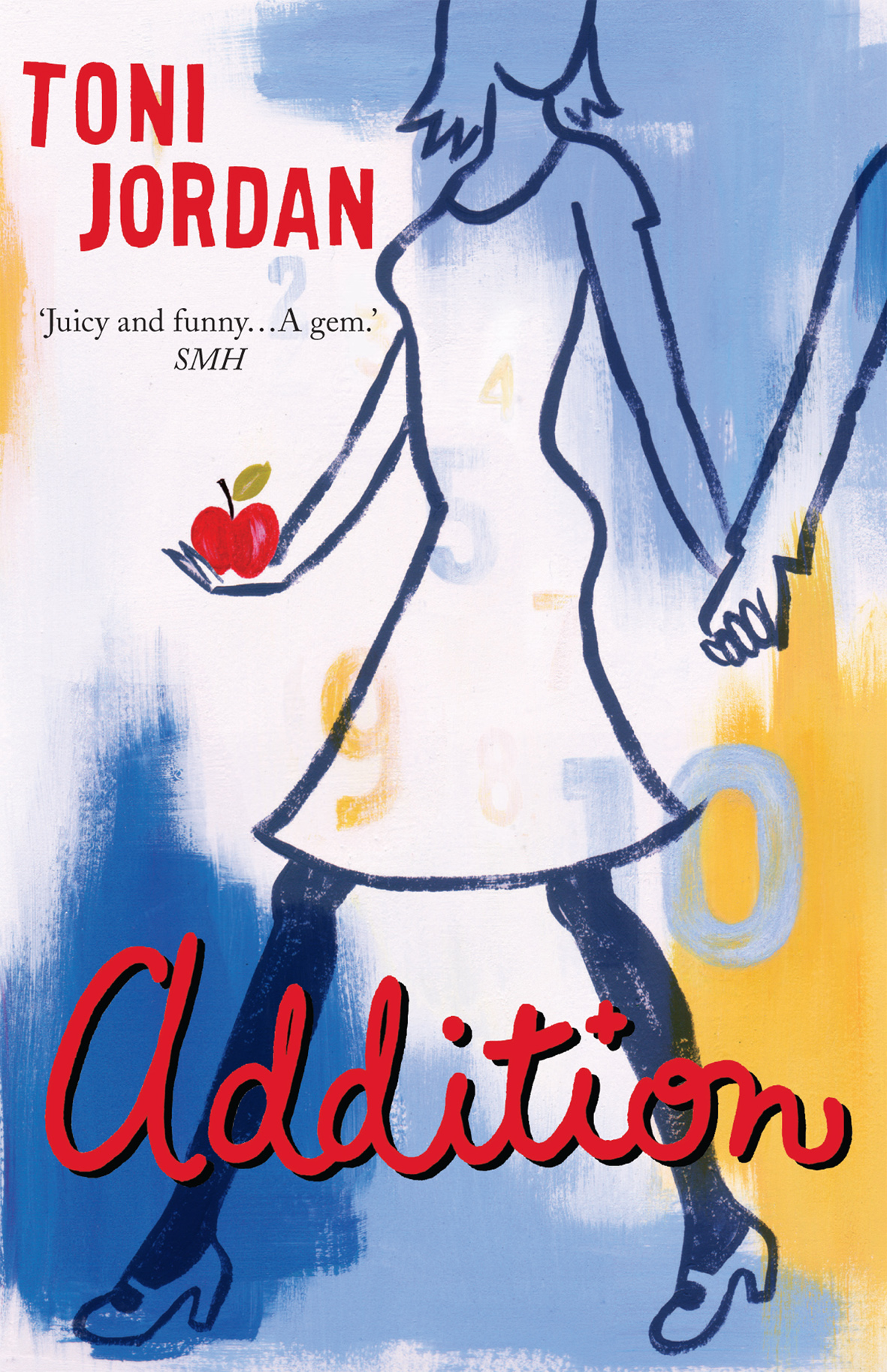
Book cover for Toni Jordan's Addition

Addition Paperback cover (Courtesy: Text Publishing)

What is it that makes readers want to “diagnose” characters? Is it a desire to do the opposite to what Hyland wants, that is, to simplify them, to put them in neat explainable boxes rather than allow them all the messiness that make us human? By saying this I am certainly not suggesting that “real” people with these conditions are simple. Far from it. But I am suggesting that making such diagnoses, extratextually, can be used to simplify the fictional world. Labelling Darcy as autistic denies us the challenge of teasing out who he is, and why he does the things he does. Or what about Albert Camus‘ Meursault from L’étranger? Had Camus labelled him autistic, as some critics/reviewers have suggested, would we, could we, analyse the book in the same way? Or Patrick Suskind‘s Grenouille from Perfume? Does it help or hinder our analysis to call him a sociopath? I don’t have an answer to this except to say that I like to proceed with caution when I go beyond the text on the page.

Of course, there are books in which characters are ascribed conditions by their creators. Think Mark Haddon‘s The curious incident of the dog in the night-time in which the protagonist defines himself as having “behaviour difficulties” (though nothing more specific than that) and Toni Jordan’s Addition in which the heroine has OCD. Because these characters admit to their conditions, the focus of their novels is different. They deal more directly with the issue of how these characters face the challenges of their particular “condition”.

Anyhow, what do you think? How far do you think it is reasonable to go in terms of describing fictional characters – and why?

Weekends with TS Eliot

Reading TS Eliot's SELECTED POEMS

Reading TS Eliot's Selected poems (Image: Courtesy RubyGoes via Flickr, using CC-BY 2.0)

Breakfast in bed is my weekend treat. It’s when I kick back with a book and simply relax – except this weekend and last I kicked back instead with my iPad and app for TS Eliot‘s The waste land. What fun I am having and intend to have over a few more weekends.

So, what have I been doing?

Fiona Shaw’s performance

Well, last weekend I pottered around the app checking out what’s there and how to navigate it, trying a couple of the readings (but not listening to the whole), and so on. And then I listened to/watched Fiona Shaw‘s performance of the poem. This is a performance rather than a reading. She uses gesture and limited movement (around the upper storey room in a house in Dublin somewhere) to convey the drama, humour and mystery of this rather tricky poem. If you hold the iPad in landscape orientation, Fiona Shaw’s performance fills the screen. However, if you rotate it to portrait orientation, the poem appears below the image with the text synchronised to the performance. This is what I did and, being a textual person, I preferred it this way. I loved seeing the words played out on the screen – and she was almost word-perfect.  I didn’t time it properly but it took, I’d say, 15-20 mins. I’d recommend this as a good way to start re-acquainting yourself with the poem if, like me, it’s been an embarrassing number of decades since you last read it.

Perspectives, from Seamus Heaney, Paul Keegan, Jim McCue and Craig Raine

I said above that I am a textual person and that’s true but, paradoxically I suppose, the thing that most grabs when I’m reading is rhythm and sound (something I’m loving in my current read, Kim Scott‘s That deadman dance, but that’s for later). And so, I have always loved TS Eliot:

In the room women come and go
Talking of Michelangelo
(from ‘The love song of J. Alfred Prufrock”)

And now a gusty shower wraps
The grimy scraps
Of withered leaves about your feet
And newspapers from vacant lots.
(from “Preludes”)

We are the hollow men
We are the stuffed men
[…]
This is the dead land
This is the cactus land
(from, of course, “The hollow men”)

Here is no water but only rock
Rock and no water and the sandy road
The road winding above the mountains
Which are mountains of rock without water
(from “W. What the thunder said” in The waste land)

…  and so on. Staccato or sing-song, repetition or not, rhyming or not. It gets into your bones.

This weekend I decided to explore the Perspectives section of the app which is where various luminaries talk about aspects of Eliot and the poem. I listened to/watched Irish poet Seamus Heaney, poetry editor from Faber and Faber Paul Keegan, Eliot expert Jim McCue, and English poet and academic Craig Raine …. and I gained some new perspectives! I’m not going to comment on all they say since you really should explore this app yourself (if, that is, you have access to an iPad). I’ll just focus on an aspect that most comment on, one way or another – Eliot and sound.

Heaney comments on the “musicality” of the poem. Paul Keegan goes a little further. He suggests that
“acoustic things, tonalities” are what attracts people more, today, to the poem than the “monolithic meanings”. These “acoustic things” though do convey meaning, don’t they, particularly when the allusions elude us. I do not, I admit, “get” all the allusions, but I love the sound of the poem and can sense his concerns even if I may not be able to articulate them in an analytical way.

Somewhat related to this, Keegan argues that Eliot showed it was possible for a poet to write without knowing exactly what larger meanings he was conveying. He suggests that Eliot didn’t necessarily know what he was getting off his chest and that he was more interested in “what poems do than in what they say”. This rather ties back to sound doesn’t it? Or, it does for me. What his poems “do” to me is complex – they move me emotionally but can often mystify me intellectually. They can sound at times like nonsense and yet you “feel” or “hear” something profound. How does he do that? Anyhow, Keegan expands his point, suggesting that Eliot’s poetry encouraged a new fearlessness about poetry “having to make sense, forensic sense”. It freed up, he says, some of those questions*.

Jim McCue’s contribution is a short but interesting one on the history of the poem’s publication. And then, Craig Raine takes up the sound issue again, but from a slightly different perspective. He describes Eliot, the American born English poet, as, really, a world citizen. The waste land is full of “voices” – something conveyed well by Shaw in her performance – from around the world including, most obviously, Germany, France and India. It’s like, Raine says, changing the radio dial (which was still a fairly new technology then.) He also describes the poem as “a fantastic operatic selection”, a not surprising description, I suppose, for a poem which Eliot considered titling “He do the police in different voices”!**

A technical (sort of) note

The app doesn’t always behave exactly as I would expect or like. Changing the orientation will sometimes bring a surprising result and take you away from where you were. It’s not hard to get back as there’s always the Home icon available at the bottom, but it can be disconcerting.

* I will though come back to meaning in my next post after I’ve finished the “Perspectives” section of this App.
** From Dickens’ Our mutual friend

Amazon: The good, the bad and the …

Book Stack

Books, where next? (Courtesy: OCAL, from clker.com)

Well, let’s not go there because, really, we all want convenient, economic access to good books don’t we? And Amazon has done a great job of forging/championing a whole new world of book distribution – both through their online service for  selling traditional books and then their development of the Kindle and eBook distribution. (I know Amazon was not necessarily the first in all these services, but it has certainly brought them into the mainstream.)

This is not to say I haven’t had my grumbles –  about such things as freight costs (no supersaver deals for we downunder) and the more limited availability of eBook titles for our market – but I am glad such online services exist. I have been able to purchase books that would previously have been difficult if not impossible to get any other way. Similarly, readers overseas (that is, over the seas from me!) who find it hard to locate Australian literature can purchase Australian titles from Amazon, including more obscure works like those from Sydney University Press‘s Australian Classics Library. Now that’s what I call a good Amazon deal! And then there’s the fact that people living in remote areas where bookshops don’t exist and housebound people have been able to purchase books far more easily than they could before. There is a lot to like.

But of course, it’s not all good. What change is? Monopolies (and near-monopolies) are rarely beneficial in the longterm (for consumers anyhow), so the news of an Amazon-Book Depository merger is rather concerning. But it’s not a fait accompli (yet). And the continuing loss of traditional face-to-face book stores is also disappointing – but I don’t understand the economics enough to know where and how this one can be resolved. We like to browse bookshops but we also like the convenience, and sometimes cheaper prices, of online and/or eBook purchase. Can we have our cake and eat it too? If someone knows the answer to this one, I’d love to hear it.

I am not defending Amazon per se. Nor am I cheering on their Book Depository merger plans. We should feel concerned. We are right to question. But, I’d like to recognise what Amazon has achieved and what we have gained. I (selfishly) wish I knew how we can keep the industry (authors, publishers, distributors) strong so that we readers can get what we want, when we want it, at a price that is reasonable for all. Ideas anyone?

TS Eliot’s The waste land, app-style

TS Eliot plaque SOAS London

Would Eliot have liked this new way of publishing? (Image, via Wikipedia, released into Public Domain by Man vyi)

Hands up if you’ve seen Touchpress‘s gorgeous iPad app for TS Eliot‘s poem The wasteland? Now, if your hand is up, why didn’t you tell me about it? Luckily, though, I have a real-life, dinky-di librarian friend who told me what my online friends didn’t!

This is not going to be a proper review as I only downloaded it yesterday, but it’s worth sharing sooner rather than later. At least , I think it is, because it’s a great example of how technology can enhance our reading experience, particularly of complex texts. The app comprises the following menu items:

  • Poem (the full text)
  • Performance (a filmed performance of the full poem by Fiona Shaw. You can watch the performance on its own, or with the text synced to it!)
  • Manuscript (facsimile of the original typed manuscript showing Eliot’s handwritten edits)
  • Perspectives (commentary on the poem and Eliot, by various people including Seamus Heaney and Jeanette Winterson)
  • Readings (several audio renditions of the poem, including two by Eliot himself, and others by Alec Guinness, Ted Hughes and Viggo Mortenson)
  • Notes (annotations and references explaining the poem)
  • Gallery (images relating to the poem).

There is a Home icon so you can quickly return to the menu screen to navigate around the app. And there are also well thought through navigations on other screens. For example, on the screen containing the straight text of the poem are icons linking directly to the annotations (Notes) and the list of audio versions (Readings).

I feel like the proverbial child in a lolly shop. Where do I start? Do I simply read the poem? Probably not, since if that’s all I wanted to do I’d have taken my lovely old Collected Works down from my bookshelf. So, what do I do? Do I read it with the annotations? Or listen to TS Eliot read it or watch Fiona Shaw perform it? Or do I play around with the edited manuscript facsimiles? Whatever I do, though, I’ll be in good company. The app – for a rather challenging poem, remember – was one of the topselling apps the week it was released and was named “app of the week” in the US.

I read, much of the night, and go south in the winter
(line 18, The waste land)

It will take many nights to read, watch and absorb this terrific production, but it’s winter here so I’m starting now…

TS Eliot
The waste land
iPad app (AUD16.99) 
Touch Press and Faber and Faber, 2011
951mb

On the literary (and linguistic) road in Japan: 1, Central Honshu

Given this is primarily a litblog, I like my travel posts to have some literary or, at least, linguistic interest. And so in this first post about our current trip to Japan, literary and linguistic observations and thoughts will be my focus.

Linguistic challenges

Japanese language has a pitch-accent system which can provide particular challenges for English-speaking foreigners who try to use some Japanese words when communicating. For example:

  • Kaki: Oyster or Persimmon, depending on, to me, a very slight difference in intonation
  • Sake: Salmon or, well, Sake, with the same proviso as above
  • Hana: Flower, Nose or a Girl’s name with, I think, no variation in pronunciation. So, when you see a shop, as we did the other day, called Hana No Hana (‘no’ denoting ‘possession’), you wonder whether it means ‘Hana’s Flower’ or’ Hana’s Nose’ or ‘Flower’s Nose’ or, Flower’s Flower’, or … well, you can see where I’m going can’t you? You can have fun playing word games with Japanese people.

Japlish

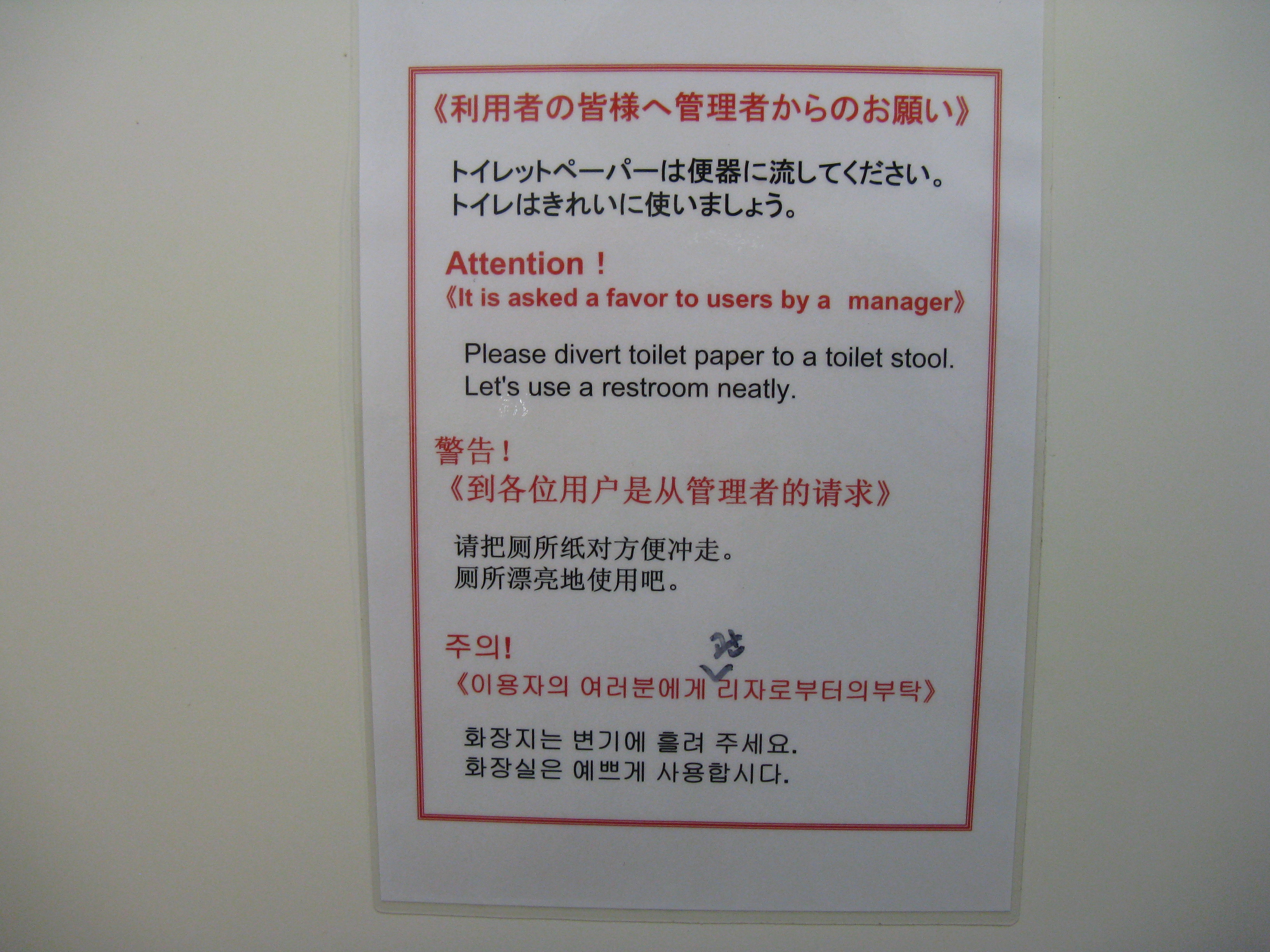
Sign in toilet, Japan

Sign in toilet, Japan

English-speaking foreigners, as you probably know, love to “catch” Japanese out in their English usage … and so for fun I’ll share just a couple that we’ve come across to date with you. But, please note that these are shared in a sense of fun not ridicule. After all, most Japanese know more English than I do Japanese, and at least they try.

  • On a special English menu in an izakaya that I shall leave unidentified to protect the innocent:

It is necessary to enjoy oneself over meal after it acknowledges though it is thought that the mistake of the word is somewhat found in the menu.

  • Inside a toilet door. For some reason, hotels and tourist venues often feel the need to tell you what to do with your used toilet paper. This one is particularly (unconsciously, we presume) entertaining:

Attention!
(It is asked a favour to users by a manager)
Please divert toilet paper to a toilet stool. Let’s use a restroom neatly.

Literature

I like to read Japanese writers, and have reviewed a couple on this blog to date, but here I’ll share something different.

A little haiku written by the poet Koyabashi Issa (1763-1827), one of Japan’s four haiku masters. It was inspired by a frog mating battle at Gansho-in Temple in the lovely little town of Obuse, and was written to encourage his sickly son. (Unfortunately, his son died a month later. In fact, Issa was pre-deceased by all his children and his wife).

Yase-gaeru,
Makeru na! Issa,
Kore ni ari.

It roughly translates to:

Skinny Frog,
Don’t give up! Issa
Is here.

English traveller-explorer Isabella Lucy Bird‘s* letters, titled Unbeaten tracks in Japan, published in 1880 about her trip to Japan. I downloaded an eBook version and have been dipping into it during our trip. In Letter XVIII she talks about her travels in the alpine region of Central/Western Honshu through which we travelled a day or so ago. Here is an excerpt:

It is an enchanting region of beauty, industry, and comfort, mountain girdled, and watered by the bright Matsuka. Everywhere there are prosperous and beautiful farming villages, with large houses with carved beams and ponderous tiled roofs, each standing in its own grounds, buried among persimmons [kaki, remember!] and pomegranates, with flower-gardens under trellised vines, and privacy secured by high, closely-clipped screens of pomegranate and cryptomeria.

She then names a number of villages, including the gorgeous Takayama which we have now visited on two occasions. She describes the farms as “exquisitely trim and neat”, and nothing has changed today.

I was also struck by a comment on food from the same letter. When she asked her hosts whether they drank milk from their cow, she learnt that they didn’t, that they thought it was “most disgusting” the way foreigners put into their tea something “with such a strong smell and taste”. Tea is of course a significant part of Japanese culture, but from a country which eats the oddest things to our western minds – salmon nose anyone? – this did make me laugh. Each to her own, as they say!

And here ends, my first little travel piece. More to come (probably).

*In the interests of full disclosure, I must add that according to Wikipedia, her first adventure was to Australia but she apparently didn’t like it.

Monday musings on Australian literature: Popular Penguins at a Perfect Price

Penguin with No. 1 ribbon

Since Penguin never responds to my copyright queries (Courtesy: OCAL via clker.com)

You all know Penguin Books – and perhaps something about the company’s origin. The story goes that Allen Lane, standing on a train platform in 1935 and not being able to find “something good” to read, decided that there existed “a vast reading public for intelligent books at a low price”. He staked all he had, apparently, and a publishing giant was born.

Over time though, prices have climbed and so a few years ago, Penguin decided to introduce plain covered (much like the original orange and white covers) editions of popular titles. The first set was published (here, anyhow) in September 2008. The price, in Australia dollars, $9.95. I like them – their bindings are easy to open, they are light and easy to carry, they look classic, and they are inexpensive. What’s not to like?

Content-wise – and fair enough, since reading should not be not an exclusively nationalistic activity – the majority of the offerings are non-Australian. However, each release of new titles includes a small selection by Australian authors, and it is these that I look out for and buy if I don’t already have them (because some nationalism is good!). Here is a list of what I believe are the currently available Australian titles published as Popular Penguins:

  • Astley, Thea It’s Raining in Mango
  • Carmody, Isobelle Obernewtyn
  • Clarke, Marcus For the Term of His Natural Life
  • Conigrave, Timothy Holding the Man
  • Courtenay, Bryce Power of One
  • Cracknell, Ruth Journey from Venice
  • Drewe, Robert Bodysurfers
  • Drewe, Robert Our Sunshine
  • Garner, Helen Monkey Grip
  • Garner, Helen Postcards from Surfers
  • Hartnett, Sonya Of a Boy
  • Hartnett, Sonya Surrender
  • Horne, Donald Lucky Country
  • Hyland, M.J. How the Light Gets In
  • Jolley, Elizabeth The Well
  • Leunig, Michael Curly Verse: Selected Poems
  • Lindsay, Joan Picnic at Hanging Rock
  • Marshall, Alan I Can Jump Puddles
  • Niland, D’Arcy Shiralee
  • Park, Ruth Playing Beatie Bow
  • Park, Ruth Harp in the South
  • Richardson, Henry Handel Getting of Wisdom
  • Stow, Randolph Merry-Go-Round in the Sea
  • Turner, Ethel Seven Little Australians
  • Winton, Tim In the Winter Dark

That’s twenty-five titles, mostly novels, but some non-fiction as well as poetry and short stories. A couple of the novels are children’s or young adult.

The temptation of course is to quibble with choices like this, to argue for one’s favourites, or on other grounds for why some other title/s may be more worthy … but why bother? The point is that it’s good to see an interesting variety of Australian titles being re-published in an affordable format – and, since the series seems to be popular, we can only expect that more Aussie titles will be published in the future. Meanwhile, non-Australian readers looking for Australian titles to read would not go too far wrong by choosing (according to their own interests) from this list.

A little postscript

I’m (well Whispering Gums, anyhow, is) 2 years old today. I can’t quite believe how quickly these two years have gone. It’s been great fun writing this blog, responding to comments on it, and reading the blogs of those I’ve met through blogging. Thanks a bunch for sharing your thoughts and ideas. And thanks especially to those who helped me get going in my early days. You know who you are and, while I won’t out you here, I want you to know that I greatly appreciate you! Roll on year 3 …

Nine, just 9, books by female authors at the top of a 20th century list?

Portrait of Virginia Woolf, 1902

Woolf, 1902, by George Charles Beresford (Presumed Public Domain, via Wikipedia)

The Reading Ape, in his February Literary Fact of the Day compilation, included the following tidbit:

There are only 6 female authors on The Modern Library‘s list of the 100 best novels of the 20th Century.

In fact, in the Modern Library’s Board’s list (over 10 years old now), a woman doesn’t appear until slot 15, and it’s Virginia Woolf‘s To the lighthouse. By contrast, a woman – Ayn Rand no less – occupies the first two slots of the Modern Library’s Readers’ List. Granted, this list is old news now as it was published at the end of the 20th century and was well raked over at the time. But, the Reading Ape reminded me of it and it seemed to me to be worth another look, 10 or so years down the track.  Here are the women:

  • 15. Virginia Woolf’s To the lighthouse
  • 17. Carson McCullers’ The heart is a lonely hunter
  • 58. Edith Wharton’s The age of innocence
  • 61. Willa Cather’s Death comes for the archbishop
  • 69. Edith Wharton’s The house of mirth
  • 76. Muriel Spark’s The prime of Miss Jean Brodie
  • 84. Elizabeth Bowen’s The death of the heart
  • 94. Jean Rhys’ The wide Sargasso Sea
  • 95. Iris Murdoch’s Under the net

Oh, that’s actually 9. The Reading Ape can’t count! Still 9% is pretty poor isn’t it? There are only 2 in the first 50, and did you notice that only one of these authors is represented by more than one book? That’s not the case with the male authors. I’m not going to be thorough about this but Joseph Conrad, William Faulkner, Ford Madox Ford, EM Forster, James Joyce, DH Lawrence, and Evelyn Waugh are just some of the male authors represented by two or more novels.

Anyhow, back to the women. I’ve read all those authors, and 7 of the books. I would agree with the inclusion of most of them, but let’s think about who’s missing. Well, for a start, there are quite a few Nobel Prize winners, including the following who write in English (which seems to be what this list is – Top 100 English language novels):

  • Pearl S. Buck
  • Nadine Gordimer
  • Toni Morrison
  • Doris Lessing (Nobel granted in 21st century, but her main body of work was written in the 20th century)

Surely each of these has at least one novel worthy of inclusion and could, say, replace one of DH Lawrence’s 3 (THREE!) inclusions? And what about Christina Stead, Margaret Atwood, Margaret Drabble, Anita Brookner, AS Byatt to name a few other significant female authors of the 20th century? What about Keri Hulme’s The bone people? Or a novel by Thea Astley? (Because, another feature of the list is that it’s very America-England centric)

Given that we are now over a decade into the 21st century, it might be interesting to reflect on a list compiled at the end of the 20th century. What do you think of the balance, and do you think there are novels by female writers which should have been included in the top 100 of the 20th century? (Let’s not get too bogged down in what we’d eliminate – that’s much less fun!)