Monday musings on Australian literature: Australian writers and AI

Today I saw an Instagram post promoting the latest interview on Irma Gold and Karen Viggers’ podcast, Secrets From the Green Room. The interview was with Emily Maguire, and the promo shared this:

Other people of my age who’ve been working at something for as long as I’ve been working at writing – they have a better lifestyle than me. They’re able to live in a way that I can’t, even though I feel successful. (Emily Maguire)

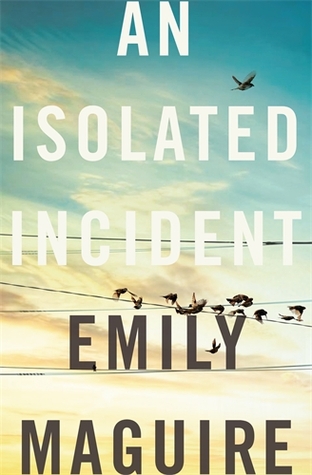
Emily Maguire, An isolated incident

Emily Maguire should indeed feel successful. She has written seven novels, and three works of nonfiction. In 2013 she was named one of The Sydney Morning Herald Best Young Australian Novelists. Her fifth novel, An isolated incident (my review) was shortlisted for several significant literary awards including the Stella Prize and the Miles Franklin Literary Award. Her latest novel, Rapture, won the Queensland Literary Award for Fiction and was listed for other awards.

And yet, she doesn’t have the same lifestyle as her peers. This brings me to the issue which is currently causing concern among writers internationally, including those in Australia. I’m talking of course about the AI industry’s use of copyrighted material to “train AI models”. This issue has been bubbling along for some time now and I’m not going to track it all here. The Conversation published an article in September summarising the current state of play in Australia, including these points:

  • The Productivity Commission’s interim report (published in August) “proposed a text and data mining exception to the Australian Copyright Act, which would allow AI training on copyrighted Australian work”.
  • The Minister for the Arts, Tony Burke, said in that same month that the government had “no plans, no intention, no appetite to be weakening” our copyright laws. 
  • Both the Australian Society of Authors (ASA) and the Australian Publishers Association oppose the the Productivity Commission’s proposal. The publishing industry is not entirely opposed to AI, but recognises significant legal and ethical challenges. The Australian Publishers Association wants government policies on AI to prioritise “a clear ethical framework, transparency, appropriate incentives and protections for creators”. They want a balanced policy which enables both AI development and cultural industries to flourish.

The concerns make sense to me. I am a librarian by profession, which means that freedom of information is one of my founding principles. It also means that I love the Internet and all that it offers us in terms of being able to find (discover) the things we want to know. However, this doesn’t mean that I believe these things should come at a cost to others.

So, what do librarians think about this? In February this year, the National Library of Australia published its Artificial Intelligence Framework. It recognises that “AI technologies present opportunities for developing new ways to collect, understand and share the collection” (p. 3) but also that:

Responsible AI governance includes recognition of legal rights holders and their valid commercial interests. Where legal frameworks for AI are evolving or unclear, any development will proceed with caution and consent from relevant stakeholders and copyright owners will be sought. This includes engaging with external stakeholders such as the NED Steering Group, publishers and independent publishing communities. We will not on-sell or share in-copyright data under any circumstances. As discussed below, we recognise the rights of Indigenous peoples to control their own cultural and intellectual property.

And, under their principles, they include that “We will always respect Australian copyright law and protect valid commercial interests”.

Meanwhile, Australian authors and musicians spoke last week at a Senate committee hearing on the Productivity Commission proposal to introduce the exception to the Copyright Act to allow AI training. Anna Funder, Thomas Keneally and other authors spoke powerfully on the importance of copyright to sustaining writers’ careers. I loved that Keneally invoked Frank Moorhouse, the author who was significant in the development of Copyright law in Australia, but he also made his own points:

It’s not copy-charity. It’s not copy-privilege. It’s not copy-indulgence. It’s copyright.

Anna Funder concluded her comments with:

If Australia would like books to delight itself, to know itself, to be itself, and not a source of raw materials for American or Australian computer companies, we will need books. But without copyright, no one will write them.’

(I saw these on Instagram, but you can read a summary on the ASA’s page.)

AMPAL, the Australia Music Publishers Association Limited, posted on Instagram that:

If AI needs our songs to learn … then our songwriters deserve to earn.

Life is tough for creatives, and yet what they create for us is, as one person told me many years ago, what makes life worth living! (Besides our family and friends of course.) So, I stand with Australian creatives in their fight to retain the right to say who can use their material, and how, and to be recompensed for that.

Monday musings of Australian literature: National Tree Day

Around ten years ago, I wrote a post on National Arbor Day. It was inspired by a Library of America story. The thing is that then I didn’t, and I still don’t hear, about Arbor Day anymore. Indeed, Mr Gums and I reminisced that it was mainly through school that we heard about it at all. Nor do I hear much about National Eucalypt Day, which I wrote about 8 years ago. I do hear sometimes about various tree-planting initiatives, but I was surprised to hear on ABC Classic FM on the weekend that Sunday was National Tree Day! A bit of research took me to the National Tree Day website.

Here, I learned that it was established in 1996, by Planet Ark, and that it has “grown into Australia’s largest community tree planting and nature care event”. The site continues that it is “a call to action for all Australians to get their hands dirty and give back to their community”.  I also learned that they run three tree days, whose dates for this year are:

  • Schools Tree Day Friday 25th July 2025 (set for the last Friday in July)
  • National Tree Day Sunday 27th July 2025 (set for the last Sunday in July)
  • Tropical Tree Day Sunday 7th December 2025

I said above that I don’t hear about Arbor Day anymore, so I checked Wikipedia. Under Australia, on the Arbor Day article, it says:

Arbor Day has been observed in Australia since the first event took place in Adelaide, South Australia on the 20th June 1889. National Schools Tree Day is held on the last Friday of July for schools and National Tree Day the last Sunday in July throughout Australia. Many states have Arbour Day, although Victoria has an Arbour Week, which was suggested by Premier Rupert (Dick) Hamer in the 1980s.

The implication is that it is still observed. It doesn’t, though, seem to get much publicity. I could research this, but so could you if you are interested! Meanwhile, I plan to use this post to share some tree quotes from Australian novels, and a couple of tree-inspired covers, as my little tribute to National Tree Day. 

My first quote is one I’ve shared before, because it’s my first memory of a tree playing a significant role in a novel. I’m referring to Ethel Turner’s children’s book, Seven little Australians (1894), and the death of our beloved Judy:

There was a tree falling, one of the great, gaunt, naked things that had been ringbarked long ago. All day it had swayed to and fro, rotten through and through; now there came up across the plain a puff of wind, and down it went before it. One wild ringing cry Judy gave, then she leaped across the ground, her arms outstretched to the little lad running with laughing eyes and lips straight to death.

This is realism. The tree has an important role to play in the plot. Another memorable novel featuring trees is Murray Bail’s Eucalyptus (1998). There is a narrative, of course, but it is framed around multiple species of gum trees, and opens with this:

We could begin with desertorum, common name hooked mallee … and anyway, the very word, desert-or-um, harks back to a stale version of the national landscape and from there in a more or less straight line onto the national character, all those linings of the soul and the larynx, which have their origin in the bush, so it is said, the poetic virtues (can you believe it?) of being belted about by droughts, bushfires, smelly sheep and so on; and let’s not forget the isolation …

As you can tell from the tone, the trees – although very real right down to their botanic descriptions – also set the novel’s tone and have something to say about Australian life and character.

More recent is Madelaine Dickie’s Red can origami (2019, my review). It is set in the Kimberley, but here is a description of a boab tree in Perth, a place where they don’t belong. It symbolises displacement:

The boab’s bark is cracked, its leaves are withered, and its roots strain from the soil, as if it’s planning on splitting town, hitching north.

There are more, but I’ll end with a writer who is loved for his landscape descriptions, Robbie Arnott. It’s hard to choose, but I’m going to use the one I used in my review of his novel, Limberlost, because it is a beautiful example of the landscape mirroring the emotions of the character moving through it. It occurs after a beautiful lovemaking scene:

Afterwards he’d driven them across the plateau through white-fingered fog, through ghostly stands of cider gums, through thick-needled pencil pines, through plains of button grass and tarns, through old rock and fresh lichen, until the road twisted and dived into a golden valley. Here at winter’s end, thousands of wattles had unfurled their gaudy colours. As they descended from the heights their vision was swarmed by the yellow fuzz. Every slope, every scree, every patch of forest, every glimpse through every window was a scene of flowering gold.

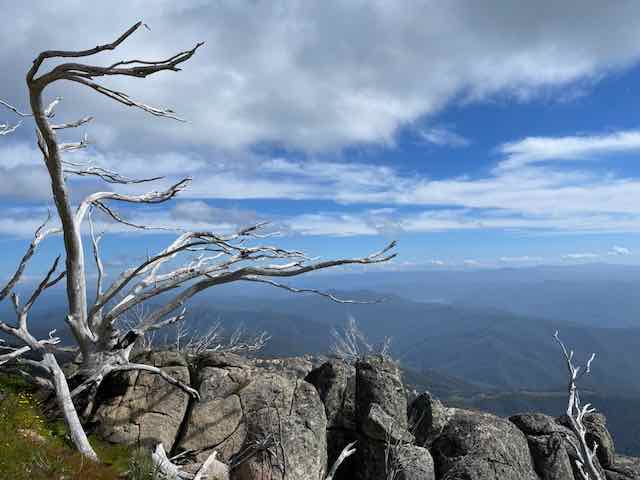
The book cover for this novel depicts what I assume is a stylised image of a Huon Pine with a boat, made by the protagonist using this wood.

Trees – or parts of trees, like branches or bark – often feature on book covers, because trees evoke so much in our consciousness. I guess they are easy to stimulate emotions in readers. They can be majestic and grand, or stark and threatening, or soft and sheltering – and suggest the associated feelings.

However, in doing a little research for this post, I stumbled across an old discussion about trees on book covers for crime novels. One was a 2007 blog post titled “Fright time in the forest”. The post broke down the four ways trees had been used on crime novel covers. There are those

  • used “more or less anthropomorphically–that is, as stand-ins for human-like monsters”
  • used “to establish a sense of desolation and bleakness, or mystery”
  • ominous-looking tree fronts, “on which the bark-encased stars loom belligerently overhead like villains preparing to fall upon and do violence to their victims”
  • used to “convey a mysterious atmosphere” through effects like fog, snow, a nighttime sky. 

Some of these overlap, I think, but I love the blogger’s conclusion, which suggests that

the designers of crime novels–like the storytellers who wanted to warn children off from wandering into the deep woods–have sought to associate trees with danger, disorientation, and despondency, all in the interests of book sales. One wonders whether this is healthy for the future of forests, a rapidly dwindling resource–or even healthy for the future of mankind, which might also become a dwindling resource.

I wonder whether book cover designers ever think of their larger responsibilities (besides garnering sales, I mean)!

I have strayed from where I started, which was to pay tribute to trees and share some favourite covers. However, this little discussion, which was picked up by England’s The Guardian was too interesting to ignore.

Any thoughts on trees in novels or on covers?

On the comedy of Jane Austen (1905)

A regular part of my Jane Austen group’s monthly meeting is a show-and-tell which means of course that we share anything new we’ve acquired, seen or heard about relating to Jane Austen. At our February meeting, a member brought along a first edition (I think) of a book a friend had given him as a result of that friend’s downsizing. It pays to have your friends know your enthusiasms!

The book was G.E. Mitton’s Jane Austen and her times, 1775-1817 (1st ed. 1905). We were intrigued as none of us had heard of this book or its author. Who is Mitton? The assumption from some in the group was male, but others of us were not so sure – and we were right to be, because G.E. Mitton is Geraldine Edith Mitton (1868-1955). She was, according to Wikipedia which cites Who’s who from 1907, “an English novelist, biographer, editor, and guide-book writer”.

Wikipedia provides a brief biography for her – drawn primarily from a couple of obituaries – followed by a list of works. It’s not much, but provides some background. She was born in Bishop Auckland, Country Durham, the third daughter of Rev. Henry Arthur Mitton, who was a master of Sherburn Hospital. In her late twenties, Mitton moved to London, where in 1899 she was employed by the publishing company A & C Black, and worked on the editorial staff of Who’s who. In 1920, she became the third wife of colonial administrator Sir George Scott and collaborated with him on several novels set in Burma. (Wikipedia lists four collaborative novels.) Her biography of him, Scott of the Shan Hills (1936), was published the year after his death. Several of her books are available at Project Gutenberg.

I could research her further, and, who knows, I might one day, but she’s not the main point of this post. What I want to share is how she starts her book. Chapter 1 is titled “Preliminary and Discursive”, and it opens with:

Of Jane Austen’s life there is little to tell, and that little has been told more than once by writers whose relationship to her made them competent to do so. It is impossible to make even microscopic additions to the sum-total of the facts already known of that simple biography, and if by chance a few more original letters were discovered they could hardly alter the case, for in truth of her it may be said, “Story there is none to tell, sir.” To the very pertinent question which naturally follows, reply may thus be given.

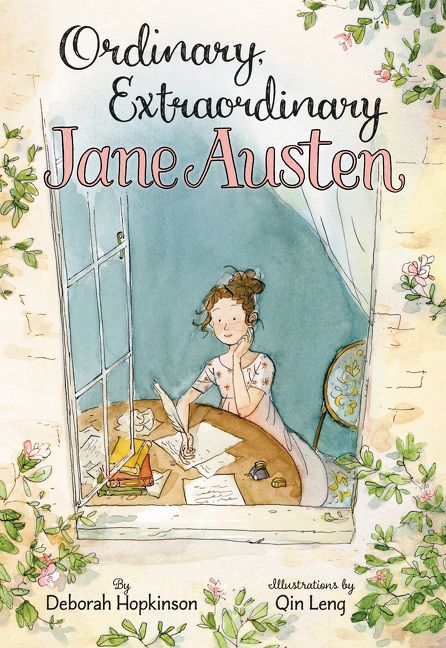
Deborah Hopkinson, Ordinary, extraordinary Jane Austen

Little did Mitton know! Despite the significant gaps in her biography, Austen is surely up there as a biographer’s subject. There have been many traditional biographies, including, in alphabetical order, those by David Cecil, yasmine Gooneratne, Park Honan, Elizabeth Jenkins, David Nokes, Carol Shield and Claire Tomalin. But, perhaps partly because of the gaps and partly because books about Austen are popular (and presumably sell well), her life has been written about from almost every imaginable angle, such as:

  • through the places she lived (Lucy Worsley’s Jane Austen at home) and the objects she owned (Paula Byrne’s The real Jane Austen: A life in small things);
  • through her beliefs and values (Helen Kelly’s Jane Austen: The secret radical and Paula Hollingworth’s The spirituality of Jane Austen);
  • through her relationships (E.J. Clery’s Jane Austen: The banker’s sister, Irene Collins’ Jane Austen: The parson’s daughter and Jon Spence’s “imagined biography” Becoming Jane Austen);
  • through (or by) her fans (Constance Hill’s Jane Austen: Her homes and her friends); and
  • for children (such as Deborah Hopkinson and Qin Leng’s picture book biography, Ordinary, extraordinary Jane Austen: The story of six novels, three notebooks, a writing box and one clever girl).

Need I continue?

But all that’s an aside. The opening paragraph then continues, and here is the main point of my post:

Jane Austen stands absolutely alone, unapproached, in a quality in which women are usually supposed to be deficient, a humorous and brilliant insight into the foibles of human nature, and a strong sense of the ludicrous. As a writer in The Times (November 25, 1904) neatly puts it, “Of its kind the comedy of Jane Austen is incomparable. It is utterly merciless. Prancing victims of their illusions, her men and women are utterly bare to our understanding, and their gyrations are irresistibly comic.”

Remember, this was written in 1905. Austen may not stand “absolutely alone” – and I would hope that women are no longer seen as “deficient” – in having “a humorous and brilliant insight into the foibles of human nature, and a strong sense of the ludicrous”, but I appreciate Mitton’s recognition of her wit. And that last sentence from The Times is close to perfect.

My Jane Austen group plans to discuss this subject later in the year, so you might see more on this topic, particularly regarding whether we see her comedy as “utterly merciless”. Meanwhile, you are more than welcome to share your thoughts.

Monday musings on Australian literature: Gloomy books

As I did last year for 1923, I plan a series of posts through this year about Australian literature in the year 1924. What I write about will be driven by what I find. So far, I’ve found articles on the Platypus Series, but I wrote about that inititiative last year, and of course about new releases, which I will feature in a future post. However, out of the blue I found a little article titled “Gloomy books” which I’m sharing this week. It’s a one-off rather than part of an ongoing discussion as far as I can tell, so I’m not including it in my 1924 series.

The article was written by one W.M.S. in Sydney’s The Land newspaper. I’m building up quite a list of mysterious by-lines that I’d like to identify one day, but it is often difficult. W.M.S. is an example. I found a reference to a W.M.S. in Wagga Wagga’s Daily Advertiser (10 October 1928). They identify him as W.M. Sherrie, and say that he had been an editor of the paper (for ten years) but was by 1928 a contributor. The paragraph says that he was “equally at home on a wide variety of subjects, and to his advocacy may be largely attributed the healthy tone of public life in Riverina”. This W.M.S. was ‘bred in “the bush,”‘. He “cultivated a love of nature” and wrote “delightful nature stories” which were popular state-wide. Trouble is, I can’t find much about this W.M. Sherrie.

However, I did find at the Mitchell Library transcriptions of letters written in 1916 and 1917 by Noel Hunter Sherrie, who was “wounded at Gaza taken by Turks & died in Damascus”. The addressee was his mother, Mrs. W.M. Sherrie, of Wagga Wagga. I believe this Wagga Wagga Sherrie is the W.M.S. who published in The Land, because while The Land‘s W.M.S. wrote occasionally about literature, most of the pieces I found were from his “Bush Notes” column.

So now the article (The Land, 18 January 1924). It starts with:

Book cover

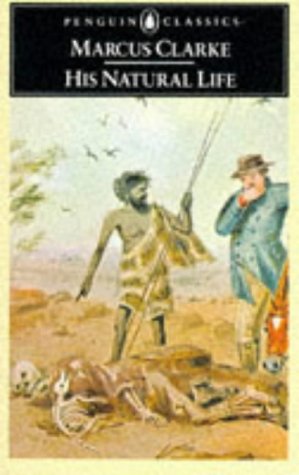
The brilliant Marcus Clarke wrote that the dominant note of the Australian bush “was weird melancholy.” If Clarke had known Australia better he would not have written that erroneous estimate of the bush. But the mental attitude of the author of “His Natural Life” towards the Australian bush seems to find parallel these days in the mental attitude of most of our fiction writers to life itself. There was a time when all the intolerably gloomy and unhappy books were turned out by Russians and Scandinavians. To-day we find a similar tendency among English writers.

You can see in this opening his love of the bush – but it’s also clear that he was a man of his those optimistic early Federation times. The way he sees it, life can be gloomy or unhappy enough at times, “without having the same thing served up to us in our literature.” He doesn’t name contemporary names, but says, for example, that ‘much of the “new humour” of the Americans is more depressing than the gloom-saturated works of such great Russians as Turgeniev, Tolstoy, and Dostoievsky’. He’s talking, presumably, about the early 20th Century realists and modernists, such as D.H. Lawrence (whom we will meet in our 1924 Aussie Lit travels), and T.S. Eliot. Did he include, in this, Katharine Susannah Prichard who’d started publishing by then but wasn’t really in full swing? I must admit that most of the writers I’ve read from these schools were published in the second half of the 1920s and into the 1930s and 40s, but the trend was well under way by the early 1920s, and W.M.S. didn’t like it.

As far as he was concerned, “life is not all gloom”. What the nation needed, he wrote, was “more light and shade in literary work”, because without it, “no work of the imagination can be entirely true”. Unfortunately, though, what he saw rising was “a new school of fiction writers” in which “the lens of the camera, register[ed] nothing but the dark patches of the object upon which it [was] focussed.”

I understand his point, but I don’t fully agree that every work needs some right amount of “light and shade” to be “true”. I share this because I know several readers who, like W.M.S. back then, worry about negativism in much of our contemporary literature. I see it a bit differently. When life gets challenging, as it was in those between wars years, and is again now with climate disaster looming, among a host of other challenges I’m sure I don’t need to elaborate, our writers want to capture and/or explore it. Some see hope, while others don’t. C’est la vie?

What do you think?

Monday musings on Australian Literature: the Story Factory

In last week’s Monday Musings on Parramatta’s inaugural Laureate for Literature, I mentioned that Parramatta had been chosen as the second location for the non-profit organisation, the Story Factory. I said I’d do a separate Monday Musings on it, and have decided it might as well be now.

So, who or what is the Story Factory?

I love that like any good storyteller, and unlike many websites, they have a page on their history – and it’s a good one, the history I mean, because it has an inspiration that is truly inspiring. This inspiration comes from San Francisco, where, in 2002, the novelist Dave Eggers and educator Ninive Caligari founded something called 826 Valencia. This is “a creative writing centre for under-resourced young people” in the city.

Apparently, the idea spread quickly across the USA, “with seven more 826 chapters in places including New Orleans, Boston and Brooklyn, New York”. From here, the idea has spread internationally, with similar creative centres set up, some also by or with the help of successful authors. These include London’s the Ministry of Stories (with help from Nick Hornby); Dublin’s Fighting Words in Dublin (with Roddy Doyle); and Melbourne’s 100 Story Building, which started life in 2009 as Pigeons, becoming 100 Story Building in 2012.

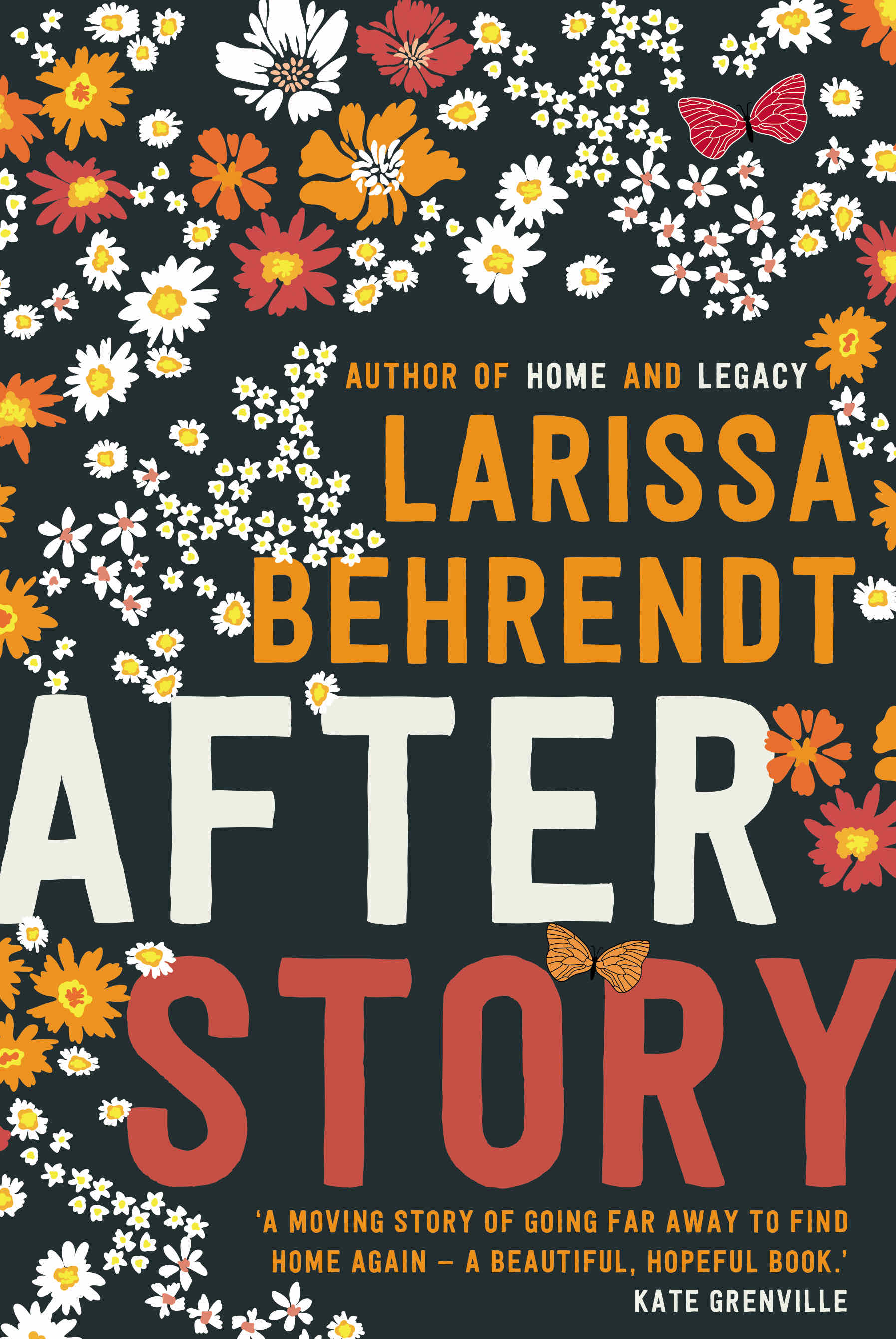
The Story Factory was also founded in 2012 – in Sydney – after Sydney Morning Herald journalists Cath Keenan and Tim Dick had visited 826 Valencia in 2011. Their aim, says the website, was “finding a solution to the growing concern about writing skills rates and limited creative opportunities among marginalised children”. That year, a Board was established. Members included Michael Gonski, the Chair and “a solicitor and leading young philanthropist”; educator and well-known First Nations author to us, Professor Larissa Behrendt (my posts); and Professor Robyn Ewing, “an expert in creativity in education”. They launched in May 2011, but were not officially opened at the Redfern premises until July 2012. Their initial focus was the Redfern/Waterloo area, but increasingly they were asked to work in Western Sydney, resulting in Parramatta being opened in 2018. They make very clear on their website that they “only work with young people from communities that are under-resourced”.

They are part of over 60 organisations that form the International Alliance of Youth Writing Centres, which they describe as “a coalition inspired by 826 and united by a common belief that young people need places where they can write and be heard, and where they can have their voices polished, published, and amplified”. The organisations names vary, but there are places over the US, the UK, and in places like Chile, Argentina, Denmark, Italy, the Netherlands, Iceland, and Pakistan. There is even a travelling program, Story Board, based in the Northern Rivers of New South Wales.

So, what do they do?

They offer a wide range of programs, which mostly sit under the following umbrellas::

  • Digital Programs: online interactive programs, across many age levels, run via Zoom and bookable by classroom teachers.
  • School Programs: face-to-face, “one-off, term-long, and year-long, curriculum-aligned writing programs”.
  • Special Projects: often run in collaboration with other arts organisation, and bringing students together from different schools.
  • After School and Holiday Programs: in-person and online.

Clicking on their Programs link and navigating around will give you a sense of the sorts of programs they offer – in different forms; for different age-groups, from primary to secondary; and exploring different ideas, from magic to cli-fi, from literary form to developing the imagination.

They also produce stuff! You can read some of the stories produced by young writers, online on the Stories pages. Or, you can buy books, because they also publish writings. For example, they run annual programs like Year of Poetry and Year of the Novella, and publish selected output. You can see 2023’s here, but to see all their publications, this link will take you to the first of NINE pages.

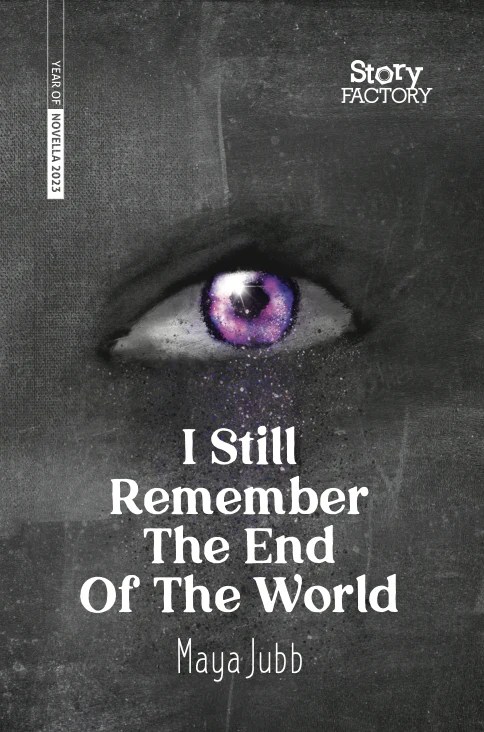
Maya Jubb’s I still remember the end of the world was one of the books published from the 2023 Year of the Novella program. This year long program aims for the participants to complete a novella. The page says that “Maya is a 17-year-old writer who loves to write fantasy novellas”. All the books look gorgeously designed, which is probably at least partly due to “the unstinting support of the editorial and production teams at Penguin Random House”. So nice to see a big publisher helping out.

As for how effective they are at achieving their goals, that’s harder to tell:

  • the University of Sydney wrote in 2016 about a formal impact evaluation that had commenced in early 2014. This was very early days, but they said that “focusing on case study methodology, the preliminary findings of the longitudinal evaluation suggest that some students have demonstrated substantial development in their creative writing and literacy skills, as well as improved problem solving, persistence, collaboration and discipline – all important indicators of creativity”. This is somewhat qualified, “some students”, but it’s indicative of potential.
  • Canterbury Boys High School was clearly so happy with the Story Factory’s role in their “literacy achievements” in 2017 that they continued the partnership in 2018. (They reference an independent evaluation which concluded the partnership had been “a huge success”, but the link is broken).
  • Better Reading shared some statistics in 2018, saying that the Story Factory had had “16,000 enrolments from young people, with 20% Indigenous and 40% from language backgrounds other than English”. 

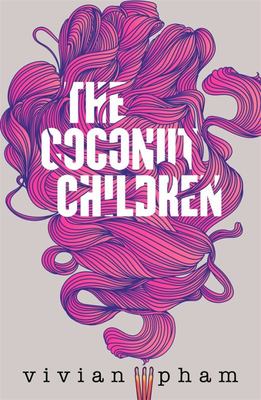
But the best piece of evidence I can give readers is the achievement of Vivian Pham. Her debut novel, The coconut children, which is set in 1990s Cabramatta, was published by Penguin Random House in 2020 when she was just 19. Some of you might remember it as it made quite a splash. She was named one of the Sydney Morning Herald’s Best Australian Novelists in 2021 (my post) and won ABIA’s Matt Richell Award for New Writer of the Year. The novella was also shortlisted for that year’s Victorian Premier’s Prize for Fiction and the Voss Literary Prize. In an interview for Writing NSW, she said that:

Every Sunday when I was in Year 11, I attended Story Factory’s Novella Project workshops at the local arts centre.

Her book was published as part of that year’s program, and she thought that was it. But through the intercession of others, it was picked up by Penguin and, after more editing, was published. There’s more in the interview, but I’ll just share her answer to the question about “marginalised voices in Australian society” and “the responsibility of fiction authors to explore diverse perspectives in their writing”:

I don’t think of this as a responsibility so much as an imperative.

How better to conclude a post on the Story Factory?

Do you know of other organisations like this? I’d love to hear about them.

What would you recommend?

Last week, Mr Gums and I drove back from Melbourne where we had spent the holiday season with family. Having spent over two weeks in the city – very lovely because we saw family – I did want a little country respite before hitting our own (much smaller, admittedly) city. Bright, in Victoria’s Alpine Shire was our chosen destination and it was truly delightful. Mountains and rivers are my happy places.

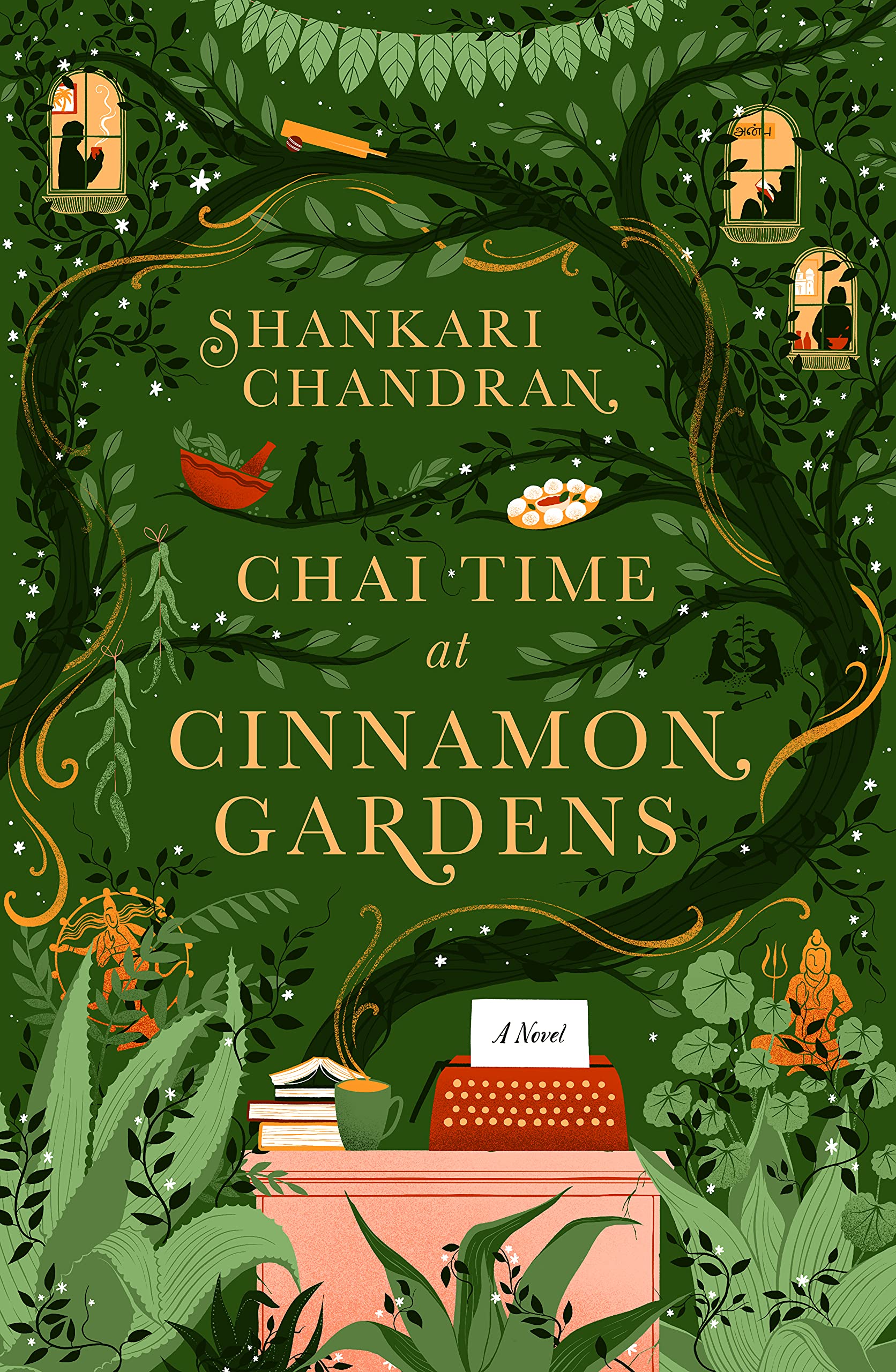
However, it wasn’t all road-tripping and bushwalking. The township of Bright has some good restaurants and, I noticed, a lovely little independent bookshop called, yes, The Bright Bookshop. I mean, you’d have to wouldn’t you? It’s a small shop but its inventory was excellent and with much to tempt me. But I just bought one book, Shankari Chandran’s Chai time at Cinnamon Gardens, which is on my reading group schedule this year.

None of this, though, is the point of my post. There was one other person browsing in the shop while I was there, and I overheard her asking for advice from the bookseller. She told him that her 18-year-old daughter wants to be a reader. She didn’t like science fiction, fantasy or dystopian novels, she said. In fact, she didn’t like anything involving suspension of disbelief. But the book couldn’t be “too literary” either, as her daughter preferred a nice linear story. Oh, and she wouldn’t read any books her sister read! I didn’t ask about historical fiction or crime, which is a shame, but the conversation kept spearing off, and I was running out of time.

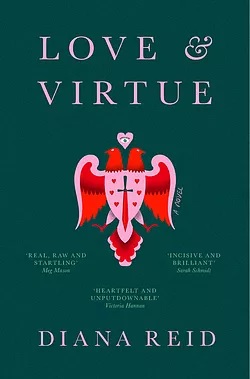
However, I had to go, we did throw around a few ideas, including the American Curtis Sittenfeld, the Australian Diana Reid, Robbie Arnott’s Limberlost (“no”, said the mother to the bookseller), Jack Kerouac’s On the road (the mother didn’t think so, and nor did I), and older American writers like Anne Tyler (which the mother thought a possibility). The mother also suggested Sally Hepworth, whom I don’t know, and I wondered about other Aussies like Toni Jordan, Karen Viggers and Irma Gold – to name a few – who have written young women well. By the time I left, a decision hadn’t been made. But, my question to you – my litblogging community brains trust – is, what would you have suggested to get a wannabe reader keenly reading?

Over to you …

Monday musings on Australian literature: on 1923: 7, Humour

With 1923 nearly over, I’m running out of time to share more of the thoughts and ideas I found regarding Australian literature in 1923 from Trove. This post, I thought to share some of the ideas expressed about humour in Australian literature.

Humour wasn’t always specifically mentioned in 1923 as being a feature of Australian literature, but was mentioned enough to suggest that some, at least, appreciated its use.

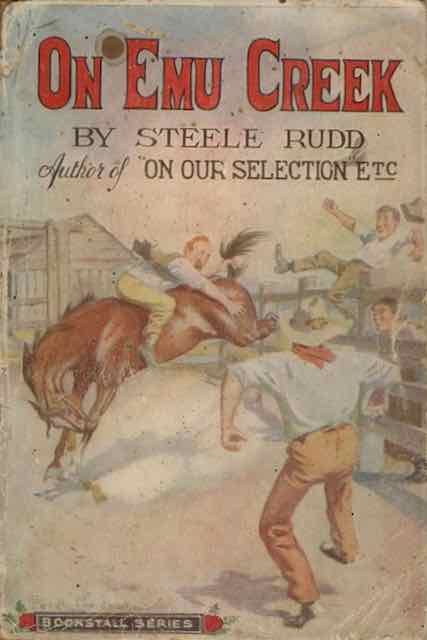
The most frequent mention I found concerned, Steele Rudd, famous for the Dad and Dave stories. He is praised for using humour to make interesting and enjoyable the truths he has to tell about Australian lives. The Queensland Times (2 May) introduced Rudd’s new book, On Emu Creek, and describes it as giving “full play to his whimsical humour, his knowledge of the rural dwellers, and his sympathy with their struggles”. Melbourne’s The Age (5 May) is more measured, but seems also to like the humour, describing it as “an agreeable story, without any affectation of style, and containing points of humor”.

Others, though, are a little less enamoured, with various reviewers qualifying their approval. One of these is J.Penn, writing in Adelaide’s The Register (19 May). There is some satire, he says,

But the main idea of nearly every chapter is someone being knocked over. It is difficult to think of any other humourist who would not seek to find humorous terms in which to describe intendedly humorous incidents. But Steele Rudd is firmly convinced that his readers will find sufficient fun in the mere fact of some one being humiliated or hurt, without the author’s having to worry to hunt for words.

Presumed Public Domain, from the NLA

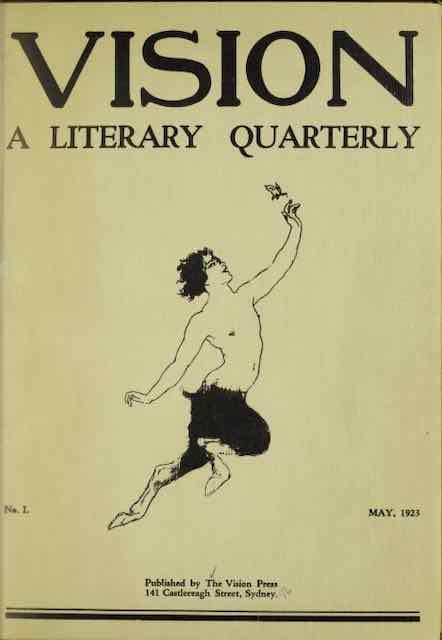
Ouch … This is not to say that J.Penn doesn’t like humour. He clearly likes satire. And, he critiques another 1923 literary endeavour for lacking “gaiety”. It was a literary magazine titled Vision: A Literary Quarterly, that was edited by Frank C Johnson (comic book and pulp magazine publisher), Jack Lindsay (writer and son of Norman Lindsay), and Kenneth Slessor (poet). The quarterly, which only lasted 4 issues, aimed, says AustLit, “to usher in an Australian renaissance to bolster the literary and artistic traditions rejected by European modernists”, but they also wanted to “invigorate an Australian culture they claimed was stifled by the regressive provincialism of publications such as the Bulletin“. 

Anti-modernist in ethos, Vision, continues AustLit, was influenced by “Norman Lindsay’s principles of beauty, passion, youth, vitality, sexuality and courage” and “consistently provided readers with potentially offensive content”. Penn was thoughtful about the first issue:

It is a welcome guest, as giving outlet for a lot of good work which might not find a fair chance elsewhere. But it has three faults, one of outlook, two of detail. Contemplation of sex matters is not the only way to brighten life; yet they constitute quite four-fifths of this opening number.

Not only that, but, he says, ‘while it would seem difficult to be heavy, even “stodgy,” on matters of sex, that feat has been accomplished here’. Indeed, it has “no spark of gaiety”, which is exactly what Norman Lindsay, in the same issue, accuses James Joyce of. (Excuse the prepositional ending!) However, not all of Vision is like this:

The poetry in this volume, by Kenneth Slessor and others, has much of the desired element of gaiety; and a page of brief quotations from modern writers in other countries, with satirical footnotes, is delightful. There remain the pictures. These are as bright and gay as could be wished—a riot of triumphant nudity, in which Norman Lindsay in particular finds full opportunity.

Overall, he feels that “with some judicious editing, this endeavour to brighten Australia should have at any rate an artistic success”. (Also, he does like Jack Lindsay’s “valuable essay … on Australian poetry and nationalism, with a theory that we must get away from shearers and horses”.) 

A very different magazine is one praised for its cheerfulness, Aussie. It ran from 1918 to 1931, and had various subtitles, The Cheerful Monthly, The National Monthly, and The Australian Soldiers’ Magazine. I had not heard of it before, but AustLit once again came to my rescue. Created for soldiers in Europe, most of its early contents came from them, and comprised, says AustLit, “jokes, anecdotes, poems and drawings” which reflected “the character (most likely censored) of the Australian soldier in World War One”. In 1920, it was revived as a civilian magazine, but “the humour … was maintained”. Now, though, its contributors were established writers and artists, like AG Stephens, Myra Morris, and Roderic Quinn. I found a review of a 1923 issue in The Armidale Chronicle (19 September). It is unfailingly positive, telling its readers that “every page of Aussie breathes cheerfulness, and there is not a joke, a picture, or a story that fails to portray some phase of Australasian humor”. I wish it described what it meant by “Australasian humor” but the word it uses most is “cheerfulness”. This perhaps makes sense, given AustLit’s assessment that “it maintained its position between political extremes, addressing the views of a predominantly middle-class audience”. 

Humour is also mentioned reviews of books for children, such as The sunshine family, by Ethel Turner and her daughter Jean Curlewis. It is described in the Newcastle Morning Herald and Miners’ Advocate (14 December) as having “rare good humour”, but is that unusual for a book for children?

The descriptions of the 100 books chosen by AG Stevens for Canada, that I wrote about earlier this year, include several references to humour – in fiction, such as EG Dyson’s 1906 Factory ‘ands, with its “brilliant satirical humour”; in children’s books, like C Lloyd’s 1921 The house of just fancy, whose pictures “have quaint loving humour”; and in much of the poetry, including JP Bourke’s 1915 Off the bluebush, which contains “verses of sardonic humour”.

Humour is such a tricky thing – from the sort of situational humour in Rudd’s On Emu Creek, through the apparent “cheerfulness” of Aussie, to the more satirical humour liked by J.Penn – but unfortunately, most of the references I found don’t analyse it in much detail. I will keep an eye out as we go through the years.

Meanwhile, do you like humour in your reading? And if so, what do you like most?

Other posts in the series: 1. Bookstall Co (update); 2. Platypus Series; 3 & 4. Austra-Zealand’s best books and Canada (1) and (2); 5. Novels and their subjects; 6. A postal controversy

Monday musings on Australian literature: Your 7-year-old self

Emma Ayres, Cadence

Ok, I admit it. This post’s link to Australian literature is tenuous, but there is a link, even though it’s not the subject of this post. The link is that the person who inspired this post, Ed Le Brocq, previously known as Emma Ayres, has written several books – memoirs, mostly – of which I’ve read and posted on one, Cadence. Since then, as Eddie/Ed Ayres and Ed Le Brocq (married name), he has published Danger music, Whole notes and Sound bites. None of these, however, have much to do with this post, though they all interest me.

Ed Le Brocq became known to many of us – starting back when he was Emma – as a radio announcer on our ABC Classic FM. She was hugely popular. Since then, she left radio, travelled some more, transitioned to Ed, and in 2019 returned to ABC Classic FM, doing the Weekend Breakfast show. I often listen in. This last weekend, he told a little story and asked us a question – and I thought, for a change of pace, that I would ask it of you too.

The story goes this way – but needs a little explanation first. As well as radio announcing, Ed Le Brocq performs music, and teaches it – the viola and cello. The story concerns a lesson he was conducting recently from his garage because his usual venue in a school wasn’t available. A mother walked by with her 7-year-old son and apparently the son was attracted to the music. He came into the garage, and asked, “What’s that you’re playing?” and, on being given the answer, said, “I want to play that too”. He will start lessons next year – on one of those two stringed instruments.

Ed was fascinated by the child’s recognition of something that he really wanted to do, and asked the radio audience whether they knew around that age what they wanted to do – and whether they’d done it. So:

Did you realise when you were around 7 years old (give or take a couple of years) what your interest or passion was, and is that what you ended up doing in some way or another?

It seems I did. When I was around 5, my father was President of the local Apex group (a service organisation roughly like Lions and Rotary). I was fascinated by his papers, and am reported as saying, “When you die, can I have your Apex stuff?” Jump a few years to when I was around 11, and I remember myself creating a little neighbourhood library, complete with Date Due notations in the back of my books. Around the age of 14, I encouraged my sister to help me write an encyclopaedia, starting with one article per letter (though we didn’t get far because adolescence hit!)

Is it any wonder that I ended up being a librarian-archivist – and that it was a career I loved?

Now, over to you …

Monday musings on Australian literature: Masterpieces of fiction, 1910-style

A straightforward post this week, and one shared in the spirit that readers love lists of books. This list is not Australian (despite my posting it in my Monday Musings series) but it was shared in multiple Australian newspapers in 1910 which makes it part of Australia’s literary history, don’t you think?

The list was headed in most newspapers as “A short list of masterpieces of fiction” and the explanation provided was essentially this, “An American paper offers the following as an excellent though, of course, limited list of the best books for one to read”. The papers don’t value add, so we don’t know which American paper produced the list or under what circumstances. However, I thought it was a fun one to share because it’s not just a list of recommended books, but of the “best” in different categories. Here they are:

William Makepeace Thackeray, Vanity Fair
  • The best historical novel — Ivanhoe (Sir Walter Scott, Scottish) 
  • The best dramatic novel — The Count of Monte Cristo (Alexandre Dumas, French)
  • The best domestic novel — The vicar of Wakefield (Oliver Goldsmith, English)
  • The best marine novel — Mr. Midshipman Easy (Frederick Marryat, English)
  • The best country life novel — Adam Bede (George Eliot, English)
  • The best military novel — Charles O’Malley (Charles Lever, Irish)
  • The best religious novel — Ben Hur (Lew Wallace, American) 
  • The best political novel — Lothair (Benjamin Disraeli, English)
  • The best novel written for a purpose — Uncle Tom’s Cabin (Harriet Beecher Stowe, American)
  • The best imaginative novel — She (H. Rider Haggard, English)
  • The best pathetic novel — The Old Curiosity Shop (Charles Dickens, English) 
  • The best humorous novel — The Pickwick Papers (Charles Dickens, English) 
  • The best Irish novel— Handy Andy (Samuel Lover, Irish) 
  • The best Scotch novel — The heart of Midlothian (Sir Walter Scott, Scottish)
  • The best English novel — Vanity Fair (William Thackeray, English)
  • The best American novel — The scarlet letter (Nathaniel Hawthorne, American)
  • The best sensational novel — The woman in white (Wilkie Collins, English) 

And:

  • The best of all — Vanity Fair (William Thackeray, English)

I was interested, and infuriated, that the authors’ names were not included in the over ten published versions I saw, so I’ve added them in parentheses. I don’t care whether readers at the time knew the names of the authors or not, the authors should be identified. It is a little soap-box issue of mine that there is often not enough recognition of the authors of the books we read. This is why I always start my review posts with the name of the author not the title of the book. It’s my little bit of literary activism!

Like all such lists, this one is interesting for what is and isn’t there. Where are Austen or the Brontes for example, while other authors like Dickens and Scott appear twice? Clearly their popularity hadn’t waned. More to the point, perhaps, why only one non-English language book? No Russians, for example? It’s also interesting to see which books have dropped off the radar. Does anyone know Mr Midshipman Easy for example? Wikipedia tells me that it’s been adapted to film twice,

The “best” categories also tell us about the interests and reading habits of the time – “best pathetic novel” anyone? Or “best religious”? Or “best novel written for a purpose”? And so on.

Anyhow, I’ll leave it there … and ask you,

Just for fun, what categories would you suggest for a similar list today?

Source: The first paper in which I saw the list was Victoria’s The Elmore Standard, 12 February 1910.

Monday musings on Australian literature: Thoughts on literature’s moral purpose

I struggled with titling this post because I don’t want it to sound like a thoroughly thought through treatise on the topic. However, I jettisoned my original plan for today’s post to respond to Angela Savage’s question on my CWF post on the Robbie Arnott interview because it seemed worth exploring.

If you haven’t read that post, the gist is that Robbie Arnott talked about why he writes fiction and what he likes to read. Responding to a question about whether fiction does something, he made clear that for him it does (or at least that he would like it to.) Fiction, he said, can expand our consciousness, can make us feel things. We come away a different person after reading it. In this way fiction shapes who we become. Later in the interview, he talked about there being a moral aspect to everything we do, which for him, includes writing. This translates into his feeling a strong responsibility, for example, to tell stories about the land in a way that improves our country. My response to this was that I loved Arnott’s absolute commitment to fiction – to its ability to change us, and to its moral (but not didactic) heft.

Enter the lovely Angela Savage, award winning novelist, former director of Writers Victoria, and current CEO of Public Libraries Victoria who comments occasionally on my blog. She commented on the post with:

Interestingly, I just read an article arguing against the premise that literature/fiction needs to be moral or change us. Would be interested in your opinion.

The article appeared in last Friday’s The Conversation, and is by Dan Dixon, Adjunct Lecturer at the University of Sydney. It’s titled “Friday essay: what do publishers’ revisions and content warnings say about the moral purpose of literature?” It was inspired by two recent issues: the controversy about the rewriting of passages from authors like Roald Dahl to remove “potentially offensive material”, and the “precautionary measure” being adopted by some publishers of adding content warnings and disclaimers to some older books.

It’s a thoughtful piece, and I recommend it to you because I only going to discuss bits of it here, the bits that relate to my answer to Angela’s question.

Dixon makes the point that the media only becomes interested in literary stories when there are “moral concerns” and that these discussions are part of a “moral battle which encourages the application of the same ethical criteria to books that might be apply to elected officials or ministers of religion.” He then suggests that writers’ festival programs demonstrate that we “struggle” to talk about books on any other terms.

Dixon looks at the economic drivers behind these controversies and how they can commodify books. He recognises that literature is affected by the marketplace but argues that it also pushes back against that. Do read his argument if you are interested. Meanwhile, I want to focus on his exploration of what literature is about.

A common question, he says, is:

is there a necessary connection between a work’s literary value and its moral quality? When we read a book do we expect a degree of moral instruction, as to how we should or should not live?

He believes this is a worthwhile question, but that it is not the only question. Literature is more than this. Indeed, he argues that limiting discussion to moral debates encourages “definitive judgements” which enables us, he says, to

avoid what Keats described as negative capability: “being in uncertainties, mysteries, doubts, without any irritable reaching after fact and reason”.

This is where I want to come in, because I am perfectly happy with what Dixon calls “the unpleasantness of irresolution” – and so, I believe, is Robbie Arnott. In Limberlost, for example, Ned’s daughters confront him with being a farmer on stolen land. Arnott believe it was important for Ned to be confronted with this fact, that to ignore the issue would not be real. But he offers no resolution, no moral closure; it just sits there, as it often does in life.

I’m not sure what Arnott meant exactly by his statements, but I think he’s right that there’s a moral aspect to everything. However, I don’t think he means, as a result, to provide the moral answers. In fact, I’m confident that he knows there aren’t necessarily any, or at least not easy ones. Rather, I understood him to mean that he is aware of the moral implications of the way we live and wants to include those in his books, because that’s real. This is subtly different from saying there must be a moral to the story (to literature, to any art).

Now, I’ll return to Dixon and some things he says about literature. First:

The best literature can be spiky, ambiguous, difficult, cruel, strange, unpredictable, hectoring and unpleasant. It is not the job of a book to ease the life of its reader. Reading a good book might mean having a terrible day, a day in which you are scared, sad, distressed. 

I can agree with this. Arnott’s point that you come away changed could work with this!

Then Dixon says:

But literature does not have an obligation to be useful; we do not have to learn anything from it. It need not produce anything except a readerly response.

I also agree with this. My belief is that, at the purest level, the only thing literature (art) needs to be is whatever its creator wants it to be. It is then up to the reader/viewer/listener (whatever the art form is) to decide whether they appreciate the art. I know this is simplistic as creators are, for a start, constrained by any mix of economic, legal, social, political and practical factors, but this is my theoretical starting point.

Returning to Dixon one more time, he says near the end of his piece that “any argument that treats literature as fundamentally therapeutic, self-improving or society-improving, risks reducing literature to self-help”. This is a bit trickier, but I think it hangs on the word “treat”. And it takes me back to my previous point. If I argue that literature doesn’t “need” to be anything, then by definition I should not “treat” it as needing to be something. I can, however, prefer literature that tries to improve or change things. A fine line perhaps but I think it’s defensible.

I therefore like Dixon’s conclusion that the best way to think about literature might be as a “conversation”. He expands this to say that conversations “can be morally nourishing or deadening … neither good nor bad”. Seeing literature this way suggests for him that “reading resembles conversation … an ongoing exchange between reader and writer”. Which brings me back to Arnott who sees novels as a two-way communication between author and reader, one in which he’d love to know whether what he feels resonates with the reader. 

I hope I’ve answered Angela’s question, and I also hope I have accurately represented Arnott in terms of the question. What do you think?