Bill curates is an occasional series where I delve into Sue’s vast archive, stretching back to May 2009, and choose a post for us to revisit.
_______________________
My original post
You could easily give yourself away when reviewing Christos Tsiolkas’ latest novel, The slap. For example, do you align yourself with the uncompromising, emotional earth mother Rosie or the rational, cool and collected but somewhat more willing to compromise Aisha? Do you rail against the liberal use of expletives, the relaxed attitude to recreational drug use, and the focus on carnal appetites more often in their ugly or elemental than their loving guise? Do you engage in the private versus public school argument? These are the sorts of things that confront Tsiolkas’ readers.
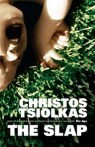
In simple terms, The slap explores the fallout that occurs after a young child is slapped by an unrelated adult at a family-and-friends barbecue. This slap occurs in the first “chapter”, reminding me of Ian McEwan’s books which also tend to start with an event that triggers a set of actions and reactions. However, unlike McEwan, Tsiolkas does not build up a strong sense of suspense about “what will happen next”. In fact, the actual slap storyline is resolved about two-thirds of the way through the novel.
Rather, the book is about its characters and their relationships as spouse, parent, child, sibling, friend. At face level, most are not particularly appealing. They are often intolerant, narrow-minded and/or confrontational. Just as you begin to like, or at least understand, them they do something that changes your mind. And yet, in all their imperfections, they do engage.
The book has an interesting though not unique structure. Like Elliot Perlman’s Seven types of ambiguity, the story is progressed through a sequence of different, third person, points of view covering three generations. This shifting of perspectives and stories has the effect of moving our focus from the plot to the content. And the content ranges broadly across the things that confront families and marriages – love and hate, family versus friends, anger, loyalty, compassion and forgiveness. It has moments of real venom, but also of real tenderness.
Not surprisingly, violence features heavily in the book. Tsiolkas shows how pervasive violence is in western middle class society. Through the various characters’ stories we see a wide range of violent behaviour from domestic violence through consensual but aggressive sex to those seemingly casual expressions of violence such as “I wanted to kill her” about a person who annoys. We also see how deeply ingrained prejudice against “other” is, whether that other be racial, religious, cultural, sexual orientation or socioeconomic. In Tsiolkas’ world it feels as though only a thin veneer of civility covers our more primitive selves and the reader is never quite sure when or whether these selves will break through and wreak havoc. It is to the credit of the characters, and by extension us, that they rarely do, but we are left in no illusion that they could.
A critical aspect of the structure is whose perspective starts and ends the novel. Interestingly, again perhaps emphasising the minimal importance of plot, these are neither the slapper nor the “slappee”. In fact, the final voice is given to someone who starts out on the edge of the main action but is gradually drawn in. As an involved outsider, with issues of his own, he is able to resolve (as much as they can be resolved) the secondary plot lines and, as a person on the brink of adulthood, he can offer a sense of hope to what has been a pretty gritty story.
Wallace Stegner, the great American writer, wrote in his book, Angle of repose, that “Civilizations grow by agreements and accommodations and accretions, not by repudiations”. This, taken at a more personal level, seems to be the point of the novel for as Aisha says in the second last chapter, “This finally was love … Love, at its core, was negotiation, the surrender of two individuals to the messy, banal, domestic realities of sharing a life together. In this way, in love, she could secure a familiar happiness”.
POSTSCRIPT: In 2011 The slap was adapted for television, for the ABC, and closely followed the novel’s narrative style with each episode being viewed through the eyes of a different character. The scriptwriters are, I think, a quality bunch: Emily Ballou, Alice Bell, Brendan Cowell, Kris Mrksa, Cate Shortland. Interestingly, Tsiolkas is not among them.
_______________________
So, Bill likes Tsiolkas too, but, from his comment on my review of Damascus, it seems that that book’s subject matter doesn’t appeal to him much. Given Bill hasn’t read The slap nor Damascus, I’m guessing he’s read the earlier novels, which I haven’t – and should rectify.
Oh, and re length of reviews. I love that Bill noticed that. I started by wanting to keep my reviews to 800 words, but now my goal (not rigorously adhered to) is 1000-1200.
Anyhow, are any of you Tsiolkas fans and, if so, what is your favourite?
 I said, when I introduced this series, that Sue began writing Whispering Gums in May 2009. It seems that once begun she could not stop. There are WG posts for May 2,4,5,6,10,14,15,16,19,21,22,27,28,30,31. The May 31 post is titled, prophetically, “When too much Jane Austen is barely enough”, and is in fact the third Jane Austen post for the month. Today I reprise the second. But there will be more.
 My first choice is Sue’s review of Eve Langley’s masterpiece The Pea Pickers. One day Australians will overcome their cultural cringe and realise that in Joseph Furphy’s Such is Life and Eve Langley’s mostly unpublished eleven journals and novels we have writing that should be ranked alongside Ulysses and Rembrance of Times Lost. That’s my opinion and not necessarily Sue’s, but I think she still ranks The Pea Pickers pretty highly, and while she says she might now have written this piece a little differently – it was in fact her first review – I think you’ll agree it stands the test of time.
 Whispering Gums