Victorian Premier’s Literary Awards Shortlist

And so, as reported by Perry Middlemiss on his Matilda blog, it’s pretty much the usual 2009 suspects that have been shortlisted for the Vance Palmer Prize for Fiction. They are:

  • The pages by Murray Bail (Text)
  • Dog boy by Eva Hornung (Text)
  • The boat by Nam Le (Penguin)
  • The slap by Christos Tsiolkas (Allen & Unwin)
  • Breath by Tim Winton (Penguin)

I have read the last three of these (links are to my reviews here or elsewhere), and will be reading The pages in the next month or so. Nam Le’s The boat won this year’s New South Wales Premier’s Literary Awards Book of the Year and UTS Glenda Adams Award. Will it win in Victoria? I rather hope it does – if only because it represents a fresh new and talented voice that would be great to encourage.

More Jolley

Elizabeth Jolley (Photo: Courtesy Fremantle Press)

Elizabeth Jolley (Photo: Courtesy Fremantle Press)

A decade or so ago my local reading group, with trepidation from some, decided to try a poetry night. The idea was that we’d all bring a favourite poem or two to share. What would I bring? I have some favourite poets from my student days – poets like Gerard Manley Hopkins, T.S. Eliot and William Wordsworth – but was that all I knew about poetry? Well, it just so happened that my brother had given me a few years earlier The Penguin book of Australian women poets (1986) so I hied me thither to see whether anything inspired. And what did I find but one of my favourite writers, Elizabeth Jolley, there ensconced.

Now, fair dealing provisions of the Australian Copyright Act are not clear for poems and anthologies so I won’t reproduce the full poem, “Neighbour woman on the fencing wire”, but here is its beginning and end:

So you’ve bought this place well let me tell you
straight away your soil’s no good all salt even a
hundred and sixty feet down and up on the slopes
is outcrops of granite and dead stumps of dead
wood nothing’ll grow there we know we’ve tried

dead and then there was that pig ate a woman’s
baby right in front of her door mind you I always say –

Says it all really…how can you not laugh along with a writer who writes a poem like this. (It is also published in her book Diary of a weekend farmer, 1993).

Elizabeth Jolley, My father’s moon

‘No one,’ she says, ‘can write anything till they’ve had experience. Later on perhaps. You will write later on.’ (Elizabeth Jolley, My father’s moon, 1989)

Although fiction demands imagination, it must be based on  some kind of genuine experience. (Elizabeth Jolley, “Only Connect”, essay first published in Toads, 1992)

My father’s moon is the first book in Jolley’s semi-autobiographical trilogy, the others being Cabin fever and The George’s wife. It won The Age Book of the Year Award in 1989.

I am an Elizabeth Jolley fan – and, along with Helen Garner, another Jolley fan, I enjoy the way she repeats and revisits stories and characters from one book or story to another. In this book is the chapter, “Night Runner”, which was published as a short story in Meanjin in December 1983, and again in a short story anthology, Room to move, published in 1985. The narrator of the story – and of the novel – typifies Elizabeth Jolley’s alienated protagonists and their often peculiarly self-centred and self-deluded ways of coping with their loneliness. Clearly Jolley decided that this was a character she wanted to develop further. And clearly she also drew a lot from her own experience to develop this character. Like Vera, Jolley was brought up as a Quaker, her parents sheltered refugees before and during the Second World War, and she trained as a nurse. Like Vera, Jolley probably experienced loneliness and alienation. However, this is fiction and so we need to be careful about how far we take these analogies between Vera and her creator. Much as I can empathise with Vera’s predicament, I must admit that I would hate to think she is Elizabeth Jolley.

It’s an uncomfortable novel. Vera, the first person narrator, is not a highly sympathetic character but neither is she totally disagreeable either. What she is, though, is lonely. The book has a somewhat challenging structure – and I had to concentrate to keep track of where I was. It starts with Vera, a single mother, leaving her parents’ home, with her young daughter, to live and work in a boarding school. Her hopes for a lovely life there among people “who feel and think as I do” are dashed. Such people “are not here as I thought they would be … I am by my own mistakes buried in this green-leafed corruption and I am alone”. In this first chapter are flashbacks to the past, and gradually the book moves into the past, providing us with insights into her character and how she has ended up where she is. Most of this past takes place in the hospital where she trains as a nurse during the war. The book finally returns to the beginning of the novel with Vera resolving to make a step towards alleviating her loneliness. However, we are by no means convinced she will.
Moon, by atomicshark @ flickr, licensed under Creative Commons CC-BY 2.0

Moon, by atomicshark @ flickr, licensed under Creative Commons CC-BY 2.0

The book comprises titled chapters, many if not all of which could be (and some have been) published separately as short stories. This gives it a somewhat disjointed feel – but seems appropriate for the story of a person like Vera. It is full of wonderfully drawn characters, with some very funny (if often dark) scenes and dialogue. Just think nurses and hospitals! There are many references to music – something that is common in Jolley’s works. Music is usually a comforting force for her characters, offering them respite from what is often a cruel world – and this is the case here, with Vera being drawn to characters who love and play music. There is a lot of irony, some of it subtle, some of it less so as in Magda’s comment to Vera who has fantasised about an affair with her husband: ‘You are so innocent and good … Don’t ever change’. Naive perhaps, innocent no!

So, what about the title? Funnily enough(!), it refers to Vera’s relationship with her father, a major stabilising influence in her life. He tells her throughout her childhood that wherever she is she can always look at the same moon he is looking at, ‘And because of this … you must know that I am not far away. You must never feel lonely’. A lovely concept and one to which Vera regularly returns in the book.

My father’s moon is not, I think, the easiest Jolley to read, and there are some things that might become clearer on a second reading. However, its concerns are very representative of her work – loneliness and alienation, homosexuality, parenting, memory, music and religion. While Vera is deeply lonely, while she often behaves selfishly, she can also be kind. She is also no quitter. For that I rather like her.

J.M. Coetzee, Diary of a bad year

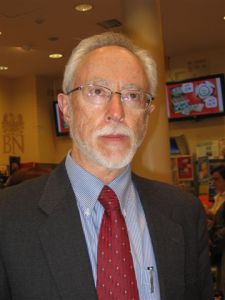
Coetzee, Poland, 2006 (Photo: Mariusz Kubik, from Wikipedia)

Coetzee, Poland, 2006 (Photo: Mariusz Kubik, from Wikipedia)

J.M. Coetzee is one of those rare novelists who pushes the boundaries of what a novel is. The progression from his mid-career novel, the spare but terrifying Disgrace (1999), through Elizabeth Costello (2003) to Diary of a bad year (2007) is so dramatic that there are those who question whether these last two are even novels. It’s actually been a year or so since I read Diary of a bad year but it is currently being discussed by one of my reading groups so now seemed to be a good time to blog about it here.

One of the first things to confront the reader who picks up Diary of a bad year is how to read it. It has three (two to begin with) concurrent strands running across the top, middle and bottom of the page. Some readers try to read the three strands as concurrently as possible while others read the strands sequentially. Following this latter path, though, means you risk missing the way the strands comment on each other. The three strands are:

  • the narrator’s formal voice, basically taking the form of essays he is writing
  • the narrator’s informal voice in which he talks about his life as he is writing the essays
  • the voice of Anya, his “little typist”, and, through her, of her boyfriend, Alan

The three characters represent three modes of viewing the world: the narrator’s is primarily theoretical, while Anya’s is more pragmatic and Alan’s rational. Through these modes, Coetzee teases out the moral conundrums of the early 21st century both in terms of the political (the events confronting us) and the personal (how are we to live).

Towards the end, Coetzee refers to his love of Bach. To some degree the book is a paean to Bach: its three-part structure in which each part counterpoints the others seems to be a textual representation of Bach’s polyphony. The essays running across the top of the page, while a little uneven and dry on their own, are counterpointed by the views of the characters in the other two strands, resulting in our being presented with different ways of viewing the same world.

The characterisation is interesting: Senor C, the writer of the essays, is the logical, moral but somewhat pessimistic thinker; Anya is practical, down to earth, but with a strong moral sense; and Alan is the economic rationalist for whom money is essentially everything. The views of the two men are strongly contrasted, while Anya is caught in the middle. There is a Darwinian sense in Alan of the survival of the fittest, while Senor C spurns competition as a way of life, preferring collaboration. For all his “moral” views, though, Senor C is not presented as a paragon and we are discomforted at times by his attitude towards the beautiful Anya.

The overall theme seems to be how do we live in a world full of paradoxes and contradictions, a world that seems to be pervaded by dishonour and shame (the things Senor C explores in the essays). He talks about ordinary people and how they (we) cope with things they (we) don’t approve of. He wonders why they (we) don’t do something about it, but suggests in the end that they (we) practise “inner emigration”. He says:

The alternatives are not placid servitude on the one hand and revolt against servitude on the other. There is a third way, chosen by thousands and millions of people every day. It is the way of quietism, of willed obscurity, of inner emigration.

I like that concept though it does smack of burying one’s head in the sand. He also talks about collective guilt, and about bearing the dishonour of what’s gone on before. Through choosing a “novel” form like no other, one which blends but in no way harmonises fact and fiction, Coetzee shows in a very concrete way that difficult times need new ways of presenting ideas. He offers no neat conclusions, no easy outs;  he is quite subversive really. Late in the book he ponders the value of writing, and says:

Are these words written on paper truly what I wanted to say?

This then is another step in Coetzee’s path of trying to find the best, perfect perhaps, way of saying what he wants to say. I, for one, will be ready for his next step.

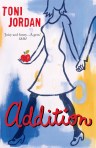
Toni Jordan, Addition

Addition Pb cover, Courtesy Text Publishing

Addition Pb cover, Courtesy Text Publishing

(SPOILERS: FOR WHAT IT’S WORTH)

Looks like, feels like, is it? Chick lit, that is. Toni Jordan’s first novel Addition has all the hallmarks of chick lit. The cover design with its line drawing of a female form invokes chick lit – albeit chick lit with an edge as the heels aren’t quite high enough and the colours not quite girly enough. The plot though is pure rom com and pretty much standard chick-lit: girl meets boy, girl loses (kicks out) boy, girl gets boy back. So why has this book garnered more attention and positive critical response than its sisters?

Well, Jordan is no Jane Austen (who is sometimes called the mother of chick lit) but she has produced something a little fresh. Her heroine, Grace, is not quite the standard chick lit heroine. She has had a breakdown, she is not in employment, she is not upwardly mobile and she is not focused on fashion and appearance (though it has to be said that she’s not oblivious to these latter either). Instead, she’s an ex-primary school teacher (not the most fashionable career, anyhow, in the world of chick lit) and she suffers from an obsessive compulsive disorder that results in her need to count, anything and everything, in order to maintain control over her life. And her hero, Seamus, a happy, ordinary dresser in an ordinary go-nowhere job, is “average”. Fortunately, though, with the help of her smart young niece, Grace realises at the end “that average can actually be unique”.

Grace’s voice is chick-lit-sassy and the book is genuinely funny a lot of the time, but there are also times when it is forced and tips over into being smart-alecky, such as her reactions to the psychiatrist and therapist. Her other hero is Nikola Tesla, the not-properly recognised famous inventor of many things electrical, who also had an obsessive compulsive disorder relating to numbers. It is the presence of Nikola in Grace’s life which sustains her at the beginning, helps ground her at the end and gives the book its real hook – that is, that being different is to be cherished and encouraged, as long as it doesn’t drag you down.

Jordan has a nice flair for language too. I liked the change in tone and pace when Grace’s panic rises, and a similar change in Jill’s speech to Grace when they are in hospital discussing their mother’s future. She’s lightly ironic in places and includes the odd bit of wordplay. It will be interesting to see where she goes next.

In addition (excusez-moi!) to its trying sometimes to be a bit too funny and its somewhat preachy ending (“Listen … Life is ..”), the book’s main problem is it’s too close adherence to the formula. You know she is going to lose him and you know she is going to get him back. It’s just a matter of how. Some level this same criticism at that favourite author of mine, Jane Austen, but her books encompass way more than plot to say some fundamental things about the human condition. I can read her again and again and see something new, or take away another perspective. I can’t see anything in Addition, as delightful as it is, that would afford me that pleasure on multiple readings.

So, read it, enjoy it – as I did – but if you want something a little more sustaining, try Jane.

Four time winner: Tim Winton wins 2009 Miles Franklin

Photo by Denise Fitch, Australia Council for the Arts

Photo by Denise Fitch, Australia Council for the Arts

Well, it’s finally happened as I knew it must. Someone has equalled Thea Astley’s record number of four Miles Franklin Award wins as tonight Tim Winton was announced the 2009 winner with Breath. I was seriously considering making Thea Astley my third favourite writers post – I think this means that I will now have to.

Winton has won the award for Shallows (1984), Cloudstreet (1991), Dirt Music (2001) and now Breath (2009); and Astley for The Well Dressed Explorer (1962), The Slow Natives (1965), The Acolyte (1972) and Drylands (1999). Both writers are great stylists who use metaphor well, both tend to explore strong connections between character and landscape, and both are indubitably Australian! I think, however, that Astley’s pen ranged wider than Winton’s and she took more risks. That’s not to say that Winton doesn’t deserve his wins but I do think that Astley (she died in 2004) was and continues to be undervalued.

Breath

Anyhow, here is a brief recap of my thoughts on Breath which I read long before I started writing this blog. I’ll start with a quick plot summary just in case there’s someone out there who doesn’t know it! It is a first person, coming of age story told by Bruce “Pikelet” Pike. It starts with his boyhood friendship with Ivan “Loonie” Loon. As young boys, they dare each other to perform dangerous stunts in the local river, and then as teenagers, they take up surfing where they are encouraged into new levels of recklessness by a former professional surfer named Sando. As time passes, Pikelet’s friendship with Sando and Loonie disintegrates and is replaced by a rather equally scary relationship with Sando’s American wife Eva, an injured and therefore ex-skier.

Southwest Western Australia, by soulsurfer 3 @ flickr

Southwest Western Australia, by soulsurfer 3 @ flickr

I like the book. I like the way he sustains the “breath” metaphor throughout to represent various facets of life and life-giving (or life-taking) forces. Despite not being a surfer, I love his wonderfully visceral descriptions of surfing. I also like his exploration of the imperative to take risks that is so common in young men and that is often accompanied by a drive to “be someone”.

Related I suppose to the coming-of-age issue is the theme of learning to accept being ordinary.  After Sando and Loonie leave the first time, Pikelet goes out and surfs Old Smoky: the first time he does it he’s so successful he feels he’s not ordinary, but then in his overconfidence he does it again and nearly does himself in…this is the beginning of his changing point of view. As he says a little later when he reviews his relationship with Eva, “No, Eva was not ordinary. And neither was the form of consolation she preferred. Given my time over I would not do it all again”. In other words, while he had originally equated not being ordinary with doing big risky things, with courting fear, by the end of the novel he realises that life is “a tough gig” and is about more than courting fear and taking big risks. This doesn’t mean that he can’t do and enjoy a job that provides an andrenalin rush (paramedic/ambulance driver) but it does mean that he no longer seeks to be anything other than himself and that he now goes for an adrenaline rush in “safer” more acceptable ways.

Before he gets to this point, though, he has to come to terms with his Eva experience and with the fact that he spent a big part of his life blaming her for his problems. He eventually comes to the conclusion that “people are fools, not monsters”. This closely resembles my own world-view: that is, that mostly (there are obvious exceptions) when people do the wrong thing they do it, at best, from the best of intentions, or, at worst, for reasons of laziness, selfishness or just plain obliviousness.

There’s no neat ending or pat conclusion: Pikelet recognises that he has been damaged by his life experiences and that he needs to manage himself – but he still loves to surf, that is, to do something “pointless and beautiful”. In this sense it is very much a book of its post-modern age: the lesson almost is that there is no lesson, that each of us has to find our own way. Pikelet says to Sando “maybe ordinary’s not so bad”. As one who is rather ordinary herself, I concur!

Favourite writers: 2, Elizabeth Jolley

Not , unfortunately, being a time-traveller, I haven’t managed to see or hear Jane Austen in person. I am, however, far more fortunate in this regard when it comes to the subject of my next favourite writers post – Elizabeth Jolley. I did get to see and hear her at a literary lunch at the height of her career. My reaction was the same as many others – her “little old lady” appearance and voice belied her sharp wit and earthy worldliness.

Elizabeth Jolley (Photo: Courtesy Fremantle Arts Centre Press)

Elizabeth Jolley (Photo: Courtesy Fremantle Press)

It’s not surprising that she is one of my favourite writers: I call her my antipodean Jane Austen. She is witty and ironic, she is wicked (though blacker than Austen), and she tends to write about a small number of people in a confined, often domestic, situation. But here the similarity ends. While the “character” of Austen’s characters play a role in what happens to them – there’s a reason why Elizabeth not someone like Lydia “gets” Mr Darcy – Austen’s main interest is in the social and economic constraints on her characters. Jolley on the other hand focuses more on the interior. She explores loneliness and alienation. She looks at the disturbing or unsettling sides of relationships, the ‘feelings’ people have but often don’t admit to such as those for a person of the same sex or for a person for whom they should not have feelings for (due, for example, to age differences, power differences, or infidelity). She shows how difficult it is to maintain a long-term intimate or deep relationship that is equal on all levels (physical, intellectual, social, material, etc).

In the Australian and New Zealand Journal of Psychiatry (Vol. 25, No. 1, 1991), Jolley writes:

In my own writing I have been interested in the exploration of survival (perhaps emotional survival), resilience and responsibility. (I only know this now after several books are written).

How very Jolleyesque that aside is – humble but a bit sly at the same time. She continues a little later to say:

…for the most part my characters are perplexed, anxious, often frightened with perhaps one redeeming aspect in their personalities – that of optimism which might for a time, until it gets out of hand, keep them from the specialist’s doorstep.

Photo: Courtesy Fremantle Press

Photo: Courtesy Fremantle Press

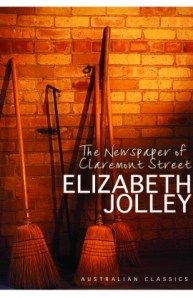
The first Jolley I read was the short story, “Night runner”, in an anthology titled Room to move. It introduced me to her concept of alienation and rather black notion of survival, her particular brand of irony, her portrayal of characters who more often than not suffer from some level of self-delusion, and her dark humour. I went on to read Miss Peabody’s inheritance, The newspaper of Claremont Street, The well, The sugar mother, and An innocent gentleman, among others, and have never really been disappointed. I enjoy her use of repetition and self-referencing, the motifs and the characters, even, that reappear in different works.  She gets me in the pit of my stomach with her vulnerable but often unkind or downright cruel characters, but makes me laugh at the same time with her depictions of their attempts at survival. You just have to see Ruth Cracknell playing The woman in a lampshade to know what I mean!

I have not yet read all of Jolley’s works. Just as for a long time I kept back one Jane Austen novel because once I’d read it I’d have read them all, I am now doing the same with Jolley. Her books are so delicious they need to be savoured. I’m sure this is not the last post I’ll be writing about her.

Cheaper books? At what cost?

Richard Flanagan gave the closing address at this year’s Sydney Writers Festival and spoke about recent moves to end territorial copyright in Australia which would allow the sale of overseas editions in Australia. It appears that this move is supported by big businesses such as Dymocks, Coles and Woolworths who apparently call themselves the Coalition for Cheaper Books. Flanagan argues that they should more rightfully be called the Coalition for Bigger Business.

IMG_3462I should put my cards on the table:

  • I buy books.
  • I buy new books mostly.
  • I prefer independent stores but I also use chain stores.
  • Price is an important criterion but is not the only criterion.
  • I like to buy books from knowledgeable staff who are prepared to help me if I’m having trouble.
  • I rarely buy online.

As I understand it the current situation is, partly anyhow, that:

Australian publishers have 30 days to publish a domestic version of any book that has been released anywhere in the world. If the book is published within 30 days, all booksellers are obliged to buy the publication from the Australian publisher and cannot import the book from an overseas publisher. (Bookseller.com)

I must admit that I don’t fully understand how this territorial copyright really plays out in terms of authors, publishers, booksellers and bookbuyers. How can I? With all the vested interests presenting their cases – and often making diametrically opposed statements –  it is hard to separate out the remainder from the classic. So, who do I support? I guess the main question to ask is, what is broken that this proposal is trying to fix? 

The Coalition says this in their submission to the Productivity Commission:

The Coalition supports the removal of these restrictions because an open market for books will lead to lower prices and quicker availability. This benefits consumers.

Ah, how sweet, they care about us, the consumer! And look, they continue with “There is strong evidence that access to books increases literacy”. I will repress my desire to be sarcastic here.

And then we get to the point: “Without parallel import restrictions [the same thing as “territorial copyright” I presume?] the consumer will have greater choice and pay less because it will be in the interests of Australian publishers to serve the consumer better…”

In other words, this appears to be, just as Flanagan said in his speech, a fight for control between booksellers and publishers. The funny thing is that the Australian Booksellers Assocation (presumably not representing the big boys) has changed its position from the one it held in 2001 and now supports the status quo.

I would love to pay less for books – and here I disagree with Flanagan that books cost about the same in the USA as they do here. In my experience they don’t. But, I am also aware that there has been a wonderful renaissance in Australian writing and publishing over the last couple of decades. If there is any risk that changes to these laws will see reduced publication of Australian authors then I am not willing to support these changes. 

So, let’s have an honest analysis of the problem – I’m still not sure what it is though can guess it’s to do with threats, real or imagined, being posed by the electronic and online world – and canvass a range of solutions. Flanagan puts forward a couple in his speech. Let’s not shoot from the hip with a solution that seems to be currently supported by only one part of one sector of the Australian book industry.

Note: See Australians for Australian Books for the anti-Coalition case.

Steve Toltz, A fraction of the whole

I reckon the voters for the NSW Premier’s Literary Awards inaugural People’s Choice Award got it right when they chose Toltz’s A fraction of the whole as the first winner. Not necessarily because it is the best book of the year, because I’m not sure that it is, but because it is such a life-writ-large book. It is funny – belly-laugh, sometimes, and quiet chuckle, other times – but serious at the same time. Just when you think you have grasped what it is about, it dives off on another tangent and your brain has to start working all over again.

I’m not sure how to describe it. It’s basically a father-son story, told in first person by the son, Jasper. However, Jasper inserts into his story three long sections in his father’s voice: Martin’s life-story (to the age of 22) as he tells it to Jasper in a seventeen hour stint, entries from Martin’s journal describing his relationship with Jasper’s mother, and Martin’s unfinished autobiography. These add some texture to the novel and allow us to know things that Jasper couldn’t know.

Created by Tinette, Wikipedia, under GNU Free Documentation Licence

Created by Tinette for Wikipedia under GNU Free Documentation Licence

The characters are intriguing, with Martin being centre-stage. At my bookgroup’s discussion of the book one of the members wondered whether there could be a bit of yin-yang between Martin and his brother Terry, and she could have a point. Jasper quotes the following from his father’s journal:

No symbolic journey can take place in an apartment. There’s nothing metaphorical about a trip to the kitchen. There’s nothing to ascend! Nothing to descend! No space! No verticality! No cosmicity! … The essential important idea that will shift me from Thinking Man to Doing Man is impossible to apply here. … I am a halfway man …

But, while he tries, Martin never really does move from a Thinking Man, while his brother remains the Doing Man. Jasper seems caught in the middle. Martin’s trouble is that he has “thought himself into a corner”, one where he is so distrustful  of humanity, and so fearful of death, that he can’t trust the ideas that could get him out. As Martin says: “If men are constantly manufacturing meaning in order to deny death, then how can I know I didn’t manufacture that experience myself?”. This corner, this distrust, is to bring tragedy to his life near the end of the novel.

It’s a very funny book, with the comedy being both verbal and situational. It is at different times absurd, ironic or satiric. The satire is aimed at pretty much anything you could imagine – education, politics, media (journalists in particular), philosophy, death and, indeed, humanity. Almost any page you open will provide either a laugh or a description that makes you go “aha” – on many pages you will find both.

So what is it actually about? It is about father-son relationships, and about sons who don’t want to replicate their fathers. It is about Australia (“our demented country”) and Australians – and is not too complimentary about our willingness to put others down, our lack of compassion for those who need our help. It is about the paradoxes that make up our lives and thus humanity and much of the book is expressed in terms of these paradoxes – the good and bad, life and death, pessimism (Martin) versus optimism (Jasper), sanity and insanity, forgiveness and unforgiveness, and so on.

There is so much to write about this book that I think it’s best I end here with, fittingly, a paradoxical statement made by Martin two-thirds through the novel. “Fiction”, he says in his unfinished autobiography, “has a habit of making the real world seem made-up”. Toltz has produced in his novel a world that seems both real and made-up. It is up to us to decide which is which…and act accordingly!

What does prestigious mean?

In the June issue of Limelight magazine is this news item:

Entries are now open for two of Australia’s most prestigious literary prizes, the Melbourne Prize for Literature, and Best Writing Award. The first is awarded to a Victorian author who has made an outstanding contribution to literature and is worth $60K, the latter is for writers under 40 and offers a prize of $30K.

Hmm…do prizes for which only Victorians are eligible qualify for being among Australia’s “most prestigious”? Methinks prestige is being equated here with monetary value. My definition is closer to the dictionary definition, that is, having high reputation or being in high esteem. Does having been chosen only from Victorians grant the winner of this award prestige across Australia?

Miles Franklin, 1902, by H.Y. Dorner

Miles Franklin, 1902, by H.Y. Dorner

A quick Google search comes up with an interesting array of statements about literary awards in Australia. An Australian government website describes the Miles Franklin Award as “one of the most illustrious events on the Australian literary calendar”. As one of Australia’s oldest continuous awards and as a national award, it perhaps better lives up to being described as “illustrious” (or “prestigious”). Of course, this award has its own qualification: the winner must be “of the highest literary merit and present Australian life in any of its phases“. This has got the award into trouble on more than one occasion.

Young novelist Nerida Newton is more objective in her description of the Miles Franklin Award as “At around AU$42,000 this award is Australia’s richest literary prize”. She’s clearly out of date, however, as it is no longer Australia’s richest prize. Not even the prestigious Melbourne Prize for Literature can claim to be this. As far as I can tell, that honour goes to the new Australia-Asia Literary Award. In 2008, its prize value was $110K.

Meanwhile, over at Allen & Unwin, they try to cover all bases. They describe The Australian/Vogel Literary Award as “one of Australia’s richest and the most prestigious award for an unpublished manuscript by a writer under the age of thirty-five”. While the prize money is only $20K, it does also include publication of the manuscript. That IS worth a lot if you are a writer struggling to get published. 

The superlatives continue. The 2006 announcement of the Australia Council for the Arts Writers Emeritus Award describes itself as “one of the highest honours in Australian literature”. It too, though, is qualified as it “recognises the achievements of Australian writers over the age of 65 who have made an outstanding contribution to the field and created an acclaimed body of work”. That puts it out of reach of all but the grand dames and messieurs of the Australian literary firmament.

The thing is that when it comes to literary awards there are a lot of apples and oranges being compared. Is it an award for a piece of work or for a body of work? Is it an award for a published or an unpublished work? Is it limited by age or gender of writer, by region, genre or subject? 

I guess it all depends on your perspective. Monetary value is important – more for the winner, though, than the public looking for an indication of Australia’s leading literary lights. For me, it comes down to how widely the award net is cast (in relation to my literary interests) and who the judges are. And so, while some of my best friends are Victorian, the Melbourne Prize for Literature will not be in the top group of my literary  awards watchlist.