Helen Garner, The children’s Bach

I’ve said a few times now that I rarely reread books, and then go on to write about something I’ve re-read. I must look like a liar, but the fact is that if I’ve liked a book so much that I’ve reread it it’s likely to find its way here. The funny thing is, though, that my reason for rereading The children’s Bach was not so much because I loved it first time around (though I did enjoy it) but because I read a critic who described it as one of the four best short novels – ever! It’s hard to ignore a commendation like that, isn’t it? And so I read it again …

It’s set in Melbourne, and concerns a couple, Athena and Dexter, who lead a self-sufficient life with their two sons, one of whom is severely disabled. This apparently comfortable life is disrupted by the arrival of Elizabeth, from Dexter’s past. With Elizabeth come her sister Vicki, her sometime lover Philip, and his prepubescent daughter Poppy. Through them, Athena and Dexter are drawn into a world whose ideas and values test the foundations of their relationship.*

This sounds like a pretty standard plot, but from it Garner draws something quite special, something tight and marvelously observed, and something, in the way that Garner has, that is brutally honest. This is the thing that I admire about her most – even though I don’t always agree with her: she doesn’t flinch from unpleasant “truths”. And so, in this book, she tackles the challenge of parenting a severely disabled child. While there are people who talk about the joy and meaning a disabled child brings to their lives there are others who feel quite differently. This is the shock at the centre of this book.

Garner introduces a sense of uneasiness right at the beginning with a photo of Tennyson and his family (why Tennyson, I’m not quite sure) which shows them together but not quite together and which is described simply as “the photo of a family”. The photo is old but Dexter keeps sticking it back up again. This beginning is followed by a fairly idealised image of Dexter and Athena as a loving, supportive couple – “she loved him. They loved each other” (p. 4) – and then Garner slowly reveals the cracks. Dexter’s idealisation of Athena is one cause, but the disabled child who holds Athena back, is another. The arrival of Elizabeth and her entourage – with their different and challenging ways of viewing the world – is just the catalyst.

Athena’s harsh attitude regarding Billy, her disabled son, is psychologically real, but is shocking to see in a character who is idealised as the earth-mother. Our readerly assumptions take a knock! Early in the story Athena looks at handprinted cards of places for rent:

… Athena was … scanning the window covered in handprinted cards on which people advertised rooms to let in their rented houses. Athena lived, for as long as it took to read a card, in each sunny cottage, each attractive older-style flat, spacious house, quaint old terrace, large balcony room with fireplace, collective household with thriving veggie garden. Her children dematerialised, her husband died painlessly in a fall from a mountain. What curtains she would sew, what private order she would establish and maintain, what handfuls of flowers she would stick in vegemite jars, how sweetly and deeply she would sleep, and between what fresh sheets.

This could be typical daydreaming but it’s pretty specific in detail (children dematerialised, husband dead): it’s Garner telling us that Athena feels trapped and is ready for change. Then Philip comes along and she is attracted to him; she’s not morally repulsed the way Dexter is by his behaviour: “Dexter lay rigid as a board … but Athena slept, and dreamed that she was in a garden….”.

And so, Garner writes, “The edifice crumbles”. The cracks have been there, in the edifice, but Dexter is (has been) oblivious to them. He’s a kind man but he’s pretty unaware of how other people feel; he expects them all to see life as simply, as happily as he does. But this is not the case – as he finds out …

All this is told in tight, expressive language.  Here is a delicious description of Dexter’s mother:

Like many women of her age whose opinions, when they were freshly thought and expressed, had never received the attention they deserved, Mrs Fox had slid away into a habit of monologue, a stream of mild words which concealed the bulk of thought and knowledge as babbling water hides submerged boulders. (p. 101)

Garner focuses on the gap between appearance and reality, particularly regarding the problems of idealisation (of self and/or of other). Athena is idealised but is shown to have feet of clay; Dexter is also idealised and idealises himself – until his own fall from grace: “he was in its moral universe now, and he could never go back”.

We can read this book in two – not totally exclusive – ways. One is psychological and relates to the realisation of self, particularly for Athena. The other is social and relates to role definitions, again particularly for Athena in terms of the expectations of her as wife and mother. One of the things that Garner tends to do well, in fact, is explore the point where social expectations of how we should feel meet and often clash with our real emotional selves. We see this clearly in The spare room where the character Helen shocks us with her anger at her dying friend.

I have really only touched the surface of this book – there is the music motif to consider, and the conflict of values represented by the intrusion of Elizabeth and her entourage into Dexter and Athena’s world – but I have talked about some of the issues that grabbed my attention and that, I think, will do!

* This is, essentially, the plot summary I wrote a couple of years ago for the Wikipedia article on the book.

Helen Garner
The children’s Bach
Penguin Modern Classics, 2008 (first published 1984)
180pp.
ISBN: 0869140299

Longlist for 2010 Miles Franklin Award announced

Book cover for Jasper Jones, by Craig Silvey

Jasper Jones cover (Courtesy Allen & Unwin)

Without further ado, here are the twelve who’ve made it to the 2010 Miles Franklin Award longlist:

  • Allington, Patrick Figurehead
  • Carey, Peter Parrot and Olivier in America
  • Castro, Brian The bath fugues
  • Doust, Jon Boy on a wire
  • Foster, David Sons of the rumour
  • Foster, Deborah The book of Emmett
  • Guest, Glenda Siddon Rock
  • Hartnett, Sonia Butterfly
  • Keneally, Thomas The people’s train
  • Miller, Alex Lovesong
  • Silvey, Craig Jasper Jones
  • Temple, Peter Truth

Well, shock! horror!, as you can see from my lonely link, I’ve only read one of these to date. While I like to give some focus in my reading to Australian writers, my reading, it seems, is driven by things other than catching the latest books out!  I do, however, have Lovesong and Truth in my TBR pile … so I will try, now, to get to them sooner rather than later … and then, well, time will tell how many of the others I manage to get to …

It is good to see a mix of new authors and established authors. That is a healthy sign, isn’t it. Still, there are some interesting omissions here, and I’m sure there’ll be plenty of comments on those. Cate Kennedy’s The world beneath (another on my TBR pile) is one that garnered some positive critical attention but is not here. Marion Halligan’s Valley of Grace and David Malouf’s Ransom, on the other hand, would have missed out because they do not meet the award’s conditions: that is, the work “must present Australian Life in any of its phases”!

All this, however, is now water under the bridge. The shortlist will be announced in April, and the winner on June 22.

If you’d like to research any of these titles further, a good start is this link to Readings Bookshop in Melbourne: it contains links to their interviews with several of the nominated authors.

Dorothy Porter, The bee hut

The bee hut, by Dorothy Porter

Cover image (Courtesy: Black Inc)

The most powerful presence
is absence
(from “Egypt”)

The above lines open Australian poet Dorothy Porter‘s The bee hut, a collection of poems mostly writen in the last five years of her life. The lines are prophetic … and they appropriately open a collection which deals very much, though not exclusively, with the tension between life and death. The poems are, in turn, angry, resigned, beautiful, humorous even, and philosophical. Some draw on Christian and other mythology, some allude to other poets, and some are simply founded in the unembellished here-and-now. And, despite the fact that we and she know that death is coming sooner rather than later, they are life-affirming.

The collection is divided into eight groups:

  • Head of Astarte
  • The enchanted ass
  • Poems: January – August 2004
  • Smelling tigers
  • Jerusalem
  • Africa
  • The freak songs
  • Lucky

The title poem, “The Bee Hut”, is in the “Poems: January – August 2004” group:

But do I love the lesson
of my thralldom
to the sweet dark things
that can do me harm?

In her brief introduction to the collection, novelist Andrea Goldsmith, Porter’s partner, writes that:

The bee hut became a metaphor for these last years of her life … She marvelled at the bees, as she had always marvelled at life, but she was also aware of the danger amid the sweetness and beauty.

Danger in life, the darkness that is found alongside beauty, is the defining paradox of the collection: “In living there is always/the terror/of being stung” (from “Bluebottles”). Not all poems explore this idea but many do.

There is some sort of thematic underpinning to the poem groupings, and there is a strong autobiographical flavour. The “Africa” section, for example, clearly relates to travels in Africa; “Poems: January – August 2004” were written about her time undergoing chemotherapy for the breast cancer that was to kill her; while “The Freak Songs” are “a song cycle written for performance with the music of Jonathan Mills“. These last are older poems, and therefore predate her diagnosis, but are an apt inclusion. They are wild and defiant: “I bite the apple/I lick the fire/I kiss the sweet sweet snake” (from “The Fruits of Original Sin”). But even here there’s recognition that death, in the end, has the upper hand: “You live your life/as if there’s a secure cage/for the clipped wings/you’re planning” (from “The Bluebird of Death”).

Even more than with a short story collection, it is impossible to discuss every poem in a collection – and, to be honest, I would find it hard to do so since while  some spoke to me easily and some I could grasp with a little thought, there are others that elude me, mostly because their allusions are not familiar to me. I am not, for example, an expert on French poets like Rimbaud, Verlaine, Baudelaire, so when she invokes them I can guess at their meaning but am not totally sure I “got” it. Consequently, I’m just mentioning a few of the poems which particularly appealed to me.

Her poem “Blackberries” in “The enchanted ass” deals with the imperative to write poetry and the urgency to get it down, to locate and express the idea:

and your pen slashes ahead
like a pain-hungry prince
hacking through
the bramble’s dragon teeth
to the heart’s most longed for
comatose, but ardently ready
princess.

Most of the poems are like this – strong, vivid and comprised of short active lines. There are quite a few recurrent images – blood, birds, incense. All very concrete and yet all highly evocative as well. I think that’s what I like about most of the poems – they work well on a visceral as well as a philosophical level. You feel them as well as hear them.

Also in “The enchanted ass” are “Three Sonnets”. The first refers to Byron, the second to Woolf and the third to Blake. In the Woolf one, she writes:

Life is so dangerous,
but this morning you can take
the wave
right to the sparkling shore

You can bear knowing
the street will one day dump you.
(from “What a plunge!”)

One day she finally is dumped … and yet, even then, just two-and-a-half weeks before her death she can write:

Something in me
despite everything
can’t believe my luck.
(from “View from 417”)

There are poems here that are a little obscure to me – that I will need to read again with Google at my side to check the allusions – and there are no amazingly new revelations about life and death, but their passion and vigour engaged me from the get-go! I’m glad I’ve finally been introduced to Dorothy Porter.

Dorothy Porter
The beet hut
Melbourne: Black Inc, 2009
146pp.
ISBN: 9781863954464

Ruth Park, Swords and crowns and rings

Note to self: never again “read” an audiobook over a long period, such as, say, 5 months! This is how I read Ruth Park‘s engrossing 1977 Miles Franklin award-winning novel, Swords and crowns and rings. It was not hard to keep up with the plot as it’s pretty straightforward – and powerful. It is hard, though, over such a time to keep up with and remember all the nuances in her writing and expression and the way they affect character development and thematic strands. For a thoughtful review of the book by someone who read it more sensibly, please see my friend Lisa’s, of ANZLitLovers, here.

I am not an experienced “reader” of audiobooks and I have to say that I found what seemed to me to be the over-dramatisation of the story rather trying in the first few CDs. I gradually got used to it, however, and by the end I was happy with Rubinstein’s reading, but it did take me a while to settle into it.

New-Zealand born Ruth Park is a wonderful chronicler of Australian life. Her novel, The harp in the south, set in working class Sydney in the 1940s is, to my mind at least, an Australian classic – but it is just one of her extensive and well-regarded body of work. Her autobiographies are also well-worth reading, not only for the light they throw on her life and on that of her husband, author D’Arcy Niland, but also on that of the Australian literary establishment of the mid-twentieth century.

Anyhow, back to the novel. Swords and crowns and rings tells the story of two young people born in an Australian country town before World War 1 – pretty Cushie Moy (born to a comfortable family with the stereotypical socially ambitious mother who has married down) and the dwarf, Jackie Hanna (whose background is well and truly working class). Not surprisingly, Cushie’s parents frown on the friendship which develops between the two. This is not an innovative story but, rather, good historical fiction with evocative writing and sensitive character development. Consequently, as you would expect, the two are separated just as they realise their love for each other and the book then chronicles their respective lives – Cushie with various relations in Sydney and Jackie in a number of country locations before he too reaches Sydney. Much of the book takes place during the early 1930s Depression. Park gorgeously evokes the hardships – physical, economic and emotional – experienced by people like Jackie and his step-dad “the Nun” as they struggle to support themselves. All this is underpinned by Park’s thorough knowledge of the social and political history of the time: we learn about labour organisations and the rise of socialism, of that irascible politician “Big Fella” Jack Lang, and of the building of the Sydney Harbour Bridge.

The resolution is predictable – it is, after all, a book of its genre – but it is not over-sentimentalised and is not achieved before the characters, Jackie in particular, have matured to the point that we can trust that he not only deserves what will come but that he will continue to work and mature for the betterment of himself and those he loves. It is truly a powerful book about human nature, as well as about the place and time in which it is set.

Ruth Park
Swords and crowns and rings (Audio CD)
Read by Deidre Rubenstein
Bolinda Audio, 2007
18 hours on 15 compact discs
ISBN: 9781741636628

Martin Boyd, A difficult young man

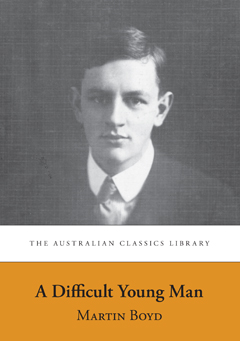
Martin Boyd's A difficult young man
Difficult but handsome (Courtesy: Sydney University Press)

I’m not sure what I was expecting, but I certainly wasn’t expecting the delightful sly wit I found in Martin Boyd’s A difficult young man, which, I understand, is the second book in the “Langton Quartet”. This novel though can clearly stand on its own – otherwise, why would Sydney University Press publish it alone as part of its Australian Classics Library? Is it the best written of the four? The most readable? The one most commonly studied (which goes back to the original question anyhow)? Or was it simple a case of eeny-meeny-miny-moe? (Even “eeny meeny miny moe” has a Wikipedia article – how great is that?) Whatever  the reason, my appetite has been whetted, and the first book, A cardboard crown, will now be promoted in my TBR pile.

Anyhow, back to the serious stuff. I know it was written in a completely different place and oh, nearly a sesquicentenary later, but there’s more than a whisper of Jane Austen about Boyd’s book. Superficially, this book and Austen’s works are very different: this is not a romance – but then neither is that Jane Austen’s focus either; its main characters are male rather than female; it has an autobiographical thread which none of Austen’s novels do; and it uses first person rather than Austen’s omniscient third person narrator. The similarities are, rather, in language (their wit and irony) and form (both write what can be described as social satire). I may be the first person to have put these two authors in the same sentence, but, well, that’s the fun of being a blogger: you can say it as you see it! And what I see is that both writers make me chuckle with their observations on human nature.

So what is the plot? The story is narrated by Guy Langton (a veiled Martin), who is the fourth son of Steven and Laura Langton. He focuses on the late adolescence-early adulthood of the eldest living son, Dominic (inspired by – but not – Merric), the “difficult young man” of the title, who, as the story progresses, manages to fail in, or otherwise mess up, pretty well everything he does. Through the course of the book the family moves from Australia (Melbourne and environs) to the family seat in England and back to Australia again. The book chronicles a number of domestic crises, at the root of which is usually Dominic who somehow undermines “the various attempts to fit him into some place in the world”.  In many ways though, the book is just as much about Guy who, through the process of narration, works to find a balance between “the unaltered impression” of “my childish mind” and “the glaze of adult knowledge”. This is a clever book which reads like, but is not, an autobiography.

It’s an engaging story – not so much for its rather episodic plot as for its array of wonderful and mostly eccentric characters, from the social-climbing arriviste Aunt Baba (who thinks anyone who does “a kindness from which they received no benefit” is silly) to the gentle, wise but somewhat ingenuous father, Steven. My favourite aspect of the book though is its style. I usually enjoy self-conscious narrators, and Guy is definitely that. He regularly addresses the reader directly, reminding us that he can use “the mask of a character in the story” and advising us of which “glaze” he is applying at the time. In this way he lets us know which parts might be more suspect than others in terms of the “facts”, which he recognises as being different from the “truth”:

..but the reader must take certain wild statements as intended for fun, though they contain an element of truth too subtle to be confined within the limits of accurate definition. One can make exact statements of fact, but not of truth, which is why the scientist is forever inferior to the artist.

And this brings us to another concern of the novel – the importance of the imagination. In many ways the book is a hymn to the creative life, a statement of the Boyds’ belief that a life lived without imagination is probably a life not worth living. It also makes a plea for humane values, for peace not war, for gentle not brutal discipline of children, for education that is not conformist. The book is set in the years leading up to World War 1 and the point is made that life before the war – the “secure civilisation” – was to change irrevocably after.

In addition to irony, Boyd uses a wide range of literary techniques rather effectively, such as foreshadowing (which teases us while at the same time directing our understanding), analogies, contradiction, and allusions (particularly to art and literature). All of these imbue the book with a reflectiveness that undermines a focus on plot.

There are so many strands to this novel – its style, diverse subject matter, and characterisation – that would be fun to explore, but that would leave nothing for the rest of you to talk about, so I will finish with a statement made by the narrator towards the end of the novel:

This is really what I am seeking for throughout this novel, the Memlinc in the cellar, the beautiful portrait of the human face, lost in the dissolution of our family and our religion.

I am doubtless romanticising the Bynghams [maternal ancestors], but there is an element of truth in what I write, which is all I ever claim. Also everyone romanticises what interests him.

As he does so often in the novel, he says one thing here and then undermines it immediately after. But it works, and it works because life is messy and contradictory and yet out of this mess and contradiction comes a vision of something that is real and enduring – and that is the transcendence of family, and the importance of imagination.

Martin Boyd
A difficult young man
Sydney: Sydney University Press, 2009 (orig. pub. 1955)
223pp.
ISBN: 9781920898960

(Review copy supplied by Sydney University Press. This is the last of 12 books that my friend Lisa (aka ANZLitLovers) and I received to review. We believe more will be published in this series: if these 12 are anything to go by we are in for a real treat – and the cause of Australian literature can only profit from that.)

ABR’s Favourite Australian Novel poll

Back in October I wrote about the Australian Book Review’s poll to find our favourite Australian novel (not Australia’s favourite novel!). Well, the result has just lobbed into my email inbox: it’s an interesting list. No great surprises, and it’s certainly pretty acceptable even though one can always find something to argue about when the opportunity arises.

Here they are:

  1. Cloudstreet, by Tim Winton (since members of the Australian Society of Authors voted this their top novel in 2003, it’s not a totally surprising win – and I’m happy enough with it!)
  2. The fortunes of Richard Mahony, by Henry Handel Richardson (the oldest in the top ten – and great to see a woman in second spot!)
  3. Voss, by Patrick White (woo hoo … this was my well-considered vote!!)
  4. Breath, by Tim Winton (another guernsey for the popular Tim – and perhaps its ranking here is largely due to its still being fresh in people’s minds? You know, along the lines of how well Harry Potter has done in recent readers’ polls. I’m not saying this is a bad choice but … currency often does come into play in these polls doesn’t it?)
  5. Oscar and Lucinda, by Peter Carey (this would have been a serious contender for my second choice if I’d had one, because I think it is often overlooked in discussions like this)
  6. My brother Jack, by George Johnston
  7. The secret river, by Kate Grenville (a riveting read that gets to the heart of our origins as a convict settlement and so good to see here)
  8. Eucalyptus, by Murray Bail (great to see this beautiful fable-like tale appearing in the top 10)
  9. The man who loved children, by Christina Stead
  10. The tree of man, by Patrick White (another worthy choice I think … though after Voss it is hard to choose which White should come next!)

In the link I’ve provided above, you will find the next 10, and here is a link to the complete list. Apparently 290 were nominated, and thousands (nothing more specific than that) voted.

And, before I close, some basic stats. Ten novels:

  • 8 authors;
  • 3 women;
  • no indigenous author (but Alexis Wright does appear in the top 20);
  • all published after 1900 (but a couple of earlier ones appear in the top 20); and
  • I have read only 7, of which I am a little ashamed (but I have seen one of the others as a miniseries – does that count? – and the remaining two are in my TBR, one physical, one virtual).

Geoff Page, The scarring

Geoff Page (born 1940) is a Canberra-based poet who has been active in the Australian poetry scene for many decades now. He was also, for nearly three decades, an English teacher. Page has published several volumes of poetry and at least three verse novels, of which The scarring is his first.

The scarring, which I read a few years ago but have been wanting to review here, is, I have to say, one of the most gut-wrenching works I have read. Page has set it in the landscape – rural northern New South Wales – of his childhood and says it was inspired by rumours he heard as a child (but it is not a “true” story). The story spans around seven decades from the 1910s to the 1980s, and chronicles the lives of a couple from their youth and courtship through to old age. As the blurb on the back cover says, “their separation through war sows the seeds of their eventual destruction”.

One of the things I love about the book is the way Page weaves so much of the social and political history of twentieth century Australia through the lives of this couple – war, the Great Depression, the boom of the 1950s, city versus country life and values, and of course gender inequity and the old double standard! The scene is set from the first line:

Breed em tough, the old man says.

Little do we know what lies beneath this seemingly innocuous opening – and I’m not about to give it away to you now. Let’s just say that Page deftly weaves the breeding motif through his tale of a young couple running a cattle property.

Here is an example of how history is told alongside life on the farm:

the new white stiffness of the sheets
where Sally will be his forever

‘Forever’ moves on two years more.
The set of skills they share between them
shoves them sideways from the news:
Sudetenland, then through to Munich,
Kristallnacht and into Prague.
It rattles in through bakelite
and once or twice on Cinesound
showing at the flicks in town,
that lifted arm and square moustache
relishing a massed salute.

And so the story moves on to its more or less inevitable – given the events that occur – conclusion. This is not flowery poetry. Page tends more to a spare style that is well suited to his setting and subject.  The poetry’s insistent rhythm draws you on, and Page’s use of repetition slowly but subtly builds up the tension. This is a novel that you’ll want to read in one sitting.

Page is, I think, a little too unsung … but then, isn’t that the case with most poets?

Geoff Page
The scarring
Alexandria: Hale & Iremonger, 1999
111pp.
ISBN: 0868066826

Australia Post’s new set of Living Legends

Australian Legends of the Living Word, stamps

The six on the stamps (Courtesy: Australia Post)

Does the choice of writers for Australia Post’s Australian Legends of the Written Word look a little one-sided to you? Here is the list:

The Guardian books blog – Australian writers’ stamps send the wrong message – suggests so, and has a bit of a discussion going on the topic. I’m inclined to agree. I was trying to list the 6 recipients for my co-diners at lunch yesterday and, having remembered a few, started running through other possibilites. Helen Garner? No, I’m sure she wasn’t there. Alexis Wright? No. Kate Grenville perhaps? No. And so on … you get the drift. Personally, I’d have Bryce and Colleen outta there, and would have instead some of the names I’ve mentioned – or any of the many others I could think of. But then, this is “legends” and I suppose Bryce and Colleen have earned that right if only by dint of their recognition in the popular imagination of Australians who buy their books by the droves. Who am I to argue with that?

And just for a different approach to the topic, Australian ex-pat journalist and bookblogger in London, kimbofo at Reading Matters has asked her readers who they would choose for British authorial legends. You might like to think upon that too…

Top non-fiction of 2009

Is it cheating to do separate lists for fiction and non-fiction? Some people list their top books regardless of form or genre, while others created separate lists. I’m going to do the latter because – well, because I get to choose more books for a start. Actually, I didn’t read a lot of non-fiction this year so my top non-fiction titles will almost be all the non-fiction I read. As with my top fiction, I am listing them in the order I read them.

I didn’t nominate a top fiction for the year, but I’m going to here – and it is the one I read before I started blogging: Chloe Hooper’s The tall man and so I’ll do a little mini-review of it now.

Chloe Hooper’s The tall man

In a nutshell the book, which is best described as “true crime”,  chronicles the fallout that results from the death in custody on Palm Island of indigenous man Cameron Doomadgee, fallout which includes the autopsy report and ensuing riots, and the homicide trial of policeman Chris Hurley. Hooper explores the awful disconnect between people in the communities involved, between white and black, and within the white and black communities. She shows how women (particularly those on Palm Island) are caught in the middle. They believed the policeman killed Doomadgee but, when the riot occurred, they didn’t want the police gone because “who will protect us from the men”.

Throughout the book, Hooper manages to bring what is a very complex situation into rather clear focus…showing, not surprisingly, that in the end it’s the whites who have the power. For example, she attends a police rally organised to support Hurley and notes how they, the police, were fashioning themselves as victim. She comments that “measured against two hundred years of dispossession and abuse, the idea is fantastic, but no-one in that hall was thinking about historical relativities”! This point regarding “historical relativities” is well-made: this is not simply a case of white devil versus black angel, but we know where the real “victimhood” lies. The book also touches on the notion of power corrupting – or, questions at least how police officers are chosen and trained in the first place.

Hooper manages to walk a fine line. You know where her sympathies lie (particularly as the book progresses and she teases out the evidence) but she takes an analytical approach encouraging her readers to also do so. This begs comparison with Helen Garner who takes a far more heart-on-sleeve approach to her subjects in her books, The first stone and Joe Cinque’s consolation.

Finally, she makes an important point when she describes Hurley’s trial as “a false battleground”. Truth and justice – those universal concerns – do need to come out, but the trial is not going to solve the underlying problems. The tall man is a highly readable book about some significant concerns (for Australia at least)…and, in my mind, well deserves the awards it has won. I have only one quibble with it: I wish it had an index!

POSTSCRIPT: Thea Astley also dealt with troubles on Palm Island in her novel The multiple effects of rainshadow. It deals with the event which occurred on Palm Island in 1930 when the supervisor at the time ran amok and killed his children, something which Hooper refers to in the book when she provides a little rundown of Palm Island’s history.

Chloe Hooper
The tall man: Death and life on Palm Island
Camberwell: Penguin Books, 2008
276pp.
ISBN: 9780241015377

C.J. Dennis, The moods of Ginger Mick

Sometimes a bloke gits glimpses uv the truth
(“In Spadger’s Lane”)

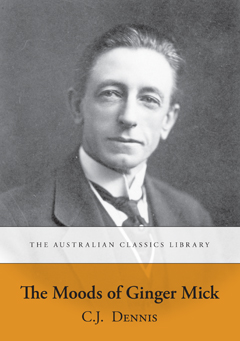
I wasn’t sure, really, that I wanted to read CJ Dennis’ verse novel, The moods of Ginger Mick, which I received as a review copy from the Sydney University Press as part of their Australian Classics Library – but have surprised myself. I rather enjoyed reading it and am glad that I had this little push to do so!

The moods of Ginger Mick
The moods of Ginger Mick cover (Courtesy: Sydney University Press)

The moods of Ginger Mick was published in 1916 just weeks before the big Conscription Referendum, according to Philip Butters who wrote the new introduction to this edition. It does not however buy into that debate. The book comprises 15 poems “written” by Dennis’ other character, The Sentimental Bloke, at whose wedding Mick was best man. The poems introduce us to Mick and his larrikin life before the Great War and then go on to chronicle his life as a soldier.

Dennis writes his poems in broad Australian slang (but there is a glossary at the end). Most are 6-line stanzas with an ababcc rhyme (the same as Wordsworth’s “Daffodils”!) but every now and then there is a different rhyme scheme which mixes it up a little. The sweet poem “The singing soldiers”, for example, has a sing-song aab(with an internal rhyme)acc, while the poignant “Sari Bair” about the eponymous battle has 4-line stanzas with a simple aabb rhyme.

I enjoyed reading the poems, not only for their evocative language but also for their subject matter. While their setting and language make them very much of a particular time and place, their concerns have some universality. They are about egalitarianism vs class difference, and about what it means to be a man (a “bloke” as it were). Mick starts off as a bit of a larrikin – one who cares not for the “toffs” and for whom the “toffs” care not! As he says in an early poem:

But I’m not keen to fight so toffs kin dine
On pickled olives …
(“War”)

What sends him to war in the end is “The call uv stoush” but, when he gets there, he starts to discover that in uniform all men are equal, that

… snobbery is down an’ out fer keeps,
It’s grit an’ reel good fellership that gits yeh friends in ‘eaps.
(“The push”)

This poem, “The push”, provides a wonderfully colourful roll call of the sorts of men who enlisted. Other poems cover the support of women at home, hopes for work when they return home now they’ve proved themselves (after all the “‘earty cheerin’ … per’aps  we might be arstin’ fer a job”) and the sense that Australia has grown up as a nation (“But we ‘av seen it’s up to us to lay our toys aside”). There is ironic humour (as in “Rabbits”) and pathos (as in “To the boys who took the count” and “The game” in which Ginger Mick finally realises that he’s found his metier). There’s also some racism that was, unfortunately, typical of the time. And of course there is patriotism, with some rather lovely descriptions of the Australian landscape. I just have to mention here some references to gums:

An’ they’re singin’, still they’re singin’, to the sound uv guns an’ drums.
As they sung one golden Springtime underneath the wavin’ gums.
(“The singing soldiers”)

An’ we’re ‘opin’ as we ‘ear ’em, that, when the next Springtime comes,
You’ll be wiv us ‘ere to listen to that bird tork in the gums
(“A letter to the front”)

As a group, the poems offer an interesting insight into Australia’s experience of the First World War, particularly given their mix of realism and romanticism that belies perhaps the recent glorification that’s developed around our ANZAC heritage. If you are interested in Australia’s cultural and literary heritage, it is well worth giving this short little book a look.

C.J. Dennis
The moods of Ginger Mick
Sydney: Sydney University Press, 2009 (orig. pub. 1916)
87pp.
ISBN: 9781920898984

(Review copy supplied by the Sydney University Press)