Monday musings on Australian literature: My literary home, more or less

Once again Mr Gums and I have left daughter and dog at home in order to hit the road – well, in this case, the skies as by the time this is published we will be in Hong Kong. My posting and commenting will consequently somewhat sporadic for the next week…and so I decided to make this Monday musings a simple one.
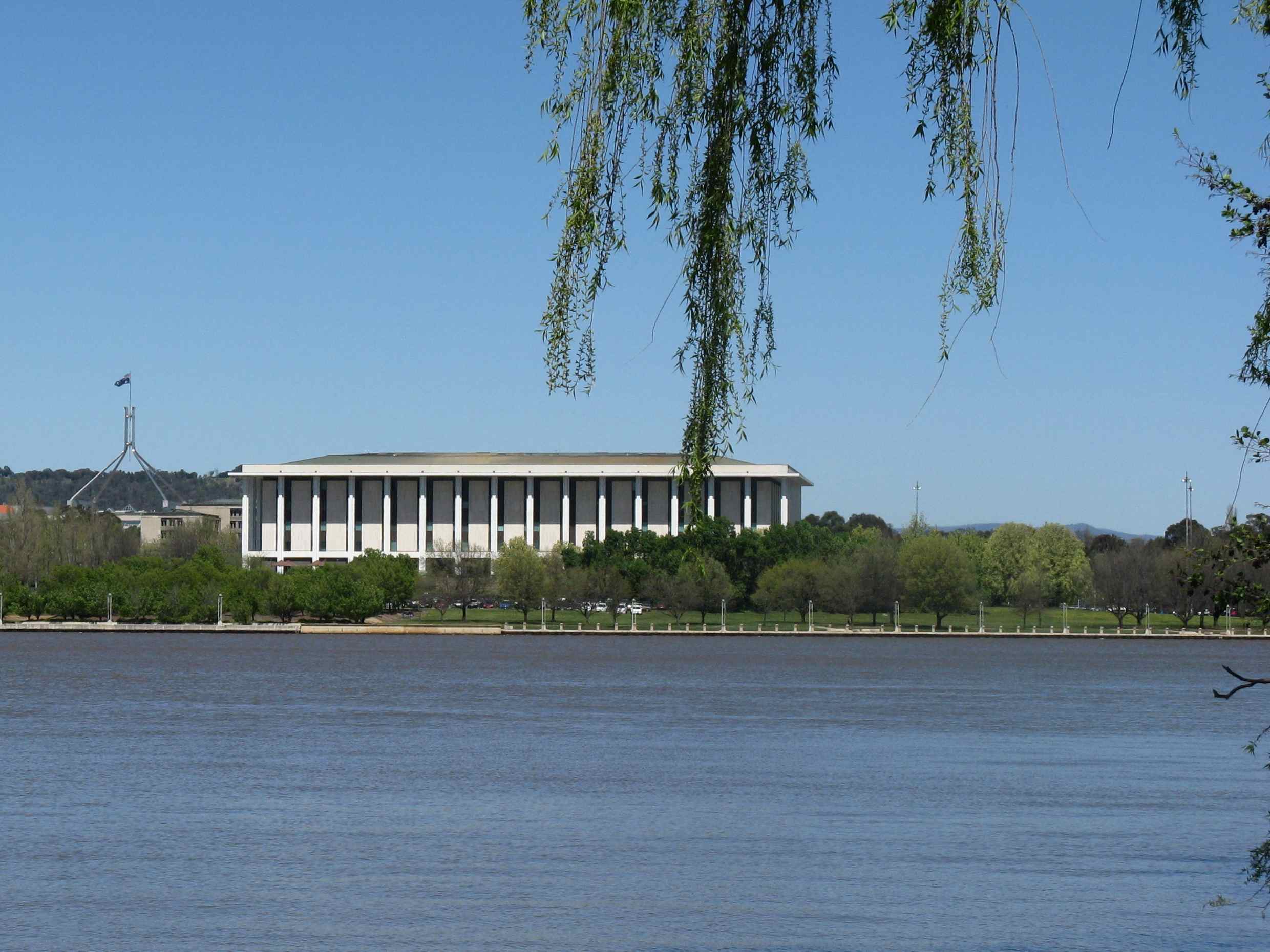
National Library of Australia

National Library of Australia, viewed from Commonwealth Park on the opposite side of Lake Burley Griffin

Now, my real literary home is, as for most of us I expect, my childhood. That is where my love of reading started. I cannot remember a time without books. My parents read, and encouraged reading. Books were my favourite presents. For me, this all translated into choosing librarianship for my career, and this brings me to this post. I count myself lucky that my first professional job as a librarian was at the National Library of Australia. Eventually, the section I worked with separated and became a new institution. Since its work was where my heart lay, I went with it.

However, I have stayed close to the Library: I’m a “Friend” and, since taking early retirement a few years ago, I visit there regularly to read and research, attend seminars, visit the bookshop and exhibitions, and meet friends for lunch. I have heard many Australian writers speak there – including David Malouf, John Marsden, JM Coetzee, Geraldine Brooks, Janette Turner Hospital – and have seen some doing research there – including Kate Grenville.

Being our National Library, it is of course home to many of Australia’s most famous literary manuscripts – too numerous to mention here, but a fairly recent coup was the believed-to-have-been-destroyed papers of Patrick White. It is also where, due to legal deposit, you should be able to see any book published in Australia. A great resource!

The National Library has been one of the world’s forerunners in using and managing the digital domain. Here are some of its major projects:

  • Pandora, the Australian web archive, was among the first attempts in the world to archive online information. It was established in 1996.
  • Picture Australia is a federated search project providing access to image collections from institutions all over Australia. It was established in 1998.
  • Newspaper Digitisation Project, to which I referred in last week’s Monday musings, is a project to digitise, using OCR technology, Australia’s early newspapers up to 1954. Since OCR technology – particularly when used on old newsprint with old printing technologies – results in a lot of “errors”, the National Library invites users to edit the articles. Anytime I use it, I do my correcting bit on the articles I find. The top user-corrector, recorded on the project’s home page, has now made nearly 560,000 corrections. 560,000!! Now, that’s a lot of participatory value the Library has harnessed.
  • Trove is the Library’s latest big project and enables users to search “the deep web” for material relating to Australia and Australians. It uses modern search technologies to point to related material, to enable users to manage the information they find and contribute their own content, and to encourage users to actively engage with the library and each other through forums.

And there’s much more besides … but I’ll leave it here and let you explore my literary home through the links above while I explore Hong Kong …

Monday musings on Australian literature: Dear Sir, or The cult of ugliness

As I was researching Ruth Park for last week’s Monday musings, I came across some “Letters to the editor” in The Sydney Morning Herald and thought they were worth sharing. (As you read them do note how some of the letter writers sign themselves.) I’ll start with a couple of letters criticising Park’s novels:

Sir, The type of literature exemplified in Ruth Park’s “Harp in the South” and the first two instalments of “Poor man’s orange” fits into a pattern which appears also in modern painting and sculpture, and perhaps in a lesser degree, in much modern music.

This general trend may be described as the “cult of ugliness” …

Why cannot she, with her undoubted talent for portraying people, let us believe there are some normal and pleasant people, whose trials and failures and successes, joys and sorrows, would still present a fruitful field for her literary powers?”

(H.E. Ellen, Cronulla, 13 July 1949, p. 2)

Ruth Park, in her novel about the Darcy family seems to revel in the unpleasantness and beastliness of life…

(K.W., Pymble, 15 July 1949)

… We all know that such conditions exist, but making them a subject for a novel will do nothing towards eliminating them.

It seems a pity that we should feel duty bound to hasten on Sunday morning to keep that part of the “Herald” from falling into the hands of the young.

(M. Blayney, Rozelle, 15 July 1949)

The Surry Hotel, Elizabeth Street, Surry Hills

Surry Hotel, Surry Hills (Courtesy: J Bar via Wikipedia, using CC-BY-SA 3.0)

Fortunately, though, other letter-writers saw value in the “cult of ugliness”, such as:

… Too many of us are cramped and stifled by our small world, so that when Miss Park flings a challenge to our “good” society, we shrink from the “ugliness” her claim contains, not willing to admit that the unpleasant morals of Surry Hills are to be found also in many a far more respectable suburb.

I should encourage my lads, were they old enough, to read these novels, for only by a personal touch with the fortunate and less fortunate, can they be really balanced in their adult outlook.

(Mother of Three, Lindfield, 15 July 1949)

… she has drawn a strong picture of loyalty and devotion in family life as it exists in the hearts of the poor and unfortunate, in spite of the worst possible conditions of living. One may just as well condemn Charles Dickens for exposing the horrors that existed in his day, as to condemn Ruth Park for the same objective …

(Mrs L.R. Fowler, 15 July 1949)

… Hughie Darcy’s loyalty to his friend, Mr Diamond, his understanding of his frailties, is born of a Christ-like love, however distorted it may appear to us …

Instead of writing scornfully about “nasty” novels, we need to “get under the skin” of our fellow Australian citizens and guard against such degradation in the future.

(G.M. Powell, St John’s Rectory, Mudgee, 15 July 1949)

Others distance themselves from the prudes and hypocrites who aren’t interested in facing society’s problems:

… “Poor man’s orange” … shows an understanding almost unrivalled in Australian literature of human psychology and of the problems facing certain sections of our society. I tender my congratulations to Miss Park and the “Herald” for writing and publishing, in spite of prudes and hypocrites, this human and moving story of slum life.

(Humanist, Sydney, 15 July 1949)

But my favourite of the supporters is G.M. Powell (already cited partially above) who praises Ruth Park’s ability to

look behind the dirty facade of human behaviour, and to find that the real personality behind it is really very lovable after all, and frequently very similar to us who walk the paths of rectitude…

Oh dear. Given more recent furores over books and “arts” in general (and I’m sure you all can name some favourite ones) which have engendered rather similar responses, it seems that we readers – including the prudes, hypocrites, and walkers in the paths of rectitude – are as universal as the subjects of the books we read. Funny that!

With thanks to the National Library of Australia for its wonderful newspaper digitisation project which made this post possible.

Ruth Park, Missus

Missus was the last written in Ruth Park‘s Harp in the South trilogy, but is the first in terms of chronology. The first two novels, Harp in the South and Poor man’s orange, were published in 1948 and 1949 respectively, while Missus was not published until 1985.

These first novels, which met with some controversy on publication, are set in early post-war Sydney, the tenements of Surry Hills, and deal with the lives of Mumma and Hughie Darcy and their daughters. Missus is set in the 1920s, in country New South Wales, and relates Mumma and Hughie’s youth and courting days. I have only just read Missus, partly because I read the first two in my teens which was, I have to admit, before Missus appeared on the scene.

You can tell that the writer of Missus is the writer of Swords and crowns and rings (1977). The latter is larger scale – and deals more consciously with its historical time-frame. That is, it more specifically addresses the wars and the Depression, and their impact on the main characters. However, the First World War and the coming Depression do provide the backdrop to Missus. Both books depict rural life and characters with convincing realism.

WARNING: SPOILER, IF YOU’VE NOT READ HARP IN THE SOUTH

Now, the plot. For those who’ve read the first two novels, the interest here is not whether Mumma (Margaret Kilker) and Hughie get together but how they get together and who they are. The first chapter – after a brief introduction to the town of Trafalgar including how the early settlers cruelly despatched the Indigenous inhabitants – introduces us to Hughie and his family. We meet his brother Jer (Jeremiah), who is born with “his feet back to front”, and we learn of the failure of his parents marriage, his mother’s early death and his being turfed out by his father when he was around 14 years old. Jer goes with him, and becomes both millstone and support from then on.

In Chapter 2, we are properly introduced to Margaret (who makes a brief appearance in the first chapter) and her family. Unlike Hughie, she grew up in a large, loving family, though not one without its stresses and losses. Margaret, we learn, has taken a shine to Hughie, much to her mother’s concern, because she sees Hughie for what he is, “a wild goose of a boy … [who’s] got flighty feet”, a “shifty article”. This mother (Rowena) is, in fact, a powerful presence. I love this description of Rowena after she decided to give up on (“on” being the operative word) her first true love:

Her chest ached as if it had a skewer stuck in it, but she tossed her head more often than she hung it.

From here on the story progresses chronologically as Hughie moves around the countryside obtaining and losing or leaving jobs, while Margaret stays at home waiting for Hughie’s occasional visits. The characters of our characters, if you know what I mean, are illuminated by the actions of, or their interactions with, other characters. Margaret’s younger sister, the jealous Josie, provides an interesting foil for Margaret as well as an opportunity for Park to explore women’s lack of rights. Josie marries young – for the wrong reason to the wrong man – and the marriage fails. She’s intelligent and manages to obtain accountant qualifications, but her attempt to set herself up as an accountant in the town fails because no-one will use a woman accountant. Other characters include Alf, Margaret’s long-suffering but sensible aunt who works as a housekeeper for the local priest and who, at different times, provides shelter and monetary support for Josie and Jer; the Biddles (the mustard-gas damaged Joe and his common law wife) who take in Hughie and then Jer at one time in their lives; and the redoubtable Bids Tookey who … but that might give away what little plot there is.

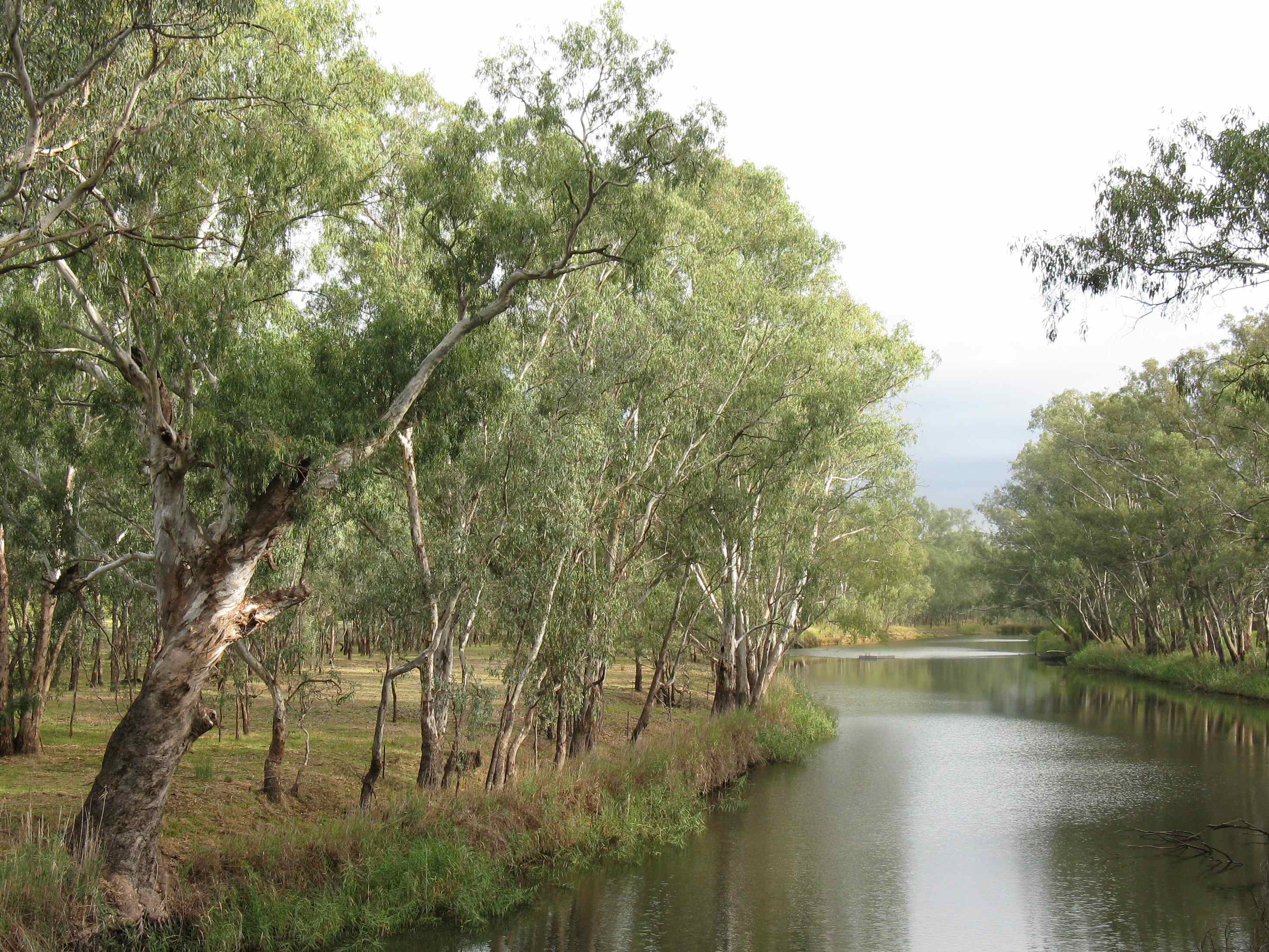
Sunday Creek, near Rutherglen

Australian country creek, lined by eucalypts

In just 250 pages Park paints a rich picture of 1920s life in rural Australia while at the same time developing Hughie and Margaret’s characters. Her characters are all flawed, some more than others, but she draws them with a clear-eyed warmth. She sees them for who they are but she respects them nonetheless. There’s no sentimentality here, but neither is it cynical or bitter. Her themes are universal ones: innocence and experience, familial and romantic love, deception and loyalty, most of it overlaid with that pragmatism that is necessary for survival in a hard place in hard times. As I wrote in this week’s Monday Musings, it’s not surprising that these books still resonate.

Finally, the language is lovely – simple, direct and evocative. Read this from the last few pages of the novel:

In the unkempt garden bloomed freesias and grape hyacinths. The eucalypt twig flushed red, the four creeks overflowed, lambs appeared on the hills, white as mushrooms and as sudden.

‘Them two had better wed quick,’ said Eny ominously, ‘or I won’t answer for Margaret’.

Ha! I think I’ll leave it there – pregnant with possibility …

Ruth Park
Missus
Ringwood: Penguin Books, 1985
247pp.
ISBN: 0140089438

Monday musings on Australian literature: Ruth Park

The muddle-headed wombat, book cover

Wombat book cover (Courtesy: HarperCollins Australia)

For a New Zealander, Ruth Park is a very popular Australian! Not only did she write the much-loved (and studied) Harp in the south trilogy, but she also wrote the hugely popular (in its time) radio serial The muddle-headed wombat, was married to the Australian D’Arcy Niland (now deceased) who wrote The shiralee, and is mother to children’s author-illustrators Deborah and Kilmeny (now deceased) Niland. Ruth Park also won the Miles Franklin Award with her Swords and crowns and rings, and wrote two very popular autobiographies, Fence around the cuckoo and Fishing in the Styx. And this is not all – or even all of the best – that she’s produced in her long career.

Park was born in New Zealand in the early 1920s and first came to Australia in 1940 when she met D’Arcy Niland. She writes that Australian writer Eve Langley*, with whom she had a longstanding friendship, said of Niland:

‘That’s a good face … Do you know what it is saying?’
‘No, what?’
‘It says “Take me or leave me.” I like that.’

So apparently did Park. She returned to Australia in 1942 to work as a journalist, and married Niland. They worked at various jobs in rural New South Wales for some years before Park’s stories gained the attention of the Australian Broadcasting Commission (ABC) resulting in their decision to try to make a living from free-lance writing. They wrote, and wrote, and wrote – anything that would earn money. They wrote, for example, short stories, genre stories (such as romances and westerns), radio talks and radio plays, scripts for radio comics, all the while honing their skills for their more serious writing goals. And they lived during these early years in Sydney’s inner city slum, Surry Hills.

These experiences of living in rural areas and city slums are clearly evident in Swords and crowns and rings (the story of the dwarf Jackie, and his love Cushie Moy) and the Harp in the south trilogy (the story of the Darcy – ha! – family). The thing I love about these books – both of which span the first 4-5 decades of the twentieth century – is the way Park explores gritty issues like poverty, abortion, religious bigotry, unemployment and illness with a psychological and social realism that also encompasses warmth and humour. Her main characters tend to be the quintessential Aussie battlers, but their concerns transcend time and place. It’s not surprising, really, that these works keep being read, re-published, set for study, and adapted for television and film.

Realism though is not the only string to Park’s fictional bow. She wrote in several “genres” for a range of audiences, including fantasy for children. Her Muddle-headed wombat stories ran on the ABC Children’s Session from 1957 to 1971. I have to say that I never have really been one for anthropomorphism, and have read few children’s classics featuring animals (no, not even The wind in the willows) but even I would tune in for the wombat! Park also wrote a children’s time-travel fantasy Playing Beatie Bow, which is taught in schools and has been made into a film.

And yet, for all this, I’m sure she is little known outside Australia … if I am wrong, please let me know!

In the meantime, I will conclude with her description in her first autobiography, Fence around the cuckoo, of her first sighting of Australia as she arrived by boat:

What I saw were endless sandstone cliffs reflecting the sunrise. A chill ran over my skin, my ears buzzed as they had once done when I was about to experience uncertainty about something as yet unknown. The sea fled south, its malachite green changing to beaming blue; the sky was sumptuous with a sun hotter than I had ever known.

This was my first glimpse of Australia Felix, the ancient, indifferent, nonpareil continent that was to become the love of my life.

Ruth Park is not one of those ground-breaking writers who makes you go, wow!, but  she is an excellent story-teller who has an enviable ability to create and develop memorable characters who confront the real “stuff” of life. You could do far worse than read her if you want an introduction to Australian literature. If I haven’t convinced you, read Lisa at ANZLitLovers and Tony of Tony’s Bookworld on Harp in the South, and kimbofo at Reading Matters on her “Top 10 novels about Australia”.

*Park mentions Langley (whom I reviewed early in this blog) several times in Fence around the cuckoo. One concerns Park’s decision to stay with Eve to escape a Peeping Tom uncle but, when she arrived at the windmill in which she believed Eve to be living, she found no Eve but another woman who had heard of Eve but not for some years. “What had happened to that weird girl?”, the new windmill resident wondered. Poor Eve. She was indeed a bit weird and had a rather sad life, but that is another story.

Monday musings on Australian literature: Elizabeth von Arnim

Cover of "All the Dogs of My Life"

All the Dogs of My Life (Courtesy: Vintage Books, via Amazon)

This week’s Monday musings is a bit cheeky since Elizabeth von Arnim (or Mary Annette Beauchamp, her birth-name) was born in Sydney in 1866 but her parents left Australia in 1871 for Switzerland and then England. Von Arnim spent the rest of her life abroad. So, why am I writing about her? She didn’t grow up in Australia and doesn’t write about it either. Well, it’s because I love her writing and thought I could use the Australian birth justification to write about her now rather than later. After all, it’s my blog and I’ll do what I want to!

Before I talk about her writing, it’s worth mentioning that she has a famous relation: her first cousin was Katherine Mansfield (born Katherine Mansfield Beauchamp in 1888). But this isn’t the only name-dropping that can be done. The writer E.M. Forster tutored her children at one stage, she had a three-year relationship with H.G. Wells, and she married (but soon regretted it) Bertrand Russell‘s older brother. In other words, she had an interesting life.

I have read a few of her 20 or so books:

And, I have Vera (1921), which some see as her best, on my TBR pile.

So, why do I like her? Well, not only is her main theme, at least from the books I’ve read to date, women’s lack of power in a male-dominated world but, like Jane Austen, she approaches this with wit and irony and with a clear eye for human failings in general. In other words, she empathised with women’s lot but wasn’t blind to their faults and foibles (as individuals, as women and as representatives of humanity). Just read Mr Skeffington, and you will see what I mean.

To give you a sense of her writing, here are the opening paras of her “memoir” All the dogs of my life:

I would like, to begin with, to say that though parents, husbands, children, lovers and friends are all very well, they are not dogs. In my day and turn having been each of the above – except that instead of husbands I was wives – I know what I am talking about, and am well acquainted with the ups and downs, the daily ups and downs, the sometimes almost hourly ones in the thinskinned, which seem inevitably to accompany human loves.

Dogs are free from these fluctuations. Once they love, they love steadily, unchangingly, till their last breath.

That is how I like to be loved.

Therefore I will write of dogs.

How can you not be captivated by such a wry writer? The book continues in this teasing tone. She insists it is not her autobiography (“as this isn’t an autobiography, I needn’t go into that” is a refrain), but a story of her dogs, and regularly tells us so. But of course, through the story of her dogs, we get a pretty good impression of her life. She may not give us all the details, but we certainly learn about many of her “ups and downs”. This book, though, was not my introduction to von Arnim: that goes to the delightful Elizabeth and her German garden.

In a recent post, Max of Pechorin’s journal wrote that “the line between novel and memoir can be a tricky one”. I immediately thought of Elizabeth and her German garden, which I first read back in the mid 1980s. This is, I believe, a novel (in diary form) but it is also rather close to her life. She did, like the Elizabeth of the book, marry a German (count) and she did call him, as she does in the book, “The Man of wrath”. Furthermore, she did have several children. In fact her second book, The solitary summer, is dedicated “To the man of wrath, with some apologies and much love”.  Anyhow, here is the Elizabeth in the novel:

The people about are persuaded that I am, to put it as kindly as possible, exceedingly eccentric, for the news has travelled that I spend the day out of doors with a book, and that no mortal eye has ever yet seen me sew or cook. But why cook when you can get someone to cook for you?

OK, so she is well-to-do … but still, I love her priorities! Here she is in her (aforementioned) memoir, speaking of herself and one of her dogs:

Fortunately we liked the same things. She only wanted to be outdoors in the sun, and so did I …

And so, while some of the facts may differ (though I don’t know which ones), the basic “truth” of her life – her likes, dislikes and, more to the point, her attitudes and personality, come through both books.

Elizabeth von Arnim was a woman who tackled life head on. Her first husband died, she had affairs and a failed marriage; she lived in England, Europe and the USA; and she met some of the significant thinkers and writers of her time.  But, through it all, she never lost sight of “women’s lot” and the psychological ramifications of their powerlessness. Here she is in Elizabeth and her German garden on migrant workers:

From us they get a mark and a half to two marks a day, and as many potatoes as they can eat. The women get less, not because they work less but because they are women and must not be encouraged.

There is also, in the same book, an extended – and infuriating – discussion between Elizabeth, the Man of Wrath, and two others on German women having the same (lack of) rights as children and idiots. But politics was not her main game, I think. Rather, she was interested in women’s lives, in their wish and need to make self-determined, meaningful lives for themselves. So, I might just finish with another little excerpt from All the dogs of my life:

What on earth did I, of all people, want with a lot of husbands? I asked myself in wonder. Besides, by readily sticking to poached eggs for dinner I was getting abreast of my expenses, and the bills of Saturdays held no more terrors for me.

Ha! What indeed (at least in those inequitable days)!

Monday musings on Australian literature: The gum tree in the Australian imagination

In the next week (I hope), I’ll be reviewing Anna Krien’s Into the forest, her investigation into the longstanding conflict over logging native forests in our southernmost state, Tasmania. In the meantime, though, as I’ve been reading the book, I’ve been thinking again of the role eucalypts play in Australian life and culture – and, voilà, this week’s Monday musings was born.

Salmon Gum (Eucalyptus Tintinnans)

Salmon Gum (probably Eucalyptus Tintinnans) at Nitmiluk National Park

But, where to start? Why not with Waltzing Australia, an American blogger who has travelled extensively in Australia, written a book as a result, and is now writing a blog about her experiences? She complained – nicely of course – in our little comment to-and-fro about her visit to my city that “My whole first day there, I didn’t see any gum trees, and that made it almost seem that I’d somehow left Australia”. If that doesn’t tell you something about gums and Australia nothing will!

My first memorable literary confrontation with gum trees came in the childhood classic, Seven little Australians (1894), which is, perhaps, to Australian girls what Little women is to American. It is about a family of children and includes a tragic death, but here the death is caused not by illness but, yes, by a falling gum:

There was a tree falling, one of the great, gaunt naked things that had been ringbarked long ago. All day it had swayed to and fro, rotten through and through; now there came up across the plain a puff of wind, and down it went before it. …They lifted it off the little bodies, the long silvered trunk with the gum dead and dried in streaks upon it… (from Seven little Australians, by Ethel Turner).

Never fails to move me. As for which of the seven is so tragically killed, my lips are sealed, but let’s just say that, in contrast to Alcott’s book, it is not the meek, mild one.

As backdrop or centre front, gums are rarely absent from our literature, but the next most memorable example for me has to be Murray Bail‘s mysterious and beautiful novel, Eucalyptus, which can be read as a modern fairy story: once upon a time there was a father who promised the hand of his daughter to the man who could name each eucalyptus species that the father had carefully and lovingly planted on his property. The book starts as follows:

We could begin with desertorum, common name hooked mallee … and anyway, the very word, desert-or-um, harks back to a stale version of the national landscape and from there in a more or less straight line onto the national character, all those linings of the soul and the larynx, which have their origin in the bush, so it is said, the poetic virtues (can you believe it?) of being belted about by droughts, bushfires, smelly sheep and so on; and let’s not forget the isolation …

It is these circumstances which have been responsible for all those extremely dry (dun-coloured – can we say that?) hardluck stories which have been told around fires and on the page. All that was once upon a time, interesting for a while, but largely irrelevant here.

If you haven’t gathered a sense of Bail’s tone and intent from this, you might when I tell you that the last species mentioned in the book is Eucalyptus Confluens! It is fairy story, a love story, and a meditation on stories, framed by gums in all their diversity: “A forest is language; accumulated years”.

In Peter Temple‘s Truth, which I reviewed here a month or so ago, a running motif is the eucalypt and oak forest planted by Villani and his father. The trees provide an important point of contact for father and son throughout their lives, and the forest’s survival in the fire at the end signifies the survival too of Villani’s relationship with his father.

Often of course, gums are simply the backdrop – the ever-present part of the landscape that makes that landscape recognisably Australian. They are an important part of the landscape in Chambers’ The vintage and the gleaning … just by being there.

The thing is, though, that gums are so ubiquitous that they can become clichéd. The 1930s was an important and active time in Australian literature – and a time when there was enthusiasm for defining and creating literature that was, in a word, Australian. Australian poet, Rex Ingamells wrote, in 1938, an article titled “Conditional culture” in which he explored “the state of the art” of Australian literature. Not surprisingly, gums pop up several times in the article, often to show failures in the Australian imagination, such as when gums are invoked in nondescript ways. However, he also sees them as a barometer for the maturation of our culture:

Before long, the strange, unorthodox beauty of the Australian gum tree, and many other manifestations of beauty peculiar to this country, will find a sure place in the standards of general culture, which will be one stage nearer universality and so much the richer.

All this makes me wonder whether there is anything similar – any motif that has as much universal recognition – in other national literatures? Anyone?

(Oh, and just in case you are interested, there is a pretty extensive listing of eucalyptus species at Wikipedia.)

Monday musings on Australian literature: In praise of the “taker-outers”

Today’s Monday musings post is not solely about Australian literature but it was inspired by an Australian writer, Kate Jennings, about whom I’ve written a few times in the last month or so. In 2002 she wrote an essay titled “Bone and sinew”, for our now defunct Bulletin magazine, in which she praises short novels (or, novellas*). Tony of Tony’s Bookworld likes novellas, and so do I.

Anyhow, Jennings starts her essay with a statement that F. Scott Fitzgerald apparently made to Thomas Wolfe. He said:

You’re a putter-in, and I’m a taker-outer.

It seems that Wolfe believed a novelist couldn’t be taken seriously until, to use Jennings words, “he or she had produced something that could hold up a three-legged sofa”. Jennings likes Scott Fitzgerald’s description and goes on to say:

Putters-in and takers-out – as good a way as any to classify novelists. Putters-in: writers who pile on atmosphere, adjectives ad arguments, who share with readers all their thoughts, and research, who follow storylines like a dog on the loose. Takers-out: writers who fiddle with each comma and finesse every word, who know exactly what Samuel Johnson meant when he said that when you think you’ve written a particularly fine passage, strike it out.

Jennings admits to her bias – after all, she says, she’s written a couple of short novels herself – but says she does also enjoy  the likes of George Eliot, Christina Stead, Patrick White and Rohinton Mistry. Her point is that their novels are not “superior because of their length” and that short novels should not be perceived as “slight” simply because they are “slim”. There are many short novels with proven staying power (such as The great Gatsby, Joseph Conrad’s The heart of darkness and George Orwell‘s Animal farm) and yet, she says, publishers, recognising that readers and reviewers are prejudiced against shortness, “often ask writers to pad out short novels with stories. The term ‘novella’ is now pejorative: a marketing kiss of death”.

Well, it isn’t for me. Jennings quotes David Mamet on elegance in writing. He asked “how much can one remove and still have the composition be intelligible”. I like this way of describing it. Taker-outers, I believe, trust their readers, viewers and listeners (because this also works for theatre, film and music) to get it. They don’t believe they have to explain every detail. Kate Jennings certainly doesn’t in Snake. She presents a series of little vignettes and expects her readers to “get” the whole picture – and we do, only too vividly!

Kate Grenville with her cello

The versatile Kate Grenville (Courtesy: Peter Ellis via Wikipedia using CC-BY-SA 3.0)

Fortunately for me, many of my favourite Australian writers (hmm … is this a “chicken or the egg” situation?) have written short novels (as well as, for some, longer novels). I have listed some before and so here will add some others, mostly lesser known, that have impressed me:

  • Thea Astley’s Coda
  • Kate Grenville’s Dreamhouse
  • David Malouf’s Ransom
  • Eva Sallis’ The city of sealions
  • Tim Winton’s In the winter dark

Jennings writes “That short novels can be tough, specific and encompassing can come as a surprise to readers. Sinew and bone …”. Really, though, it’s a matter of what you read for. If your preference is to escape into fat and flesh, then short novels may not be for you, but if you like chewier fare, then a good short novel will rarely disappoint.

* I think novellas are generally defined as those under 150 pages, but I tend to include in my personal definition books that are up to 200 pages (or so).

Kate Jennings, Snake

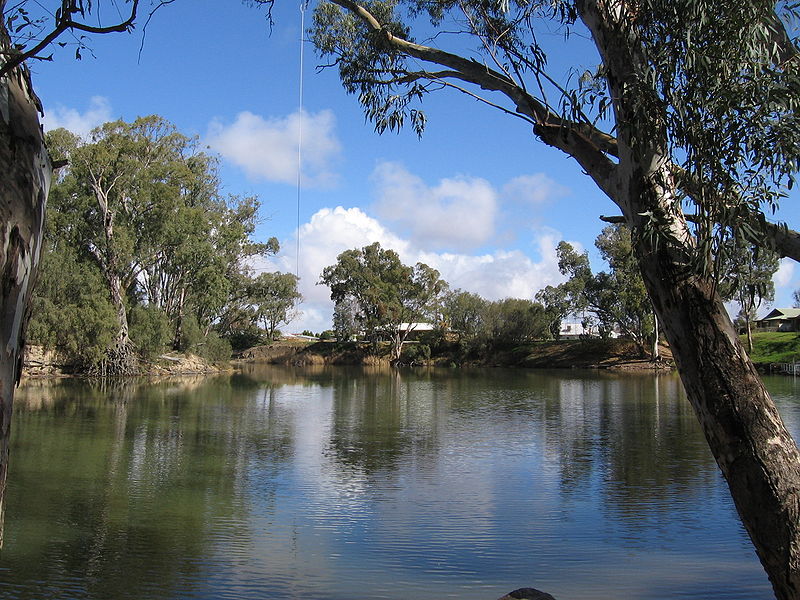
Murrumbidgee River

Murrumbidgee River in the Riverina (Courtesy: Mattinbgn, via Wikipedia, using CC-BY-SA 3.0)

In her “fragmented autobiography”, Trouble, Kate Jennings used excerpts from her first novel, Snake, to convey her childhood experience of growing up on a farm in the Riverina region of New South Wales. She had, she wrote, an “unhappy mother, diffident father”. Snake is the story of such a mother and father. While the novel is not totally “true” to her life in the factual sense, I have read enough novels and memoirs (such as Jill Ker Conway‘s The road from Coorain) about rural Australian life to know that it is “true” to the sort of experience it describes.

The blurbs on the back of my edition include the following descriptions: “a string of prose poems” (Times Literary Supplement) and a “domestic dystopia” (Sydney Morning Herald). The novel – novella in fact – is intriguingly structured. It has 4 parts. Parts 1 and 4 are short bookends, told in second person: the first part is addressed to the father and the last to the mother. The middle two parts are told in the more traditional third person voice and chronicle the life of the family: Rex the ironically named father, Irene the mother, and Girlie and Boy, the children who are caught in the middle. The chapters are short, some being only a paragraph or two long, and present vignettes of the family’s life rather than a simple this-then-that chronology. Dystopian is, unfortunately, an accurate description of their life. As Daphne, Irene’s sister, guesses on the wedding day,

Rex was a nice enough chap but about as interesting as a month of rainy Sundays. Irene will be bored with him before they arrive at the Blue Mountains guesthouse for their honeymoon.

While we never hear from Daphne again, she was not wrong. Rex is a “good man”, “decent”, a farmer of simple needs, while Irene, as her father realises, “dances to a tune no one else hears”. Not a likely recipe for success.

I thoroughly enjoyed this novel. Despite its unusual mix of voice and rather episodic form, it has a strong narrative that drives us on to its inevitable (but no spoiler here) conclusion. The snake motif runs through the book. Snakes are a fact of rural Australian life and so are a natural, real presence in the book, but their symbolic allusion to temptation, deceit and danger lurks behind every reference. Early in the novel, we are told of Irene’s youthful romantic tendencies – her love of

… smoky-voiced singers and innuendo-laced lyrics. Tommy Dorsey and Benny Goodman, Frank Sinatra and Peggy Lee, they were the snake charmers and Irene the snake.

Later, Girlie looks at snakes in a book on Australian fauna: they are “fanged, flickering, unblinking”.

Kate Jennings is a poet – as well as novelist and essayist – and it shows. The language is accessible but full of imagery. This is particularly apparent in the chapter titles, most of which are obvious in meaning, though some are more cryptic: “Home is the first and final poem”, “Send my roots rain” and “My mother has grown to an enormous height”. They are fun to think about as you read. There are some beautifully apposite descriptions. Here for example is Rex experiencing misgivings about his new wife:

The sight of her caused his nature – practical, honourable – to assert itself … What was done was done. Without being conscious of it, he coughed importantly – I am a man, I have a wife – and squirmed inside the jacket of his uniform until it sat better on his shoulders.

And here is Girlie reading:

Girlie read books like a caterpillar eating its way through the leaves on a tree.

Their town is, ironically, called Progress. However, very little “progress” occurs in the book. Rex struggles to keep the farm going in the face of mice and locust plagues, hail and dust storms. Irene tries to make a life that suits her romantic, imaginative spirit – she creates a garden, seeks friendships with interesting people, looks for work – but in the end nothing works:

Rex and Irene had given up arguing. He no longer bothered to tell her that he wasn’t asking much – harvest his crops, care for his animals, share it all with a good woman, tra-la – and Irene didn’t reply that far from not asking much, he was asking everything.

Such is the life of a mismatched couple. We’ve read of such couples before, and we will again, but for a clear-eyed, finely balanced, while also touching, portrayal, this one by Kate Jennings is hard to beat.

Kate Jennings
Snake
Sydney: Picador, 2003 (first pub. 1996)
153pp.
ISBN: 9780330364003

Another award for Nam Le

I read Nam Le‘s collection of short stories The boat a few months before I started my blog. The collection has been well reviewed nationally and internationally, and has won quite a few awards. I have just read that he has now been awarded another: The Kathleen Mitchell Award which is a biennial literary prize for writers under 30 years old (as Nam Le was when the book was published). This award has been previously won by Sonya Hartnett who has gone on to write several highly acclaimed novels – and been shortlisted for the Miles Franklin – and Markus Zusak.

I loved The boat. It’s an unusually diverse collection. The language is highly differentiated from story to story to suit the particular characters and setting of each; the narrative voice varies from 1st to 3rd person, and from male to female points of view; and there’s an asonishing variety in his protagonists and settings. The subjects range from an 8 year old orphan girl in Hiroshima to a middle-aged painter in New York, from a 14 year old hitman in Colombia to a 35-year old American woman visiting Iran. Despite this diversity, though, there is a strong underlying theme, that of survival. This is probably not surprising in a writer who came to Australia from Vietnam as a boat refugee (albeit when not much more than a baby).

As it’s been a while since I read the book I’m not going to review it now but, given my particular interest in the intersection between fact and fiction, I’ll just mention the autobiographical aspect of the first story, “Love and honour and pity and pride and compassion and sacrifice”. That story is so close to Nam Le’s own life that it is tempting to read it as his life. A character says to the fictional Nam that “instead [of writing immigrant stories], you choose to write about lesbian vampires , and Colombian assassins, and Hiroshima orphans – and New York painters with haemorrhoids”. One reviewer, Hari Kunzru in The Scotsman, wrote that “Sure enough, The Boat, contains all these stories, minus the lesbian vampires, who presumably got lost in the edit”. My question is: Does he know this for a fact? Did the real Nam Le write such a story or is it only the fictional one who did? Is this a case of life getting mixed up with art? In an interview on the ABC’s Bookshow Nam Le admits to a story about lesbians but says “the vampires I needed to leave some interpretive distance, I reckon”. I like to think of it as Nam Le’s little joke – but I may be wrong!

Oh, and did I mention that Nam Le attended the Iowa Writers’ Workshop? Doesn’t seem to have done him any harm!

Monday musings on Australian literature: Kookaburras at the coast

Kookaburra

Kookaburra (Courtesy: Noodle Snacks via Wikipedia, using CC-BY-SA 3.0)

With daughter and dog left to guard the fort, Mr Gums and I are holidaying on the northern NSW coast with Ma and Pa Gums, and so this week’s musings will be short and more relaxed. In fact, I am just going to write about one thing: Kookaburras.

I was pondering what this week’s Musings should be, until I awoke on our first morning here to the wonderful sound of kookaburras. My topic was born, because they reminded me that there is another famous Australian song, perhaps almost as well-known as “Waltzing Matilda“:

Kookaburra sits in the old gum tree
Merry, merry king of the bush, is he.
Laugh, kookaburra, laugh, kookaburra,
Gay your life must be.

And they do laugh, even if New Zealand-born Australian poet Douglas Stewart didn’t think so. He described their sound as “a triumph of trumpets” (from “Kookaburras“). Their nickname, however, is the Laughing Kookaburra* or Laughing Jackass, though you don’t hear the latter name used so much these days. I’m not sure whether that’s because we’ve become more boring or more reverent! Kookaburras, carnivorous birds of the kingfisher family, are pretty ubiquitous in eastern Australia. We see them regularly on street lamp posts in our city, but we don’t hear them often from our house and so it is always a treat to hear them when we are out and about in the country – even if it’s at 4.30am on the first day of our holiday!

Anyhow, back to the song. It was written by a teacher, Marion Sinclair (1895-1988), for a Girl Guides Association of Victoria competition in 1934 … and the rest, as they say, is history! That said, I’ll conduct a little straw poll: are there any non-Australian readers here who have not heard or sung this song?

Kookaburras, of course, often feature in Australian writing. John O’Brien, whose “Said Hanrahan” I mentioned in last week’s musings, also wrote a poem called “The kookaburras”. While it’s a fairly sentimental poem, I can’t resist these lines:

Comes a buoyant peal of laughter from the tall, white, slender timber,
Rugged mirth that floods the bushland with the joy of brotherhood.

And that seems as good a place as any to end this week’s brief holiday musings.

*This is the more common kookaburra. There is another, the slightly smaller Blue-winged Kookaburra, but its call is also described as a “laugh”.