Monday musings on Australian literature: Mountain murmurings

Mountain? Because this week’s Monday musings was inspired by my recent sojourn in the mountains. Murmurings? Because it will be more pictorial than textual. And what does all this to have with Australian literature? Two things, primarily:

  • My definition of “Australian literature” for this blog series is a broad one – it is intended to not only be about Australian literature but also about the things that our literature draws on, such as culture and landscape. This post is about a very specific part of Australian landscape.
  • In my last post, on Barbara Hanrahan, I referred to her looking in vain for “the sunburned land” she learned was her home. My aim in this post is to support her, to show that in fact much* of Australia, albeit a dry continent, is not sunburned.

Here’s a little context. The second – and most well-known – verse of Dorothea McKellar‘s famous (in Australia) poem “My country” starts with “I love a sunburnt country“. This is the image which Hanrahan rails against in her novel, and it is probably still the prevailing image Australians have (or like to have) of our country. And yet, there are other images – real ones as you’ll see in this post, and poetic ones, like the following:

By channels of coolness the echoes are calling,
And down the dim gorges I hear the creek falling
(The opening lines of  “Bell-birds”, by Henry Kendall)

There are, in other words, many ways of seeing Australia: not all of them are “sunburnt”, and neither are they all romantic or nostalgic, but those are not for today’s just-back-from-holiday mood.

So, to cut to the chase, here is a small selection of images from the Snowy Mountains (in Kosciuszko National Park). Enjoy, because next week we’ll be back to more serious stuff!

Through the stringy barks and saplings, on the rough and broken ground,
Down the hillside at a racing pace he went
(From “The man from Snowy River“, by Banjo Paterson)

Snowy Mountains, near Thredbo
In the Snowy Mountains, taken from the Thredbo riverside walk
Near the top of Dead Horse Gap walk, on the Main Range

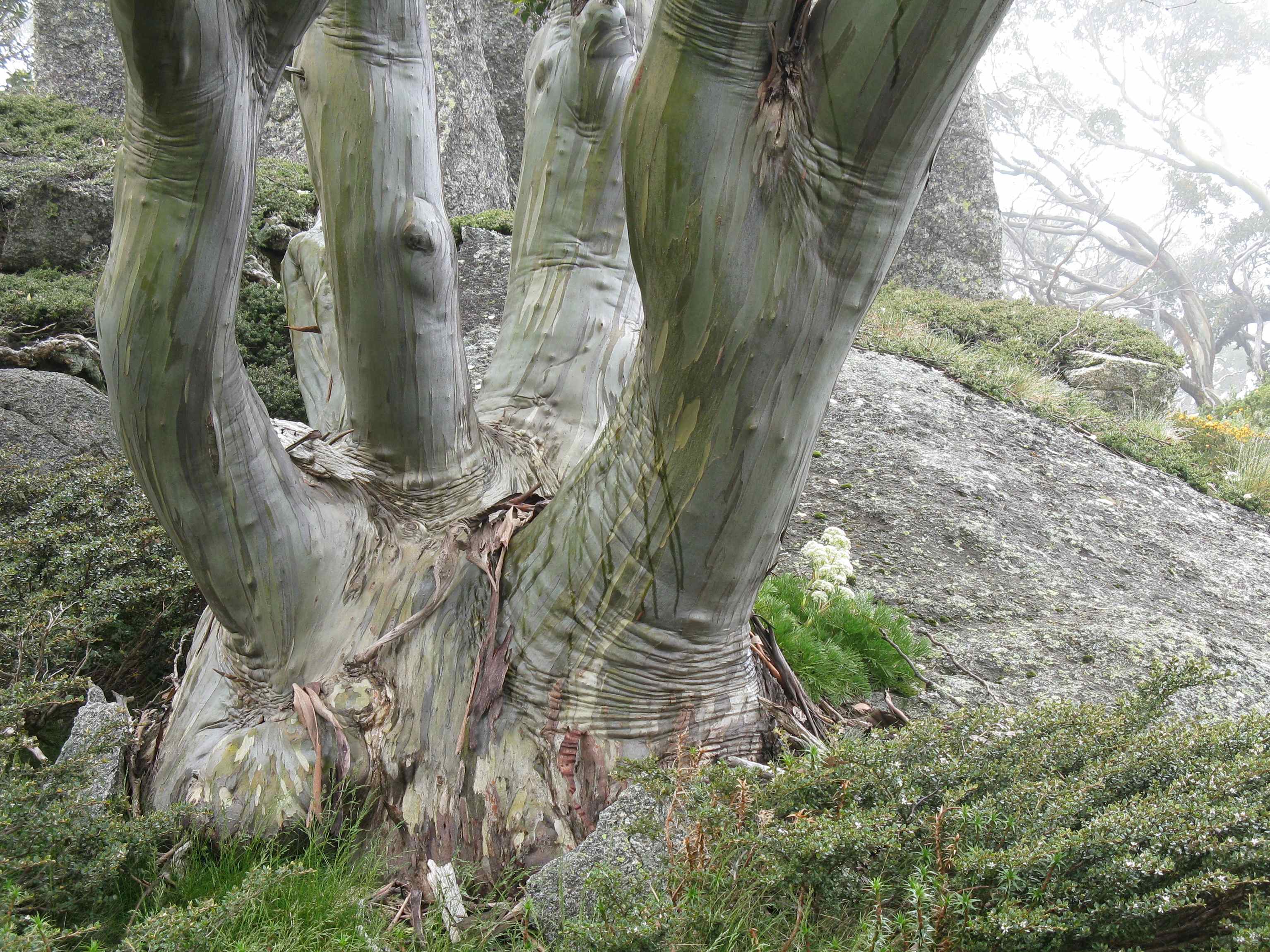
It's mid-summer, but not so sunburnt here

Eucalyptus Stellulata or Black Sallee

Weird but wonderful, a gum just at the tree-line

Snow Daisy close-up

Snow Daisy and friends

Gunn's Willow-herb

Gunn's Willow-herb may not be on the tip of every Australian writer's tongue but how pretty it is

Short-beaked echidna

You never know who you might meet on a bushwalk - such as a Short-beaked echidna nosing around for food

And finally, one bit of Australiana that all Aussies know: (Eastern grey) kangaroos, in the bush.

* Defined as the parts of Australia where the majority live. Much of the Australian continent is indeed pretty sunburnt!

Barbara Hanrahan, The scent of eucalyptus

Writer-artist Barbara Hanrahan was born half a generation before I was and in the city of Adelaide not a country town in Queensland, but the childhood she depicts in her first novel, The scent of eucalyptus, could almost have been mine. Almost, but not quite, as I was brought up in a standard nuclear family and she by three women – her mother, grandmother, and Aunt Reece (who had Downs Syndrome) – resulting in a somewhat different experience of home-life even if not of wider society.

And there’s another more crucial difference. The half generation time lag accounts for a major change appearing on the horizon – in the education of women. Hanrahan, like my mother who was born nearly half a generation earlier, suffered from the reduced opportunities and low expectations that were women’s lot back then. Both were expected to undertake commercial training at high school – rather than join the academic streams they desired – in order to fulfil “the plan” as Hanrahan calls it:

“( … Our expectations were swallowed by shorthand symbols, hammered by typewriter keys, imprisoned by the columns of a neatly-ruled ledger whose credit column never balances its debit.)

I was part of a school that was a factory, pumping forth each year, from the swollen Commercial class, the girls of fifteen who would go to work as typists and clerks. At eighteen they would be engaged, at twenty, married, at thirty – old. These were the girls I stood with under the lacquered fig trees in the Grade Seven photograph. (They are at their prime at the age of twelve … )

How sad that is. I loved this book from beginning to end. The writing is poetic – not the sort of poetry that is full of allusions and ambiguities in which you have to work hard to locate meaning, but the sort that paints word pictures of both the physical and emotional landscape. An example is her description of a visit to relations in the hills:

“I remember rising while it was still dark to visit them; … watching the sky turn pale and frayed with light; seeing houses jump forward from the darkness; hearing the cold voices of first roosters, the kookaburra’s ruffled peal.”

The writing is rhythmic. There are few wasted words, there is effective use of repetition, there is stream of consciousness, and she uses punctuation precisely to control flow and meaning.

Hanrahan tells her story more or less chronologically, with thematic chapters interspersed at appropriate points and occasional asides foreshadowing her future. The novel spans her life – this is an autobiographical novel – from birth to puberty. It’s not strong on plot, but there is a powerful story here about the development of self. For example, in chapter 2, we see the origins of the artist she was to become: “As a child and ever after, the minute, hidden facets of things intrigued me”.

The first few chapters introduce us to the significant people – the “important” three – in her life. Here she is on her mother:

“My mother was a lark whose tongue was cut; a gull with clipped wings. She learned to expect nothing that she did not strive for … My mother trod a familiar path; hedged by as many briers as Sleeping Beauty’s ever was”.

Such economy of expression that conveys so much. She writes similarly of her grandmother and aunt, and we learn how “the three” love and support each other but also harbour disappointments. These, though, our narrator is barely aware of:

“(I was deceived by familiarity. I didn’t see, couldn’t see, forgot to reason.)”

And so the novel progresses through infancy, kindergarten, and primary school until we reach the point at which I began this post. She paints perfect pictures of school days, of special holidays, of childhood friendships, of fears and hobbies, of a flirtation with religion, and of a sense throughout, but becoming stronger as she grows older, of being “different”:

“And as I grew older I became adept at leaping quicksilver from one of my selves to the other. And as I grew older the split grew deeper, yet I forgot it was there.”

This is a delicious novel – the language is almost mesmeric, capturing a world that has passed and yet is still part of our cultural landscape. I will finish with one final excerpt which delighted me. She, like most Australians, grew up with the image of outback Australia, our “sunburnt country”, firmly entrenched in her mind, but she, also like most Australians, was “a city child” and so she asks:

“But where were the hills of the history book, stitched with the pathways of Burke and Sturt and Leichhardt?- the hills of the sun-burned earth and budgerigar grass, and azure skies and fiery mountains we sang about at school before the flag spangled with all the stars of the Southern Cross I was never sure of seeing? Where were the old dark people I did not link with the lost couples on suitcases at the railway station? Where were the crocodiles and brolgas, the billabongs and snakes? Where were the flowers that wilted in blistered clay, the rusty waves of Spinifex that looped the cliff?

… I looked about me for the sunburned land. In vain.”

This is not the end of the book … but is as fine a place as any to end my review because it, as much as anything, conveys the paradox of her childhood – the knowing one thing but the seeing of/the being something else. This is a book for all Australians to read … and for anyone else who is interested in a thoughtful, lyrical rendition of a childhood.

Barbara Hanrahan
The scent of eucalyptus
St Lucia: University of Queensland Press, 1973
188pp.
ISBN: 0702225169

Monday musings on Australian literature: The King’s Speech (Movie)

His Majesty King George VI of the United Kingdom.

King George VI, c. 1942 (Presumed Public Domain: From the United Nations Information Office, via Wikipedia)

I wasn’t going to review The King’s Speech, the current biopic about how Lionel Logue helped cure George VI‘s stuttering, because I mostly review Australian films. But, I do like a biopic and this film does have some Australian connections. These connections may not be particularly literary but, what the heck, at least one of the connections does relate to language … and so I’ve decided to make the review my first Monday musings of 2011.

Like most who’ve seen this film, I was engaged by it and would happily see it again to further explore its subtleties and nuances. Of course it helps that it stars Colin Firth. Anyone who has played Mr Darcy as well as he did is a friend of mine! And, it stars other actors from that wonderful 1995 miniseries of Pride and prejudice: Jennifer Ehle (Lizzie Bennet then, Myrtle Logue now) and David Bamber (Mr Collins then, a theatrical producer now). In addition, its actors include some Australians, including Geoffrey Rush as Lionel Logue and Guy Pearce as David, the abdicating King Edward VIII. And, let’s not forget the often underappreciated Helena Bonham Carter who plays George VI’s wife (later to become the much beloved Queen Mum). (Did you know that Helena’s distant cousin, Crispin, played Mr Bingley in the Firth-Ehle Pride and prejudice? Oh, the tangled webs!)

Now, I’m no expert in the history of George VI. I knew he was a shy man who did not want the monarchy; I knew he was a very popular monarch; and I was vaguely aware that he had stammered. I knew, however, absolutely nothing about the role an Australian played in the management (cure?) of this stammer. Consequently, I’m not going to comment, as I believe some others have done, on the veracity of the film. It is a biopic after all. Rather, I’ll just mention a couple of issues.

One relates to the fact that it was an Australian who helped George (Bertie to his family). At the time, the 1920s-1940s, Australians were very much seen as the “colonials” and not, really, as people who could teach the Brits anything. In the film this is portrayed pretty clearly through the Archbishop of Canterbury’s (played by another British acting great, Derek Jacobi) disdain for Logue and his lack of formal credentials, despite the successes he had already achieved with Bertie. I was tickled by the subtle way the film conveyed this little part of the history between our two nations. The tension between the two men is not subtle, but this particular subtext is.

The other issue has nothing to do with Australia, but is related to the film’s very effective sound design. First though, let’s talk Colin Firth. Can you imagine being an actor playing someone who can’t speak? What a challenge, but Firth pulls it off. The film is not afraid to let time drag when Bertie/George tries to speak. It lets the clicks and stutters reverberate as he struggles to get a word out . It’s excruciating – and is sustained just to the point at which we feel his pain and that of those around him but are not irritated by it. The score underpinning the movie is pretty spot on too – lovely original music combined with well-known music (particularly by Mozart and Beethoven). But, here’s my issue. I was intrigued by the use of a favourite piece of mine, the first movement of Beethoven’s 7th Symphony, to background the King’s first war-time speech. Beethoven? For a speech about a second war with the Germans? That was to me weird … Was it intended to be ironic in some way? The King’s triumphant speech set against the reality of what was to come?

Whatever, it’s an engaging film which not only tells a specific story about English royalty, but is also about universals: perseverance and hard work (the King’s in overcoming his speech problem), supporting, encouraging and standing by the one you love (his wife), and the value of experience and ingenuity over paper qualifications (Logue).

If you haven’t seen it yet, do … and tell them an Australian sent you!

Kate Holden, The Romantic: Italian nights and days

kate Holden, The Romantic book cover
Book cover (Courtesy: Text Publishing)

The romantic, by Kate Holden, is hard to categorise. In an interview with Richard Aedy on ABC Radio’s Life Matters she comments that, despite the success of her memoir In my skin, she was “a little bit uncomfortable with memoir” because it felt a bit “narcissistic”. And so this, her second book, she intended writing as a novel, albeit based heavily on her experiences in Rome. However, as she tells Aedy, her editor told her that most of what she’d written was not fiction, but “life” and so she decided to write it as memoir. So why my opening statement? Well, it’s because this memoir is told in third person.

Who, then, is Kate Holden? Today she is a professional writer living in Melbourne, but she was not always so. In my skin, which I read before my blogging days, is an astonishingly honest chronicle of her twenties when she was a heroin addict and sex worker. The romantic is a sequel of sorts. It tells the story of her year or so in Rome and Naples where she went to further her recovery, to, as she says, find herself. She tells Aedy that she decided on third person to enable her to maintain “critical distance from my own former self” (since the events in the book occurred around 2003) and to give the reader the prerogative of that distance too. Which, I think, is not a bad thing – as this is one very explicit book about, as she says, “the permutations of love, sex and romance”. Sex, though, predominates this threesome, if you get my drift.

Okay, that might be a cheap shot, because Holden is, again, fearlessly honest. The book, told chronologically, is divided into 7 parts, most of them named for a sexual/romantic partner, and some of these partners overlap a little. Throughout the book she alludes to poets – particularly the romantic poets, Byron and Shelley. In fact, each part of the book is introduced with a quote from a poet. In her interview with Aedy, she said that she wanted to be “honest, sincere and authentic like the Romantic poets”. Well, she certainly seems to be that, even if much of what she is being honest about is not exactly “romantic” – unless, that is, we define ongoing self-questioning as “Romantic”.

And here, in a way, is the rub. Holden is not only a fearless writer, she is also a good one. She knows how to string a sentence together, she describes character and evokes place well, and she expresses emotion clearly. But, I’m not sure what the point is for the reader. There is a lot of detail here about relationships – and sex in particular – that is not particularly positive for her. Around the middle of the book she writes:

She wishes to be free, virtuous, brave, joyous. The men around her say she is needy, neurotic, manipulative, disingenuous, hurtful, promiscuous. She knows she is deceptive, duplicitous and cynical. Somewhere in all of this is a portrait. She thinks this; and buries her face in the pillow.

This sort of self-analysis is the flavour of the book so that, in the end, it feels more like something that is therapeutic for her than enlightening for the reader.

The seventh part of the book – a short one named Kate – is introduced by the following lines from Byron:

I am not now
That which I have been.

I certainly hope so because the Kate in this book has, by the end, still not quite found herself. However, her interview with Richard Aedy in 2010 reveals a composed, confident and articulate woman. I look forward to seeing what this woman produces next.

Kate Holden
The romantic: Italian nights and days
Melbourne: Text Publishing, 2010
240pp.
ISBN: 9781921656743

(Review copy courtesy Text Publishing)

Katharine Susannah Prichard, The pioneers


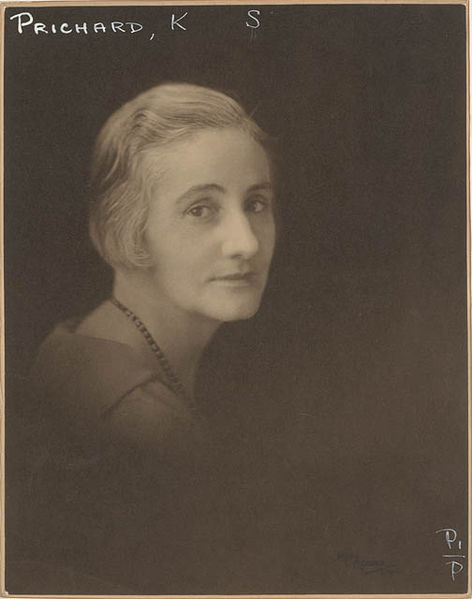
Katharine Susannah Prichard

Prichard, 1927/8, by May Moore (Courtesy: State Library of NSW, via Wikimedia Commons)

Katharine Susannah Prichard (1883-1969) is probably not as well-known in Australia, let alone internationally, as she should be. She was born in Fiji, but grew up in Tasmania and Melbourne, travelled overseas and in other parts of Australia, before settling in Western Australia in 1919. She was a founding member of the Australian Communist Party (1920) and also of the Western Australian branch of the Fellowship of Australian Writers. Politics and literature, then, were the twin passions of her life. Her most famous novel and the only one I’d read until now, Coonardoo (1929), was remarkable in its time for its exploration of the relationship between white men and black women.

I don’t usually commence a review with a biography, but it felt appropriate in this case – partly because she is so little known despite her significance and partly because her politics were an intrinsic part of her literature. In the foreword to my new edition of the book, her granddaughter describes Prichard’s values as:

a huge love of and respect for the bush; the importance of living your life with integrity; of caring and fighting for the underdog; of holding strong principles and remaining true to them; and of embracing life with passion.

These values are evident in The pioneers, her first novel which won the Hodder and Stoughton All Empire Literature Prize for Australasia in 1915. She went on to write over thirty works, including novels, plays, short stories and poetry. But, perhaps that’s enough prelude for now – on with the book.

It’s a simple tale really, plot-wise. It starts with a couple, Donald and Mary Cameron, arriving by wagon in an unsettled area of Gippsland (in eastern Victoria) in the early-mid nineteenth century. They clear the land, build a home and establish a successful farm. Very early in the story, while Donald is away getting supplies, Mary is “visited” by two desperate men, Dan Farrell and Steve. A tricky situation for a woman on her own but she manages to win them over and they leave her, unharmed. The novel tells the story of these people – and the others who move into the district – over the next two decades or so, as they work to make lives for themselves, some honestly and some not so.  There are archetypal characters here – the hard-working, tough, taciturn farmer; the loving, but wise and stoical wife; the loyal but unappreciated-by-his-father son; and more. There are escaped convicts, cattle rustlers, and a thoroughly bad man.

This may all make it sound rather typical and a bit melodramatic. And, in fact, it does have its melodrama. But the book is more than this. Its overriding style, or approach, is social realism, as Prichard explores the hopes and wishes of a new country struggling to come to terms with its origins and forge a more positive future. Her style is not particularly innovative and, while the combination of social realism and melodrama is appropriate for a novel set in the nineteenth century, the melodrama was a little discordant to my modern ears.  Take this, for example:

It was as if that encounter in the valley of shadows had brushed all misunderstandings from the love that was like the sun between them. Deirdre had wrestled with death for possession of him.

A contemporary review suggested that the romance – which drives most of the melodrama – was included primarily to attract readers who may not be interested in the history. This could very well be so.

Despite not being particularly innovative, Prichard’s writing is sure and shows that while this was her first novel she’d been honing her craft for some time. I particularly loved her language. It is gorgeously descriptive. She perfectly captures the paradox of a place that is both beautiful and harsh – and effectively conveys the physical and emotional impact of the landscape:

The bright hours were rent by the momentary screeching and chatter of parroquets, as they flew, spreading the red, green and yellow of their breasts against the blue sky. At sunset and dawn there were merry melodious flutings, long, sweet, mating-calls, carollings and bursts of husky, gnomish laughter. Yet the silence remained, hovering and swallowing insatiably every sound.

The plot, as I’ve suggested, is a little melodramatic and fairly predictable but it’s a well-told tale, nonetheless, of good forces fighting bad, of compromises that are sometimes made, and of bad judgement calls that come back to bite you. The characters, while tending to archetype, are nonetheless real so that you believe them and their various plights. There is, I think, something reminiscent of Dickens here.

The themes reflect very much the values identified by her granddaughter in the foreword. The main characters are imbued with a strong sense of principles that they try to live by. When Mary meets the convicts early in the novel, she says:

But if you will believe the truth it is this: My heart is with you and all like you.

In her twenties, Prichard apparently met the Austrian sociologist, Rudolph Broda, who introduced her to the ideas of socialism and suggested that, as a new country, Australia was leading the world in social legislation. This idea is reflected in the novel. Early on, Mary says to Donald:

It’s a new country and a new people we’re making, they said at home, and I’m realising what they meant now.

Little did she know, then, what this “making” would really involve but defining “a new country” is clearly the goal Prichard set for herself. The novel concludes by suggesting that the new generation will

be a pioneer of paths that will make the world a better, happier place for everyone to live in.

Corny? Or aspirational? Take your pick … but whichever way you see it, this novel makes a significant contribution to the development of the Australian psyche, to our transition from colonial convict-fearing past to an independent self-realised future. I am glad it has been re-released and hope that more people read it.

Katharine Susannah Prichard
The pioneers
Singapore: Monsoon Books, 2010 [first ed. 1915]
272pp.
ISBN: 9789810848804

NOTE: An ebook version of the novel is available at Project Gutenberg.

Garry Disher, Wyatt (Guest post)

Some time ago I found in my mailbox a bundle of books from my lovely contacts at Text Publishing. Unfortunately, there were more books in the bundle than I could read at the time, and a couple were in genres I don’t generally read (though that’s not to say I wouldn’t read them if I had the time). So, like Lisa at ANZLitLovers and as I did for my last LibraryThing Early Reviewers copy of That Paris Year, I decided to use the Guest Post idea. For the LibraryThing guest post, the reviewer was my daughter, Hannah of Wayfaring Chocolate. This time, it’s my son, Evan. The book is Garry Disher‘s latest crime novel Wyatt, which won the 2010 Ned Kelly Award for Best Crime Fiction.

Evan read the novel while he was with us for Christmas. He has since returned to Melbourne (his home and the setting of the novel) and, while busy preparing for his flight to the USA tomorrow, made the time to please his mum by writing his review. I must say, it looks like the sort of crime novel I could enjoy. Thanks Evan …

Evan’s review of Wyatt, by Garry Disher

Gary Disher, Wyatt

Wyatt (Courtesy: Text Publishing)

Less a cops and robbers story than a robbers and robbers story, Wyatt is a new crime novel from the Australian author, Garry Disher. We are introduced to the protagonist and title character, Wyatt, as he is attempting to rob an extortionist. As one would expect in a good crime novel, it doesn’t go according to plan. Disher’s prose is terse and to the point, much like Wyatt himself, and the narrative races along, following a jewel heist and its aftermath. Set in Melbourne, which suddenly becomes dirtier and more sinister under Disher’s pen, Wyatt features many of the trappings of classic noir-ish, hard-boiled novels. This world is populated by seductive femme fatales, tough, if old-fashioned, men, and it will get the better of you if you don’t have your guard up. Wyatt is an aging, professional criminal, who is treated with reverence as a master within his field. He is cold, intelligent and calculating, yet sympathetic.

Surrounded by a host of characters, all dangerous in their own ways, Wyatt is pitted, almost indirectly over the course of the novel, against a French criminal much like him, and much his equal. However, to discuss more of the plot would be to spoil most of the fun. The pace rarely slows down, and the writing is taut and spare. The characters are archetypes, almost larger than life, but not overwritten. Disher has an invigorating, simple style. The violence, when it erupts, is abrupt and surprising and, without a hint of an overdrawn epilogue, the ending simply ends.  Wyatt is apparently the seventh book in a series featuring the title character. Despite having never read any of the others, and having a perhaps irrational bias against series in general, I am now eager to check out the others.

Garry Disher
Wyatt
Melbourne: Text Publishing, 2010
274pp.
ISBN:  9781921656811

(Review copy courtesy Text Publishing)

Monday musings on Australian literature: My top Australian reads of 2010

Eva Hornung, Dogboy

Dog Boy: Winner of 2010 Prime Minister's Literary Award (Courtesy: Text Publishing)

In last week’s Monday musings I said that this series would resume in the New Year. But then the thought occurred to me: this is an Australian focused litblog, so why don’t I divide my top reads of the year into those by Australian writers, and the rest? That decision made, it seemed logical to devote the last Monday musings of the year to my top Australian reads, so – surprise – here I am again.

I never read as many books in a year as I would like to, but this year I did manage to read a range of Australian writers, including some older works I’ve been wanting to get to. I hope to achieve similarly in 2011. You never know, 2011 might be the year I finally read Christina Stead.

I’ll list the books in alphabetical order under categories (some being very short categories as we are talking top reads here).

Top recent (post 2000) fiction:

  • Eva Hornung‘s Dog Boy: Won this year’s Prime Minister’s Literary Award. It’s a visceral read which contemplates the nature of humanity.
  • MJ Hyland‘s This is how. I’m not really sure that we can claim Hyland as Australian. She wasn’t born here, and she no longer lives here. She did however do some secondary and tertiary education here. This is the sort of writing I love. The writing is tight, the tone is beautifully controlled, and the central character is so complex that even by the end you are not completely sure who you have before you.
  • David Malouf‘s Ransom: Although I had some reservations about this book in terms of its point, I did love it nonetheless. Does that make sense? Malouf’s writing is beautiful, and I love his humanity. I guess that should be enough, eh?

Two other recent Australian novels I enjoyed this year were Alex Miller‘s Lovesong and Peter Carey‘s Parrot and Olivier in America.

Top older (pre 2000) fiction:

  • Thea Astley‘s: The multiple effects of rainshadow. A re-read. I love Astley’s “imagistic” writing. This is a multiple point-of-view novel set in early 20th century northern Queensland, and deals with the emotional and social consequences of living in a difficult place at a difficult time.
  • Martin Boyd‘s A difficult young man. Part of his semi-autobiographical trilogy, this book explores the challenges of living an artistic life, of being a different person in an extraordinary family in an ordinary world. Martin Boyd is a member of one of Australia’s leading creative families.
  • Katharine Susannah Prichard‘s The pioneers. Won the Hodder and Stoughton All Empire Literature Prize for Australasia in 1915. It’s an historical novel exploring pioneer Australia, particularly in relation to our convict heritage, but I’ll say more in the coming review.

Three other older Australian novels I particularly enjoyed this year were Kate JenningsSnake, Hanz Bergner’s Between sky and sea, and Ruth Park’s Missus.

Top short stories

Regular readers of this blog know that I enjoy short stories and try to include them in my regular reading schedule. Mostly, I read one-offs, but I also enjoy collections. I only read one collection of Australian short stories this year, but it was excellent and so easily qualifies for a top read:

  • Gretchen Shirm’s Having cried wolf. Shirm is a new Australian voice. I was impressed by the tight, controlled writing she demonstrated in this set of connected stories. I hope we see more of her.

Top non-fiction

As this is primarily a litblog, I don’t read a lot of non-fiction, but there were two standouts this year:

  • Kate Jennings’ Trouble: The evolution of a radical. This is the memoir you write when you are not writing a memoir. Jennings tells her story through thematically grouped writings from her past, each group introduced by current commentary. I loved her honesty and provocativeness.
  • Anna Krien’s Into the woods. A history – exposé really – of Tasmania’s logging history. Krien may not have been as objective as she set out to be, but the book is an insightful read nonetheless.

I am reading another Australian book at present, but I don’t expect it to quite qualify for this list – and, anyhow, this is the last Monday of the year so there you have it…

I’d love to know what your favourite Australian reads of the year were – or, if you didn’t read any, whether my list above has inspired you to read any next year!

Literary encounters, Australian style

I’ve been remiss. I could have solved some of your Christmas shopping challenges by telling you about two books which would be perfect gifts for readers: Shane Maloney and Chris Grosz’s Australian encounters, and Susannah Fullerton’s Brief encounters. Both have “encounters” in the title, but they use the word in slightly different ways, as you’ll see when you read on …

Australian encounters book cover

Book cover (Image: Courtesy Black Inc)

Maloney and Grosz’s book is the more light-hearted of the two, and just right for the Christmas season. Every encounter involves at least one Australian, but not all are literary. Some are a little tongue-in-cheek and a couple, even, are not between people. Take for example, Esperance and Skylab. (Australians will know what this is about!). Each encounter is given a page, with text by Australian novelist Shane Maloney, and a cartoon illustration by book illustrator Chris Grosz. I’ll choose just three* to share with you:

  • Australian novelist George Johnston and Canadian singer-songwriter Leonard Cohen (1960). Cohen (25 at the time) met Johnston (48) and his writer wife, Charmian Clift, in Greece. Johnston and Clift let Cohen stay in their spare room. Cohen says “They drank more than other people, they wrote more … they helped a great deal. They were an inspiration”.
  • Banjo Paterson and Rudyard Kipling (both of whom have been featured in this blog) (1900).  Paterson (36) sat next to Kipling at a dinner in South Africa, where Paterson was visiting to report on the Boer War. They apparently discussed politics and war, and must have hit it off because they met up again a year later in Kipling’s home in Sussex.
  • Robyn Davidson and Bruce Chatwin (1980). This was an organised encounter, and occurred in London. Chatwin had heard of Davidson (30) and her camel journey across the Australian desert. You can imagine what these two remote-area travel writers talked about, can’t you? Nomads was one topic, but politics was not. Chatwin apparently found politics boring and preferred to talk about (and mimic) people. Despite this, Davidson gave him contacts in Alice Springs which he would later use for his Australian travel book, Songlines.

This is an entertaining book, great for dipping into and discovering fun facts. I would have loved it if sources were provided for the information in the encounter descriptions, but this is not that kind of book. And, knowing now that these encounters took place, I can always research them myself.

Susannah Fullerton’s book, albeit called Brief encounters, is a longer tome and describes visits to Australia by 11 literati between 1836 and 1939. The book has an index and an extensive bibliography, satisfying my historian-self. The first visitor she covers is Charles Darwin, and the last HG Wells. In between are writers such as DH Lawrence (who wrote and set his novel Kangaroo only a couple of hours from where I live), Joseph Conrad, Agatha Christie (the only woman), Mark Twain and yes, even Rudyard Kipling.

Given Kipling appears in both books, I’ll use him as an example. Fullerton describes how Kipling came to visit Australia. It had its roots, she says, in an unhappy childhood and a consequent difficulty in forming relationships with women. He set off from England in 1891:

The ostensible reason he gave for the trip was that he was going to visit Robert Louis Stevenson in Samoa. What he desperately needed was to “get clean away and re-sort myself”.

His first experience of Australia was Tasmania – but only briefly – before he landed in Melbourne on 12 November. On 13 November, The Age newspaper reported him as saying:

This country is American, but remember it is secondhand American, there is an American tone on top of things, but it is not real. Dare say, bye and bye, you will get a tone of your own.

I find this quite fascinating because right now many of us feel there is an “American tone” to things in Australia, whereas back in the early to mid twentieth century the tone was distinctly British. Anyhow, Kipling said quite a bit in this early interview, both complimentary and not. His comments apparently “ruffled feathers” and he worked to smooth them over during the rest of his stay. While in Australia, he also briefly visited Sydney and Adelaide.

Now, here’s the interesting bit that ties us back to Maloney and Grosz’s book. He left Australia, Fullerton writes, rather “unenthusiastic about Australians” but this changed eight years later when he went to South Africa for the Boer War. There he met Australian troops and felt he had discovered “a new nation – Australia”. He is quoted as saying that he had never come across a “cleaner, simpler, saner, more adequate gang of men” and saw Australia as forging its own identity. Oh dear – why it is through war that our identity seems to be formed (at least in the eyes of others)?

Fullerton not only uses memoir, biographies and newspaper reports to track Kipling’s relationship with Australia, but she also quotes from his poetry and stories. One of the most significant of these is the ode he was asked to – and did – write for the Melbourne Shrine of Remembrance. The last verse includes the lines:

Then they returned to their desired land,
The kindly cities and plains where they were bred…

Clearly his view of Australia had softened. Fullerton concludes her Kipling chapter with:

Kipling spent only two weeks in Australia and saw very little of the country in that time. The visit may or may not have achieved his purpose of “re-sorting” himself. But it did leave a rich legacy – an ode, the beautiful poem “Lichtenberg” and a delightful explanation of how Australia’s most memorable animal, the kangaroo, came to look the way it does.

Fullerton’s book is well worth reading if you are interested in the authors she covers and/or in Australia as a literary destination! Lisa at ANZLitLovers agrees.

Shane Maloney and Chris Grosz
Australian encounters
Collingwood: Black Inc, 2010
111pp.
ISBN: 9781863955058
(Review copy supplied by Black Inc)

Susannah Fullerton
Brief Encounters: Literary Travellers in Australia 1836-1939
Sydney: Picador, 2009
396pp.
ISBN: 9781405039505
(Personal copy, signed by the author)

* I have left out the juicy bits – you’ll have to read the book yourself if you want to know those!

Monday musings on Australian literature: Australian Christmas imagery

As a 50-something Australian, I grew up with a big disconnect regarding Christmas. Our Christmas occurs in summer but the cards we received (and could buy) and the carols we sang (and still do) tended to be winter-focused. And then we discovered the carols by Wheeler and James. John Wheeler (lyricist) and William G James (composer) both worked for the ABC, our government-funded broadcaster. In the late 1940s-mid 1950s they wrote Christmas carols for Australians.

The most famous of the Wheeler-James carols is the “Carol of the birds”. Not only is it a lovely song, but its chorus includes, significantly, an indigenous Australian word, Orana, which means “welcome”. Our (sheet music) version of Wheeler and James’ Christmas carols comes in three sets of five carols:

  • Set 1 (1948): The three drovers; The silver stars are in the sky; Christmas Day; Carol of the birds; Christmas bush for His adorning.
  • Set 2 (1954): The day that Christ was born on; Christmas night; The little town where Christ was born; Sing Gloria; Noel-time.
  • Set 3 (1953*): The Christmas tree; Our lady of December; Golden day; Country carol (The oxen); Merry Christmas.

Paddocks in Lake George, 2005

Sheep in brown paddocks in Lake George, 2005

So, what makes these songs Australian? Most reference the Christian aspect of Christmas, as you can tell from some of the titles, but the important point is that they also evoke Australian colour and sound through celebrating our landscape, flora and fauna. Here are some examples:

The North wind is tossing the leaves,
The red dust is over the town;
The sparrows are under the eaves,
And the grass in the paddock is brown;
As we lift up our voices and sing
To the Christ-Child our Heavenly King.
(the beginning of  “Christmas Day”)

Friar birds sip the nectar of flowers,
Currawongs chant in wattle-tree bowers;
In the blue ranges Lorikeets calling-
Carol of the bushbirds rising and falling-
Chorus: Orana! Orana! Orana to Christmas Day
(Verse 3 and chorus of “Carol of the birds”)

When the sun’s a golden rose,
And the magpie carols clear,
You can say, and I can say,
On the summer morning,
Here at last is Christmas Day,
The day that Christ was born on…
(The beginning of “The Day that Christ was born on”)

Sheep in fold, Shine like gold,
As the day is dawning,
Riding by, Stockmen cry,
Welcome Christmas morning.
(Middle of first verse of “Merry Christmas”)

Interestingly, Geoff Strong, writing in The Age newspaper, believes that these songs have failed to endure, but I’m not so sure. Just because they don’t feature in shopping mall carol “musak” doesn’t mean that they’re forgotten. They are taught in schools, and recordings do exist of them. Most Australians, I believe, know at least a couple of them.

There are also more humorous, non-Christian-focused Australian Christmas songs. A couple of favourites are:

I hope you’ve enjoyed my little nod to the season. As this is the last Monday musings before Christmas, I wish all those who visit and comment on my blog, a very happy holiday season and a peaceful 2011. Monday musings will continue in the New Year.

* Don’t ask me why the date for Set 3 is before the date for Set 2, but that’s how it is.

POSTSCRIPT: The complete words to all the songs can be found on A Growing Delight’s blog.

Vale Ruth Park

“Harp in the South silenced: author Ruth Park dead at 93” confronted me this morning on page 3 of our daily newspaper. I guess it had to happen, but it is nonetheless sad to see such a grand dame of Australian literature leave us. I have referred to her several times on this blog, three of those times being focused specifically on her – reviews of Swords and crowns and rings, and Missus, and a Monday Musings dedicated to her – so that will give you some measure of my regard for her and, really, of her standing in Australia.

Susan Wyndham, who wrote the announcement I read, concluded with the following:

Park’s publisher at Penguin, Robert Sessions, once said that she was one of three older women who had a huge impact on him, along with the writer Thea Astley and the legendary editor Beatrice Davis. All have now died.

Astley and Park both had huge stature in Australian literature and they had that rare combination of talent and strength and humility, he said.

What more can I say, except, well done Ruth, we’ll miss you – but we’ll keep on reading you.