Monday musings on Australian literature: Forgotten writers 16, Edna Davies

Of all the forgotten writers I’ve researched, Edna Davies proved by far the most difficult. Even AustLit had nothing on her besides a list of a few works, but she intrigued me so I soldiered on. This post, like most of my recent Forgotten Writers posts, a revision, with a little bit of added information, of the one I posted there.

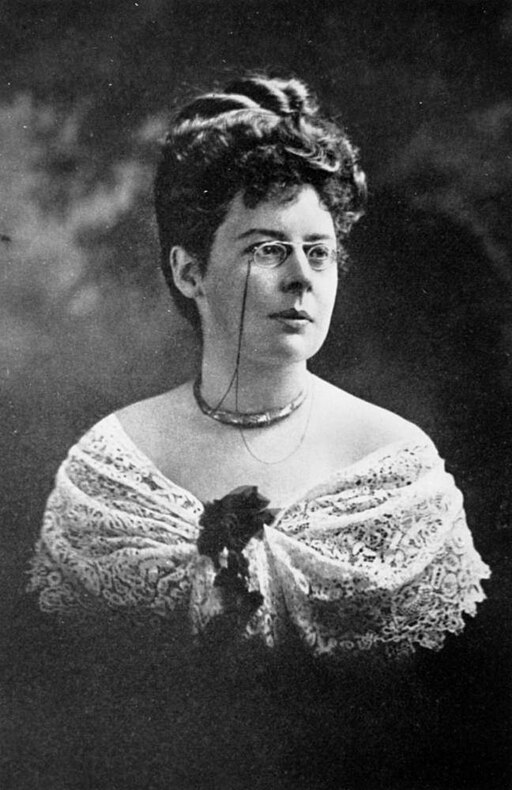
Edna Davies

So, for my AWW post I started at the end, where we get some facts. Her death was reported on 26 December 1952 in the Family Notices section of The Pioneer (from Yorketown, South Australia). It said she was 56 years old, which suggests she was born in 1896. The notice gives her name as Edna Irene, identifies her parents, and names her siblings as Daisy, Keith and Jack (deceased).

There are two other entries for her in the newspaper in December. On 12 December, a brief article announced that ‘Miss Edna Davies, “Pioneer” representative and correspondent, has been absent for some weeks because of ill health, and is at present in hospital, where she may have to spend some time yet’. They identify someone who will gather news, and add that “until Miss Davies’ return to Minlaton, advertisements, or payment of accounts, should be sent direct to the Pioneer Office”, which suggests she had an administrative role. They conclude this announcement, by saying that ‘The weekly feature “Comments on the News” (Written by Miss Davies) will, we regret, have to be temporarily suspended”, which confirms her writing contribution.

On 26 December, the same day the death notice appeared, they published a brief obituary. Here it is in full:

Press and Radio Correspondent Dies
Yorke Peninsula generally will feel the loss of Miss Edna Davies, of Minlaton who died in an Adelaide Hospital on Monday. Miss Davies, whose name is particularly familiar to readers of “The Pioneer,” has served many years as Southern and Central Yorke Peninsula’s chief correspondent for radio stations, provincial and metropolitan newspapers. People in many Peninsula towns will miss the friendly weekly phone calls she used to make in her search for news about the doings of local organisations and people. Her articles, as well as her Peninsula news items, have been of great value and interest, and we join her brother and sister and our readers in mourning her sudden demise.

So, it’s likely that she was born in Minlaton, central Yorke Peninsula, which is about 30 kms north of Yorketown, the home of her employer The Pioneer. Indeed, on 20 March 1926, a brief article appeared in The Pioneer, headed “Minlaton. Farewell to Miss Edna Davies”. The article describes an event that was held at the Minlaton Institute “to bid farewell to Miss Edna Davies and Mr. Jack Davies” (presumably the brother mentioned in the death notice.) They were leaving for London. (Indeed, according to Adelaide’s The Register, they left on 20 March). There were “eulogistic addresses” and “a useful cheque” was handed to Miss Davies. What does this tell us? Not a lot, but we can glean some information. She was around 30 years old, and seemingly not married. She was known in the community, at least enough for her departure to be reported on, albeit social news was more common at the time. It also tells us – from the headline – that it was she, not her brother, who was most known.  

Since writing my AWW post, I have done more research, and have discovered something about why she was known in the community. For example, Adelaide’s Observer (3 November 1923), writing on the Central Yorke’s Peninsula Agricultural Society’s annual show, observed that “the show committee provided the dinner … under the able management of Miss Edna Davies … Things worked smoothly in this department”. The article also praises the work of the Society’s secretary, Mr D.M.S. Davies, Edna’s father.

Anyhow, back to her chronology, three months after the report of her going to London, Moonta’s The People’s Weekly (12 June 1926) writes about the Minlaton Literary Society’s fourth annual musical and elocutionary competitions, advising that entries go to “secretary (Miss Edna Davies)”. This must have been a clerical error because, from the many newspaper reports under her by-line – and headed “Travel” or “Our London Letter” – it’s clear that she was in England by June 1926, then through 1927 and probably into early 1928. It’s possible that some of the articles dated later in 1928 were written back home.

Certainly, on 31 May 1929, there is a report in The Pioneer of the Minlaton Institute Literary Society’s seventh annual musical and elocutionary competitions and once again entries were to go to secretary Edna Davies. She probably was back on the job then. From this time, there are more articles, stories and columns – including her “Comments on the News” – by her South Australian papers. Together they build up a picture of who she was, and what she thought about life – local, national and international.

One that captured my attention was written from England, and published in The Pioneer on 6 January 1928. She starts by saying she hadn’t been doing much sightseeing so was “short of material” for her London Letter. So, she writes about some reading she’s doing about Australia, including a book by Mr Fraser. From what she says, I believe the book was Australia: The making of a nation (1911/12) by Scottish travel writer John Foster Fraser. Chapter 19 is tilted “A White Australia”. Fraser, a man of his times, understands the desire for a “white Australia”, but asks this:

What will Australian people say when the question is put to them, “As you are not developing this region [the great uninhabited north], what right have you to prohibit other people from developing it? It was not your land in the first instance. You obtained it by conquest that was peaceful. What can you do to resist conquest by force of arms? Who are you to say to the world, Let other peoples crowd together and be hungry owing to congestion of population, live cramped and struggling lives, but we, although doing practically nothing to develop our own resources, do not want anybody else to come in and develop the resources of a part of the world not given to us but given to the human race?'”

Davies is taken with this question and asks, “Have we all studied the pros and cons of the question carefully, so that should it be wanted, we can without hesitation give a carefully thought out decision after viewing the question from all sides. Looking back through history we see that no nation has ever come into, or held its own, without fighting for it, so why should we be an exception”. Her thinking – and Foster’s thinking – is not our thinking, but that she took the issue up and was published tells us something about her and the times. Neither of course consider that “little” line of Foster’s that “It was not your land in the first instance”.

Another randomly chosen example of her thinking comes from 20 June 1952, when she writes in her column “Comments on the News”:

READING about a press conference Mr. Menzies had recently in London this thought struck me — “What much wider outlook British pressmen seem to have than do their colleagues in Australia.”
And that’s a bad thing for Australia. Because if pressmen haven’t a wide outlook how can the public, who depend on them for news of the outside world, be expected to have one.

She slates it to the “old problem” of Australia’s geographic isolation, suggesting that “we are so isolated from other places that it it [sic] hard to realise that their welfare and their doings are important to us”.

AustLit lists 5 stories by her, and AWW lists 12 short stories in Stories from online archives (11 from the 1930s and 1 from the 1940s), but these are just a few of many short stories by her that were published in South Australian newspapers, and The Bulletin. I shared one of The Bulletin stories in my AWW post. Titled “Scrub”, it’s perfect “Bulletin-fare”, with its story of a woman who cannot get over a childhood nightmarish experience in the bush, and an intriguing take on lost-child-in-the-bush tradition in Australian culture.

Edna Davies turned out to be another example of an independent woman who seems to have made a career for herself in journalism and writing.

Sources

Edna Davies, “Scrub“, The Bulletin, Vol. 56 No. 2906 (23 Oct 1935)

All other sources are linked in the article.

Monday musings on Australian literature: Forgotten writers 15, Tarella Daskein

I first came across Tarella Daskein back in 2021 when Bill (The Australian Legend) wrote a post about her as the result of her coming up in discussions and reading about Katharine Susannah Prichard. She then slipped my mind until a couple of months ago when I was searching around for a subject for my Australian Women Writers post that month. This post, like most of my recent Forgotten Writers posts, s a minor revision of the one I posted there.

Tarella Daskein

As with many of the lesser-known writers we research for this blog, Tarella Daskein (1877-1945) was somewhat challenging to pin down. It’s not that she wasn’t known. Indeed, Wikipedia and AustLit both have entries for her. However, there were conflicting details of her life. For example, both Wikipedia and AustLit had her death date as 1934, which was curious because Adelaide’s The Advertiser reported on her visiting that city in June 1935. How could that be? Further, The Advertiser also had her husband as Mr. T.S. Daskein while Wikipedia and other newspaper articles had him as Mr. T.M. Daskein. Compounding all this was her use of multiple names, including some confusion over her maiden name. The above-mentioned Advertiser, for example, reported it as Quinn. AustLit, however, resolved this by noting at the end of its entry that her name had been incorrectly spelled as ‘Quinn’ in Miller and Macartney’s Australian Literature: A Bibliography (1956). The death date issue was clarified by, strangely, Wikipedia’s article on her father, Edward Quin, which gave her death as 1945 and cited a newspaper notice as evidence. And a death notice for her husband confirms him as T.M. not T.S.

So, with all that resolved, who was this Tarella Daskein? Tarella Ruth Quin was born in Wilcannia, second daughter to pastoralist and one-time member of the New South Wales Legislature, Edwin Quin, in 1877. She is best known as a writer of children’s stories, but also wrote three adult novels – A desert rose (1912), Kerno (1914) and Paying guests (1917) – and many short stories which were published in contemporary newspapers and magazines. AustLit provides a good outline of her origins. She was one of eight children. Her father owned a dairy farm called ‘The Leasowes’, near Victoria’s Fern Tree Gully, and a sheep station called ‘Tarella’, after which she was named, in far western New South Wales near Wilcannia. ‘Ella’, as she was known, was educated in Adelaide, but spent most of her life on stations. She married Thomas Mickle Daskein, part proprietor of a station in far northwest NSW.

Cover for Tarella Quin Gum Tree Brownie

AustLit says that her first writing comprised short sketches of station life, which were published under the pseudonym “James Adare” in the Pastoral Review. At the editor’s suggestion, she also wrote some stories for children, which she sent to Ethel Turner, hoping to have them published in Sydney newspapers. However, Turner apparently recommended they be published as books. Her first book, Gum Tree Brownie, was published in 1910, with illustrations by Ida Rentoul whom Ella’s younger sister, Hazel, knew at school. This began a long partnership between the two, with Ida Rentoul Outhwaite illustrating many of her books for children. Wilde et al say she was “one of Australia’s most successful writers of fairy-stories for children” and that “humour, irony, a fluent, dramatic style and fantasy reminiscent of Lewis Carroll enliven her stories”.

Bill, as mentioned above, came across her, initially in Katharine Susannah Prichard’s autobiography, Child of the hurricane. Apparently, Prichard was governess for a year at Tarella Station in 1905, by which time Tarella, who was six years older than KSP, was already a published author. Prichard, says Bill, is “pretty dismissive” of Quin’s writing.

However, not all were. Several contemporary reviewers praised her adult novels, often singling out Kerno: A stone for special mention. On 10 April 1915, Adelaide’s Observer wrote:

Kerno, although similar in some respects, is nevertheless distinctly different from A Desert Rose. The latter is a novel – the former is a study – a keen analysis of human feelings and desires. One cannot well peruse the book without thinking deeply, and wondering what one would have done in circumstances like those in which the leading actors found themselves placed. Young people and those having a preference for light ephemeral literature may be inclined to consider the story rather tame; but all who have a true appreciation for human nature, and endeavour to probe into its many and varied qualities, will find in it compelling and absorbing interest.

Those who praise Kerno mostly praise it for its “real” characters and deep understanding of human nature. Indeed, the Observer says that it “richly deserves to rank among the best truly Australian novels”. Daskein was also praised for her understanding of and ability to convey life in the bush and, as the Observer says, for her “descriptive writing which … captivates the reader”.

Notwithstanding all this, Quin mostly wrote for children, with The Australian Women’s Weekly claiming, after the publication of Chimney Town in 1936, that

She has published more ambitious volumes, but her tales for children have a unique charm that makes one feel that this is her real metier.

Quin’s publishing career lasted from around 1907 to the mid-1930s, so it was no flash in the pan. AustLit lists over 20 works by her, but this may not be all. Regardless, she was well-known to readers of her time, and, according to Adelaide’s The Rouseabout, had some presence in literary circles, including being “a foundation member of the Melbourne centre of the P.E.N. Club and a constant attendant at its meetings”. She died on 22 October 1945, at a private hospital in Melbourne. The fact that I found little mention of this beyond The Rouseabout’s short article suggests that in the last decade of her life – after the death of her husband in 1937 – she faded from view.

The piece, “The camel”, which I chose for AWW, was published in The Bulletin’s Christmas issue in 1935. It shows a writer a writer who knows the outback, knows how to entertain her audience, and, who firmly belongs to the bush tradition. Life is tough, but our woman protagonist is resourceful.

Sources

Bill Holloway, “Tarella Down a Rabbit Hole“, The Australian Legend (blog), 16 December 2021 [Accessed: 9 November 2025]
The Rouseabout, “In Town and Out“, The Herald, 12 November 1945 [Accessed: 16 August 2025]
Tarella Quin, AustLit [Accessed: 16 August 2025]
Tarella Quin, Wikipedia [Accessed: 16 August 2025]
William H. Wilde, Joy Hooton and Barry Andrews, The Oxford companion to Australian literature. Melbourne, Oxford University Press, 2nd, edition, 1994

Monday musings on Australian literature: Forgotten writers 14, Gertrude Mack

Gertrude Mack is the third of the Mack literary sisters, and by far the least known, though at the time she was well-recognised, with her activities and thoughts frequently reported in the newspapers. Her “disappearance” from view is most likely because, unlike her sisters, all her writing was for newspapers and magazines. She did not have one published book to her name. It makes a big difference to a writer’s longevity in the literary world.

As with many of my Forgotten Writers posts, I researched Gertrude Mack for the Australian Women Writers’ blog. This post is a minor revision of the one I posted there. So, who was she …

Gertrude Mack

Gertrude Mack (?-1937) was an Australian journalist and short story writer. The youngest of thirteen children – who included five daughters – Mack was born in Morpeth, New South Wales, to Irish-born parents, Jemima (nee James) Mack and the Rev’d Hans Mack. As a child, she lived in various parts of Sydney including Windsor, Balmain and Redfern, and was educated at Sydney Girls’ High School. Two of her older sisters also had literary careers, Louise Mack (see my posts) and Amy Mack (whom I featured last week). These sisters have been documented in Dale Spender’s Writing a new world: Two centuries of Australian women writers (1988) and by their niece Nancy Phelan in the Australian Dictionary of Biography, but neither Spender nor Phelan mention Gertrude. According AustLit, a diary of Mack’s is included in Phelan’s papers at the State Library of New South Wales. Curious.

This dearth of formal biographical information meant relying heavily, for this post, on Trove, where articles written by Mack abound. They tell of a curious and adventurous woman who was able to report firsthand on those challenging 1920s and 30s in Europe and the Americas. For example, in 1924, four years after the Mexican Revolution, she decided to go to Mexico City, something her American friends thought “a wild whim”. She writes for The Sydney Morning Herald (22 November 1924), that “according to American newspapers, it did seem a risk, but I knew their way of making any Mexican news appear hectic”. In the end, it does prove difficult, and she fails on her first attempt. She admits that she was not prepared for the poverty she sees in Juarez, just over the border from El Paso, and “was not yet accustomed to the unshaven Mexican”, but she later wrote admiring pieces on the country.

Mack spent eight years in London from around 1929 to 1937, and returned at least once for a few weeks in 1933. It was a difficult time in Europe, and The Sun (18 June 1933) reports that she had found “the same sense of strain in all the European countries, and this has been intensified more recently by the war menace, which seems to be very real.” I have not been able to find an image of her, but during this visit, sister Louise described her in “Louise Mack’s Diary” in the Australian Women’s Weekly (17 June 1933):

Tall, very slight and svelte, in a smart black frock of her own making, her hair marcelled, her big, grey eyes looking big-ger than ever under the glasses she had taken to lately. Elegant? Yes, certainly.

An interesting little fact which came up in a couple of the newspaper reports of this 1933 visit was that on her voyage she, and two other “matrons” had been in charge of 48 children, who had been selected for the Fairbridge Farm School to be taught various branches of farming. Sydney’s The Sun (June 18) explained that “the children, whose ages ranged from eight to twelve years, included both boys and girls, and were chosen by the selection committee of the Child Immigration Society, which body exercises the greatest care in choosing only suitable potential citizens for Australia, says Miss Mack”. If you haven’t heard about Fairbridge, check out Wikipedia. Miss Mack might have had faith in it, but the whole scheme was marred by dishonesty, and worse, child abuse.

Gertrude returned again to Australia in 1937. There was much interest in her return, with newspapers reporting on her thoughts from the moment she first touched the continent in Western Australia. The West Australian (3 March 1937) wrote that she had passed through Fremantle in the “Orama”, and quoted her as saying Australian writers were doing well in London. “Henry Handel Richardson was acclaimed by many critics as the finest writer of the day”; and Helen Simpson (my first Forgotten Writer) “had taken up broadcasting work in addition to her writing”. She said Nina Murdoch had had success with Tyrolean June and Christina Stead with Seven poor men of Sydney. The paper observed, tellingly, that “undoubtedly Australian writers were getting more recognition in London than in their own country”.

It also quoted Mack as saying she believed England was interested in stories about Australia, but that their interest depended “entirely on the topic of the story.” Unfortunately Australian writers “usually presented the drab side of the life of the country and laid too much stress on the droughts and the drawbacks” and “the frequent descriptions of struggles against drought and the hardships of Australian life gave readers a wrong impression of the country”. Consequently, readers “did not realise that the country had a normal life, with a bright social side, and the mass in England seldom knew that there was very fertile land in Australia”. According to Mack, “German people knew more about Australia and were more interested than the people of any other country”.

Adelaide’s News (6 March 1937) took up the issue of how Australia is viewed, but with a slightly different tack, writing:

“It would be difficult,” said Miss Mack, “to make the average uneducated English man or woman believe that there is, in Australia, such a thing as culture. English people would be surprised if they could have a glimpse of real country life on a big station.
The only way to overcome this wrong idea.” she said, “is by our literature, which has not yet developed fully.”

Although she was talking about staying in Australia for just 6 months, it appears that Gertrude Mack was seriously ill when she returned in 1937. She visited her brother C. A. Mack, of Mosman, but died in a private hospital in Darlinghurst on Wednesday 31 March and was buried at the Northern Suburbs Crematorium on the Friday.

A few days later “an appreciation” written by “W.B.”  appeared in The Sydney Morning Herald (6 April). W.B. It’s a moving tribute:

To those of us who had the happiness and the privilege of an intimate association with Gertrude Mack over a long period, abroad and in Australia, her death has meant a very poignant personal loss and sorrow. Her happy outlook on life, her faculty for perceiving the humorous side of things, and her sensitive reactions to atmosphere, made her a delightful companion, and she made friends among every class of people, whether they were foreigners or people of her own race. She had an unusual flair for getting at the heart of the interesting aspects of life and affairs, and this, added to her other gifts, enabled her to write such charming and interesting sketches, stories, and interviews. Her short stories and sketches were invariably the outcome of personal contacts. She could paint engaging pictures of people and places, and make them real to her readers. She also possessed outstanding musical ability, and might have won distinction as a pianist had she elected to take up music as a profession, for she had a fine critical perception and a rare appreciation of the true values in music.

She also translated stories from Russian, collaborating with Serge Ivanov to publish in English a volume of N. A. Baikov’s tales for children. Gertrude Mack was a fascinating woman, and would be a worthy subject for a biography – either on her own, or as part of a larger biography on the Mack sisters.

Sources

Monday musings on Australian literature: Forgotten writers 13, Amy Mack

In the first decades of the 20th century, a family of sisters made some splash on Australia’s literary scene. I have already written about the eldest of them – Louise Mack – but there were also Amy (this post’s subject) and Gertrude, all of whom appeared in newspapers of the time as writers of interest. They were three of the thirteen children of their Irish-born parents, Rev. Hans Hamilton and his wife Jemima Mack. As with many of my Forgotten Writers articles, I researched Amy Mack for the Australian Women Writers’ blog, where we have several posts devoted to her.

Amy Mack

Amy Eleanor Mack (1876-1939) was a writer, journalist, and editor. She was six years younger than the more famous Louise, and, says Phelan in the Australian dictionary of biography, was “less temperamental … and lived more sedately”, which is not to say she lived a boring life.

Mack began work as a journalist soon after leaving school, and from 1907 to 1914 was editor of the ‘Women’s Page’ of the Sydney Morning Herald. She married zoologist Launcelot Harrison, in 1908, and in 1914, they went to England where he did postgraduate work at Cambridge, before serving in Mesopotamia as advisory entomologist to the British Expeditionary Force. While he was away, Mack worked in London as publicity officer for the ministries of munitions and food.

The couple returned to Sydney after the war, with Launce becoming professor of zoology at the University of Sydney, and Amy continuing her literary career among other roles and activities. They did not have children. According to Phelan, after her husband died she continued to publish occasional articles, but her impulse to write faded as her health declined. She died of arteriosclerosis in 1939.

Works

Amy Eleanor Mack’s subject was nature, and she wrote about it in newspapers and books, for adults and children. Australian ecologist, Manu Saunders, writes on her blog that:

Australia has a wonderful heritage of nature writers, many working before nature writing was ‘a thing’. The national collection of Australian children’s books about native wildlife is inspiring. Even more inspiring, many of Australia’s best nature stories were written in the early-mid 19th century, and mostly by women.

And one of those women, she continues, was Amy Eleanor Mack. (I have written before on one of our early colonial nature writers, the pioneering Louisa Atkinson.)

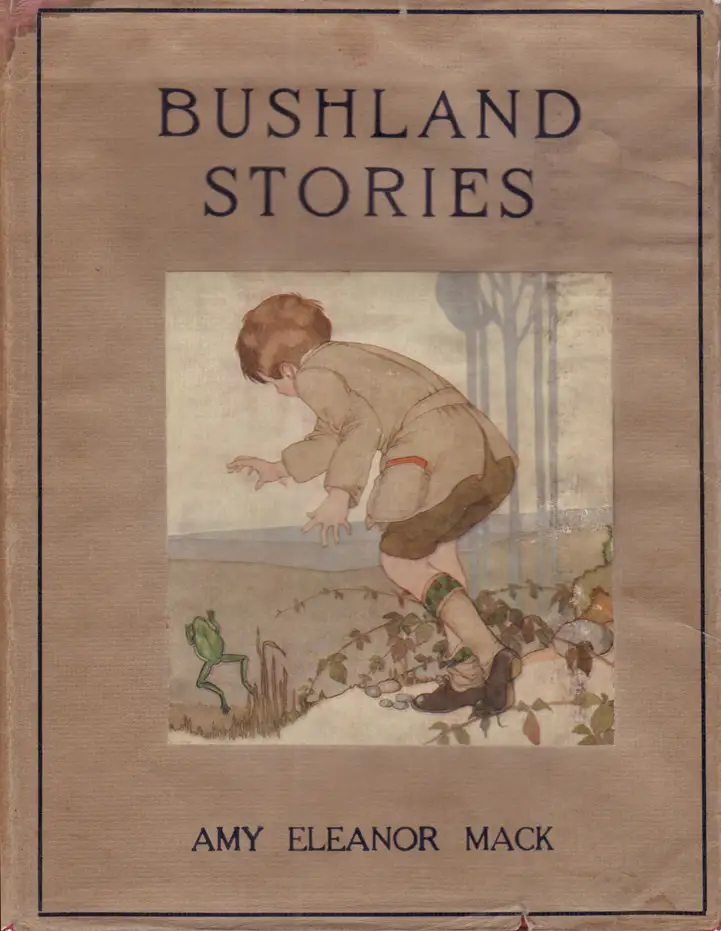
Book cover for Bushland stories

Mack’s first publications were two collections of essays, A bush calendar (1909) and Bush days (1911), which were compiled from articles she’d written for the Sydney Morning Herald. She also wrote two popular children’s books, Bushland stories (1910) and Scribbling Sue, and other stories (1915). Wikipedia lists 14 books, many of which were first published in newspapers, but all of which have nature-related titles, like The Fantail’s house (1928) and The gum leaf that flew: And other stories of the Australian bushland (1928).

Her books were well-reviewed in the newspapers of the time. Her first, A bush calendar, was described by Sydney’s The Farmer and Settler (26 November 1909), as charming, “a sympathetic review of bird life and plant life in the Australian bush during the four seasons of the year”. But what is interesting is what they say next:

It is the kind of book that ought to be on every girl’s bookshelf, and every thoughtful and intelligent boy’s also, being not only an exceedingly pleasant thing to look at and to read, but one calculated to induce in many a desire to get to know more of nature in some of her sweetest phases.

I’m intrigued by the gender differentiation – “every” girl, but only “every thoughtful and intelligent boy”. These sorts of insights into other times make researching Trove such a joy. Anyhow, the review also suggests that it would be “a delightful remembrancer for Australians abroad”. A year later, on 26 November 1910, Sydney’s The World’s News, reviewed Mack’s children’s book, Bushland stories, calling it an improvement on A bush calendar. It comprises a “collection of fables, allegories, fairy tales, or whatever one chooses to call them” which, the News says, has “created a folklore for young Australians”. In it, Mack personifies nature, with birds, beasts and fish all acting and speaking “like rational beings”. Each story has a moral but there is none of the “preachiness, which many youthful readers shy at”.

Reviews of later books continue in a smilier vein. In 1922, on 6 December, Lismore’s Northern Star writes about Wilderness, which, it says,”tells in a most interesting way of the fascinations of a piece of land which once had been a garden, planted with fruit trees and roses, but which has been neglected until the bush reclaimed it for its own”. This is the book that Saunders writes about in her blog in 2017. The book had been originally published in three parts in the Sydney Morning Herald. Saunders explains that it

tells the story of an unnamed patch of wild vegetation in Sydney (Mack never names the city, but given the original publisher and the wildlife she describes, it seems pretty obvious). Mack describes the plot so vividly and intimately that you imagine yourself there. You can visualise Nature reclaiming this plot of land, left untended after the keen gardener who owned it passed away.

Saunders then describes its content, including examples of the nature Mack describes, as well as her attitude to it and her observations. Saunders was surprised but “weirdly” comforted to find conservation messages that are still relevant today embedded within the book.

Legacy

Australian feminist Dale Spender, in her book Writing a new world, says a little about Amy Mack, though she spends more time on Louise. However, she makes a point about the Mack sisters and their peers, Lilian and Ethel Turner:

Lilian and Ethel Turner, Louise and Amy Mack were part of a small group of spirited literary pioneers who at very early ages adopted public profiles in relation to their work. When they moved into the rough and tumble world of journalism – when they entered competitions, won prizes, and published best-selling novels before they were barely out of their teens – they broke with some of the long-established literary conventions of female modesty and anonymity. They sought reputations and in doing so they show how far women had become full members of the literary profession: they also helped to pave the way for the equally youthful and exuberant Miles Franklin whose highly acclaimed novel, My Brilliant Career (1901), was published when the author was only twenty-one.

Ever political, Spender argues that had it “been brothers (and ‘mates’)” who created the sort “colourful and creative community” these sisters did, and achieved their level of literary success, we would have heard of them. Books would have been written about ‘their “literary mateship” and they would have been awarded a place in the readily accessible literary archives’. But,

because these writers were women, and because they have been consigned to the less prestigious categories of journalism and children’s fiction (both a classification and a status with which I do not agree) they, and their efforts, and their relationships – to rephrase Ethel Turner – go unsung.

Amy Mack is less well-known now than her sister Louise, and certainly less well-known than Ethel Turner, but in her time she was much loved. However, even then, she didn’t always get her due, as a reader wrote to The Sydney Morning Herald on 16 April 1935:

With reference to the articles on Australian women writers in the Supplement, one is surprised at the omission of Amy Eleanor Mack, who surely wrote two of the finest books for children ever published in Australia. In “Bushland Stories” and “Scribbling Sue” the true spirit of our bushland has been preserved with a charm and sincerity all its own, and I think I am right in stating that, with the exception of Miss Ethel Turner’s “Seven Little Australians,” no books published in Australia for children had greater sales.

Four years later, announcing her death on 7 November 1939, The Sydney Morning Herald said that her work “had a mark of reality about them that found for her an increasing circle of readers”, but it was “A.T.” of North Sydney, who wrote to this same paper on 8 November, who captured her essence:

Her culture, wit, and broadmindedness, and her marvellous sense of humour made her a figure in the northern suburb in which she resided.

Sources

Nancy Phelan, ‘Mack, Amy Eleanor (1876–1939)‘, Australian Dictionary of Biography, National Centre of Biography, Australian National University, published first in hardcopy 1986.
Manu Saunders, “The wilderness: Amy Eleanor Mack“, ecologyisnotadirtyword.com, 4 March 1917
Dale Spender, Writing a new world: Two centuries of Australian women writers, originally published by Pandora Press, 1988 (sourced in Kindle ed.)

Monday musings on Australian literature: Forgotten writers 12, Catherine Gaskin

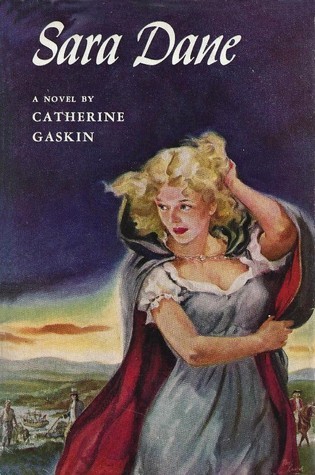
Of all my Forgotten Writers posts, this one is the most questionable because I’m not sure she is completely forgotten. For baby-boomer and I think some Gen X readers, Catherine Gaskin was a household name. Just ask Brona who reviewed her 1962 novel I know my love, and said in her post that she’d read her mother’s whole bookshelf of Gaskins. But, Gaskin has, I believe, now slipped from view and is worth a little post. Her big, breakout novel was her sixth, Sara Dane (see Wikipedia), which was published in 1954. It remained popular through the 1960s to 1980s, when it was adapted to a miniseries in 1982. So, who was this writer …

Catherine Gaskin

Catherine Gaskin (1929-2009) was, says Wikipedia, a romance novelist – but I seem to remember her books as being historical fiction so I’d say her genre was mostly historical romance. She also included mystery and crime in her stories, at times. The youngest of six children, she was born the same year as my mother, but in County Louth, Ireland. She was not there long, however, as when she was only three months old, her parents moved to Australia, settling in the Sydney beach suburb of Coogee. She wrote her first novel, This other Eden, when she was 15 and it was published by Collins two years later, while she was still a schoolgirl. It sold 50,000 copies, and she never returned to school.

After her second novel, With every year, was published, she moved to London with her mother and a sick sister, Moira (who also published two novels). Three best-sellers followed, Dust in sunlight (1950), All else is Folly (1951), and Daughter of the house (1952). Wikipedia lists 21 novels to her name. In his obituary, Stephens tells that as a child she had loved reading, and read such authors as Ernest Hemingway, Graham Greene and Scott Fitzgerald. 

According to Wikipedia, she completed her best-known work, Sara Dane, on her 25th birthday in 1954, and it was published in 1955. It sold more than 2 million copies, was translated into a number of other languages, and was made, as I’ve said above, into a television mini-series in 1982. It is loosely based on the life of the Australian convict businesswoman Mary Reibey. Stephens writes that ‘a Herald critic described the novel as “most readable”‘ although the critic also suggested “that Gaskin’s understanding of history was not deep”. He says that “after Sara Dane, many of her books were overlooked by critics, although welcomed by readers”.

At least three of her novels – Sara Dane, I know my love, and The Tilsit inheritance – were adapted for radio, by Australia’s Grace Gibson Radio Productions, and many others besides Sara Dane, were translated into other languages.

Gaskin met the man who became her husband in London, and they married in 1955. He was a TV executive and 19 years her senior. They lived in various places together, including the USA, the Virgin Islands, and Ireland. However, she returned to Sydney at the end of her life, and died there in September 2009.

I was inspired to write this post by some research I did for the #1970 Year Club last year. Journalist Rita Grosvenor visited her in Ireland around the time of the publication of her novel, Fiona. Grosvenor writes that:

She is among the elite of the world’s women novelists, with such a faithful following of readers she can be sure that every time she produces a new book it will sell 50,000 copies in hard-cover – and that’s more than most authors sell with a handful of books. With paperback sales she often passes a million.

Grosvenor’s article was for the Australian Women’s Weekly, so there’s much about her living arrangements and house, but towards the end, she shares Gaskin’s thoughts about her writing. Despite her success, Gaskin is depressed every time she starts a book, fearing that “this time it is not going to work out, but somehow it does”. However, she says:

“I know I can never be a Graham Greene, but I always want to improve within my limitations. I’m a perfectionist.”

As Stephens writes, “she knew her limitations but didn’t like being regarded as a romantic writer”. She saw herself as “an entertainer and good craftswoman who married romance with history and studies of such subjects as trades and places”. 

According to Stephens, Gaskin retired after her last novel, The charmed circle, was published in 1988. She wanted to travel with her husband, without publishers’ deadlines. So, they did travel, apparently, until his death in 1999. She then moved to Mosman, in Sydney, and spent the rest of her life there. Stephens quoted her as saying, ”I am not an Australian by birth but I think like one”.

Have any of you heard of or read Catherine Gaskin?

Sources

Monday musings on Australian literature: Forgotten writers 11, Nancy Francis

Like my last forgotten writer, Ruby Mary Doyle, today’s writer, though also a prolific contributor to newspapers in her day, has slipped into the shadows. Neither Wikipedia nor the Australian dictionary of biography (ADB) contain articles for her, but the AustLit database does and Zora Cross, writing as Bernice May in The Australian Woman’s Mirror, also did a piece on her. As with many of my Forgotten Writers articles, I researched and posted a version of this on the Australian Women Writers’ site in April, but have saved posting here until June because I am in Far North Queensland where she lived most of her life. Seemed fitting.

Nancy Francis

Nancy Francis (1873-1954) was a poet, and writer of short stories, essays and serialised novels. She was born in Bakewell, Derbyshire, England, in 1873. According to the Obituary in The Cairns Post, her mother was the surviving descendant of the Beaton family, which was connected, through service, with Mary Stuart, Queen of Scotland. Her Yorkshire-born father was a well-known musician who had played a cornet solo in front of Queen Victoria. Nancy developed her musical talent, and apparently had “a beautiful and unusual soprano voice”. She also wrote verse as a hobby and contributed to various periodicals.

According to the Obituary, Nancy married Frederick James Francis in 1900. They lived in London and other country centres, before coming to Australia, just before the 1914-18 war. With three young daughters, they travelled to the remote Bloomfield River, in Far North Queensland, where her husband joined his brother in various mining ventures. During this period Francis “acquired her exhaustive knowledge of the North Australian bush and its aboriginal inhabitants, of whose character and folklore she made a sympathetic study”. She increased her output over this time, with her verses, articles and short stories appearing regularly in the Bulletin and other southern periodicals. Much of this writing appeared under the nom-de-plume of “Black Bonnet”, which Bernice May (Zora Cross) ascribes to her love of Henry Lawson (who wrote a poem titled Black bonnet”).

After some time – not specified in the Obituary – the family moved to the small mining township of Rossville outside Cooktown, where Frederick and two brothers continued working in mining and other development. The Obituary says that “among these jungle clad hills she produced some of her best literary work, including many of the poems later collected and published in book form”. In 1927, Bernice May wrote about Francis and her daughters – who all became published writers in their teens – and praised the quality of their verse. May clearly had some correspondence with Nancy and her daughters, and was impressed by what the girls had achieved under their mother’s home schooling. Francis wrote to her, “How I long at times for a creepy novel, a box of chocolates and no bright ideas that nag to be put on paper”, which May says reminded her of Mary Gilmore who “in her first passionate days of great poetry declared she could not take her hands out of the cooking-basin and washing-up dish fast enough to run away to her pen and write some fiery line that had flashed to her across her domestic work”. Bernice May understood the challenge faced by women artists.

In 1928, Nancy and her husband moved to Cairns, but not long after, in 1929-30, she travelled back to England. On her return she “joined her husband at Herberton where she lived until her death”, on 28 June 1954. Her husband, who had also worked as a freelance journalist, predeceased her in 1942.

According to the Obituary, she was actively involved in community activities, including being a member of the C.W.A. from its inception, and President of the local branch for eight years. She also worked for the Red Cross and Patriotic Associations during both world wars. She remained a journalist throughout her life and was keenly interested in politics and world affairs. She also left behind four children, the three daughters (Patricia, Kathleen, and Christobel) and a son. The Obituary describes her as follows: “Generous and warmhearted, and with a vast fund of kindness for the underprivileged, she retained the standards of her English upbringing in a new country and a changing world”.

AustLit focuses on her writing. She wrote under many variations of her name and initials – N. Francis, Nancy Christobel Francis, N. C. Francis, N. C. F, N. F., Nancy C. Francis – as well as her Black Bonnet pen-name. They list 426 works by her under her Nancy Francis name variants, and another 62 under Black Bonnet, so she was prolific. And yet, she does not appear in the plethora of reference books, histories and guides I have on Australian literature. Why? Perhaps it’s because she spent her life in such a remote part of Australia, away from the literary world, though she did have writing published down south. Or, maybe it’s simply that for all her writing, she had only one published book, her poetry collection, Feet in the night and other poems, which was published by The Cairns Post in 1947. All her other writing appeared in newspapers and magazines/periodicals.

Indeed, this book’s reviewer in Mackay’s Daily Mercury (28 August 1948) implies that the ephemeral nature of newspapers is behind obscurity when they write that “beautifully hewn lines of poetry, melodious verses which have stirred the infrequent verse-readers for a morning half-hour, lie … forever entombed in rows of bound newspapers in libraries”. Fortunately, however, Francis had managed to compile a volume from her output, and the reviewer liked the result:

“FEET IN THE NIGHT” is … taken from the first poem of the first section, which deals sympathetically with the vanishing natives of this continent, who move like shadows on the hill, or ghosts in the scrub, along dark green valleys and dim waterways out to where the jungle ends. The other sections celebrate the Galllpoli era, romance, soft and melancholy, the scenic glories of the North, and memories of England and the out-bound voyage

We do not hesitate to express the opinion that almost every poem in the collection was well worth rescuing from its dusty obscurity. These verses have been polished and polished again. All are graceful, delicate and restrained.

According to AustLit, her writing for Queensland newspapers included essays in series, such as her studies of North Queensland Aboriginal culture, titled ‘By Forest, Scrub and Shore’ (1939-1940), which include detailed discussions of customs and practices in the region; a series of historical essays on ‘The Anglican Church in North Queensland’ (1936-1938); and many essays on Captain Cook. AustLit also says that her travels Western Europe and Northern Africa around 1930 inspired several poems which expressed her identification with the North Queensland landscape and a longing for her North Queensland home. It seems she travelled overseas more than once, with The Courier-Mail (26 April 1938) reporting on a planned trip to “the Continent” in 1938.

Nancy Francis may not (yet) have come to the serious attention of those documenting Australia’s literary history, but back in 1927, Bernice May was impressed, writing that,

“One does not know whether her crisp articles on nature study, her accounts of the blacks and their ways, or her verses are the most remarkable”.

She also compared Nancy and her daughters to the Brontë sisters, no less, saying

It was not until the Bronte girls left Yorkshire for Belgium that their hearts turned back to the scenes of their youth and they began to write of them with the wonderful feeling which has never since been surpassed in fiction written by women. I sometimes wonder if when this little outpost moves, when perhaps the mother and daughters become separated from the scenes of their early days, something missing in our fiction will be supplied—the great story of the lonely, mighty North.

This is not all she said, but you can read the rest at the link below.

The piece I shared on the AWW site is “The black snake”, which, as the title suggests, references the “snake” motif frequently found in Australian bush stories (including Henry Lawson’s). It draws on familiar short story tropes to tell a good story, and shows a writer who knows her craft and how to entertain her audience.

Sources

  • Bernice May (aka Zora Cross), “Black Bonnet and her daughters“, The Australian Woman’s Mirror, 3 (26),  24 May 1927 [Accessed: 8 April 2025]
  • Black Bonnet“, Daily Mercury, 28 August 1948 [2 April 2025]
  • Black Bonnet, AustLit [5 April 2025]
  • Nancy FrancisAustLit [5 April 2025]
  • Nancy Francis, “The black snake“, The Cairns Post, 28 December 1935 [Accessed: 8 April 2025]
  • Obituary, The Cairns Post, 10 July 1954 [Accessed: 2 April 2025]

Monday musings on Australian literature: Forgotten writers 10, Ruby Mary Doyle

Unlike my last forgotten writer, Dulcie Deamer, today’s writer, though a prolific contributor to newspapers in her day, has slipped into the shadows. Neither Wikipedia nor the Australian dictionary of biography (ADB) contain articles for her, but the AustLit database does. As with many of my Forgotten Writers articles, I researched and posted a versions of this on the Australian Women Writers’ site.

Ruby Mary Doyle

Ruby Mary Doyle (1887-1943) wrote short stories and serialised novels, newspaper articles including travel and nature pieces, and plays, mostly publishing as Ruby Doyle or Ruby M. Doyle. Much of her writing was published in Fairfax’s weekly magazine, The Sydney Mail. By the 1930s she had, says AustLit, gained a reputation as a writer of some standing. She was also active in the Lyceum Club and the Pioneer Club in Sydney. And yet, there are no articles for her in Wikipedia or the Australian Dictionary of Biography.

Doyle was born on the 20 February 1887 in Gunnedah, New South Wales, to Joseph McCormick Doyle, a bank manager for the Commercial Bank, and Annie (née Hooke). She was the first of six children. In 1935, in an article titled “The making of the writer”, Doyle wrote of how she came to writing:

As a child, when I walked through the bush, well behind the family party, every tree seemed an enchanted castle. Birds, butterflies, flowers talked, and I understood them. Imagination — that blessed gift from the gods — had come to me from every side of my family, and finally led me, whether I would or not, into the realm of writing.

According to Kingston, of the Dungog Historical Society, her first published serial was The Dragon, which appeared in The Sydney Mail from 4 June 1913, and was later published in book form as The mystery of the hills. Promoting the book form, which was published in 1919, The World’s News wrote that:

Those who love a story which is thoroughly and typically Australian and of the country will enjoy this tale of love and adventure … The “mystery” we shall not, of course, say anything about, except that it has to do with men who defy the law and have a chief, who is a man of importance. There are several love stories, and they have the usual course, and there is quite a fund of information as to how we Australians live in the country, and how we manage to enjoy ourselves there. 

This little piece says much about how Australia saw itself. “How we manage to enjoy ourselves there [ie “in the country”]” suggests that Australia was well on the way to urbanisation, but fascinated by its bush self.

Further stories and serialisations appeared, including The winning of Miriam Heron in The Sydney Mail in 1918, which was published in book form by Edwards Dunlop in 1924. Announcing this new serial in 1918, The Sydney Mail wrote:

She [Doyle] has already contributed to the ‘Mail,’ and has disclosed literary and dramatic ability of a high order. It is gratifying to note that she shows no disposition to ‘write herself out.’ On the contrary, ‘The Winning of Miriam Heron’ reveals that she has mastered the art of construction, and thus gives her readers a better chance than previously to fully appreciate her literary powers.

From 1924 to 1926, Ruby travelled overseas a few times – to the United Kingdom, the continent, Canada and America – during which time she regularly submitted travel articles to the Dungog Chronicle, which, according to that paper, “were reprinted in many country papers throughout the State.”

Doyle wrote for local papers through the 1920s and 1930s. AustLit lists over 30 works of hers published over this time. She also tried her hand at playwriting. Kingston writes that her play The Family Tree came second in a competition at the Independent Theatre, Sydney, in 1933, and that the following year, The Man from Murrumbidgee, was produced at the Kursaal Theatre, also in Sydney. I believe these are the same play, given The Man from Murrumbidgee is about a status-seeking wife who tries to find “a worthy ancestor” on the family tree.

Doyle’s writing reflects the versatility of the working writer. Her short stories dealt largely with domestic subjects, while her serialised novels included historical stories about the colonial days, and romantic adventure stories. Her non-fiction focused particularly on nature, travel and local history, rather than on social or political commentary. Many of her local history pieces drew on her own family’s long history in the region, and include some delightful touches of humour. For example, she describes a pioneer family (hers it seems), coming out to Australia in 1828 with various things, including merino sheep and

rolls and rolls of beautiful silks, Mr. Hooke having an idea that he would be able to deal successfully in such merchandise. It proved only a supposition, and for the rest of her life Mrs Hooke had a marvellous collection of silks from which her dresses were made. 

There is also some recognition of the original people of the land. Writing in The Sydney Mail 1931 on the town of Gresford, she says that:

Most of the homes in the vicinity bear English and Welsh names — Norwood, Clevedon, Goulston, Camyr ‘Allyn, Caergule, Penshurst, Tre vallyn, etc. The river, named Paterson by the white man, was called Yimmang by the aborigines; one of our poets has written a very beautiful poem, “Ode to the Yimmang,” in which he extols its beauty.

Ruby Doyle was regularly written up in the local Dungog Chronicle, clearly being of interest to the community. She went to England, again, in 1935, planning to be away for two or three years. On 1 March, the Dungog Chronicle,reported on a farewell for this “gifted novelist”, and named Flora Eldershaw – one half of the M. Barnard Eldershaw collaboration – as a co-guest at the event. This suggests Doyle was known to the literati of her time. Doyle died in England in 1943, having never returned home again. A small obituary appeared in various local newspapers, including The Gloucester Advocate (see under Sources). The obituary noted her three published works, but also commented on her writing overall, commenting in particular that

a keen observer of nature, she had the gift of translating her thoughts on paper in an easy readable way.

The piece I posted for the Australian Women Writers Challenge is titled “The flame” (linked below). It is an intriguing story about a disgruntled wife, and invites – particularly from modern eyes – a variety of readings. I’d love to hear your thoughts.

Sources

  • Miss Ruby Doyle, The Gloucester Advocate, 12 January 1943 [Accessed: 14 January 2025]
  • Ruby Doyle, “The flame“, Sydney Mail, 24 July 1935 [Accessed: 3 February 2025]
  • Ruby M. DoyleAustLit [Accessed: 3 Feb 2025]
  • Maureen Kingston, “Was Ruby Doyle our first local travel writer?”, Dungog Chronicle, 25 August 2021 [Accessed via the NLA eResources service: 3 February 1924]

Monday musings on Australian literature: Forgotten writers 9, Dulcie Deamer

Dulcie Deamer, like my most recent Forgotten Writer, Jessie Urquhart, has retained some level of recognition – or, at least notability, with there being articles for her not only in Wikipedia and the AustLit database, but also in the Australian dictionary of biography (ADB). I have briefly mentioned her in my blog before, in Monday Musings posts on the 1930s and 40s.

Dulcie Deamer

Born Mary Elizabeth Kathleen Dulcie Deamer, Dulcie Deamer (1890-1972) was, says Wikipedia, a “novelist, poet, journalist, and actress”. ADB biographer Martha Rutledge, however, is more to the point, describing her as “writer and bohemian”, while her contemporary, the journalist and author Aidan de Brune, puts it differently again, commencing his piece with, “Dulcie Deamer has had an adventurous life”. From the little I’ve read of her and her work, it’s clear she was imaginative and fearless.

Born in Christchurch, New Zealand, to George Edwin Deamer, a physician from Lincolnshire, and his New Zealand-born wife Mable Reader, Dulcie Deamer was taught at home by her ex-governess mother. The timelines of her youth are sketchy in places, but Rutledge says that at 9, she appeared on stage, and De Brune writes that she was writing verses by the age of 11. A year after that, in 1902, De Brune and Rutledge agree that her family moved to Featherston, a small bush township in the North Island of New Zealand, where, de Brune says, “she ran wild” for five years, “riding unbroken colts, shooting, learning to swim in snow-fed creeks, and going for long, solitary rambles of exploration through the virgin bush”. It was here ‘that what she describes as “memories of the Stone Age” came to her’. Somewhere during this time, according to Rutledge, she was sent to Wellington to learn elocution and ballet lessons, apparently in preparation for the stage. At the age of 16, she submitted a story to the new Lone Hand magazine, and won the prize of 25 pounds. It was “a story of the savage love of a cave-man” and it changed the course of her life.

This story, “As it was in the beginning”, won the prize in 1907, from around 300 entries, said one contemporary report (The Wellington Times, NSW, 18 November 1909), and was published in The Lone Hand at the beginning of 1908, illustrated by Norman Lindsay. The critical responses were shocked but, mostly, admiring, that such virile writing could come from such a young woman. The story went on to be published in a collection of her stories in 1909, titled In the beginning” : six studies of the stone age, and other stories ; including “A daughter of the Incas”, a short novel of the conquest of Peru. One reviewer of this collection (Barrier Miner, 27 May 1910), wrote that Deamer “writes with a freedom of speech and a knowledge of things in general which must have fairly astounded her respectable parents, one would think, when they first read her compositions”! You get the gist. This work was republished in 1929 in a special limited edition titled, As it was in the beginning. The Australasian (21 December 1929) reviewed this and wrote of that original award winning story:

It was a tale of primitive man and woman, of a wooing and winning and retaining with club and spear— an unmoral tale, utterly pagan, terrifically dramatic. Its paganism was unsophisticated; its dramatic force was the expression of natural gift. Mr. Norman Lindsay illustrated the story. His paganism could hardly be called unsophisticated, but there was no doubt about his dramatic power. 

She was really quite something it seems and I might research her a little more. Meanwhile, Wikipedia picks up the story (sourced from newspapers of the time). As well as writing, she continued her stage career. She married Albert Goldie, who was a theatrical agent for JC Williamson’s, in Perth, Australia, in 1908. She had six children, but separated from Goldie in 1922. Rutledge, writes that

In the crowded years 1908-1924 Dulcie bore six children (two sons died in infancy), travelled overseas in 1912, 1913-14, 1916-19 and 1921 and published a collection of short stories and four novels—The Suttee of Safa (New York, 1913) ‘a hot and strong love story about Akbar the Great’; Revelation (London, 1921) and The Street of the Gazelle (London, 1922), set in Jerusalem at the time of Christ; and The Devil’s Saint (London, 1924). Three were syndicated in Randolph Hearst’s newspapers in the United States of America. Her themes, including witchcraft, gave ‘free play to the lavish style of her writing, displaying opulence and sensuality or squalor of traditional scenes.

Reviewing The devil’s saint for Sydney’s The Sun, The Stoic gives a flavour of Deamer’s writing. “She has style (a little too ecstatic perhaps) and she has a fine instinct for story-telling”, but there is much kissing – quite explicitly described – and “Sheikish stuff”. However, as The Stoic knows, there are readers for such writing, and s/he concludes that ‘If anybody wants romance, with a flavor of the supernatural and plenty of “pash,” this is the book’.

Deamer left her husband in 1922, and lived a Bohemian life in Kings Cross, while her mother brought up her children. She worked as a freelance journalist, contributing stories, articles and verse to the Australian Woman’s Mirror, other journals and newspapers, including the Bulletin and the Sydney Morning Herald. Like other writers we have featured, she often used pseudonyms. Rutledge tells us that Zora Cross described her in 1928 as ‘Speedy as a swallow in movement, quick as sunlight in speech … [and] restless as the sea’. Debra Adelaide writes that she was known as the “Queen of Bohemia” due to her involvement with Norman Lindsay’s literary and artistic circle, with Kings Cross Bohemianism, and with vaudeville. Various commentators and critics refer to her interest in religion, mythology, classical literature and the ancient world.

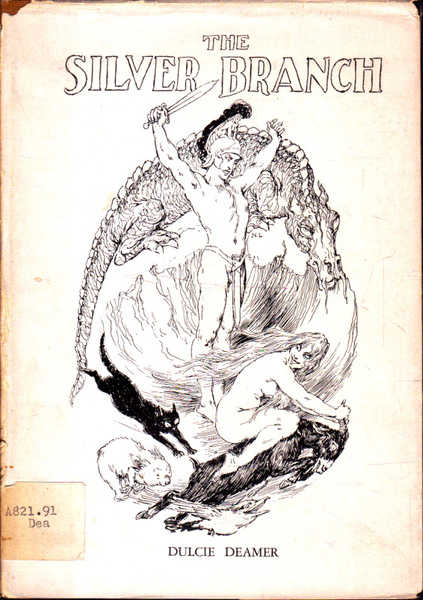
Deamer was a founder in 1929 and committee-member of the Fellowship of Australian Writers. In the 1930s she wrote plays, and a volume of mystical poetry titled Messalina (1932), while in the 1940s she another novel, Holiday (1940), another volume of mystical poetry, and The silver branch (1948). De Brune, writing in 1933, says that she was also hoping “to contribute screen stories to the newly-established Australian film industry” but it doesn’t appear that she achieved in this sphere.

In their short entry on her, Wilde, Hooton and Andrews say that her unpublished biography, The golden decade, “is informative on the literary circles of Sydney in the 1920s and 1930s”. They also say that she features in Peter Kirkpatrick’s 1992 book, The sea coast of Bohemia. Whatever we might think of her novels now, she was a lively and creative force in her time, and worth knowing about.

The piece I posted for the Australian Women Writers Challenge is titled “Fancy dress” (linked below). It provides insight into her interests in the magical and mystical and conveys something of her lively, humorous style.

Sources

  • Debra Adelaide, Australian women writers: A bibliographic guide. London, Sydney: Pandora, 1988.
  • Aidan de Brune, “Dulcie Deamer (1890-1972)” in Ten Australian Authors, by Aidan de Brune, Project Gutenberg Australia and Roy Glashan’s Library, 2017 (originally published in The West Australian, 13 May 1933) [Accessed: 21 November 2024]
  • Dulcie Deamer, “As it was in the beginning“, The Lone Hand (1 January 1908) [Accessed: 23 December 2024]
  • Dulcie Deamer, “Fancy Dress“, The Daily Mail (12 July 1924). [Accessed: 21 November 2024]
  • Dulcie Deamer“, Wikipedia [Accessed 21 November 2024]
  • Martha Rutledge, ‘Deamer, Dulcie (1890–1972)‘, Australian Dictionary of Biography, National Centre of Biography, Australian National University, 1981 [Accessed: 21 November 2024]
  • William H. Wilde, Joy Hooton and Barry Andrews, The Oxford companion to Australian literature. Melbourne, Oxford University Press, 2nd, edition, 1994

Monday musings on Australian literature: Forgotten writers 8, Jessie Urquhart

While some of the forgotten writers I have shared in this series are in the category of interesting-to- know-about-but-not-necessarily-to-read, others probably are worth checking out again. Jessie Urquhart is one of these latter, though I’ve not read any of her novels, so don’t quote me!

However, there are articles for her in Wikipedia and the AustLit database, and I have mentioned her on my blog before, so this must all count for something in her favour. My reference was in a Monday Musings on Australian women writers of the 1930s in which I discussed an article by Zora Cross. She talked about, among other things, writers who had achieved success abroad without leaving home. One of those she named was Jessie Urquhart, who, she says, “will not, I think, do her best work until, like Alice Grant Rosman, she  relinquishes journalism for fiction”. I commented at the time that this was interesting from someone who, herself, combined fiction and poetry writing with journalism. I also wondered whether Urquhart needed her journalistic work to survive. (I suspect she did.)

I also wrote earlier this year about Urquhart on the Australian Women Writers (AWW) blog, as did Elizabeth Lhuede last year. This post draws from both posts and a little extra research. In my post, I shared a 1924-published short story titled “The waiting”. It is an urban story about a very patient woman. It’s not a new story, but Urquhart writes it well. … check it out at AWW. You might also like to read the story Elizabeth posted, “Hodden Grey”, which is a rural story. Like many writers of her time, Urquhart turned her head to many ideas and forms.

Jessie Urquhart

Novelist, short story writer and journalist Jessie Urquhart (1890-1948) was born in Sydney in 1890, the younger daughter of William and Elizabeth Barsby Urquhart. Her father, who was a Comptroller-General of NSW prisons, had emigrated from Scotland in 1884. She joined the Society of Women Writers and was secretary for 1932-33. She had an older sister, Eliza (1885–1968) with whom she emigrated to England in 1934 (years after Zora Cross’s article!) There is much we don’t know about her life, though her father’s obituary does say that neither of the sisters married.

In an article titled “Women in the World” in 1932, The Australian Women’s Mirror includes a paragraph on Urquhart, because they were about the serialise her story Giving Amber her chance. They say she “started writing very young, and in her teens had a novel, Wayside, published; she is now a Sydney journalist. Short stories and articles from her pen have appeared in the Mirror, her latest contribution being “The Woman Prisoner” (W.M. 8/3/32), based on her knowledge of the Long Bay women’s reformatory.”

Elizabeth’s thorough research found that Urquhart had turned to short story writing and journalism, in the 1920s, with most work published in The Sydney Mail, but she was also published in The Sydney Morning Herald, The Australian Woman’s MirrorThe Australian Women’s Weekly, The Sun and Queensland Figaro. Elizabeth read (and enjoyed) many of her stories, and wrote that they cover “a broad range of settings and topics, giving glimpses into the lives of modern Australian urban and rural women and men, encompassing the adventures of spies, adulterers, thieves and deserters; the faithful and unfaithful alike”.

According to Elizabeth, Urquhart’s first publications actually appeared when she was in her twenties, including a series of sketches titled Gum leaves which was published in The Scottish Australasian. The Goulburn Penny Post quoted the paper’s editor, who said that:

The sketches represent her initial effort, and indicate that she has the gift of vivid description and the art of storytelling in a marked degree. All the delineations show power and a creative facility which promises well. Some are indeed gems. [The author shows] promise of a successful literary career.

Her novel Wayside appeared in 1919, and is probably based on these sketches. (She was not a teen in 1919, so I’m not sure about The Australian Women’s Mirror’s facts.)

Anyhow, according to Elizabeth, Urquhart had “a year’s study abroad” sometime in the late 1920s or early 1930s, and wrote more articles on her return. She lived in Bellevue Hill, Sydney, and continued to publish what Elizabeth nicely characterises as “her quirky short fiction”. She also wrote more novels. Giving Amber a chance, serialised in 1932 in The Australian women’s mirror, was published in book form in 1934. The Hebridean was serialised in 1933, but was not published in book form though, wrote Elizabeth, it was “arguably” the better novel. She liked “its setting and its depiction of class tensions” and believes – a propos my introduction to this post – that it deserves to be more widely read.

Another novel, Maryplace: the story of three women and three men, was published in 1934, but unlike the previous novels does not appear to have been serialised. Elizabeth found a contemporary review, which she liked for the sense it gives of the debates surrounding Australian writing at this time, including a reading public “mistrustful of its own novelists”. The author of the review writes that Maryplace is

a story which takes the art of the Australian novel to a new plane of modernity of treatment and universality of appeal.

In style, in theme, and in the power of characterisation and analysis this book is far above the work of the average of our novelists. It is deserving of the highest recommendation. Despite the fact that the scenes of Maryplace, with the exception of one period, are laid in a New South Wales country town, the story will be of equal interest to any reader of novels anywhere. That, after all, is the real art of the novel, and it is one which is not so frequently cultivated by our writers that we can afford to ignore it when we encounter it.

The reviewer believes there’s been too much self-conscious talk about “an Australian story-art”, that all literature is naturally a product of the country which produces it and the life and times in which it is produced. In other words, says R.N.C.,

All stories have their roots in the soil. They will be true of a nation and be part of a national contribution to art without ceaseless striving to label them and brand them as ‘Australian’ on every page and in every paragraph.

Urquhart’s story, R.N.C continues, has the “unselfconsciousness that gives her book a real Australian atmosphere and setting” but that also “makes it a story of absorbing human interest and power so as to be a world novel for the world”. (I like R.N.C.’s thinking.)

The novel apparently deals with the class tensions, and a changing order which sees “the local butcher or grocer” no longer willing to deliver their goods to “the back door”. This is part, says R.N.C. of “any fast changing democracy, and Miss Urquhart in her Maryplace has drawn it with pitiless detachment, giving to her theme sympathy and understanding but the touch of irony and satire which it demands”.

After she went to England in 1934, Urquhart’s stories continued to appear in the Australian press, but whether she published elsewhere is not clear. She was clearly still active in writing circles in 1941, because she was chosen as Australia’s delegate to the PEN conference in London. She and her sister survived bombing during the war, and Jessie sent regular reports about life in London to The Sydney Morning Herald.

In 1944, the Herald reported that “gossip of London theatres, the Boomerang Club, books and their authors comes from Miss Jessie Urquhart, formerly of Sydney, who went to England before the outbreak of war”. It says that “during the first great blitz, she was an A.R.P. telephone worker” but was now “a reader for Hutchinson’s Publishing firm”. She and Eliza had been “staying with novelist Henrietta Leslie in Hertfordshire for the past three months”. Wikipedia tells me that Leslie was a “British suffragette, writer and pacifist”, which makes sense when you read in the next sentence that Jessie had “just been re-elected to the committee of the Free Hungarian Club Committee” which was chaired by Hungarian writer and exile, Paul Tabori.

She is an interesting woman, and would surely be a great subject for one of Australia’s literary biographers!

Anyhow, in 1945, another Sydney Morning Herald paragraph advised that Jessie and Eliza Urquhart would “probably visit Australia” again in 1946, and that they had reported that London was “beginning to recapture its old smartness”. I suspect Jessie never did get back to Australia, as she died in a nursing home in St John’s Wood, London, in April 1948. Eliza died in 1972.

Sources

Monday musings on Australian literature: Forgotten writers 7, Grace Ethel Martyr

The forgotten writers I have been writing about vary greatly, and most will stay forgotten because, to be honest, their time has past and not all writing remains relevant. This is not to say, however, that they are not worth revisiting. They are, after all, part of our literary culture, and they paved ways, whether we are aware of it or not. Grace Ethel Martyr is an example. She is notable enough to have entries in AustLit and Wikipedia, and was interesting enough in her time to catch the attention of Zora Cross (who wrote about her for a series she did for The Australian Women’s Mirror.)

Martyr is another writer I have posted about on the Australian Women Writers (AWW) blog, but again, I am not including here the piece written by her that I published there. Titled “The blue jar”, its subject is domestic violence, though that term would not have been used then. It’s not typical of her best-known work. However, in the light of our own times, it is worth reading. It is told from the 1920s perspective that women just need to put up with brutal husbands and manage as best they can. They didn’t have much choice. But, in this story, a bit of luck comes the wife’s way … check it out at AWW.

Grace Ethel Martyr

Grace Ethel Martyr (1888-1934) was a Victorian-born poet, short story writer and journalist. She wrote under various permutations of her name – G. E. Martyr; E. Martyr; Ethel Martyr; Grace E. Martyr; and G. Ethel Martyr.

Born in Ballarat, she was the only daughter of James Kent and Grace Flora Martyr. She grew up in Maldon in central Victoria, but spent much of her working life in Bendigo. She apparently passed the University of Melbourne matriculation examination in 1906, but I haven’t found evidence that she went on to university. AustLit and Wikipedia both say she was employed by the Bank of New South Wales, for whom her father had worked, for four and a half years, but left due to ill-health. While working at the bank, she published a collection of patriotic war poems, Afterwards and other verses (1918), but she didn’t begin to write seriously until she had left the bank. Zora Cross (writing as Bernice May in The Australian Women’s Mirror) tells how this book was given to her to by Martyr’s cousin who wanted her assessment of it, and says it was she, Cross, who encouraged Martyr to leave the bank (though the ill-health part is also true, I believe).

The Sydney Morning Herald, 18 May 1918, commented on Afterwards and other verses, describing it as “unequal” (meaning “uneven”?) but also as

characterised by sincerity, depth of feeling, and a burning patriotism which redeems many shortcomings. Her technique, though not faultless, is usually correct, and at her best Miss Martyr can reach a high level of dignified expression.

Perth’s Western Mail, 31 May 1918, offers similarly qualified praise:

War has given inspiration to Miss Martyr’s muse, and if her verse does not reach the loftiest peaks, the level of its quality is rather beyond that common to such collections.

Writing about Martyr ten years later, Cross says that

So far, Miss Martyr’s best work has been done in verse. But her true vein is the child story and child-verse. I know of no Australian writer who has so beautifully caught the spirit of the child in verse as she has. And she is that rare writer, the one who never forgets that child-verse should also be poetry.

Martyr, then, wrote children’s poetry and fiction, including several stories serialised in The Australasian, but AusLit says that her principal literary output is the poetry she published in The Bulletin and The Australian Woman’s Mirror. In addition to this writing, Martyr also worked for The Bendigo Advertiser, where she edited the women’s columns and the children’s page, and she was Bendigo’s social correspondent for several Melbourne publications.

Cross praises much about her work, saying

She shows inner melody in her verse which is often of a very high standard. Her love of music and nature comes out in her poetry. Like all Australian writers her best work has appeared in the Bulletin.

Martyr won prizes at Ballarat’s South Street Literary Awards – in 1918 for best patriotic poem and in 1919 for best original poem. In 1920 she came second to David McKee Wright, from a field of 125 entries, in the Rupert Brooke Award, which was established by the Old Collegians’ Association of Melbourne’s Presbyterian Ladies’ College.

Martyr was also a pianist, and worked with musicians Margaret Sutherland and William James on various projects. In particular, she wrote stories and verses for the 3LO children’s hour, with James setting her verse to music. (William James is best known, to me anyhow, for the 15 Australian Christmas Carols he composed with lyricist John Wheeler. I wrote about them early in my blog.)

Martyr seems to be another example of a woman who managed to make a career for herself as a writer, by turning her hand to a wide variety of forms and audiences, but she also died relatively young. She was not completely forgotten, however, because five of her poems were included in Michael Sharkey’s 2018 anthology, Many such as she: Victorian women poets of World War One. An exhibition was held at Bendigo’s Soldiers Memorial Institute Military Museum in association with this book. Curator Kirsten McCay specifically mentioned Martyr, saying “Poet Grace Martyr lived locally and was a journalist for the Bendigo Advertiser. She also gave illustrated talks on famous composers at St Paul’s Cathedral, where a cross commemorates her life.”

Cross concluded her 1927 article with:

Grace Ethel Martyr’s work is always getting better, which is surely the best sign in any writer. Time, I think, will prove her to be one of the most sincere writers among us.

Six years later, at the age of 46, Martyr was dead. The report of her death, which was repeated in several Victorian newspapers, is brief but says that:

Miss Martyr’s literary gifts were apparent at an early age, and during the years that followed she established something of value to Australian literature.

I rest my case!

Sources