Bright star, or a thing of beauty?

What can ail thee knight at arms,
Alone and palely loitering?
The sedge has wither’d from the lake,
And no birds sing.

I have always loved these opening lines  of John Keats‘ “La Belle Dame Sans Merci”. The first two lines with their mystical, but also traditionally Romantic, melancholy, just roll off the tongue. You want to read them out loud. The third line though, with its harder sounds, starts to suggest something different, and this difference is delivered in the wonderful shock of the shorter last line with its more staccato like rhythm. This, by the way, is my rather idiosyncratic introduction to the recent biopic, Bright Star, about John Keats and Fanny Brawne. I’m not being totally idiosyncratic though as several lines of the poem are recited in the movie…

Bright Star, which is also the title of a Keats’ poem, was written and directed by the wonderful Jane Campion (whom we Aussies like to call our own though she was born in New Zealand). According to the credits she based much of her script on a biography of Keats by Andrew Motion. The film is set in the last years of Keats’ life (surely this is not a spoiler?) between 1818 and 1821, so the fashions are exactly those I love – Regency. Through this and a host of other details, the film feels historically accurate – in tone and look at least. I only know the basics of Keats’ life so can’t really comment (without doing a lot of research!) on its veracity to the details of his and Fanny’s story. But, as I’ve said before, I’m not sure that matters if the essence of their story is achieved, and I believe it is.
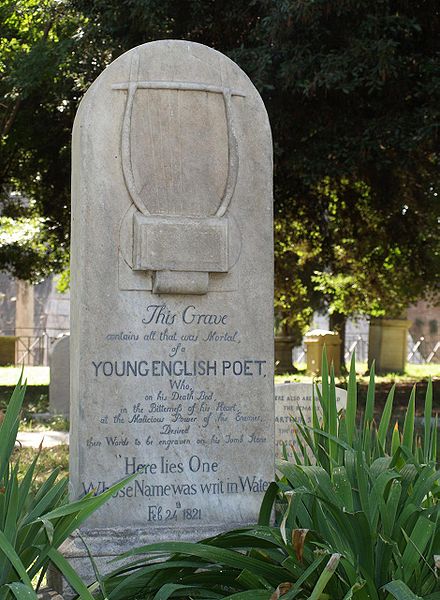
John Keats' grave, Rome

John Keats grave, Rome (Courtesy: Piero Montesacro, via Wikipedia, under CC-BY-SA-3.0)

The film has an elegaic feel – in its muted colours, slow pace, and the rather  (unusually so for a period piece) spare music. This spare use of (spare!) music is carried through to the credits during which, instead of music, we hear Ben Whishaw recite Keats’ poetry. Despite its slow march towards its inevitable conclusion, however, the film also has some light moments, many of them in the lovely family scenes which include Fanny’s brother and sister.

One of the endearing things about the film is Fanny’s comment early on that poetry “is a strain” to understand. Poetry is not an easy art form – how many people have you heard say “I don’t get poetry”? – and there is something reassuring in having that validated.  After all, Fanny is, in a way, everygirl – compassionate but also a little wilful, somewhat coy but at the same time rather knowing. She is, as conceived by Campion and played rivettingly by Australian actor Abbie Cornish, entirely believable as a universal teen girl, but one living in the early 19th century.

In a scene between the lovers (albeit an unconsummated love), Whishaw, as Keats, recites the film’s eponymous poem:

Bright star, would I were steadfast as thou art–
Not in lone splendour hung aloft the night

Still, still to hear her tender-taken breath,
And so live ever–or else swoon to death.

Here is Keats expressing the paradoxical nature of life and love, the way permanence and impermanence can exist side by side. This is rather poignant given the facts of his life: he died at just 25 years of age but his poetry has become firmly entrenched among our classics.

If you are interested in Keats’ story, or if you like films that slowly but beautifully evoke a past era, then this is likely to be a film for you. If, on the other hand, you like something with a bit of zing and an element of surprise, then you might best look elsewhere… For me though, this film is “a thing of beauty”.
The boys are back

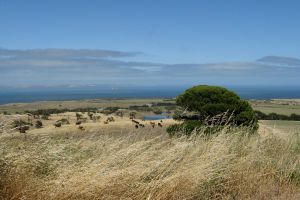
Fleurieu Peninsula

Southern end of the Fleurieu Peninsula, taken 2007

I would like to say that the real star of Scott Hicks’ latest movie, The Boys are Back, is the Fleurieu Peninsula because it is absolutely stunning. The rolling hills, the waving golden grasses, the glimpses of blue sea, not to mention wonderful stands of gums are enough to entertain even if the rest of the movie fails to. However, this is not the case. This is an enjoyable movie – not a perfect one, not a particularly innovative one – but an interesting story, well told.

The basic plot, for those who haven’t heard, is that sports journalist, Joe Warr (Clive Owen) becomes a single parent when his wife dies rather suddenly of bowel cancer. Having been a fairly absent father, and now grief-stricken, he is not well-equipped to parent his 6-year old son who is coping with his own grief and inability to fully understand the situation. Throw into the mix the sudden arrival of his 14-year old son from a previous marriage and you have the makings of chaos. And chaos is what ensues. Joe decides that the way to manage the all-male household is to have no rules – or very few anyhow – but as the movie progresses this does not prove to be a winning formula.

The cast is strong, with Clive Owen and Julia Blake (playing his mother-in-law) being the best-known names. The boys, played by young newcomer Nicholas McAnulty and George MacKay, are engaging but realistic. The music, by Hal Lindes, once a member of Dire Straits, is understated with just a bit of an edge, and effectively underscores the emotions without over-sentimentalising them. The cinematography is traditional but lovely – with an obvious but nice contrast made between golden sunny Australia and blue damp England.

The story is adapted from a memoir titled The boys are back in town by British columnist Simon Carr. It is sad and funny and, at times – perhaps particularly for women (says she being sexist) – infuriating as Joe misses clues from his sons regarding what they need. Housekeeping is not my forte but even I wanted to get stuck into the kitchen to bring it back to some level of organisation and hygiene, and as for silly boy stunts involving cars and the non-use at times of proper restraints – well, let us just say that I’m a mum!

There are some cliched moments, but overall the script is good and Hicks holds it all together to create a warm and tender but not simple movie about grief, parental and sibling love, and, really, just getting on with life when things don’t go your way. I’d recommend it. After all, if you find the story not to your liking, there is always the scenery!

The gritty viewing gets grittier…

Miranda Otto, 2006 (Photo by Diane Krauss, via Wikipedia, using Creative Commons CC-BY-SA-3.0)

Miranda Otto, 2006 (Photo by Diane Krauss, via Wikipedia, using Creative Commons CC-BY-SA-3.0)

A few months ago I wrote a post called A day of gritty viewing. Since then I’ve blogged about more gritty Australian films: Disgrace, Beautiful Kate, and Balibo. And these aren’t the only gritty films to have been produced in Australia this year. The latest to hit the cinemas, though, is Blessed (directed by Ana Kokkinos). This is one hard-hitting film.

It is an adaptation (by several writers including Christos Tsiolkas) of a quite differently titled play – Who’s afraid of the working class? – and is told in two parts. The first part follows the lives of 7 children, most of whom roam the streets under little or no parental control; and the second part explores their mothers, all of whom are battlers in one way or another. No back stories are provided for them but they’re not needed. Theirs are pretty archetypical stories so you get the picture:

  • the single mother addicted to gambling (Miranda Otto);
  • the serial monogamist mother who needs a man no matter how much damage he does to the children (Frances O’Connor);
  • the working mother with a weak husband who leaves it to her to keep it all together  (Deborra-Lee Furness);
  • the single piece-worker (and also religious) mother struggling to make a good life for her children (Victoria Haralabidou); and
  • the now-elderly mother who adopted an Aboriginal child and kept him apart from his mother (Monica Maughan).

It’s a wonderful ensemble cast – and there are more, including Sophie Lowe who also starred in Beautiful Kate. Through interweaving stories that never feel forced, the film explores the love between mothers and children and how too often this is strained by those external circumstances (most often poverty and the struggle to survive) that can get in the way of the ability to express “true” feeling. Some of the children have been damaged by experiences they shouldn’t have experienced (and I’m talking about abuse here of course) … which brings me back to the title and the double whammy contained in its combination of truth and irony.

It’s nicely shot by Geoff Burton. The night scenes, the strong contrasts, the minimal use of colour evoke well the challenges confronted by the characters in the mostly less-than-pretty parts of their city. Kokkinos direction is also sure, starting with the moving opening scenes of sleeping children which somehow manage to convey their innocence while also suggesting something darker lying beneath. If there’s a criticism to be made it could be that the film is just a little too politically correct. Not having seen the play I don’t know how closely it follows the original but there is a sense here of trying to get in all of society’s contemporary ills. That said, with strong stories and a cast that never goes near stepping over the bounds into melodrama, it works and you accept it.

I don’t always feel the need to avoid spoilers in a review – but I will here. I will simply say that it is gritty – but there is hope too, not in the sense of long-term answers but in a recognition that by reconnecting with the love that binds, you can keep going.

Balibo – the film

What to say about a film that is so close to the heart of Australia? Balibo is one of those films that leaves you sitting in the cinema for a while after it is over. This is not so much because it is stunning cinema but because of its emotional power.

East Timor (by Mats Halldin from Wikipedia, used under Creative Commons, CC-BY 3.0)

East Timor (by Mats Halldin from Wikipedia, used under Creative Commons, CC-BY 3.0)

For those who don’t know, the film tells the story of the disappearance in October 1975 of the Balibo Five and of the journalist, Roger East, who went looking for them soon after. The Balibo Five were five young Australian-based journalists who went to Balibo in Portuguese Timor (or East Timor/Timor-Leste)  to report on the worsening relations between that country and Indonesia which controlled the western part of the island.

The film chronicles two turbulent months from October to December 1975, and cleverly intertwines the story of the Balibo Five with that of Roger East’s search for them. The Balibo Five are shown to be young, idealistic, adventurous and, I have to say from the standpoint of today, a little naive. Roger East, who was lured to East Timor by Jose Ramos Horta to head up its fledgling news agency, was, on the other hand, an older man. He is conveyed as being, initially, a little unwilling to become involved in East Timor’s troubles but keen to find the young journalists. In the end, however, having discovered what had happened to the five, East remains in East Timor after all other western journalists leave. And that, as they say, is history.

The film, fittingly for its subject matter, has a documentary feel to it. It uses labels to situate us in the appropriate time and place. The story of the five journalists is presented using hand-held cameras and grainy archive-look images, which are intercut with actual archival footage and newspaper images of the time (repeating the technique used in that now classic Australian film Newsfront). And, framing all this, is (the recreation of) a present-day interview with a Timorese woman who met all six journalists when she was a young girl and they stayed at the hotel run by her parents.

The film is all the more powerful for what it doesn’t say – it doesn’t, for example, prosyletise on the inaction of the Australian government, nor does it rail against the Indonesian government. Rather, it tells its story through the horror of the events and the emotions of the people involved…conveyed convincingly by the cast involved.

Some call it a thriller. For me, though, it is too real and close to home to label it with such a “feature film” tag.  All I can say is that while it may not be the “best” film I’ve seen this year, and while the story may not be fully clear to international audiences, its emotional truth is real, and that is what I will remember when the details have faded.

Beautiful Kate?

Flinders Ranges (Photo: Georgie Sharp @ flickr, used under Creative Commons licence CC-BY-2.0)

Flinders Ranges (Photo: Georgie Sharp @ flickr, used under Creative Commons licence CC-BY-2.0)

[WARNING: SPOILERS, PROBABLY]

Well, I haven’t read the 1982 book by American novelist Newton Thornburg – in fact I hadn’t heard of it – but Rachel Ward has managed to produce out of it a stylish and engrossing film, aided by an excellent cast and gorgeous, often eerie, cinematography. It helps too that the film was shot in the remote but stunning Flinders Ranges of South Australia.

In case you haven’t heard, I’ll get it out now. The film deals with one of those big taboos – sibling incest. It is not sensational, it is not really voyeuristic; in fact it handles the topic with a great deal of sensitivity.  This is achieved partly by telling the story through flashback which, somehow, reduces the shock value and enables us to focus on the circumstances rather than the act. Forty-year old Ned (played with brooding but intelligent restraint by Ben Mendelsohn) returns to the family farm, with much younger fiancée (Toni, played by Maeve Dermody), to see his dying father (Bryan Brown). Also at the farm, caring for their father, is Ned’s younger sister, Sally (Rachel Griffiths). Ned, a writer, is clearly conflicted and has a prickly (to say the least) relationship with his father and so, as we’d expect, returning to the farm releases the ghosts of his past. This past includes a mother who died when he was young, a father who was rather harsh and domineering, and a twin sister (the Kate of the title played by Sophie Lowe) and older brother (Cliff), both of whom had died tragically in their teens. Mostly through flashbacks, the film explores the last summer in Kate and Cliff’s lives, and the events which led to their deaths, events which have reverberated for Ned ever since.

It’s not a particularly innovative film. The transitions between present and past are handled pretty traditionally – mostly fades triggered by an action, object or sound – but they are nonetheless smooth and subtle. The landscape, which is beautiful but stark and somewhat desolate, provides a perfect backdrop for the characters’ emotional lives. And the music, particularly Tex Perkins’, to use a cliché, haunting rendition of “This little bird”, supports the film superbly. The end result is a sureness in the direction belying the fact that this is Ward’s first feature – it might be fairly traditional in style but it is definitely not boring.

I do though have a small quibble with the story. I saw the film with two other people and all three of us struggled a little to understand Kate and the motivation for her behaviour. (Of course we are seeing it all through Ned’s eyes, but it does appear from other clues in the film that his eyes are reliable). Was it being motherless? Was it their isolation (their father insisted they be home-schooled through School of the Air)? Was it indeed this harsh remote father? Or, was it jealousy? This is a bit murky and spoils a little our full understanding of the situation – and, rightly or wrongly, it seems to lay much of the blame for what happens at her feet. That said, Kate is not demonised. Rather, she is presented (and played beautifully by Lowe) as charismatic, lively and risk-taking, but as trapped on a stage that is too small for her energies.

The resolution is pretty traditional but is not mawkish – we can’t help feeling glad that Ned comes to some rapprochement with his father, that he has put his ghosts to rest and that he may now move onto a more settled future. This is a gutsy feature debut for Ward – I look forward to her next one.

Disgrace-ful

Well, I finally got to see the film adaptation of J.M. Coetzee’s Disgrace today. Before seeing it, I was a little surprised that it only had an (Australian) M rating. From my memory of the book I was rather expecting an MA rating. I was slightly disappointed in the film: it’s not that I want to watch explicit “stuff” (in fact I often close – or half-close! – my eyes during realistic violent scenes on film) but I did feel that this adaptation somehow missed the full menace of the book. The book is hard to forget. The film, while engrossing, did not seem to have quite the same punch. I’m not quite sure why that is – it could simply be that having read the book, I was too prepared for what was to unfold for the shock value to work.

Interpretation of Disgrace, by Andre Pierre @ flickr.com, Creative Commons Licence 2.0

Interpretation of Disgrace, by Andre Pierre @ flickr.com, used under Creative Commons Licence 2.0

That said, I’m glad I saw it. But first, a brief synopsis. David Lurie, an English professor at a university in Cape Town, is forced to resign after some rather “improper” behaviour with a female student. He goes to stay with his daughter on her remote farm and while he is there they are brutally attacked. What then unfolds is how this impacts each of them – and in particular how he gradually sees the consequences of some of his own previous behaviours. Despite, though, some growth within Lurie, it is not a cheery film.

JohnMalkovich did a good job of portraying the complexity of David Lurie. Lurie is not an easy character to understand – after all, it seems he barely understands himself – but Malkovich goes a long way towards “explaining” him. Lurie is a man who, in his time, has “preyed” upon women taking advantage of the gender (and other) power imbalances between him and them, but who is forced to face (horrific) reality when he and his daughter become victims themselves of power imbalances. Ironically, rape (the ultimate expression of gender power imbalance) is used to usurp the racial power imbalance that is entrenched in South Africa.  The personal is clearly the political in this story. Newcomer Jessica Haines beautifully plays his daughter, conveying well the fragility that lies just below the surface of her strength. Her reaction to what happens to her and her decision regarding her future are hard for us to comprehend but, like her father, we do come to some understanding even if we’re not sure we’d do the same!

The cinematography is spare mirroring the spareness of the book. The landscape is beautifully rendered, but only to convey its harshness. The pace is measured – shots are unhurried, allowing the ramifications of the events to sink in slowly with us as they do with the characters. The score has a gravitas that adds force to the drama being played out. And yet, and yet … perhaps all this gives it an elegaic tone rather than the menace and despair I found in the book. Coetzee’s post-Apartheid South Africa is not a pretty place.

Early in the book – and the film – David uses the word “usurp” by which he means to intrude or encroach upon. This is the subject of the book: the fact that nations and people (black-white, male-female, teacher-student, parent-child, person-animal) usurp upon others/each other. While the film does not quite explore all of these with the richness of the book, it conveys enough for us the get the gist! I would imagine that Coetzee is not dissatisfied with the outcome.

(If you haven’t seen the film, see the trailer here.)

Cute but not cutesy

Courtesy:CKSinfo.com

Courtesy:CKSinfo.com

Cute has become a much maligned word but it originated as a shortened form of acute and meant  “keenly perceptive or discerning, shrewd”. This, I think, works well as a description of Sarah Watt‘s latest film My Year Without Sex, particularly when combined with more recent meanings of the word such as “charming”.

(WARNING: SOME SPOILERS)

The basic premise of the film is how a couple copes when the thirty-something wife and mother, Natalie, nearly dies from a brain aneurysm and is advised, on her discharge from hospital, that one of the risk factors is sex! Natalie (Sacha Horler) and Ross (Matt Day) learn earlier than they expected just what those marriage vows, “in sickness and in health”, imply.

Not surprisingly from the title, the film is structured around the months of the year, each month introduced with a different graphic accompanied by a sexually suggestive word/phrase such as “foreplay”, “faking it”, “doggy style” and “climax”. This could come across as artificial and contrived – and it does break up the narrative a little – but its overall impact is whimsical and fun. And it shows off Watt’s roots in animation and design.

The film teases us at times by undermining what we have come to expect of drama – an overlooked scratchie does not turn out to be a winner, a strange older man talking to a young boy does not turn out to be a pedophile.

Sarah Watt has said that “I love the big ticket life questions writ upon small domestic stories”. This is what informed her previous feature, Look Both Ways, and what informs this film. The people are very ordinary: as Natalie says, in answering her child’s question about whether they are middle class, she would like to be a “bit closer to the middle of the middle”! They live an a small, messy suburban home and cope with the day-to-day issues of job insecurity, Christmas shopping, kids birthday parties, and friendships as well as the bigger issue of “what does it all mean”?

The film deals a lot with “chance” and “luck”, from the low-odds chance of experiencing an aneurysm and the luck of its occurring in a doctor’s office, to raffles, scratchies and playing the pokies. Probably life’s biggest lottery though is one’s choice of partner and this is where Natalie and Ross, in the end, discover their best luck lies.

My Year Without Sex is one of those delightful films that does exactly what I would like more films to do – tell Australian stories in a very Australian way, that is, down-to-earth but with a touch of cheeky humour.

A day of gritty viewing

I went to two films today: Mary and Max this afternoon and Samson and Delilah this evening. Hmmm…both films are named for their two main characters. What an interesting coincidence. Both films are also slow-paced aiming, I think, to give a sense of “real time” but, while Mary and Max is a highly verbal film, Samson and Delilah is almost silent. Both are powerful though.

The claymation Mary and Max is Adam Elliot’s first feature. If a film could be called an epistolary film then this would be it, as the film is primarily about the penfriend relationship between Mary in Australia and Max in New York, and much of the story is carried through their letters and voice-over narration. At the start of the film, Mary is 8 and living in a rather dysfunctional family, and Max is 48 and living alone. Max, it also becomes clear, has Aspberger Syndrome. The thing, though, that draws them together is that both are lonely and want a friend. Mary and Max’s individual lives are beautifully realised – exaggerated and yet real at the same time – in gorgeous claymation detail. The music – including Elena Kats-Chernin’s rather eerie Russian Rag (introducing Max’s life in New York) and Pink Martini’s jangling Que sera sera (at Mary’s crisis point) – is perfectly chosen to convey the darkness behind the comedy. While the film makes you laugh, it is not a cheery film – and yet, it is also strangely affirming. Its point at the end is that we are all imperfect but that if  we accept our own flaws and tolerate/forgive the flaws in others we can have meaningful relationships.

Samson and Delilah is another thing altogether. It is an amazingly sustained movie in which little is said and in which both a lot and at the same time very little happens. It is set in a tiny indigenous community in central Australia and tells the story of two teenagers and the relationship that develops between them in an atmosphere of dislocation and cultural breakdown. When circumstances result in Samson and Delilah hitting the road together, things go downhill rapidly as they struggle to survive in a town (Alice Springs?) unfriendly to those who appear to have nothing. The film covers a lot of ground including petrol sniffing, homelessness, violence, and exploitation of Aboriginal artists. While it has some light touches at the beginning, it is pretty unremittingly bleak: it is hard to retain dignity when you are given little respect and have nothing meaningful to do. Interestingly, the message seems to be that women are the strong(er) ones, and that they are (might be) the key to the future. But the film’s resolution is a qualified one – you do not leave this film thinking all is, or even will in the near future be, well.