Russell Drysdale at Tarra Warra

English: Photograph of Australian painter Russ...

Russell Drysdale with canvases, 1945 (Photo by Max Dupain. Presumed Public Domain, via Wikipedia)

If you’d asked me to name an Australian artist when I was young, two names would have popped into my head – Russell Drysdale and the indigenous artist Albert Namatjira. As I grew up, other names came to the fore, such as William Dobell, Sidney Nolan, Margaret OlleyMargaret Preston, Jeffrey Smart, and Brett Whiteley, not to mention newer indigenous artists like Rover Thomas and Emily Kngwarreye. Russell Drysdale, in fact, disappeared a little from view – at least, I stopped hearing him mentioned. So, when I discovered recently, via Lisa of ANZLitLovers, that the Tarra Warra Museum of Art in Victoria was having a Russell Drysdale exhibition on the theme Defining the Modern Australian Landscape, I knew I wanted to see it. Fortunately, we had a trip planned to Melbourne during the exhibition. Guess where I went this week!

The thing I have always liked about Drysdale (1912-1981) is that the paintings I knew were simple – in the stark sense, not in the meaning sense! This starkness equates, for me anyhow, with the spare in writing – and regular readers here know that I like the spare. I love the fact that paintings that look simple or easy to comprehend contain layers of feelings and ideas that only become evident if you spend time looking at them. But, of course, as usually happens with exhibitions of an artist’s oeuvre, I learnt things I hadn’t known in my simple (and here I mean simple in terms of understanding) youth. Here are some of those things* …

Drysdale’s early landscapes were rejected by the Modernists

Apparently, the Melbourne Modernists didn’t think landscape was a proper subject for art – despite the fact that Drysdale’s landscapes, particularly those from 1940-1941 when the criticisms were made, were not pretty or simplistically representational. One of his artistic influences was Modigliani, which is obvious in the elongated figures he painted into his landscapes in the 1940s, such as his 1941 “Man feeding his dogs”.

As time progressed, however, his images became redder, starker and darker – and yet, the exhibition tells us, he wrote in 1956:

The vast spaces of the north, endless and old. It’s very hard to reorient oneself. Outside the traffic rushes by as in every city. The hurrying crowd, dressed and neat, and rain splashing on the roads. Neon lights and no stars; but the loneliness of the desert plains seems friendly, and infinitely peaceful. (Drysdale’s journal, 13/10/56)

Friendliness and peacefulness are not, I think, the usual feelings you take from his outback paintings. There is certainly the loneliness, but alongside it is a sense of the hardness of the life, of resignation, and, more positively, of resilience. But, there is also, from the painter, a sense of respect and affection. I found, via Google, an oral history interview he did with Hazel de Berg in 1960, in which he said of the landscape:

It is an environment which I love and which I like to go back to, and for me it has a tremendous appeal, it is continually exciting, these curious and strange rhythms which one discovers in a vast landscape, the juxtaposition of figures, of objects, all these things are exciting. Add to that again the peculiarity of the particular land in which we live here, and you get a quality of strangeness that you do not find, I think, anywhere else. This is very ancient land, and its forms and its general psychology are so intriguing as compared to the other countries of the world that it in itself is surprising.

I wonder what Murray Bail would say about this?

Drysdale was rejected for war service

Drysdale had a detached retina from his teens, which left him essentially blind in one eye and hence unfit for war service, so he (unofficially) contributed to the war effort through his paintings. During the Sydney Harbour submarine scare of 1942 he moved to the safety of Albury. His paintings at this time included soldiers on the Albury station platform. I had not seen these paintings before and found them particularly moving – dark, somewhat disproportionate figures that look weary but resigned. There’s “a man’s gotta do what a man’s gotta do” sense about them. (See Soldiers, Albury Station, 1942.)

Drysdale was concerned about environmental degradation

In 1944 the Sydney Morning Herald commissioned Drysdale and a reporter to record the effects of the severe drought that was occurring in western New South Wales. His drawings of dead trees and animals, eroded landscapes, and tired people were printed in the newspaper, and brought him to wider public attention. The exhibition included reproductions of these newspapers. Newsprint is not the ideal medium for such works, but you could still see the power of his feelings about what was happening to the land and the people. The works (paintings and drawings) that came out of this time include somewhat Dali-like surreal but also grotesquely anthropomorphised trees.

He went on in the late 1940s to paint scenes from the old gold mining towns of Hill End and Sofala. The exhibition notes talk of his depicting the impact of “bad farming, reckless mining and unrestrained civic expansion”.

One of the most famous paintings which comes from his Hill End-Sofala period, The Cricketers (1948), is in the exhibition. Its depiction of cricket players dwarfed by stark buildings in a destitute landscape is not the usual way this subject is rendered.

Drysdale was one of the first modern Australian artists to paint indigenous Australians

The exhibition included a few paintings from the 1950s to 1970s which depict Aboriginal people. The exhibition notes describe his concern and empathy for Aboriginal people, for the way they’d been “relegated to the margins”. The notes explained that he first depicted them in the traditional “white settler view of forlorn people”, but then moved to showing them as “silent figures standing in their country” and finally onto a more “abstract representation of their mystic connection beyond the material world”.

One of the strongest paintings from this period in the exhibition, and one of my favourites, is “Bob and Maudie” (1972).

I’m going to finish on a quote that was not in the exhibition, but that I can’t resist. It comes from his longstanding friend, artist Donald Friend. Friend wrote:

He loved gaiety and wild talk and drink, laughter, companionship. Everything, in fact, that was unlike those superb sad empty pictures he made in which a town was an empty street, a pub was one bored man leaning against a verandah post.

Well, he was, like me, the Aquarian – the escapist who could disappear into other shapes…

It’s interesting – the notion of escaping into darker reaches – but Drysdale isn’t the only person to do that, is he.

* Unfortunately, because Drysdale died in 1981, his paintings are still in copyright and so I can’t include any here. However, a Google Images search on his name will retrieve many examples.
Griffyn Ensemble’s 2013 Elements of Canberra season

The Griffyns ended their 2013 season on a high … literally (in a performance of “Southern Sky”) and figuratively (with beautiful playing under somewhat challenging circumstances … but more on that anon).

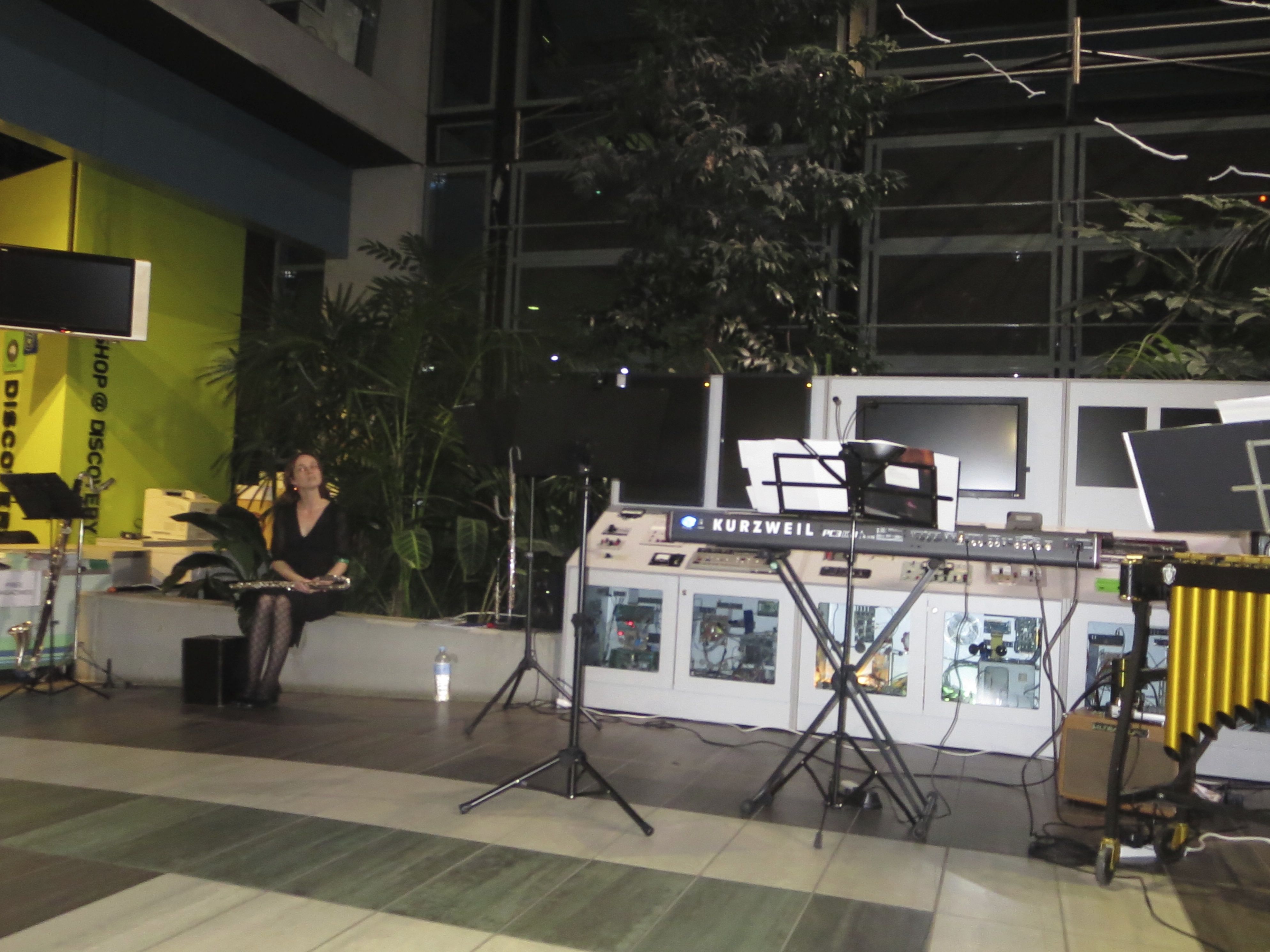
Griffyn Ensemble, CSIRO Discovery Centre

Downstairs, CSIRO Discovery Centre (A bit dark for my digital compact!)

You have to be hardy to be a Griffyn Ensemble follower. You never know where you will have to go to hear their next concert. In this Canberra Centenary year for their “Elements of Canberra” season, we went to the Belconnen Arts Centre ( “Water”) where the lovely Lake Gininderra forms a backdrop, the CSIRO Discovery Centre ( “Earth”), the TAMS Depot industrial hangar (“Air”) and the roofless shell of the ruined telescope on Mt Stromlo (“Stars”). These are not your usual concert venues with plush seats. In fact, a couple required some serious rugging up, but if the musicians are prepared to perform in these atmospheric venues, their loyal followers are clearly prepared to join them.

I haven’t written about the Griffyns this year since the first concert, mainly because we headed off overseas the day after the second concert and had only just returned, with all the concomitant catching up to do, before the third. (Indeed we sandwiched our trip to fit between these two concerts). I don’t plan to review them now. As I’ve said before, I’m not a musician. What I know, technically, about music you could fit on a clarinet reed. But, I do like music that moves, entertains, wows and challenges me – and this is what the Griffyns do for me. So, instead of writing a review, I’m just going to do a little recap of the other three concerts of the season.

It is not necessary to understand music; it is only necessary that one enjoy it (Leopold Stokowski)

The second concert was themed Earth, focusing on Trees and celebrating National Science Week. It took place in the CSIRO Discovery Centre’s atrium, where we were surrounded by trees, and displays and models from nature. It was mid-August and therefore winter in Canberra. Just as well we brought our winter woollies as the Griffyns took us on a musical and physical journey, upstairs and downstairs in this atmospheric, open-plan-glass-walled building. The concert was accompanied by a stylish booklet designed by local artist Annika Romeyn (whose illustrations were on display at the concert). That concert was some time ago now – or at least, I have done much since then including a 2-month overseas trip – so the memory has dimmed. It was, however, a typically eclectic Griffyn concert, as Annika Romeyn describes on her blog. It started with Finnish composer Kaija Saariaho‘s lovely, wistful piece “Fall” which, to me, had at times a rather Japanese sound. It featured the harp (Meriel Owen). And it ended with Michael Sollis’ composition, “City of Trees”, which was commissioned by Robyn Archer for our Centenary. In between were pieces like Martin Wesley-Smith‘s now well-known and fun “Caterpillar”; German-American composer Ursula Mamlock’s “Der Andreasgarten” featuring critters like dragonflies and hummingbirds; an arrangement of Cold Chisel’s “Flame Trees”; and, dear to my heart, Michael Sollis’ “Song of Trees”. It was composed for the opening of the National Arboretum and comprises an extensive list of tree names starting, of course, with gums. It was sung with aplomb by the Ensemble. You can read Clinton White’s review of this concert at CityNews.

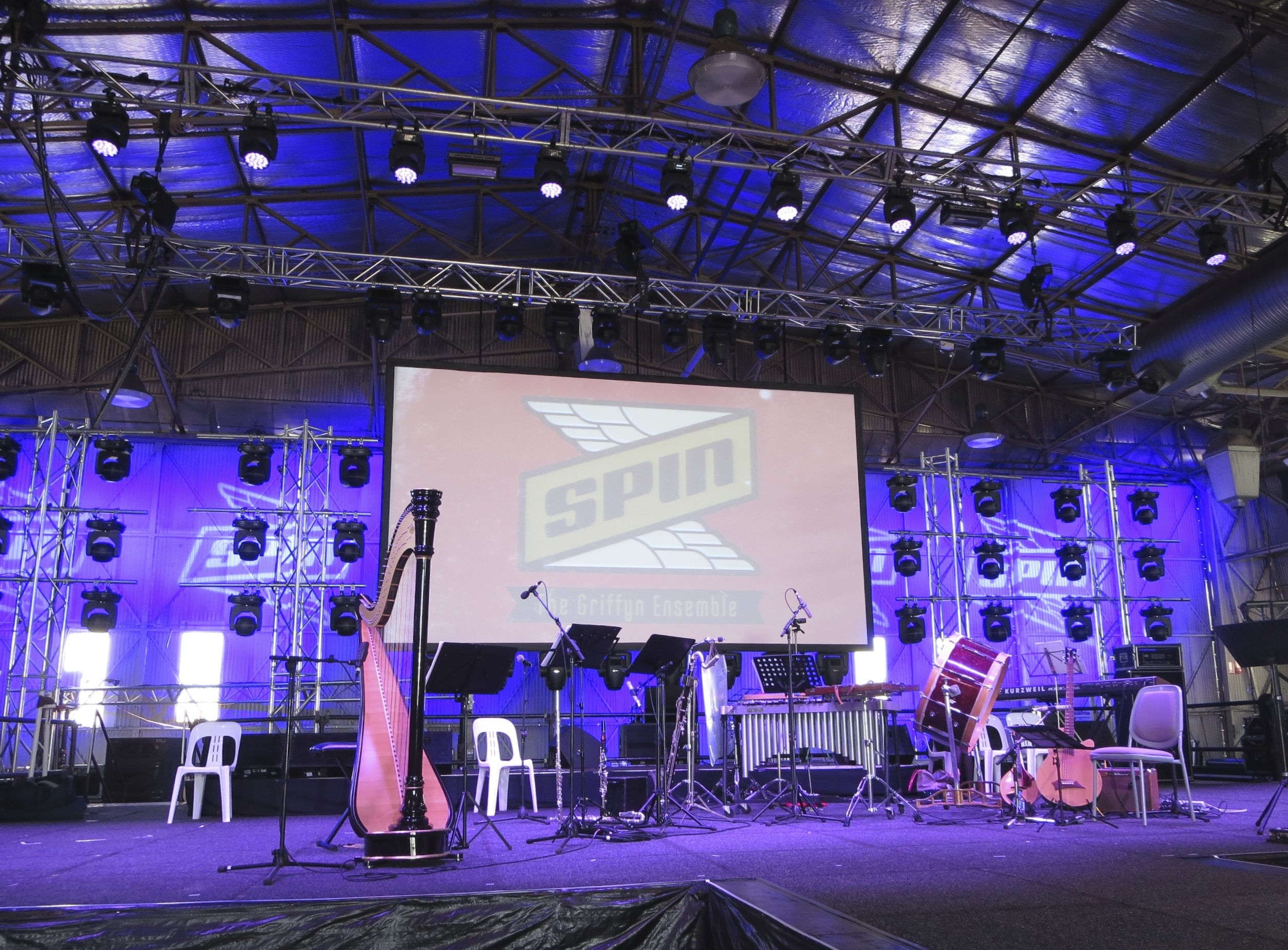
Griffyn Ensemble, TAMS Depot, Kingston

Griffyns in the Tams Depot, Kingston

The next concert, Air, saw us sitting around cable drums in an old hangar on, fortunately, a very pleasant Spring day. We were neither too cold nor too hot. This concert, which coincided with the SPIN Festival, took us travelling by train, bike, plane and even into space. It started on a light note with Luigi Denza’s “Funiculi Funicula”, led by the always-expressive soprano Susan Ellis, and included another ensemble vocal piece led by Ellis, Freddie Mercury’s “Bicycle Race”. As with all their concerts, this one featured some seriously virtuosic playing, particularly from Kiri Sollis (flute) whose “The Great Train Race” (by Ian Clarke) was breathtaking and Matthew O’Keeffe who pushed his clarinet to surely its highest registers in “Someone is learning how to fly” (by Marie Samuelson). The final piece was Brian Eno’s mesmerising, eerie “Music for Airports” (first movement). It’s some 15 minutes or so long and rather repetitive but I could have listened forever. Dare I say I could imagine doing yoga to this, lifting my spirit while contorting my body!

Mt Stromlo burnt out telescope

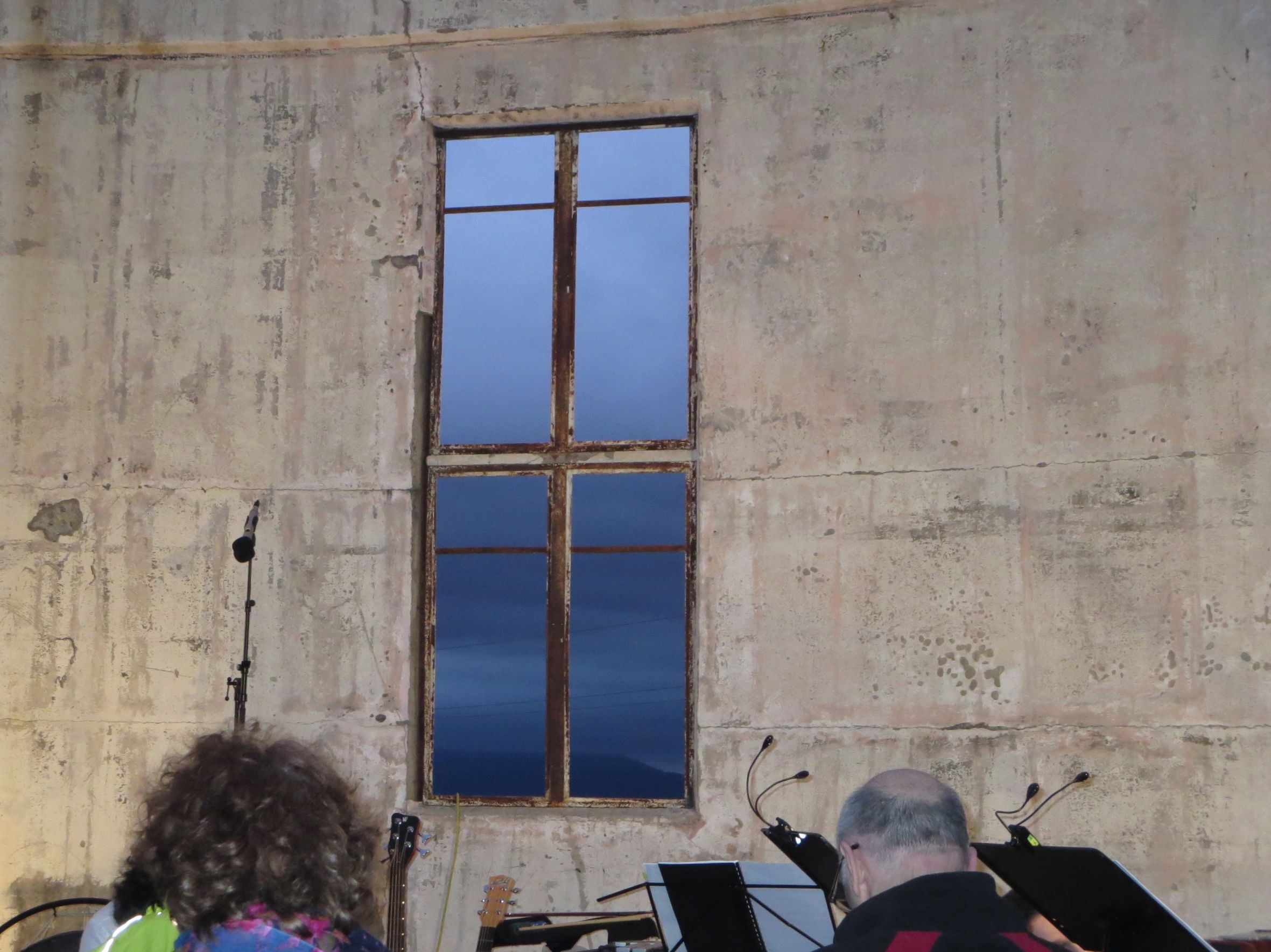
In the roofless, burnt out telescope on Mt Stromlo

The year ended on something a little different, because, unusually, the whole concert comprised one multi-movement piece called “Southern Sky” by Estonian Urmas Sisask who was inspired by his visit to Australia in the 1990s. You can read an excellent review of the concert on the Canberra Critics Circle blog. I really can’t add anything to what they’ve said. It was cold but, luckily for us (and the musicians), the rain that fell a few kilometres away on my house missed us. The piece, arranged by Michael Sollis, shows off all members of the Ensemble (as the above-mentioned review describes). It was magical, spoilt only by the fact that the cloudy sky meant that astronomer Fred Watson could not actually point out any of the constellations represented in the pieces. I did love seeing Wyana O’Keeffe back in her percussion spot. We’ve missed her this year while she’s been away on baby duties.

And so 2013 ended, a credit to Michael Sollis and his impressive all-round musicianship. What a team they are.

The Griffyns have announced their 2014 season, which is themed “Fairy Tales” and will see them again collaborating, as they like to do, with other creators around town. I can hardly wait.

If you are interested, you can hear examples of some of the music we’ve heard on the links below – but note that many of the pieces will be somewhat different to the versions we’ve heard, as ours were arranged by Michael Sollis for the Ensemble’s particular mix of instruments:

With apologies for this self-indulgent post but, you know, it’s my blog and I’ll write what I want to!

Monday musings on Australian literature: Writers’ archives

Australian author and feminist Germaine Greer ...

Germaine Greer, 2006 Humber Mouth Festival (Photo: Walnut Whippet, CC-BY-2.0, via Wikipedia)

Having heard recently about the University of Melbourne‘s acquisition of Germaine Greer‘s archives and having written in last week’s Monday Musings about the biographer Hazel Rowley who spent hours researching such archives, I thought it would be worth writing a little about writers’ archives – their importance and challenges.

First off, I am, as many of you know, a (retired) librarian/archivist, so this topic is particularly dear to my heart. The personal papers or archives or manuscripts (terminology varies a bit) of significant creators are of course the lifeblood of researchers. Without them, writing biographies of people long gone is very difficult. Consequently, libraries often start negotiating for writers’ papers long before they die – to save that embarrassing, difficult vulture-like situation of contacting families after they’ve gone! Some donate outright, some sell (though money is tight so purchase is rare except for very significant papers), some are bequeathed, and some are donated through tax incentive schemes.

So, the first challenge is negotiating acquisition. I won’t detail the challenges regarding what is acquired, but this is another minefield. What does the library want? What is the creator prepared to offer? What indeed has the creator retained? Australians will know the story of the irascible Patrick White who wrote to the National Library in 1977 that:

I can’t let you have my papers because I don’t keep any. My manuscripts are destroyed as soon as the books are printed. I put very little into notebooks and I don’t keep friends’ letters as I urge them not to keep mine, and anything unfinished when I die is to be burnt.

However, wily that he was, this was not quite true, and some 16 years after his death, Barbara Mobbs, his literary agent and executor, pulled off what White biographer David Marr has called “perhaps the greatest surprise in this country’s literary history” by offering 33 boxes of White’s papers (including some manuscripts and correspondence) to the National Library of Australia. Very exciting for Australia’s literary culture – but somewhat of an ethical quandary, because White did direct in his will that his papers be burnt. Mobbs couldn’t do it, and argued that if White had really wanted this to happen he would have done it himself. She knew him very well so we have to assume she was right. Anyhow, she waited 16 years, three years after the death of Manoly Lascaris, White’s partner of 49 years, before she made the collection known.

Another challenge is that of embargoes. Many people, when donating their papers, put embargoes on some or all of the papers, usually to protect those named within, effectively preventing the use of those papers (or sections) for years, often decades. This is pretty frustrating for the librarians who want to make their collections available and for the researchers wanting to use them, but at least the collections are secure for the future.

And then there’s the challenge of organising the papers and making them available. This is an immense task, with some ethical challenges of their own. I don’t know of any major cultural collecting institution that doesn’t have large backlogs of papers needing to be sorted, arranged, indexed/catalogued and now, these days, digitised. The first reports I saw of the acquisition of Germaine Greer’s papers implied that they were bought for A$3million which made Greer sound a little money-grubbing but it turns out, as Greer clarified on ABC’s Q&A last week, that $3million is the cost of the archives. Katrina Dean, from the University of Melbourne, writes that this amount includes “transport, cataloguing, indexing and digitisation”. She says:

Despite the efforts of archivists and digital scholars, much of the archival legacy of the 20th century [and presumably preceding centuries] remains untranslated into computer-readable language and accessible only to those with traditional archival research skills and specialised reference services.

And of course, only accessible to people who can travel to the place where the papers are stored.

Some specific writers’ papers

David Marr wrote his Patrick White biography while White was alive. He did not see the papers that the library acquired until, well, they were acquired at which time he went through them in some detail. He says they contain no great revelations that would make him want to redo the biography, but:

Jumbled and haphazard though they are, the notebooks are filled with biographical gold: scraps of diary, poems, reflections, lists of characters (121 for The Vivisector), the first pages of at least six novels in early draft, reams of detailed research for Voss (“Sydney hospital was known as Sydney Infirmary till 1881”), timelines, fashion notes and fragments of conversations overheard in the street.

Just by way of example, I thought I’d mention a few writers’ archives, and the works they’ve supported:

  • Christina Stead’s papers at the National Library of Australia were used by Hazel Rowley in her biography of Stead. Interestingly, and as often happens, Rowley’s papers relating to her research for the Stead biography are also held by the Library.
  • Elizabeth Jolley’s papers at the Mitchell Library in the State Library of New South Wales were used by Susan Swingler in her memoir-of-sorts, House of fiction. Brian Dibble, who wrote a biography of Jolley, Doing life, did the same. There are apparently embargoes on these papers, but permission can be sought to access them.
  • Mary Durack’s papers (in the Durack Family Papers) at the State Library of Western Australia were used by Brenda Niall in her book, True north: The story of Mary and Elizabeth Durack. (See my review)
  • Miles Franklin’s papers at the Mitchell Library in the State Library of New South Wales were used by Jill Roe in her book,  Stella MIles Franklin: A biography.

A small sample but, as you can see, these papers are spread around Australia, which is a good thing, really, in terms of preserving literary heritage. Now all we need is for them to be digitised and readily available to all, eh?

Villainesses thriving in Canberra

Now I know many Australians see Canberra, their national capital, as a soulless, boring, sliced-white-bread sort of place but not so. There is life here. Art is happening – and it’s fresh, vibrant and young. Not all our young people have left (yet!).

Last night Mr Gums and I went to the opening of a collaborative exhibition organised by a group of twenty-somethings. The theme was Villainess. It was chosen, as one of the collaborators Georgia Kartas wrote in the foreword of the accompanying booklet,

for its surface-level but nonetheless undeniable badassery. Heroes have quests, villains have motives.

This is not a politically-focussed feminist exhibition as its name could suggest – though by its very existence it makes a statement about young women and their sense of self, their confidence, their willingness to get out there and do something for themselves. No, in fact it’s a fashion photo shoot exhibition. It is fun, clever, wicked – and it is stylish, as you’d expect from a fashion shoot. You can read something about its origin and the creation process at hercanberra and at Georgia Kartas’ redmagpie blog.

The collaborators were Elly Freer (photographer), Laura McCleane (make-up artist), and Georgia Kartas (fashion editor). The clothing, the hairpieces, the props were all sourced locally.

The photographic subjects are – of course – villainesses and they were chosen by the models – Elly, Laura, Georgia and their friends. There are ten villainesses, and they come from literature, popular culture and mythology, ranging from the very modern, such as Elle Driver from Quentin Tarantino’s Kill Bill, to the very classic, like Medusa.

We loved the exhibition. The photographs are beautiful, and exude a delightful, but intelligent, irreverence which characterises the ethos of the exhibition. A lot of thought has clearly gone into the event, including the production of an accompanying booklet which contains written responses to the villainesses by local writers. These responses give the exhibition an extra dimension – reflective, and often satirical, or tongue-in-cheek. I particularly enjoyed Eleanor Malbon’s response to Elle Driver who was modelled by Elly Freer (what a coincidence in names here!) in which she manages to spoof both Quentin Tarantino and James Cameron (Avatar):

… All together, the problems of the world make a charge at Driver.

Flesh meets steel as she wields her swords. Elle Driver dunks soil erosion in a bucket full of gypsum. She rips the mask off charity programs to reveal their reinforcement of material inequality. Her bullets fly through the heart of the underlying causes of biodiversity loss.

You get the picture I’m sure. The booklet itself, designed by Sheila Papp, is a lovely piece of art and a fabulous memento of the exhibition.

Yep, a good night in which we saw the next generation of artists-creators strutting their stuff. What fun!

Villainess
Kaori Gallery, Cnr London Circuit and Hobart Place, Civic
7-9 November, 2013

Disclosure: I have known the photographer since she was a baby. Go Elly!

Monday musings on Australian literature: The Conversation launches its Arts + Culture Section

I think I’ve mentioned The Conversation before. It’s a blog produced by a consortium of Australian academic institutions. The posts are written by writers who are academics, and each post has a disclosure statement regarding whether the writer has affiliations with/receives funding from organisations that could “benefit” from their article. It’s a good source of thoughtful commentary.

They have “sections” such as Politics + Policy, Business + Economy, and Education. Today they launched their newest section, Arts + Culture. That’s exciting because while there have been articles before on arts-related topics, they’ve been scattered. I was a bit disappointed, though, I must admit, to see that on this launch day there are no articles (as they call their posts) devoted to literature but I suppose that’s the luck of the draw. There are articles on Visual Arts, Music, Film, TV and Gaming. I’ll be watching out for Literature.

Julian Meyrick, Professor of Strategic Arts at Flinders University, wrote the new section’s foundation essay, “Does Australia get culture“. He suggests we don’t. He says:

We are a country not without culture but without a sense of culture. That distinction is crucial. Australia does not lack art, artists or audiences. But as a nation we find it hard to see culture in any but consumerist terms.

He suggests two reasons for this – the fact that our language is English makes it easy to “free-ride the cultural goods and services” of the UK and USA, and that our history is ‘peaceful’. ‘Our cultural consciousness’, he says, ‘has never been pushed into sharp awareness by invasion or forced colonisation … unless you are indigenous of course’. Funnily enough, I read a similar point in my current novel, Christina Stead‘s For love alone. In it, an American character keeps describing an Australian character as English, and in terms of her Englishness. I was starting to wonder about this when he says, “She’s not English but Australian of course, but it’s the English race unadulterated by any revolution”!

But, that’s a bit by the by. The article is interesting but a little odd. For example, the author suggests that Australia doesn’t have a written constitution? Huh? What about this? But, I guess my main question to Meyrick is what does he mean by “culture”? It’s a rather nebulous term that can range from something quite narrow to something that encompasses pretty well everything about how we live. It’s not clearly defined in the article. I assume he’s focussing on “the arts”. And I think by “sense of culture” he is concerned about something that seems to have been crossing my reading quite a bit lately, the “Australian identity” – or what he calls “the internal order of value that allows us to articulate who we are”. Since “the arts” are the prime means by which we explore and present who we are, Meyrick’s “culture”, as I read him, is the exploration and presentation of the who we are via “the arts”.

At least I think that’s at the bottom of what he is saying, but I could very well be putting my own spin on it. Regardless, his concern is that these arts are constantly being frustrated, by a

situation whereby commercial imperatives block artistic ones because the internal order of value that should keep them in productive tension is not present to the needed degree.

I’m not sure that Meyrick completely explains what he means by this but I think I get his point. He concludes that Australia is good, however, at strong and bold cultural policy, and that all we need is good leadership from the centre. What do you think?