It is some time since I wrote about the ALS Gold Medal. This is not because I don’t think it’s interesting or worthwhile, but because there are so many awards, and I just don’t have the time to write up announcements for every award made each year. So, I pick and choose a bit, and this year’s ALS Gold Medal winner is – well, you’ll see … but first, a quick recap on the award.
As I wrote in my first post on the medal, it was established in 1928 by the Australian Literary Society (ALS) – hence its name – but this society was incorporated in 1982 into the Association for the Study of Australian Literature (ASAL), and it is this organisation that now makes the award. The Gold Medal is awarded to “an outstanding literary work in the preceding calendar year”. Note that it is for a “literary work”, which means it can be fiction, poetry, memoir, biography, and so on. It is Australia’s longest-standing literary award, but there is no money attached to it, just a gold medal. This is a shame for the writers, but it is nonetheless an award that is well worth having.
The shortlist for this year’s award was:
- Jordie Albiston, Frank (documentary poetry)
- Stuart Barnes, Like to the lark (poetry)
- Katherine Brabon, Body friend (novel)
- J. M. Coetzee, The Pole and other stories (short story collection)
- Omar Sakr, Non-essential work (poetry)
- Sara M. Saleh, The flirtation of girls/Ghazal el-Banat (poetry)
- Alexis Wright, Praiseworthy (novel)
And the winner, announced on July 8, is
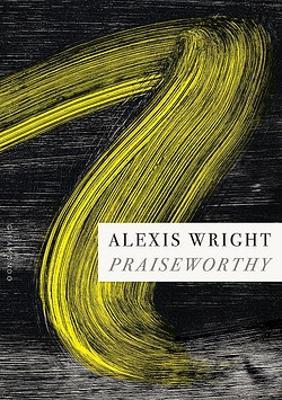
Alexis Wright’s Praiseworthy
How apposite for Wright’s win to be announced in NAIDOC Week. This is the third time that Wright has won the medal. Books+Publishing, announcing this award, says that over the life of the award only two other writers have won it three times, and they are Patrick White and David Malouf. Those of you who read my Monday Musings post this week may remember that I observed that Alexis Wright and Melissa Lucashenko are the only writers who have won the Stella Prize three times. This woman, this First Nations writer, really is something, and I need to catch up my reading of her.
For the record, Praiseworthy has, so far, won the ALS Gold Medal (2024), the Stella Prize (2024), the Queensland Literary Award for fiction (2023), and the James Tait Black Memorial Prize (2023). It has also been shortlisted for the Miles Franklin Literary Award (2024).
This year’s judges for the medal were Elizabeth McMahon (academic and literary critic), Ali Alizadeh (literary writer and theorist), and Ann Vickery (poet and feminist scholar). According to Books+Publishing, the judges described Praiseworthy as “a novel for and of our time… hilarious, furious, poetical and painful”.
(BTW I haven’t read any of this year’s shortlist, but I have read two of last year’s including the winner, Debra Dank’s We come with this place).
 Whispering Gums
I feel sorry for the writers up against Wright, she is just a class above – well maybe not Coetzee. I read Sakr’s novel, Son of Sin, this year but didn’t write it up, for which I am sorry. And I follow Saleh on X-Twitter, I really should make the effort to buy this collection.
I think she is good Bill even though I haven’t read her for a while – her books are daunting for me in size, which is shallow of me I know, but there’s so much I want to read. I’ve picked up Praiseworthy a couple of times and love what I read but then I put it down.
What a shame you didn’t write up Sakr.
What a great achievement! It sounds like an epic of a work and has also attracted so many awards. Congratulations to Wright!
Thanks Treble Clef … she’s an impressive writer.
Every time you post about an award, I have to reassess my feelings about awards. Ha! Now I’m wondering about the benefit of awards that allow the same person to win repeatedly. Most competitions don’t let you do that, from calling in to the local radio station to Jeopardy! If a prize includes money, that money can help a new writer find their feet. I know Cheryl Strayed talked about living off of credit cards while writing Wild, and when she received a check for the book, it all went to paying back what she borrowed just to write the novel. Also, these prize books become prominent and are more likely to be read. Therefore, I feel that people should only be allowed to win once. I believe it was the Women’s Prize that Atwood has won a few times, and people asked why she needed to be entered into competitions.
These are good questions Melanie. I guess it depends on what the award “means”. I know it is hard to pick winners in creative endeavours because there’s no objective measure, so my points here are tossing around ideas rather than arguing for one case or another.
If an award is supposed to mean “the best”, however you define that, what does it mean if the winner is only chosen from other non-winners because previous winners were not allowed to enter. What does such an award do for readers looking for the “best” writing, if some of the best writers are excluded from the pool?
However, I totally understand the point about spreading the money around – and particularly to those who need it – but I think that might be better done via a different mechanism to “best” type awards. Like, perhaps, grants and fellowships, or unpublished manuscript and debut book awards?
However, the idea of one writer winning “too many” awards is not new in the literary world. Patrick White – Australia’s only Nobel Laureate to date – won a couple of Miles Franklin Awards and then refused to accept any more awards. This was before he won the Nobel. When he won the Nobel Prize, he did accept it, but then used money from the prize to establish a trust to fund the Patrick White Award, which ever since then (mid 1970s) has been given annually to established creative writers who have received little public recognition. It’s a special award I think, and has often gone exactly to the sort of writer he intended. Elizabeth Harrower, a subject of my most recent post won this award, as did another favourite of mine who us under-recognised, Carmel Bird.
As usual, then, I have mixed feelings about this, but in general I think the idea of disqualifying people who have won an award can devalue the award, but on the other hand I know that (1) awards are subjective so are fraught anyhow in terms of their meaning, and (2) new writers need all the money and recognition they can get. It’s an imperfect world, but I think we should try to accommodate a range of ways of recognising and supporting writers.
I think I would be on team Patrick White.
As always, I’m on the fence – haha.
Even when I think an author/work is tremendous, I find myself wriggling around when they claim multiple prizes (also because I think it must slam down upon the writer afterwards too, as though “it’ll never get better than this”, even though, in the context of problems-to-have it’s a good one). This year the same novel won both the Carol Shields Prize for Fiction (by women) and the Women’s Fiction Prize (the former being arguably more North American and latter arguably more British) and even though I loved the novel and found it remarkable I still wanted to see two different winners ultimately. For me, I tend to think that repeatedly selecting the same book as a prizewinner could reflect an objectively acceptable or responsible choice (or a lazy one, if feeling cynical) rather than the subjective reality that different readers always have different favourites. You know I find prizelists very helpful, so I’m not dissing them, and I don’t begrudge a talented writer multiple kinds of recognition (and financial encouragement/support)…but it niggles sometimes.
Thanks Marcie … I understand all this … for me as a reader, I see these awards and I look forward to seeing a different title win the next award, though also a multiple win will make me sit up (notwithstanding the questions I might ask about why.)For the writer who wins multiple awards it must be validating but also increase the pressure to perform next time!