When I announced the two winners of Finlay Lloyd’s inaugural 20/40 Publishing Prize, a few days ago, I said I planned to read them for the Novellas in November challenge/meme/reading month. (What do we call these things?) So here, now, is my post on the first I’ve read, Rebecca Burton’s Ravenous girls.
Rebecca Burton, as I’ve said in previous posts on the prize, is an editor, and author of two young adult novels, Leaving Jetty Road and Beyond Evie, both published by HarperCollins Australia. This book, I’d say, is a cross-over. It could be read by YA readers, but its subtle perspective of looking back from some years later, means that it is particularly geared to adult readers.
Finlay Lloyd writes on their website that
Stories of family dysfunction often expose us to relentless failure. And while Ravenous Girls is about the tensions and growing distance between two sisters—the elder burdened by anorexia, the younger by self-doubt—it is distinguished by its lithe and tender understanding of the complexities of growing up.
It is, I suppose, a story of family dysfunction, but in the sense that most families, dare I say, can be dysfunctional to a point. By this I mean that many families face trauma and challenges that can affect how well they function. Which is the chicken, which is the egg? It’s probably not worth much going there – and this book doesn’t. Nonetheless, there is a bit of backstory to why things may be the way they are.
So, Ravenous girls. It’s told first person from the point of view of 14-year-old Frankie, which puts her slap-bang in the coming-of-age category, and like most her age she is unsure about who she is. She feels “the wrongness of me”, which includes sometimes being “too much me”. She is challenged by her friend “racing away” from her, as can often happen at this time of life, with neither the racer-ahead nor the left-behind having the tools – the experience – to manage it gracefully. Frankie feels the loss deeply, just when friendship is most needed.
Meanwhile, Frankie’s family life is challenged by the fact that Justine, her seventeen-year-old sister, is, as the book opens, about to enter an Eating Disorders Unit as a live-in patient. The third person in this family is Iris, their mother. She – and all of them – still suffer from the premature death of husband and father some eleven years earlier. I have seen this happen – a mother’s grief over the early death of her husband derailing family relationships. That seems to be part of the situation here.
The story primarily covers the months over the summer holidays when Justine is in hospital. Frankie, at loose ends because friend Narelle has secured a holiday job, visits Justine every day. She observes Justine, and thinks about what is happening to her and why. She and her mother attend, with Justine, a poorly-handled family therapy session, and she also attends a family support group. Neither of these provide much help or support. She doesn’t see either Justine or her family in these, so she continues to try to work it out for herself. She sees her mother’s tiredness and pain, and she sees there is no space for her own concerns when Justine’s needs are so great, which is something Justine, bound up in her own growing-up challenges, doesn’t appreciate.
What elevates this reading from what could have been a “woe is me” tale are the occasional foreshadowings or hints from later Frankie, telling us what she now knows, or in some cases, still doesn’t know. These references play several roles, from recognising their naiveté at the time (“It astonishes me now that this is the way we thought”) or her own self-absorbed inattention (“maybe if I’d listened more carefully”) to sharing lessons learnt or hinting that character development had occurred (“But now I think that I may have been a monster too”). Burton handles these later reflections adroitly – they add richness and depth without spoiling the conclusion or losing the tension or reducing our care for the characters.
The novella is set in 1985/1986 Adelaide, and Burton captures the era well – the political happenings from Queensland’s Joh Bjelke-Peterson to America’s Unabomber, the technology (cordless phones appearing, but certainly no mobiles!), the films and music. I could ask why the novel is set then, which is my usual question for novels set in the past, but, for a start, an earlier time-period is necessary to enable the inclusion of that perspective, I’ve mentioned, of the much older Frankie.
There are references during the novella to Frankie and her mum reading books about anorexia and other recovery memoirs – as readers will do when confronted by difficult situations. I liked this comment – or warning – about such memoirs:
It didn’t occur to me that what was truth for one person might not be true for another – or that the truth as people wrote about it wasn’t always the truth as they’d experienced it.
Fortunately, Ravenous girls isn’t a memoir!
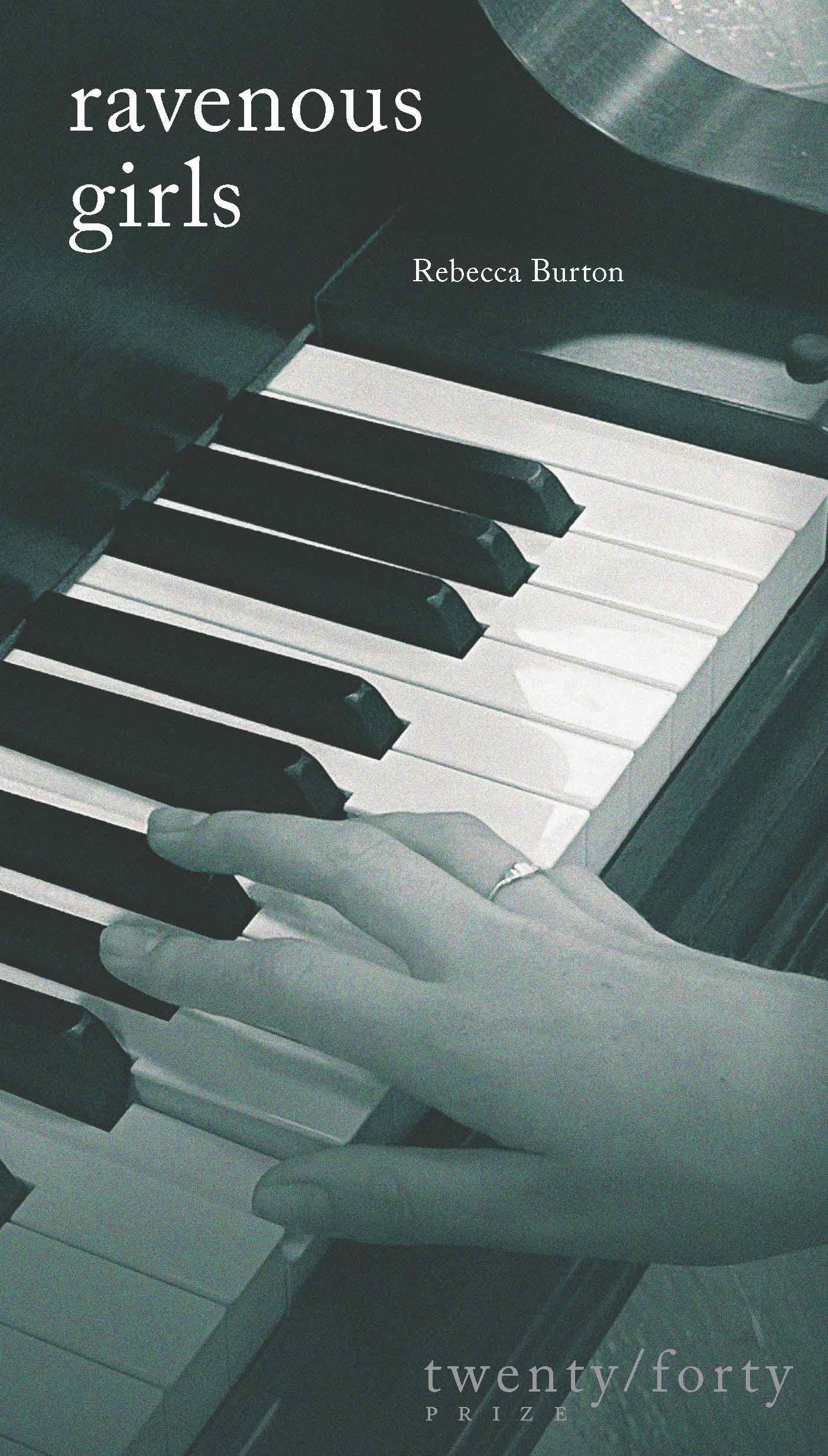
As with all Finlay Lloyd books, the design is gorgeous. It has their unique shape, a dust jacket despite being a paperback, and a stylish but minimalist overall design aesthetic with elements that carry through to the other winner.
Before I close I must mention the title, Ravenous girls, which relates to anorexia and the hunger its sufferers experience. In anorexia, as we know, the hunger, and hence the title, is not purely literal. For Justine, as she articulates to Frankie, it’s about “wants”: “I don’t want to want the things I want, you know?” “Ravenous” perfectly encapsulates the intensity of need explored here.
Ravenous girls is a compassionate book that sensitively charts the emotional ups and downs that are part of the anorexia landscape, and explores the helplessness about understanding what is such an individual and complex mental condition. It also conveys something more generally relatable about family relationships – sisterhood and daughterhood, in particular – and about how darned hard it is to grow up. But, grow up we do.
Read for Novellas in November. Lisa (ANZ Litlovers) and Theresa (Theresa Smith Writes) have reviewed both winners in one post, but I am doing them separately. Watch this space.
Rebecca Burton
Ravenous girls
Braidwood: Finlay Lloyd, 2023
103pp.
ISBN: 9780645927009
 Whispering Gums
I like the way you’ve unpacked this more than I did in my double-book post. Is this the one you read first? (I know why I chose it first, I liked the piano player on the front cover!)
Wow, I replied to this on my phone but it’s not appeared here. I am finding WP so frustrating at the moment.
Yes, I read this one first, and for a very boring reason – Burton comes alphabetically before Kelly! I like both covers – piano on one, a handwriting on the other. I plan, unless something goes awry to post on the Kelly next week.
14-15 is such a difficult age for girls – much more so than it is for boys, I think – that it must be quite odd to try and recreate it as an adult writer.
Interesting Bill. What do you think would be the equivalent difficult age for boys – or is there not one? Burton has written a couple of young adult novels, so she’s probably a bit in the zone and doesn’t find it odd representing that time in girls’ lives.
Boys famously get moody and non communicative, but girls seem entirely consumed by negotiating those couple of years.
Thanks Bill … and yes, you are right about the moody and uncommunicative! That was certainly Son Gums during those years. But, don’t you think that’s just a different way of being consumed by negotiating those years? As a parent, I found both challenging to deal with, just because your heart goes out to them, but you can’t do it for them. We all have to get through it, one way or another.
Heheh What do we call them, indeed. I feel like sometimes it actually is a challenge so I revert to that term we all used when everyone-and-their-mother was setting up a blog to write about their weekend shopping and how many kilometres they ran before breakfast but also what books they read. Other times it feels like an event, which does feel more appropriate somehow when there’s either a longer time period (e.g. a month or a year) or a much shorter one (e.g. the Persephone press reading events for instance, perhaps more memorable for U.K. readers).
I like the sound of how she’s taken self-awareness and understanding to make this a more complex story; I suppose this is another way of playing with time in a story’s telling, without it feeling like it’s about time.
It feels like there is an authenticity to this book. When you described how therapy didn’t work, that struck me because I hadn’t realized until much later in life that we may not click with a therapist, or he/she may not have the right approach for us. Then, we end up on a therapist hunt, trying to find the right person, because we have the right to do so. I know that my husband feels discouraged when he gets a therapist who doesn’t seem to listen, and he will want to give up completely.
Oh it’s so tricky isn’t it Melanie? And it can be really expensive trying to find the right one. In Australia there is a government supported mental heath plan, but it only covers a set number of sessions, so you can presumably waste sessions looking for the right therapist.
In eating disorders, in particular, the therapist can be the difference between life and death so finding the right fit can be critical.
I hope Nick doesn’t get frustrated too often.
We do grow up if we don’t starve ourselves to death. A friend of mine who recently read The Vaster Wilds by Lauren Groff commented on the number of times her female characters decide to starve themselves and die.
Absolutely true, Jeanne. I haven’t read Groff at all, so wasn’t aware of that in her work.
Added to my TBR
This one too! Of course … given I listed it.