I am not one of those readers who shun weird narrators. Indeed, you’ll find several in this blog, including a skeleton, a dead baby, a foetus and a mammoth fossil. The critical thing for me is not who the narrator is, but whether that narrator is convincing and offers a perspective that engages my mind and heart. Of all the writers I’ve read over the last decade, one that stands out in his ability to surprise and excite me with different voices is Chris Flynn. His short story collection, Here be Leviathans, is astonishing from its first page to its last in its array of narrators.
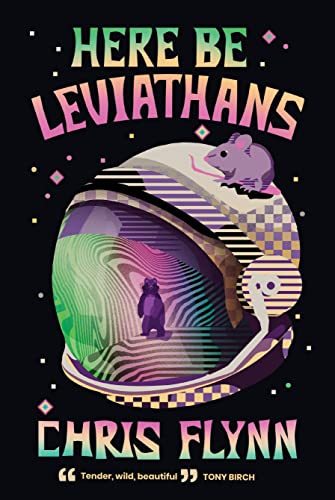
There are nine stories in this collection, and it is a testament to Flynn that by the second or third one I was fully invested in who would be the narrator this time. I was never disappointed, albeit they ranged from the animate (like the grizzly bear which opens the collection, in “Inheritance”) to the inanimate (such as the airplane seat which narrates the second story, “22F”).
But, before I continue with Flynn’s book, I want to share something he says in his also entertaining “Afterword/Acknowledgements/Blame apportioned” statement. Describing one of his stories as having been inspired by Thea Astley, he refers to his role as one of the judges in Meanjin’s Tournament of Books and shares the exact words of his that I quoted back in my 2013 post on that tournament:
Astley was the progenitor, the chain-smoking, wise-cracking, jazz-loving four times Miles Franklin-winning champion of linguistic manipulation whose style got on Helen Garner’s nerves and who pushed the envelope of Australian literature when no-one else had the cojones to do so.
Flynn’s work is different to Astley’s – time and experimentation having moved on – but he too pushes the envelope of Australian literature, which is why he was one of the writers mentioned the article that inspired my recent Monday Musings on weird Australian fiction. And like Astley, his interests are personal and political. He’s interested in the ways we live in the world, in the injustices we enact, which translates to a concern with issues like colonialism, the environment, and the fallout from an unbridled interest in progress. His touch might feel lighter than Astley’s – he can be laugh-out-loud funny at times – but fundamentally both writers question who we are as human beings. What does what we do say about who we are?
“What a piece of work is man” (Shakespeare via Albert VI)
So, let’s explore Flynn’s brand of weirdness, and why I enjoyed it so much – despite the fact that the opening sentences of the first story, “Inheritance”, were truly shocking:
I ate a kid called Ash Tremblay yesterday. Parts of him, at least. The good bits. The crunchy skull, the brain, a juicy haunch.
What is a reader to think? Fortunately, you don’t have to think very long because very soon our narrator outs himself (it is a “he”) as a bear. He shares a few home truths about humans and our assumptions and behaviours. If you ignore the gruesomeness – after all, a bear has got to eat – the story is pretty funny. Its ostensible subject matter is inherited memory – in this case the bear has inherited Ash’s memory – but it is also a work of ecofiction, which includes exploration of issues like sustainability and colonialism. It is refreshingly bold, asking us to envisage different ways of acting in nature, and, at 30 pages, it is also long. But who cares?
The second, much shorter story, “22F”, is also a work of ecofiction. Its first line seemed ordinary enough, “The first day in a new workplace is always nerve-wracking”. It is, isn’t it? As the story progresses, however, you start to wonder just who this new employee is until the penny drops, it’s seat 22F on a plane. After this story, I thoroughly enjoyed the challenge of working out who was telling each story as I started it. But, back to 22F. In his Afterword, Flynn explains that the story was inspired by the Werner Herzog documentary Wings of Hope about the sole survivor of a 1971 airplane crash. Herzog and that survivor, Juliane Koepcke, return to the site of the crash, and find parts of the plane in the jungle. Flynn writes:
Memory and place. A reminder that we are only passing through and that everything is part of something larger.
Along the way, though, he discusses other issues, like workplace behaviour:
Toilets are inveterate boasters and disgusting perverts. You can’t believe half of what they say.
Eventually 22F’s plane crashes, and while the bodies disintegrate reasonably quickly, 22F is “fashioned from material that does not break down so readily … I will be here for a very long time”.
And so the stories continue, some with multiple voices. “The Strait of Magellan”, for example, is told by the appropriately named super yacht Nemesis, with interspersed commentary by a pandemic virus, HHSV1-ABAD. “Shot down in flames”, on the other hand, is told in sequential voices – by a creek which has been here for sixty-thousand years (that is, that’s how long it’s had its name!), a red fox, a rifle, and finally a bushfire, which wins the day:
I ate the defiant people who stayed.
Such arrogance. Who do they think they are, that they might resist me? I am elemental. I define this paltry world. I decide who stays in their current state and who transforms. I will find you and I will devour you, for I am Alpha and Omega. I was there at the beginning and I will be there at the end. There is no escape.
Many of the stories’ narrators, in fact, identify human stupidity – and arrogance.
In his Afterword, Flynn describes the last story “Kiss tomorrow goodbye” as the “hardest” story to read, but that does it an injustice. It’s the only one narrated by humans, and is inspired by the people who live in the tunnels under Las Vegas. It looks hard because there’s not a punctuation mark in its 30 pages, and its spelling is idiosyncratic to say the least, but in fact the voice and its rhythms are such that it’s not hard to read. It’s a story about survival and makes for a good end to the collection – one that leaves us in no doubt about all the troubling issues that Flynn has explored throughout but that also offers a glimmer of hope in the ingenuity and defiance of its protagonists.
The question of course is do these weird perspectives work or are they just a writerly exercise in “pushing the envelope”? For me they worked. It was fun trying to nut out whose voice it was this time. But there was a point to all this, because these are voices we can’t really argue with. They are not us, but they know us intimately. They speak their truths, like Albert VI, the space monkey (macaque) in “Alas, poor Yorick” who is so hopeful of surviving his space mission but who, like all the Alberts preceding him, is ultimately another pawn in the space race.
Colonial aggression and environmental destruction are recurring themes in the collection, but both are subsumed into an overriding idea which concerns something more paradoxical – mortality and survival. Death or its threat pervades the stories, but there are openings too. Some are small, but they are there.
In his Afterword, Flynn says that “they don’t make them like Astley anymore. She wrote what she wanted and didn’t give a shit”. I disagree. I think they do, and Flynn is one of them. It is great that there are publishers around like UQP who are willing to work with such writers.
Chris Flynn
Here be Leviathans
St Lucia: UQP, 2022
233pp.
ISBN: 9780702262777
Review copy courtesy UQP, via publicist Brendan Fredericks
 Whispering Gums
Woe ! – these wonderful stories will not translate into the heard voice: no reader/narrator should accept such a gig ..
Interesting M-R … let’s hope there’s as brave a reader out there as Flynn is a writer!
I’m not sure, Sue, but I think this was one of the short story collections nominated for the QLA?
It won this year’s Aurealis award for a short story collection.
Thanks Angela … I don’t tend to keep up with those awards, but I’m not surprised.
Yes, it was Lisa – the Steele Rudd Award. It would be a worthy winner, but I haven’t read the others to compare. All I can say is that this should surely be up there.
Delighted to see Chris Flynn’s work featuring on your blog, Sue. I think he’s a genius! I love that his work manages to be profound and funny and creative. His early novels are dark and sweary, but his narratorial voices are consistently strong. I’d read anything he writes!
Thanks Angela … I’ve read two of his novels and now think I should read the others, or is it just one, Glass kingdom? Profound is a good – and perfect – word. So entertaining – in the best meaning of the word – to read, but so full of meat too.
Thanks Whispering Gums. Another example of ‘speculative fiction’ being discussed as ‘straight literature’, at least that is how I took novels by Thea Astley (which I haven’t really read, just started her books Drylands and The multiple effects of rainbow and was blown away).
[In fact in our library, there is a small section on the shelves marked ‘literature’ which has a handful of novels, eg by Thea Astley, Robert Dessaix, Patrick White, then there are the ten or more packed shelves of Fiction !! including Tom Keneally, Stephen King etc etc!].
That was what I loved so much about the short story collection This all come back now Anthology of First nations speculative fiction which I know you have reviewed. So much ‘shape shifting’ !! It was the first time I really ‘got’ ‘sci fi’ (or whatever you call it).
Anyway, I look forward to reading Here be Leviathons.
The merging of genre boundaries doesn’t worry me (except insofar as it might limit an author’s claimed potential audience??).
And there are those examples of novels like 1984 which are really some kind of ‘sci fi’ but which have now been ‘deified’ as classic literature.
Thanks Moira, and I’m glad you are reading Thea Astley. I haven’t read all her books, but quite a few of them – and some of them twice, including those two you’ve named. They are so good.
I don’t think I have reviewed that anthology. I have read, and reviewed selections from, another FN speculative fiction anthology, Unlimited futures. I need though to do an overview review. I do like “good” spec fic. I just don’t gravitate to it as a genre.
You are right about genre and authors’ potential audiences when books are too narrowly categorised.
Thanks for commenting as always.
I typically think of stories with non-people narrators as gimmicky, but I never thought about how such a narrator being NOT us, something hard to argue with, as a boon for the author’s choice.
Thanks Melanie … I guess it can be gimmicky but that idea came to me as I was thinking about these narrators. How were they working on me, and why?
Yes, I love that you spent the story guessing who the narrator was going to be. I’ll bet that once you found out you had to reassess everything, knowing it was from the perspective of a gym sock or dying plant, or whatever.
Read this one recently, Sue. My first Flynn, after he was in Alice for the Writers Festival in June.
I was afraid that the same cocksure, ironic voice in the first three stories (particularly the platypus one) would predominate throughout, like a kind of authorial ventriloquism. Thankfully, this didn’t happen. I was absolutely sold by the unique, distinct narrative voices in the stories about the hotel room, the strait of Magellan, and the homeless street artists. They were my three standouts, but even some of the others with the same-sounding voice in them (particularly the bear one and the aeroplane chair one) were heart-in-mouth narratives. The whole collection is a great addition to and extension of the possibilities (and delights) of short fiction.
Thanks Glen … I enjoyed your thoughts on these. Fair point about the similar tone in some of them, though the subjects matter varied so much that it didn’t bother me as much as it sometimes does. I also tend to tire of constant first person voices, but they were so different that I let go of that concern here.
I enjoyed the hotel room one too. It made me think of one particular motel we stay at en route to Melbourne and what it might think about us – haha.
I’m struggling to pick favourites, though the ones you name (including the bear and airplane seat) are the ones I particularly remember. I also like Alas Poor Yorick.