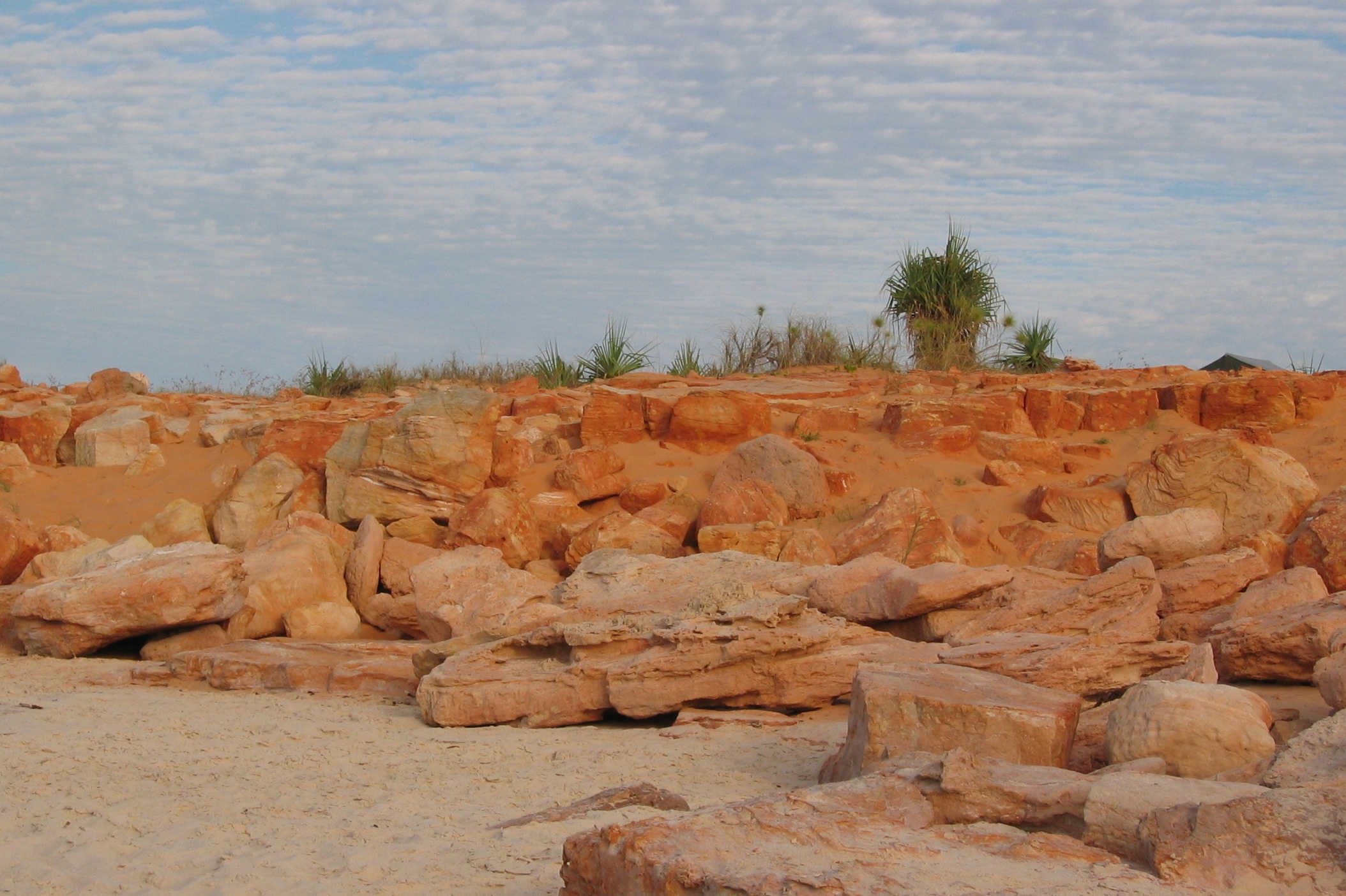
Section of beach at Cape Leveque (rather north of Shark Bay)
Do you look at those airline magazines you find in planes? I usually do … and often find something of interest in Qantas: The Australian Way. Yesterday I left Mr Gums behind and flew west for a week’s work in a remote town in north-west-ish Western Australia. It was a long flight (three actually) so I managed to watch a movie or two, read most of my novel, do a crossword and dip into the magazine. And, I’m glad I did because …
… in it was an excerpt from a new edition of Tim Winton‘s Land’s edge. The article described is as memoir, but the back of an earlier edition called it “an autobiographical meditation about his obsession with the coast”. Whatever you call it, it is clearly about his experience of one aspect of his life. I like writers’ memoirs but have yet to read this one. Its language is, needless to say (well, for me, because I like Winton), delicious:
The land around it [Shark Bay] looks blotchy and beaten. Desert right up to the water, it stains the white beaches vaguely pink. The water is variegated with sandbar whorls, veins of channels, meadows of seagrasses like bruises. It’s here that Europeans first met the Great South Land – Hartog, Vlamigh, Dampier – and they didn’t linger because the landscape seemed to shut its eyes and fold its arm against them: it was inscrutable.
I love that description of the landscape. It’s actually a wide open landscape but it “looks” empty and mysterious, rather beautiful but also somewhat unwelcoming. These days though, people flock to Shark Bay because this is where Monkey Mia is, the place where you can swim with dolphins. I haven’t been there yet, but I’m planning to:
This is the only place in the world you can do this naturally, expect to stand in the water, before breakfast, in the middle of the morning, just before sunset, and touch a free dolphin, feel its powerful bulk, look it directly in the eye and feel it slide back out of reach, unafraid. This is what all these people have caught planes and buses or spent 10 hours in a hot car for. Because none of this is normal, and the ritual has gone on since 1964, before Flipper, before environmentalism, before the New Age came slinking upon us. Generations of humans and dolphins meeting on land’s verandah.
And I think I’ll leave it at that …
 Whispering Gums
Gosh, that first description is intense – and intensely evocative! I now feel badly for having, for the first time in memory, skipped reading the inflight magazine during my recent flights. For some reason, short flights make me so sleepy…
P.S. Enjoy your trip! And write to me! 🙂
Glad you liked it Hannah … it’s pretty gorgeous isn’t it?
Rafts of dolphin envy coming your way!
Annie … I’ll make sure to tell you when I finally experience it myself!
I hope that you enjoy it. I actually went swimming with wild dolphins when I was in WA, but I didn it further down the coast in Rockingham. We went out on a boat and into the water and dolphons swam aound us – it was a really wonderful experience.
Oh, I can imagine. I’ve seen them fairly close up from boats but never swimming with or standing amongst them would be pretty wonderful. One day I will get there.
What a beautiful passage – he is so gifted. I’ve added this book to my list and will plan a Tim Winton read for this summer. Looking forward to it!
I’m glad you liked it Michelle. You can tell he loves it can’t you. It just oozes from his pen.
I’ve never heard of Monkey Mia, it’s so cool. Much better than Sea World 😉 Love the excerpts too. The first one, how he describes the landscape as inscrutable, reminded me of the desert in Sounthern California and how to lots of people it was just hot, empty expanses of sand and catus. But if you spend time there you discover it is full or life and beauty.
It is pretty cool isn’t it. It’s such a remote place – not easy to get to – that it’s less known that it might otherwise be and that, in terms of protecting it, is probably not a totally bad thing. There’s a real tension isn’t there between enabling people to enjoy nature and not letting it be loved to death.
And, being a desert lover I totally relate to your description of the the SoCal deserts. They are magical places.