A regular column in The ABC Weekly, about which I have blogged a couple of times in recent days, was written by Australian writer Vance Palmer. I have only read one novel by Palmer – The passage – and have been feeling recently that I’d like to read it again partly, but not only, because Vance and his wife Nettie were significant players – and mentors – in Australia’s literary scene of the 1930s-50s. Anyhow, back to the topic in hand … Palmer’s column is basically a weekly book review column and on 4 May 1940 the book was anthropologist Phyllis Kaberry’s published thesis, Aboriginal women: Sacred and profane (1939).
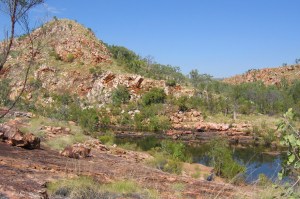
Waterhole in the Kimberleys
Now, while I did fancy myself a bit of an anthropologist for a time in the early 1970s when my university anthropological studies excited and challenged me, I don’t pretend to be anywhere near across the subject now. I won’t therefore go into great detail about this work – or its anthropological ramifications. I will say though that it was groundbreaking in its time as, based on her research in the Kimberleys, Kaberry argued that there was not a clear division in Aboriginal society, as proposed apparently by Durkheim, in which men focussed on the sacred and women on the profane. She argued that women had their own sacred ceremonies and, further, that women’s role in their society was not inferior to men’s but complementary.
This is interesting and was of course moreso in its time, but it is not what I most liked about Palmer’s review. What I liked was the fact that he saw Kaberry’s work as making a significant contribution to our understanding of indigenous society. He says that it is not necessarily an easy book to read, particularly as parts of it can be technical, but that it is an important one. He concludes the review with
But knowledge once gathered, gradually sinks into the general mind, and it is necessary that we should understand the pattern of living involved by the people we are displacing on this soil, both for our own good and theirs.
That was in 1940. How well do you reckon we have done since then?
 Whispering Gums
Your post has made me think about what I know of Australian anthropology – and the answer is almost nothing. The only one I can name is Inga Clendinnen. I love her work, and have read Tiger’s Eye, Agamemnon’s Kiss and Reading the Holocaust and Dancing with Strangers – but only this last was about anthropology. Perhaps a kind of Henry Reynolds is needed – someone who writes well and in a manner that is accessible to a general reader?
I read AP Elkin back in the early 70s – he was probably THE anthropologist of Aboriginal Australians back then (and was Kaberry’s mentor back in the late 1930s) but I’ve lost touch with who is writing now. I also read CD Rowley’s The destruction of Aboriginal society – very moving. I have read all those Clendinnens except the Holocaust one but these books are more history than anthropology I think. My sense is that her anthropological books are more her works on the Aztecs. I think she wrote the Tigers eye memoir and then moved more into history. I see Dancing with strangers more as history than anthropology. But I also think anthropology may be morphing a bit so who knows!
Anyone interested in Australian anthropology , or especially anthropologists and more especially women anthropologists, should read The indomitable Miss Pink by Julie Marcus.
Good point lithe lianas – and I’m one of those who should!